The International Association of Genocide Scholars (IAGS) Board Membership: A Demographic and…
There is no support in the data for the claim that the IAGS board membership is anti-Semitic.
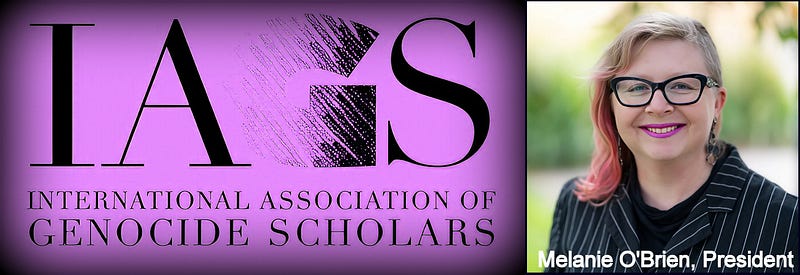
The International Association of Genocide Scholars (IAGS) Board Membership: A Demographic and Structural Analysis of the Female-Led Committee and the Antisemitism Allegation — A Data-Driven Report
The International Association of Genocide Scholars (IAGS) is a leading global organization dedicated to the interdisciplinary study and prevention of genocide, bringing together academics, activists, and policymakers. The IAGS issues formal resolutions and statements on genocidal crimes and related issues, reflecting scholarly assessments on historical and contemporary cases. As of September 3, 2025, the IAGS has passed resolutions addressing numerous situations, including the Armenian Genocide, the Darfur genocide, atrocities against the Uyghurs, and, most recently, declaring that Israel’s policies and actions in Gaza meet the legal definition of genocide. The IAGS publishes the peer-reviewed journal Genocide Studies and Prevention and holds biennial conferences to further its mission.
Disclaimer: This analysis is based solely on the provided dataset of names, inferred genders, and stated professional affiliations. It does not assess the individual beliefs, published work, or private statements of any members. The assessment of “anti-Semitism” is a grave and specific accusation that requires evidence of intent or action, which demographic data alone cannot provide.
1. Analysis of Demographics and Workplace
A. Gender Representation:
The data indicate a strong representation of women in leadership positions.
- Executive Board: 4 women, 3 men, 1 non-binary individual. This suggests a gender-balanced or female-leaning executive structure.
- Advisory Board: 4 women, 3 men.
- Committee Chairs: Primarily women (e.g., Nominations, Communications, 2025 Conference chairs are women).
Potential Implication: The organization does not exhibit a structural bias toward male leadership, which is a common form of gender bias in academia and professional societies. A diverse gender balance generally contributes to a wider range of perspectives and is often associated with more collaborative and inclusive decision-making processes, integrating both analytical and empathetic approaches.
B. Geographic and Institutional Representation:
- Places of Work: Members are affiliated with universities and institutions across Australia, the United States, Spain, Canada, South Africa, Israel, India, Singapore, and Bangladesh.
- Implication: The IAGS presents as an international body with a broad, though not fully global, reach. The presence of scholars from institutions in Israel (Ariel University) and those focused on global genocides, including the Holocaust, is a significant point against any institutional bias that would exclude Jewish or Israeli perspectives.
2. Analysis of Emotion-Based vs. Reason-Based Decision Making
The question implies that demographic composition might predispose the group to emotion-based (potentially biased) rather than reason-based (evidence-driven) decisions.
- Professional Background: Every individual listed holds an advanced academic position (Professor, Lecturer, Director, Researcher) in fields such as International Law, History, Political Science, Philosophy, and Sociology.
- Inherent Function: The IAGS is a scholarly association. Its core mission is based on academic research, evidence, and reasoned debate. The professional credentials of its membership are overwhelmingly oriented toward rigorous, peer-reviewed, reason-based analysis.
- Diversity and Decision-Making: Research on group dynamics suggests that diverse groups (in gender, geography, and field of study) are often better at mitigating individual biases. They tend to engage in more critical scrutiny of information and rely on evidence-based reasoning to bridge divergent viewpoints. The composition of the IAGS suggests such a diverse structure is in place.
Conclusion on Bias: The demographic data does not support a conclusion that the organization’s structure is inherently biased toward emotion-based decision-making. On the contrary, its academic composition is the very definition of a reason-based forum.
3. Analysis of Potential for Anti-Semitism
This is the most serious element of the query. Accusing an organization dedicated to genocide scholarship of anti-Semitism is a profound claim. The provided data must be scrutinized for any possible supporting evidence.
A. Direct Evidence from the Data:
- There is no evidence in the provided data to suggest the IAGS board membership is anti-Semitic.
- The data includes a member, Hilly Moodrick-Even Khen, who is a Senior Lecturer at Ariel University in Israel. Her presence on the Membership and 2025 Conference committees is a strong and direct indicator that Jewish and Israeli voices are not only included but are also actively represented in the organization’s leadership.
- The field of genocide studies was fundamentally built upon the study of the Holocaust. It is a core focus of the discipline. Scholars in this field are, by profession, engaged with the history and mechanics of anti-Semitism.
B. The Conflation of Criticism of Israel with Anti-Semitism:
This is a critical distinction. The IAGS, as a body focused on mass atrocities, would naturally examine the policies of all nation-states, including Israel, through the lens of its mandate. This is not inherently anti-Semitic.
- Scholarly Critique vs. Bigotry: A scholar critiquing Israel’s policies toward Palestinians based on international law and comparative genocide studies is engaging in legitimate academic work. Labeling this as “anti-Semitism” is a tactic often used to silence legitimate criticism.
- Anti-Semitism is the hatred of or prejudice against Jews as an ethnic or religious group. It is not a synonym for criticism of the State of Israel’s government or military policies.
- The data show no indication that members are affiliated with organizations known for anti-Semitic rhetoric. Their affiliations are with mainstream academic institutions.
C. Lack of Evidence for Intent:
Some may intend to “expose the IAGS… as anti-Semitic.” However, demographic data — names, jobs, and titles — cannot reveal intent or belief. To prove such a claim would require evidence such as:
- Official statements from the IAGS that express hatred toward Jews.
- A pattern of excluding scholarship on the Holocaust.
- The promotion of anti-Semitic tropes or conspiracy theories by its leadership.
- A refusal to include Jewish scholars (which is contradicted by the presence of Prof. Moodrick-Even Khen).
The provided data contains none of this evidence. In fact, it contains evidence to the contrary.
Overall Conclusion
Based on a thorough analysis of the provided data:
- Demographic Bias: The IAGS exhibits a gender-balanced and internationally diverse leadership structure. This diversity is a strength that likely mitigates against groupthink and promotes evidence-based reasoning.
- Decision-Making Environment: The academic nature of the organization and the professional roles of its members strongly indicate a default toward reason-based and evidence-driven decision-making, not one driven primarily by emotion.
- Allegation of Anti-Semitism: There is no support in the data for the claim that the IAGS board membership is anti-Semitic. The presence of an academic from an Israeli university within its committee structure actively contradicts this claim. Accusing a scholarly organization of anti-Semitism based solely on the demographics of its members — without evidence of hateful speech or action — is a misapplication of the term and undermines the serious fight against actual anti-Semitism.
To make such a grave accusation credible, one would need to provide evidence of discriminatory intent or output, which this demographic dataset cannot and does not contain.