Comparative Methodologies and Models of Productive Dialogue: Toward an Integrative Multidimensional Framework in Communication Theory
Productive dialogue emerges not from fidelity to any single model but from deliberate, context-sensitive integration of relational foundations, deliberative procedures, and polyphonic openness.
Abstract
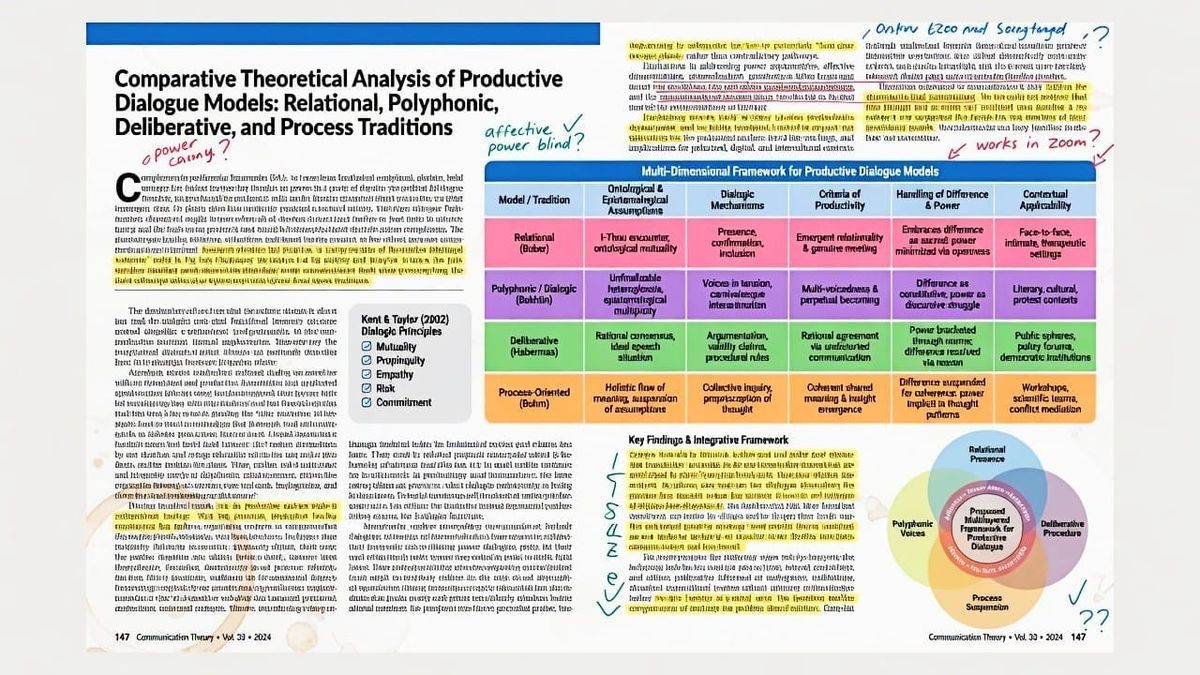
This article conducts a comparative theoretical analysis of major models of productive dialogue in communication studies and allied fields. Drawing on relational (Buber), polyphonic/dialogic (Bakhtin), deliberative (Habermas), and process-oriented (Bohm) traditions, alongside applied frameworks such as Kent and Taylor’s (2002) dialogic principles, it interrogates how each model conceptualizes the mechanisms, conditions, and outcomes of productive dialogue. The comparative methodology employs a multi-dimensional framework examining ontological and epistemological assumptions, dialogic mechanisms, criteria of productivity, handling of difference and power, and contextual applicability. Key findings indicate that while relational models emphasize emergent mutuality and presence, deliberative models prioritize procedural rationality for consensus, polyphonic approaches highlight unfinalizability and multi-voicedness, and process models focus on collective inquiry and suspension of assumptions. These differences reveal complementary rather than contradictory pathways, yet each exhibits limitations in addressing power asymmetries, affective dimensions, or mediated communication. The article advances communication theory by proposing an integrative multilayered framework for productive dialogue that synthesizes these perspectives. This contribution addresses gaps in existing scholarship, offers methodological clarity for future empirical work, and holds implications for dialogue facilitation in polarized, digital, and intercultural contexts.
Introduction
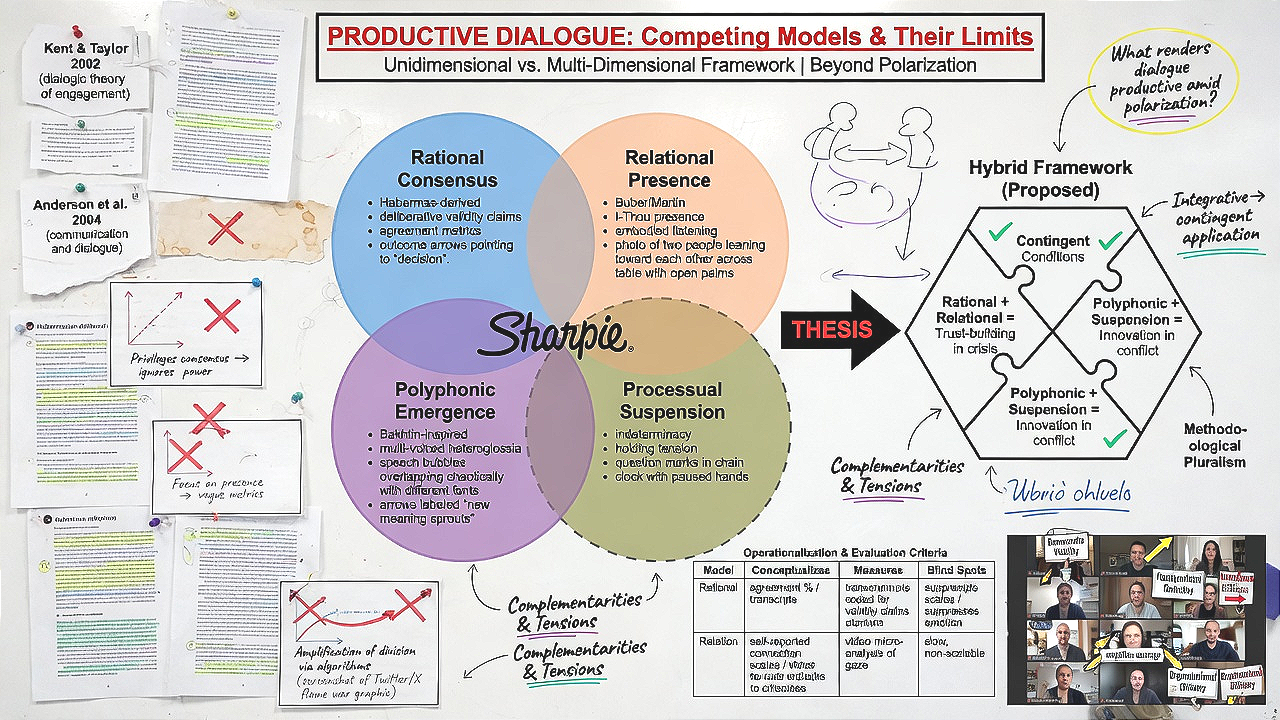
Productive dialogue—communication that generates mutual understanding, relational growth, collective insight, or transformative action amid difference—occupies a central yet contested position in communication theory. In an era of deepening polarization, algorithmic amplification of division, and mediated public spheres, the stakes of identifying what renders dialogue “productive” extend beyond academic abstraction to pressing questions of democratic viability, organizational efficacy, and intercultural coexistence. Existing scholarship, however, fragments productive dialogue across philosophical traditions and applied subfields without systematic comparison of underlying methodologies and models. This article asks: How do competing theoretical models in communication studies conceptualize, operationalize, and evaluate productive dialogue, and what comparative insights yield a more robust theoretical framework?
The thesis is that unidimensional models are insufficient because they privilege one dimension of productivity (rational consensus, relational presence, polyphonic emergence, or processual suspension) while under-theorizing others; a comparative multi-dimensional analysis reveals their complementarities and tensions, enabling an integrative framework that specifies contingent conditions for hybrid application. This contribution refines communication theory by moving beyond normative advocacy of any single paradigm toward methodological pluralism grounded in explicit comparative criteria. It extends prior work (e.g., Kent & Taylor, 2002; Anderson et al., 2004) by providing analytical discipline absent in most dialogic scholarship.
Literature Review
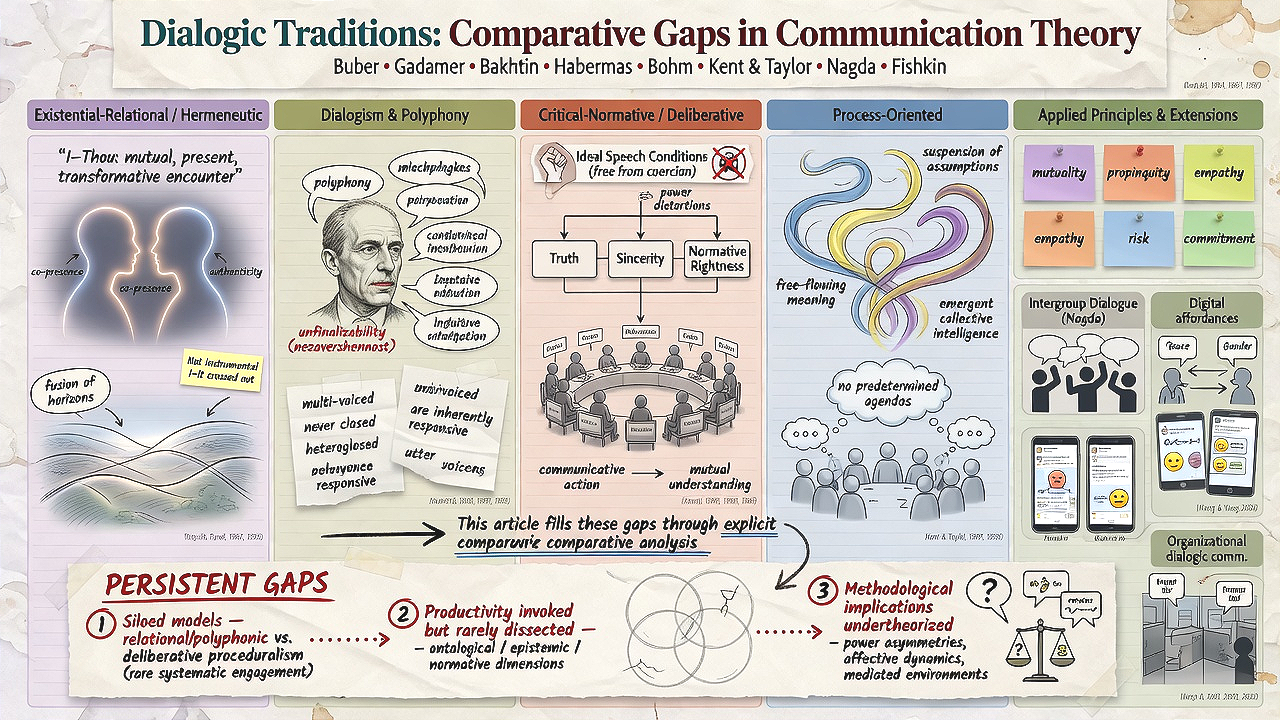
Communication theory has long drawn on philosophical foundations to theorize dialogue. Existential-relational traditions trace to Martin Buber’s (1970) distinction between I–Thou (mutual, present, transformative encounter) and I–It (instrumental) relations, emphasizing authenticity and co-presence over outcomes. Hermeneutic variants, via Gadamer (1989), frame dialogue as fusion of horizons yielding interpretive understanding. Linguistic and literary strands, most prominently Mikhail Bakhtin (1981), foreground dialogism, polyphony, and unfinalizability (or nezavershennost): utterances are inherently responsive, multi-voiced, and never closed. Critical-normative traditions, exemplified by Jürgen Habermas (1984, 1987), locate productivity in communicative action oriented toward mutual understanding through the redemption of validity claims (truth, sincerity, normative rightness) under ideal speech conditions free from coercion. Process-oriented approaches, notably David Bohm’s (1996) collective dialogue, stress suspension of assumptions, free-flowing meaning, and emergent collective intelligence without predetermined agendas.
Applied communication scholarship has translated these into practice. Kent and Taylor (2002) distilled five dialogic principles for public relations—mutuality, propinquity, empathy, risk, and commitment—positioning dialogue as an ethical, relational orientation rather than a technique. In conflict and intergroup communication, models such as intergroup dialogue (Nagda, 2006) blend Freirean critical pedagogy with relational elements to address power and identity. Deliberative democracy scholarship operationalizes Habermasian ideals through structured forums (e.g., Fishkin, 2018). Recent extensions examine digital affordances (e.g., dialogic social media; Wang & Yang, 2020) and organizational contexts (e.g., internal dialogic communication; Lee, 2022).
Despite this richness, the literature reveals three persistent gaps. First, models remain siloed: relational and polyphonic traditions rarely engage deliberative proceduralism systematically, and vice versa. Second, “productivity” is invoked normatively but rarely dissected comparatively across ontological, epistemic, and normative dimensions. Third, methodological implications—how one studies or facilitates dialogue under each model—are undertheorized, particularly regarding power asymmetries, affective dynamics, and mediated environments. This article fills these gaps through explicit comparative analysis.
Methodology / Analytical Framework
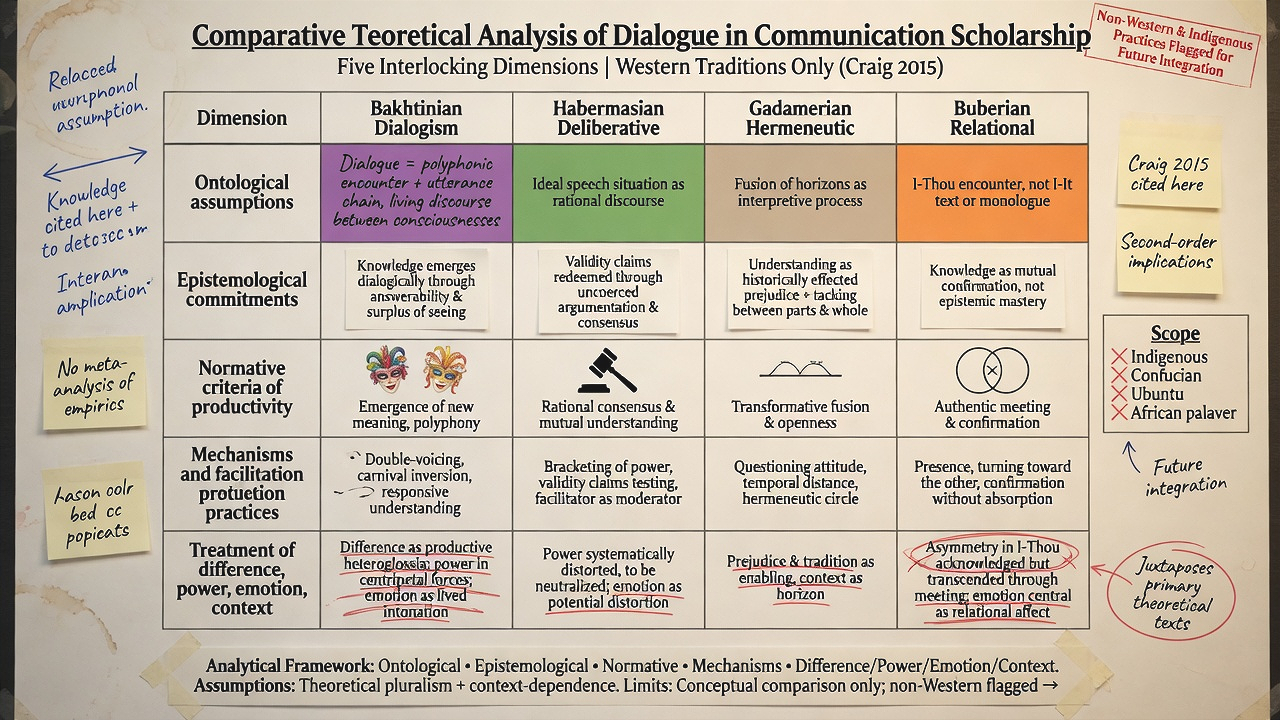
The study employs comparative theoretical analysis, a method well-established in communication theory for clarifying conceptual incommensurabilities and complementarities (Craig, 2015). Rather than meta-analysis of empirical findings, it systematically juxtaposes primary theoretical texts and their extensions in communication scholarship. Scope conditions are delimited to Western philosophical and communication-theoretic traditions with demonstrated influence in the field; non-Western and indigenous dialogic practices, while vital, lie beyond the present comparative horizon but are flagged for future integration.
The analytical framework comprises five interlocking dimensions, chosen for their capacity to surface non-obvious mechanisms and second-order implications:
- Ontological assumptions: What is the fundamental nature of dialogue (encounter, discourse, process, text)?
- Epistemological commitments: How is knowledge or understanding produced and validated?
- Normative criteria of productivity: What counts as success—consensus, transformation, emergence, relationship?
- Mechanisms and facilitation practices: What communicative moves or conditions enable productivity?
- Treatment of difference, power, emotion, and context: How are asymmetries, affect, and situational constraints theorized?
Assumptions include theoretical pluralism (no model is universally superior) and context-dependence (productivity is contingent). Limits of inference are acknowledged: the analysis is conceptual, not empirical; generalizability to non-Western or highly asymmetrical settings requires subsequent testing. This framework ensures tight argumentative discipline by anchoring every comparison to these dimensions.
Main Analysis / Results
Applying the framework reveals distinct yet complementary profiles.
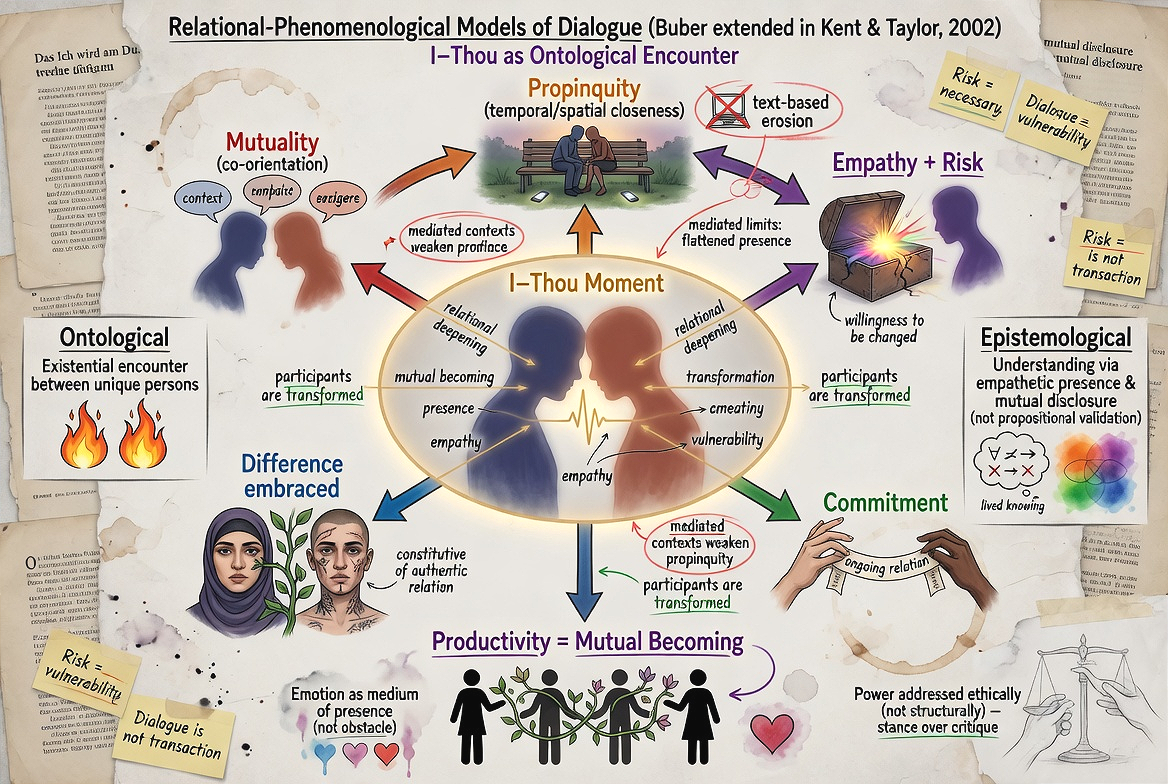
Relational-phenomenological models (Buber, extended in Kent & Taylor, 2002) treat dialogue ontologically as an existential encounter between unique persons. Epistemologically, understanding arises through empathetic presence and mutual disclosure rather than propositional validation. Productivity is normatively defined as mutual becoming and relational deepening—participants are transformed in the I–Thou moment. Mechanisms emphasize principles of mutuality (co-orientation), propinquity (temporal/spatial closeness), empathy, risk (vulnerability), and commitment (genuine engagement). Difference is embraced as constitutive of authentic relation; power is addressed indirectly through ethical stance rather than structural critique; emotion is central as the medium of presence. In mediated contexts, these models highlight limitations of text-based platforms that erode propinquity.
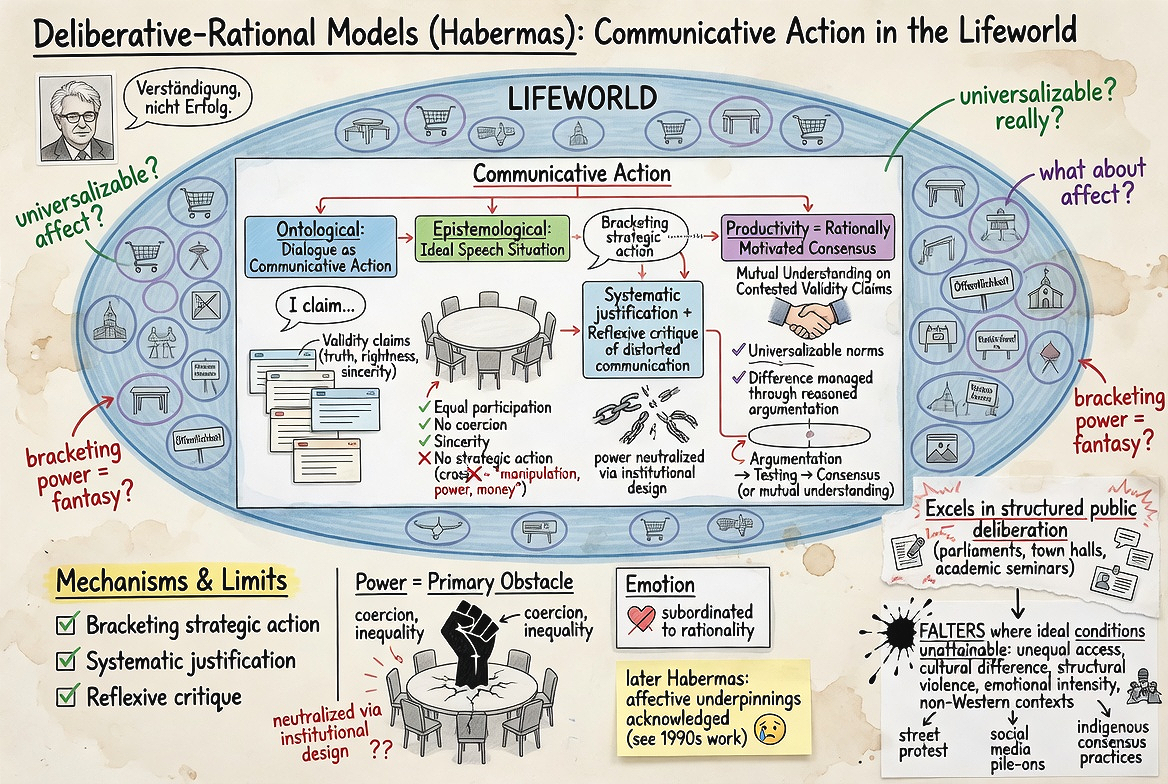
Deliberative-rational models (Habermas) construe dialogue ontologically as communicative action within the lifeworld. Epistemologically, validity claims are tested through reasoned argumentation under conditions approximating the ideal speech situation (no coercion, equal participation, sincerity). Productivity equals rationally motivated consensus or mutual understanding on contested validity claims. Mechanisms are procedural: bracketing strategic action, systematic justification, and reflexive critique of distorted communication. Difference is managed through universalizable norms; power is the primary obstacle to be neutralized via institutional design. Emotion is subordinated to rationality, though later Habermasian work acknowledges affective underpinnings. These models excel in structured public deliberation but falter where ideal conditions are unattainable.
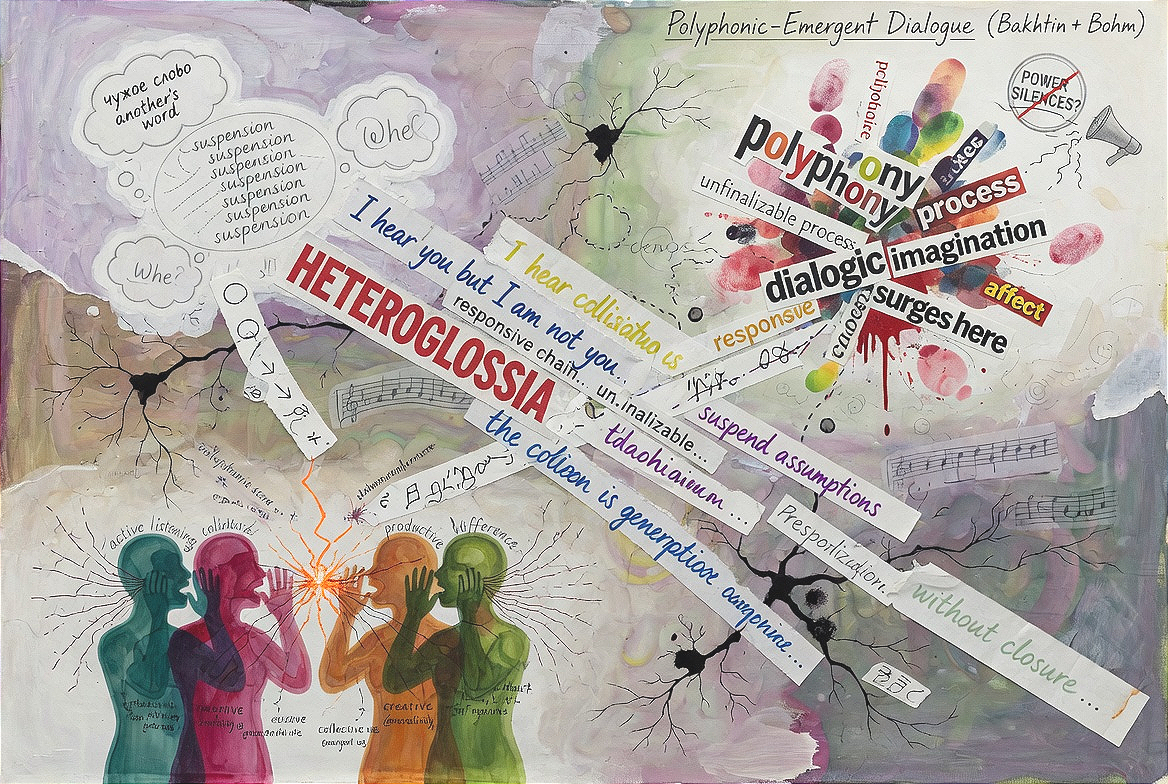
Polyphonic-emergent models (Bakhtin, Bohm) view dialogue ontologically as an unfinalizable, multi-voiced process. Epistemologically, meaning emerges dialogically through heteroglossia and responsive chains rather than monologic closure. Productivity lies in creative generativity—new understandings, identities, or collective insights arising from the collision of voices. Mechanisms include suspension of assumptions (Bohm), active listening without rebuttal, and maintenance of polyphony (Bakhtin). Difference is celebrated as productive tension; power is critiqued when it silences voices but is not systematically dismantled. Emotion and affect are integral to the dialogic imagination. These models thrive in creative, organizational, or artistic contexts but risk diffusion without closure.
Cross-dimensional synthesis yields the article’s central insight: the models are not rival but layered. Relational models supply the foundational “presence” prerequisite for any deep engagement; deliberative models provide procedural discipline for actionable outcomes; polyphonic-emergent models enable innovation amid irreconcilable difference. Productivity is thus multidimensional—relational depth, epistemic validity, and creative generativity—and contextually contingent. No single model suffices across all settings; hybridity becomes the methodological imperative.
Discussion
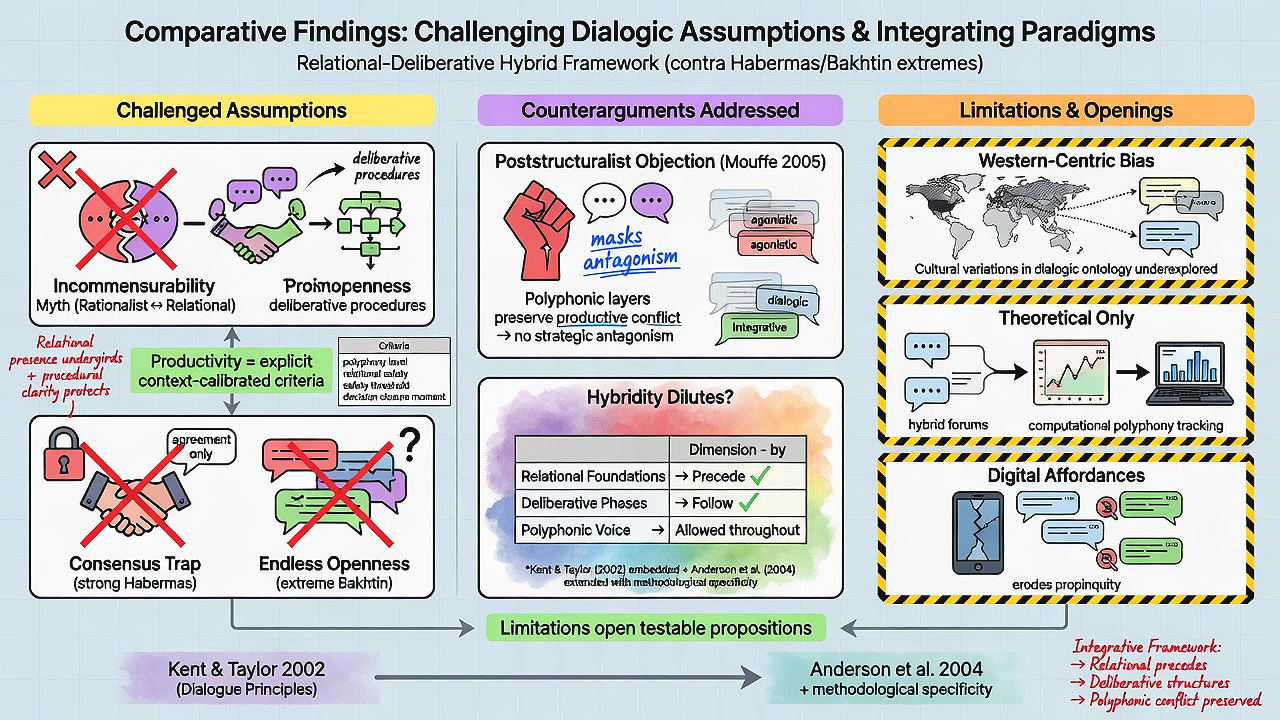
The comparative findings challenge two common assumptions in dialogic scholarship. First, the presumed incommensurability of rationalist and relational paradigms is overstated; relational presence can undergird deliberative procedures, while procedural clarity can protect relational vulnerability. Second, productivity cannot be reduced to consensus (contra strong Habermasian readings) or endless openness (contra extreme Bakhtinian readings); it requires explicit criteria calibrated to context.
Counterarguments merit address. Poststructuralist critics (e.g., Mouffe, 2005) contend that consensus-oriented models mask antagonism and that true productivity may require agonistic contestation rather than dialogue. The proposed integrative framework accommodates this by allowing polyphonic layers to preserve productive conflict without descending into strategic antagonism. Another objection—that hybridity dilutes normative force—is countered by the framework’s explicit dimension-by-dimension mapping, which preserves each model’s integrity while specifying integration rules (e.g., relational foundations precede deliberative phases).
Limitations are threefold: Western-centric sources may underplay cultural variations in dialogic ontology; the analysis remains theoretical, necessitating empirical validation via mixed methods (e.g., conversation analysis of hybrid forums, computational sentiment tracking of polyphony); and digital mediation introduces affordance-specific constraints (e.g., asynchronous text erodes propinquity) not fully modeled here. Nonetheless, these limitations open rather than undermine the contribution: the framework supplies testable propositions for future work. Relative to prior scholarship, this article advances Kent and Taylor (2002) by embedding their principles within a broader comparative architecture and extends Anderson et al. (2004) by adding methodological specificity.
Conclusion
Productive dialogue emerges not from fidelity to any single model but from deliberate, context-sensitive integration of relational foundations, deliberative procedures, and polyphonic openness. The comparative multidimensional framework developed here refines communication theory by clarifying mechanisms, surfacing complementarities, and specifying conditions for hybrid practice. Its core contribution lies in transforming fragmented normative advocacy into analytically disciplined methodological pluralism.
Future research should pursue three directions: (1) empirical tests of hybrid configurations in polarized digital environments using longitudinal designs; (2) cross-cultural extensions incorporating non-Western dialogic traditions to interrogate universality claims; and (3) development of facilitation toolkits and measurement instruments calibrated to the framework’s dimensions. By equipping scholars and practitioners with comparative tools rather than monolithic ideals, communication theory can better address the communicative demands of pluralistic, mediated democracies. The stakes—sustaining understanding amid difference—demand nothing less.
References
Anderson, R., Baxter, L. A., & Cissna, K. N. (Eds.). (2004). Dialogue: Theorizing difference in communication studies. Sage.
Bakhtin, M. M. (1981). The dialogic imagination: Four essays (C. Emerson & M. Holquist, Trans.). University of Texas Press.
Bohm, D. (1996). On dialogue. Routledge.
Buber, M. (1970). I and Thou (W. Kaufmann, Trans.). Charles Scribner’s Sons. (Original work published 1923)
Craig, R. T. (2015). The constitutive metamodel: A 16-year review. Communication Theory, 25(4), 356–374. https://doi.org/10.1111/comt.12059
Fishkin, J. S. (2018). Democracy when the people are thinking: Revitalizing our politics through public deliberation. Oxford University Press.
Gadamer, H.-G. (1989). Truth and method (2nd rev. ed., J. Weinsheimer & D. G. Marshall, Trans.). Continuum.
Habermas, J. (1984). The theory of communicative action: Vol. 1. Reason and the rationalization of society (T. McCarthy, Trans.). Beacon Press.
Habermas, J. (1987). The theory of communicative action: Vol. 2. Lifeworld and system: A critique of functionalist reason (T. McCarthy, Trans.). Beacon Press.
Kent, M. L., & Taylor, M. (2002). Toward a dialogic theory of public relations. Public Relations Review, 28(1), 21–37. https://doi.org/10.1016/S0363-8111(02)00108-X
Lee, Y. (2022). How dialogic internal communication fosters employees’ safety behaviors. Public Relations Review, 48(1), Article 102138. https://doi.org/10.1016/j.pubrev.2021.102138
Mouffe, C. (2005). On the political. Routledge.
Nagda, B. A. (2006). Breaking barriers, crossing borders, building bridges: Communication processes in intergroup dialogues. Journal of Social Issues, 62(3), 553–576. https://doi.org/10.1111/j.1540-4560.2006.00473.x
Wang, Y., & Yang, J. (2020). Dialogic communication on social media: Examining the effects of dialogic communication on organizational reputation. Computers in Human Behavior, 104, Article 106186. https://doi.org/10.1016/j.chb.2019.106186