The Complexity Crisis: A Professional Assessment of Societal Exhaustion
The creeping overcomplication of daily life and the consequent withdrawal of the ordinary citizen from the basic functions of modern existence.
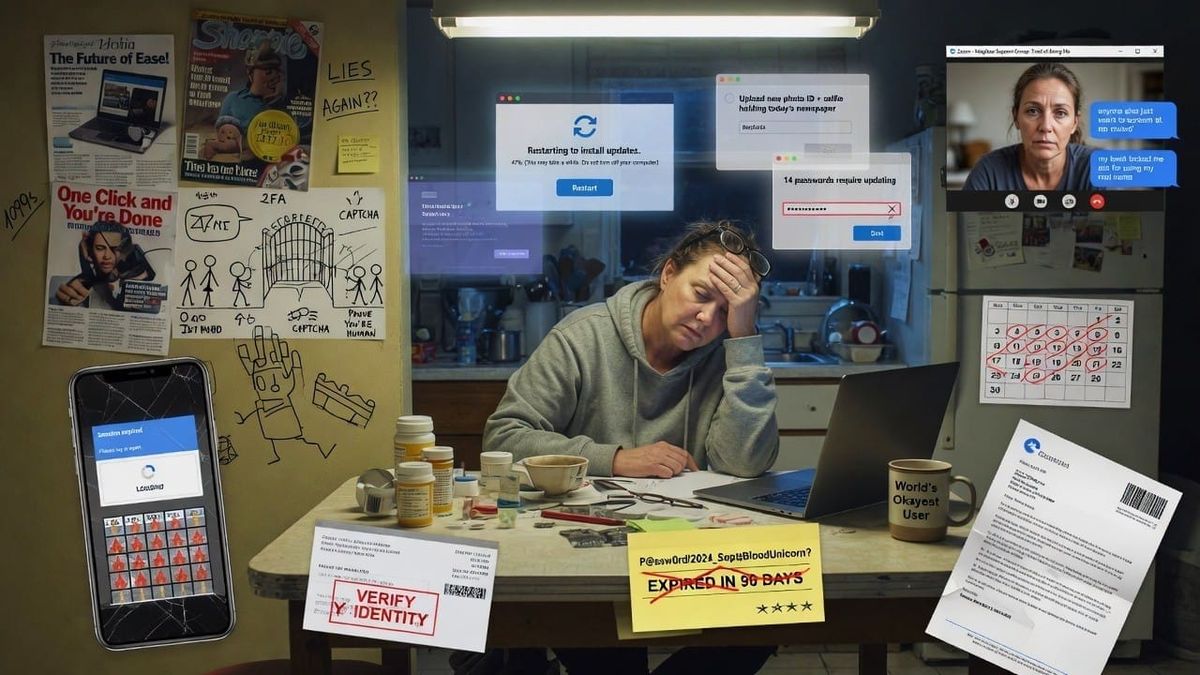
It has become commonplace to hear, in the weary voices of neighbors and strangers alike, a confession that would have sounded extreme a generation ago. People are tired. Not tired in the simple, physical sense that rest can remedy, but tired in a deeper, more existential register. They are tired of updates that rearrange the architecture of their digital lives without consent. Tired of passwords that must contain an uppercase letter, a number, a special character, and the blood of a unicorn, and which must still be changed every ninety days. Tired of being forced to prove, over and over, that they are indeed themselves—to banks that already have their money, to doctors who already have their records, to governments that already have their birth certificates. The promise of the modern era was one of ease, of liberation from drudgery. What has been delivered instead is a world in which the simplest of human tasks has been stretched and twisted into a gauntlet of authentication, troubleshooting, and quiet desperation. This report is an attempt to name that condition and to trace its contours, not with the detachment of a technical manual, but with the seriousness that a genuine societal affliction deserves.
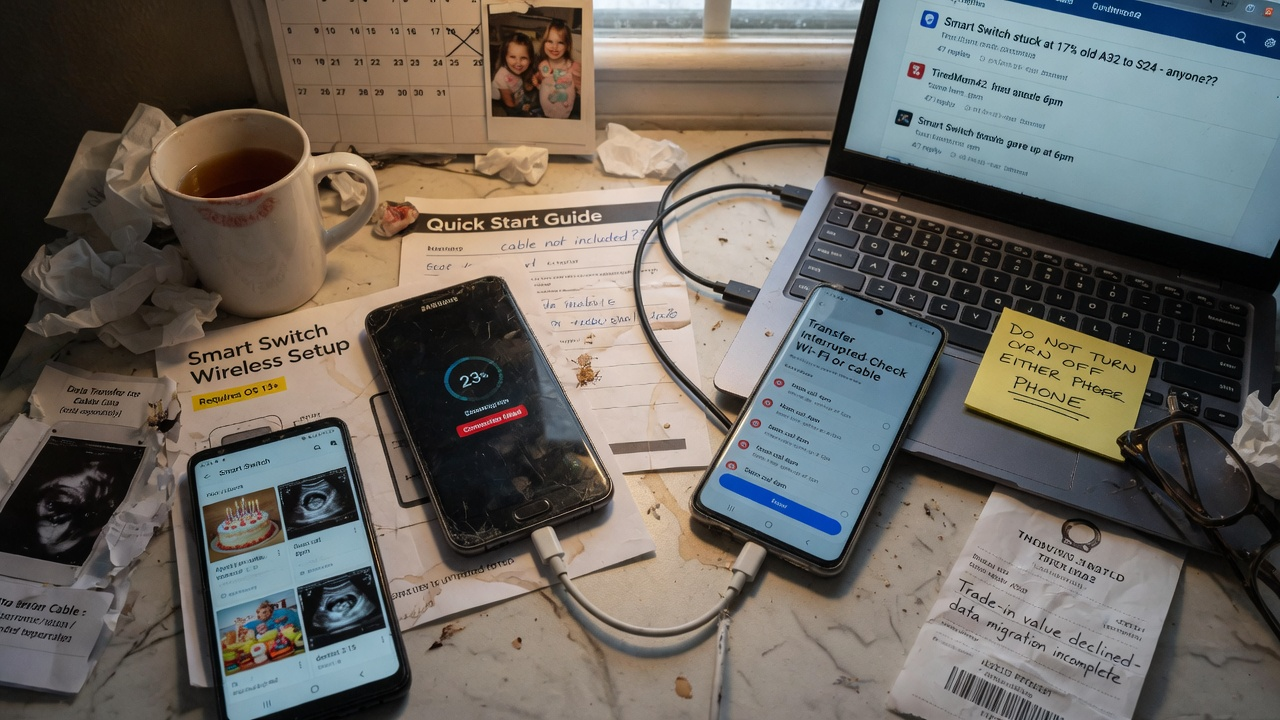
Consider the act of acquiring a new telephone and transferring the contents of an old one onto it. In a rational world, this would be a moment of quiet pleasure. You would place the two devices near one another, perhaps touch them together, and the contents of your life—photographs of children, conversations with loved ones, the mundane calendar appointments that scaffold a life—would flow from the old vessel into the new, like water poured from one cup to another. Yet for uncountable numbers of people, this moment has become a crucible of failure. The manufacturer provides a tool, a piece of software with a cheerful name like Smart Switch, that purports to handle the migration seamlessly. In practice, the tool demands a specific cable that may or may not have been included in the box. It requires that both devices run versions of an operating system that are mutually compatible, a condition that is often unmet when the old phone is a modest budget model and the new one a flagship whose software has leapt ahead by several generations. The wireless alternative, promoted as a liberation from cables, introduces its own specters: interference, dropped connections, and error messages that offer no meaningful explanation. The user, who began the process with hope and perhaps even a sense of mild excitement, is gradually worn down by silent failures, cryptic prompts, and the dawning realization that there is no human being to call. The online forums are filled with others who have suffered the same fate, their threads trailing off into unresolved silence. The automated support chatbot regurgitates the same script that has already been proven useless. In the end, the user sits amid the wreckage of an afternoon, both phones in a state of semi-functioning limbo, and feels something deeper than anger. They feel abandoned. They feel, with a certainty that is difficult to argue against, that the world has become too complicated for ordinary people to live in, and that no one is coming to help.
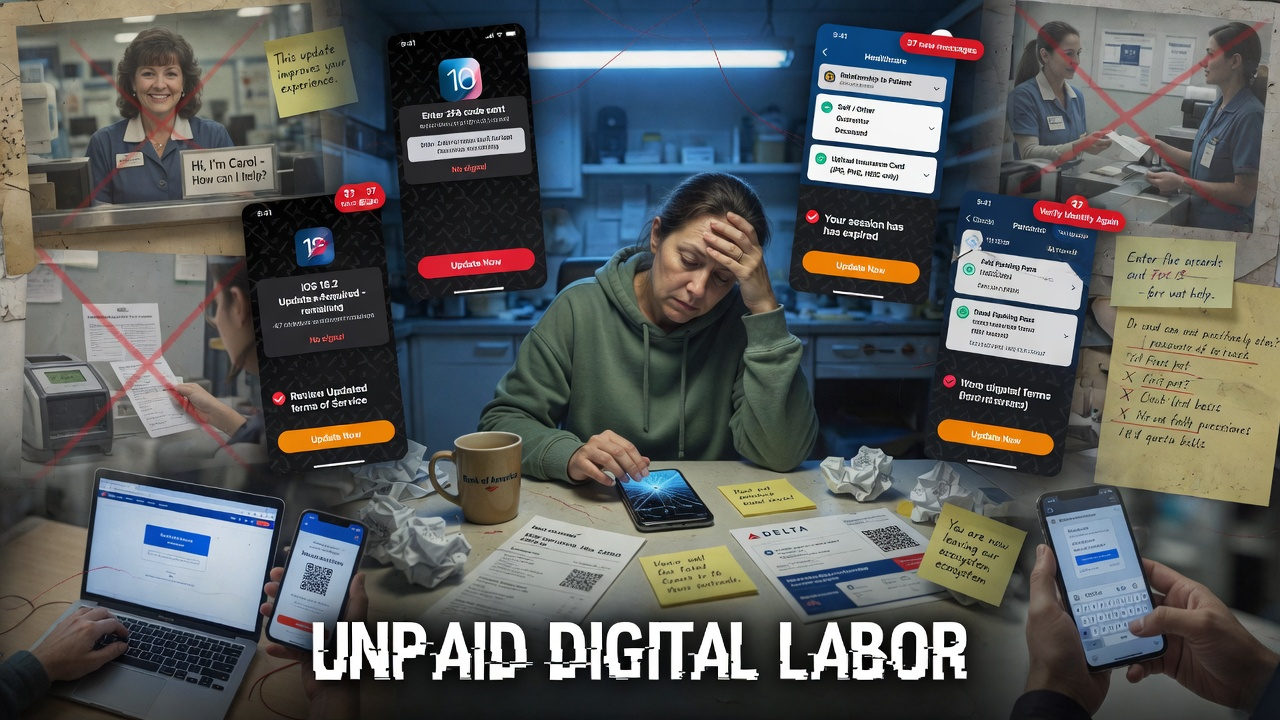
This single story is not an anomaly. It is a parable for the age. The forces that turned a phone upgrade into a source of trauma are the same forces that have colonized almost every domain of daily life. Banking, once a matter of walking into a branch and speaking to a teller who knew your name, now requires a smartphone app that must be updated every few weeks, a two-factor authentication code that arrives by text message but only if your phone has signal, and a password that you have inevitably forgotten because you last used it during a moment of acute stress three months ago. Healthcare portals demand that you upload documents in specific file formats, navigate dropdown menus designed by people who never had to use them while ill, and remember the answers to security questions you set up a decade ago in a different emotional lifetime. Travel requires apps for tickets, apps for boarding passes, apps for checking in, apps for the parking garage, each with its own account, its own terms of service, its own hunger for your attention and personal data. The cumulative effect is not merely inconvenience. It is a slow, grinding erosion of the human spirit. People feel, with every new interface and every mandatory migration, that they are being pushed further from the centre of their own existence, turned into administrators of a life that is supposedly being made easier but is in fact being outsourced to them in the form of unpaid digital labor.
Why has this happened? The answer lies not in any single conspiracy but in a convergence of incentives that have twisted the craft of design away from service and towards engagement, novelty, and cost-shifting. In the technology industry, the engineer who proposes a radical simplification of a product is rarely celebrated. The rewards go to those who add features, who ship updates, who can point to a changelog that demonstrates forward motion, even if that motion is circular or destructive. Stability is treated as stagnation. A piece of software that works perfectly well is regarded as a problem to be solved rather than a triumph to be preserved. And so the cycle churns on, leaving in its wake a trail of bewildered users who must constantly relearn what they once knew, only to have it snatched away again in the name of progress. Meanwhile, the economic logic of offloading administrative work onto the customer has proven irresistible to large institutions. Every time a bank closes a branch and replaces it with an app, it saves a fortune in salaries and real estate. The cost of that saving, however, is borne by the customer who must now become an amateur IT support technician for their own finances. The corporation frames this as empowerment, but the lived experience is one of abandonment dressed in the language of convenience.
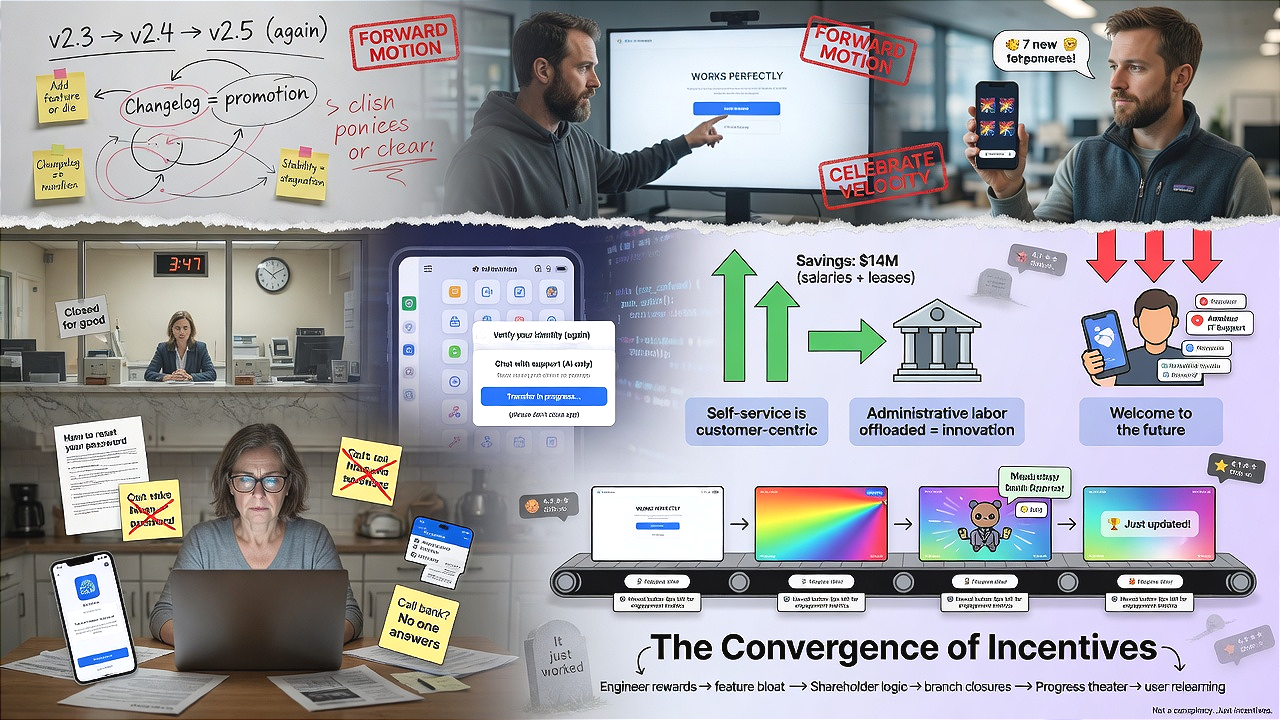
The fragmentation of assistance is the wound’s deepest cut. In an earlier era, when a product failed or a service became impenetrable, there existed a pathway to remedy. You could telephone a number and speak to a person whose job it was to listen, to diagnose, and to resolve. That person might be located in your own country, might share your cultural references, and was empowered to deviate from a script when the situation demanded it. That pathway has been systematically dismantled. In its place stand chatbots that parse keywords and respond with links to knowledge-base articles that you have already read and found wanting. The telephone support that remains is often routed through call centers on the other side of the globe, staffed by well-meaning individuals who are shackled to flowcharts that assume the system has not failed, that the user has simply made a mistake. The user who has already tried every official method and found them all broken encounters not empathy but repetition. They are told to restart the device. They are told to clear the cache. They are told to try a different cable. The scripts do not contain an escape hatch for when the system itself is the problem, because acknowledging that the system can fail utterly would require a different kind of response—a human response—that the corporation is not structurally prepared to offer. And so the user, exhausted and humiliated, retreats. They learn a lesson that is terrible in its implications: that the world is not built for them, that their struggles are not worth addressing, and that silence and withdrawal are the only remaining paths to peace.
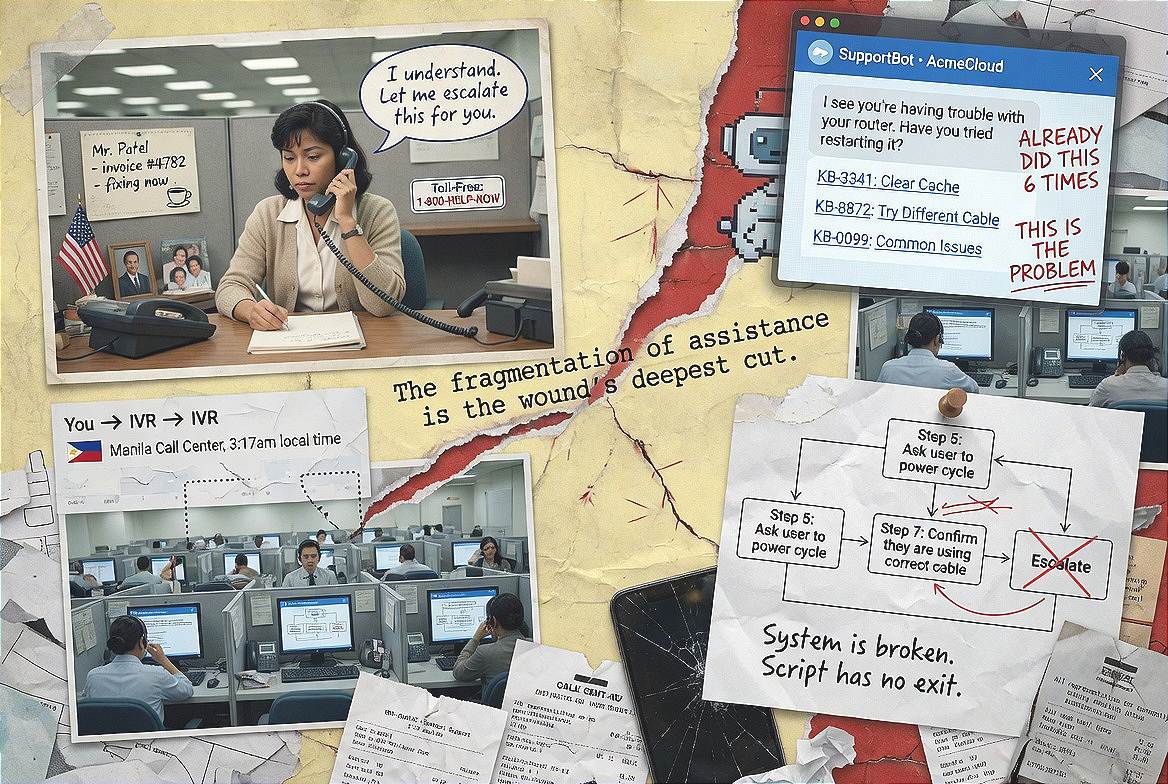
The psychological toll of this regime is difficult to overstate and rarely taken seriously by those who design the systems that cause it. Repeated encounters with unnecessary complexity induce a state that can be described as a kind of learned helplessness, a condition in which the individual no longer believes that their efforts can produce a successful outcome. Each failed interaction drains a little more of the reservoir of confidence and patience that a person needs to navigate daily life. Over time, the very thought of undertaking a new administrative task—renewing a passport online, setting up a new television, switching internet providers—triggers a visceral dread. People begin to avoid essential activities, not out of laziness, but out of a well-founded fear that the attempt will end in a morass of confusion and self-recrimination. The final stage is a quiet, dignified quitting. The user who declared “I quit” after failing to transfer a phone was not making a dramatic statement. They were reaching the end of a long, internal negotiation with a world that had demanded too much and given back only frustration. They were reclaiming their sanity in the only way that remained available: by walking away from the thing that was hurting them. This is not a failure of the individual. It is a failure of a civilization that has lost the ability to distinguish between complexity and sophistication, between progress and the restless, fruitless churn of change for its own sake.
What is to be done? The answer cannot be found in a ten-point plan or a set of technical tweaks, because the problem is not fundamentally technical. It is cultural, moral, and philosophical. It requires a revaluation of simplicity as a virtue, not a deficiency. Simplicity is not, necessarily, the absence of intelligence; it is the highest expression of it, the ability to distil a complicated reality into a form that respects the finite time, energy, and emotional bandwidth of a human being. The makers of the world—the engineers, the designers, the policymakers, the executives—must learn to see the burden they have created through the eyes of those who bear it. They must ask themselves, before adding a new feature, before changing an interface, before requiring yet another account, what the cost of that addition will be for the person who just wants to get on with their day. They must learn to leave well enough alone, to let a thing that works continue to work, to treat stability as a sacred promise rather than an inconvenience to be overridden. And when the systems do fail, as all human creations eventually do, there must be a real person to turn to, someone whose job is not to manage a queue but to accompany a fellow human being through the darkness and back into the light. The phone call, the face-to-face conversation, the patient guidance of one person helping another—these are not obsolete relics of a bygone age. They are the irreducible minimum of a society that still values its members.
The sickness and tiredness that people feel are not symptoms of weakness. They are rational responses to an environment that has become hostile to human flourishing. The world does not need to be this complicated. It has been made this way, choice by choice, by institutions that have lost sight of the people they claim to serve. And it can be unmade, choice by choice, by a deliberate return to the principles of compassion, restraint, and the quiet humility that acknowledges the limits of the human mind and the infinite value of a person’s peace. Until that return occurs, the quitting will continue. People will not shout from the rooftops; they will simply turn away, withdraw their trust, and find whatever small corners of life remain untouched by the labyrinth. The tragedy is not that they are giving up on the world. The tragedy is that the world, as it is currently arranged, gave up on them first.