The Long-Billed Paradox: Hunting, Eating, and Preserving the Eurasian Curlew
To study the curlew is to study contradiction: a species at once threatened and deliberately pursued, woven into both folklore and the dinner table.
Introduction
The Eurasian curlew, Numenius arquata, is a bird caught between reverence and consumption. Its keening, drawn-out cry once symbolized the wild spirit of Europe’s marshes and moors, yet today it is equally a conservation emblem and a quarry still hunted in several countries. While scientists and activists warn of its declining numbers, rural communities in parts of Europe, the Middle East, and Russia continue to roast or stew the bird, preserving culinary traditions that clash with ecological reality. To study the curlew is to study contradiction: a species at once threatened and deliberately pursued, woven into both folklore and the dinner table.
Taxonomy
The Eurasian curlew belongs to the family Scolopacidae, which includes sandpipers, godwits, and other waders. It is the largest of its genus, Numenius, with its immense bill setting it apart from all close relatives. Three subspecies are recognized: N. a. arquata of western Europe, N. a. orientalis stretching into central Asia, and N. a. suschkini in southeastern Europe. Its name, curlew, is onomatopoeic, echoing its ghostly call, while in Scottish dialect it is known as the “whaup.” Historically, it was not as highly prized as snipe or woodcock, yet it remained a game bird in rural traditions — an identity that persists to this day despite modern conservation status.
Biology
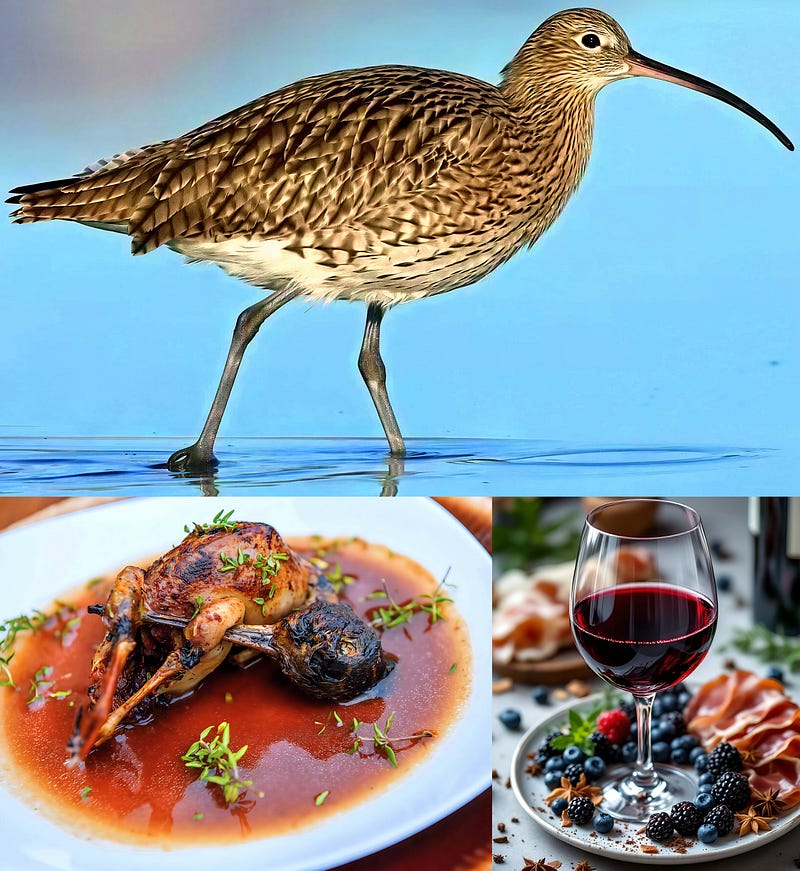
Females possess the longest bills, averaging 15–20 cm (5.9–7.9 in), while males typically measure 12–15 cm (4.7–5.9 in). The bird itself spans 50–60 cm (19.7–23.6 in) with a wingspan of 80–100 cm (31.5–39.4 in). Its mottled buff-brown plumage serves as camouflage against upland grasses and mudflats. Nesting occurs on the ground, usually four olive-green, brown-speckled eggs per clutch. Chicks are precocial, walking within hours of hatching. Its distinctive bill is not ornamental — it’s a fine-tuned probe for lugworms, crabs, and mollusks. These adaptations have allowed the species to exploit both inland and coastal habitats, though human interference now undermines this resilience.
Ecology
Curlews breed in bogs, meadows, and moorlands, overwintering along coasts and estuaries. They serve as ecological indicators, their decline reflecting the broader collapse of wetland and grassland habitats. Since the 1970s, curlew numbers in countries like the UK have fallen by over half, driven by drainage, agricultural intensification, and predator pressures. Yet this decline exists in stark tension with hunting. While banned in some states, curlews are still shot legally or illegally in others. In France, hunting bans were lifted, reinstated, and debated repeatedly, reflecting the tug-of-war between tradition and science. In Russia and parts of the Middle East, hunting continues largely unchallenged, treating the curlew as both seasonal game and migratory bounty.

Uses
Historically, the curlew provided rural households with lean meat, and its eerie calls embedded it deeply in folklore. Farmers once treated the cry as a weather omen, foretelling rain or sorrow. Today, ecotourism elevates the bird as a charismatic flagship for conservation, yet in regions where it is still hunted, its “use” remains firmly culinary. This duality — symbol of ecological fragility on one hand, quarry on the other — shows how cultural identity shapes whether the curlew is revered or roasted.
Culinary Aspects
Curlew meat is described as dark, lean, and strongly flavored, more akin to wild duck than pheasant. Its taste profile is earthy and mineral, with an iron-heavy bite. The aroma is pungent, recalling wet soil and brine. The mouthfeel is firm, sinewy, and less forgiving than partridge or grouse. Its complexity often divides palates: admired by some for its intensity, dismissed by others as bitter and overly “marshy.” Roasting has been the most traditional preparation, though stewing with root vegetables or pairing with grains softened its edges. In France and Scotland, recipes occasionally called for basting with bacon fat to counter its dryness. Nutritionally, the bird offers high protein, iron, and trace minerals, reflecting the lean diet of a wild forager. Its cultural importance lies less in refinement than in continuity: eating curlew has long been a statement of tradition, even as conservationists brand it a crime against biodiversity.
Wine Pairings
For those who still indulge, the curlew’s strong, earthy flavors demand wines of equal backbone. A northern Rhône Syrah, with its peppery spice and smoke, complements the bird’s minerality. Mature Bordeaux, with tobacco and leather notes, balances its gamey intensity. Even a rustic Chianti, with its bright acidity, can cut through the richness of a roasted curlew. Historically, game like curlew was enjoyed with whatever local wines or ales were available, but the pairing logic remains consistent: strength must meet strength.
Conclusion
The Eurasian curlew is both lament and feast. Its dwindling cries signal ecological distress, yet its flesh still finds its way to tables across certain regions. This paradox captures the uneasy tension between conservation and tradition, between global responsibility and local heritage. To hear its haunting call across the marsh is to be reminded of fragility; to eat it is to partake in a practice that risks erasing that voice forever. The choice is not simply about a bird — it is about how humanity defines its relationship with the wild.