
The Neurophilosophical Psychology of Love: Bridging Neural Mechanisms and Human Experience
The neurophilosophical psychology of love represents a sophisticated integration of neuroscience, psychology, and philosophy that moves beyond reductionist explanations to embrace the multidimensional nature of love, viewing it as both a biological imperative and a subjective experience.
Love has long been considered one of the most profound and enigmatic human experiences, inspiring centuries of artistic expression, philosophical inquiry, and, more recently, scientific investigation. The emergence of neurophilosophy as an interdisciplinary field has created a new framework for examining love through both empirical and conceptual lenses. This approach aims to understand how neural processes give rise to the complex phenomena associated with love, while also acknowledging the philosophical implications of these scientific discoveries. The neurophilosophical psychology of love represents a sophisticated integration of neuroscience, psychology, and philosophy that moves beyond reductionist explanations to embrace the multidimensional nature of love, viewing it as both a biological imperative and a subjective experience.
Historical Background and Foundational Principles
The philosophical examination of love dates back to ancient Greek philosophers who distinguished between various forms of love — eros (romantic love), philia (friendship), storge (familial love), and agape (universal love). Plato’s Symposium presented love as a means of ascending to higher forms of knowledge and connection, while Aristotle explored love’s role in human flourishing and ethical development. These early conceptualizations established love as a legitimate subject of philosophical inquiry, concerned with fundamental questions about human nature, morality, and the good life.
The scientific study of love emerged much later, with psychological behaviorism initially dismissing love as a sentimental construct unworthy of serious scientific attention. This changed with humanistic psychologists like Carl Rogers and Abraham Maslow, who reconceptualized love as essential to human motivation and self-actualization. The biological turn in psychology and the development of neuroscientific technologies in the late 20th century enabled researchers to investigate the neural correlates of love experiences, marking the birth of the neurophilosophical approach to love.
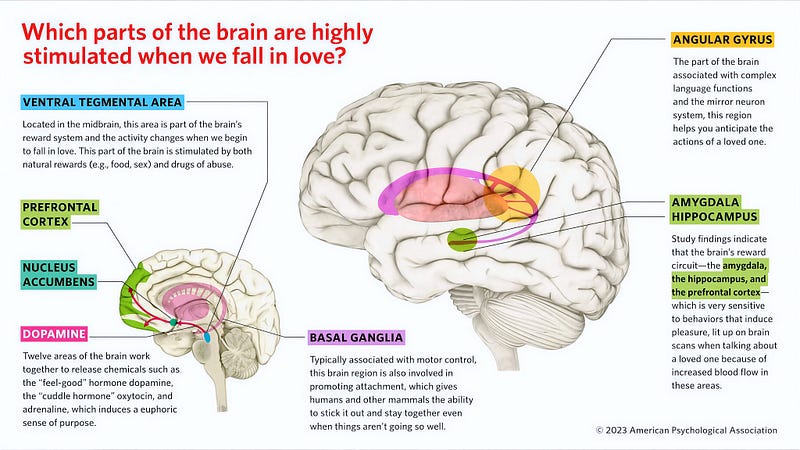
Functional magnetic resonance imaging (fMRI) studies conducted by Helen Fisher and colleagues provided some of the first glimpses into the brain in love. Their research revealed that viewing images of romantic partners activated dopamine-rich regions associated with reward and motivation, including the caudate nucleus and ventral tegmental area. These areas are part of the brain’s reward circuit, which is evolutionarily ancient and associated with pleasurable activities like eating, sex, and drug use. The involvement of this primitive neural network suggests that romantic love is maintained by something basic to our biological nature rather than being a purely cultural construction.
Additional research identified the role of neurochemicals such as oxytocin and vasopressin in bonding and attachment. These hormones, released during sexual activity, childbirth, and nursing, deepen feelings of attachment and make couples feel closer after intimate contact. The differences in behavior associated with these hormones may explain why passionate love often evolves into more stable attachment over time. Cortisol levels increase during the initial phase of romantic love, while serotonin levels decrease, potentially explaining the obsessive-compulsive thoughts characteristic of infatuation.
Underlying Assumptions and Inconsistencies
The neurophilosophical approach to love rests on several foundational assumptions that require critical examination. The localization assumption presumes that specific emotional experiences like love can be mapped to discrete brain regions or neural circuits. This approach has led researchers to identify the so-called love-brain network, including reward systems, emotional processing regions, and social cognition areas. However, this assumption has been challenged by researchers who argue that mental events arise from complex ensembles of signals across the entire brain, not isolated regions.
The one-to-one assumption suggests that neural patterns map exactly onto subjective experiences universally across individuals and cultures. This presumption has been questioned by studies demonstrating that psychological states like love are constructed through context-specific processes that vary across individuals and cultures. The experience of love while watching a horror movie in a laboratory setting may differ significantly from love experiences in real-world contexts, challenging the ecological validity of neuroimaging findings.
The independence assumption underlying much neurobiological research treats the brain as isolated from the body and environment in producing emotional experiences. This perspective neglects how love is embodied and embedded in social and environmental contexts. Love involves not only brain activity but also bodily responses, cultural narratives, and interpersonal dynamics that cannot be reduced to neural activity alone.
Methodological challenges further complicate the neurophilosophical study of love. Reverse inference problems occur when researchers assume that activation of a particular brain region indicates the presence of a specific cognitive process. For example, studies that concluded people love their iPhones because viewing them activated the insula failed to consider that this region is involved in numerous functions beyond love. The assumption of pure insertion in fMRI research presumes that researchers can cleanly isolate single cognitive processes without affecting others, which may not reflect how the brain actually works.
Cultural and gender biases also influence neurophilosophical interpretations of love. Most brain imaging studies have been conducted on Western college students, potentially limiting the generalizability of findings across cultures and age groups. Gender differences in love experiences may be overstated or misinterpreted due to researchers’ preconceived notions about masculinity and femininity.
Competing Perspectives and Counterarguments
The neurophilosophy of love encompasses diverse perspectives that offer competing explanations for how love should be understood and studied. Reductive neurophilosophy, represented by Patricia and Paul Churchland, maintains that love can be fully explained through neural mechanisms and that folk psychological concepts of love will eventually be eliminated as neuroscience advances. This eliminative materialism approach contends that love is nothing but brain activity and that subjective experiences are illusory if they cannot be reduced to neural processes.
Non-reductive neurophilosophy challenges this reductionist approach by arguing that while neural processes are necessary for love, they are not sufficient to explain its full complexity. Proponents like Georg Northoff emphasize that love emerges from dynamic interactions between the brain, body, and environment that cannot be reduced to any single component. This perspective maintains that love has both objective neural correlates and subjective experiential qualities that require different levels of explanation.
Neurophenomenology represents another approach that seeks to bridge first-person subjective experiences of love with third-person neuroscientific data. This method combines detailed descriptions of love experiences with neuroimaging data to identify how neural processes correspond to specific aspects of love. For example, researchers might examine how feelings of union with a beloved correlate with decreased activation in brain regions associated with self-other distinction.
Critical neuroscientists question whether neurobiological accounts of love actually explain anything beyond correlational relationships. They argue that identifying brain regions activated during love experiences does not explain why or how these activations produce the feeling of love any more than identifying the parts of a radio explains how it produces sound. This perspective suggests that neuroscience may be better at describing than explaining love.
Some philosophers and social neuroscientists emphasize the embodied and embedded nature of love, arguing that it extends beyond the brain to include the entire body and social environment. From this viewpoint, love is not confined to skull-bound processes but is distributed across relationships, cultural practices, and material environments that shape how love is experienced and expressed.
Broader Implications and Meanings
The neurophilosophical study of love has significant implications for how we understand human nature, relationships, and well-being. By revealing the deep biological roots of love, neuroscience has helped establish love as a fundamental human need rather than a luxury or social construct. This biological basis suggests that love is essential for human survival and flourishing, not merely an emotional accessory.
Research demonstrating love’s effects on health and well-being has important implications for medicine and therapy. Studies have shown that loving relationships can reduce stress, improve immune function, and promote longevity. These findings support the integration of social and emotional factors into healthcare and highlight the therapeutic potential of fostering loving connections.
The neurophilosophy of love also contributes to ongoing debates about human nature and morality. Patricia Churchland has argued that moral values and beliefs are grounded in the brain’s neurobiology, with love serving as a foundation for ethical behavior and social bonding. This naturalistic approach to morality suggests that love provides the neural platform for prosocial behaviors like empathy, trust, and cooperation.
Understanding the neurobiological mechanisms of love has practical implications for relationship education and therapy. Couples therapists can use knowledge about love’s evolutionary basis and neurochemical underpinnings to help partners understand the biological dimensions of their attraction, conflict, and attachment. This approach can normalize relationship challenges and provide science-based strategies for strengthening bonds.
The neurophilosophy of love also raises important questions about free will and responsibility in romantic choices. If love is driven by evolutionary imperatives and neurochemical processes, to what extent are individuals responsible for their romantic decisions? This tension between biological determinism and personal agency represents a rich area for ongoing philosophical exploration.
Real-World Applications
The neurophilosophical understanding of love has found practical applications across multiple domains. In therapeutic settings, knowledge about love’s neurobiology has informed approaches to couples counseling and sex therapy. Therapists like Richard Schwartz and Jacqueline Olds draw on research showing that long-term couples can maintain romantic activation patterns to help partners reignite dormant connections. They explain how sexual activity can increase oxytocin levels and activate the brain’s reward circuit, making couples desire each other more.
In medicine, understanding love’s health benefits has inspired interventions to reduce social isolation and promote healing. Hospitals and nursing homes have incorporated approaches that foster emotional connections to improve patient outcomes. The stress-reducing effects of love have been applied in stress management programs and mental health treatments.
Educational programs have integrated neurophilosophical insights about love to promote social and emotional learning. Understanding the biological basis of attachment has informed parenting programs and early childhood education approaches that emphasize the importance of secure attachments for healthy development.
In the legal domain, neurobiological research on love has influenced family court decisions regarding child custody and visitation rights. Judges increasingly recognize the importance of maintaining loving attachments for children’s well-being when making custody determinations.
Corporate environments have applied love research to improve workplace culture and leadership. Understanding how positive relationships affect motivation and performance has led organizations to foster more supportive and connected work environments that enhance employee well-being and productivity.
Technological applications have also emerged from the neurophilosophy of love. Dating apps and relationship tools increasingly incorporate psychological and biological insights about compatibility and attraction. While these applications raise ethical questions about reducing love to algorithms, they represent practical implementations of love research.
The neurophilosophy of love continues to evolve as researchers address methodological limitations and theoretical challenges. Future research may focus more on longitudinal studies examining how love changes over time, cross-cultural investigations of love’s neural correlates, and interdisciplinary approaches that integrate biological, psychological, and philosophical perspectives. As neurophilosophical methods become more sophisticated, they may provide increasingly nuanced understandings of love that honor both its biological foundations and its profound human significance.