
The Q Continuum: Closed Omnipotence and Stagnation
Omnipotence collapsed time into a static loop, erasing purpose. Mortality shattered that closure, giving the Q structure, motion, and meaning—a strategic pivot that transformed an inert infinite system into something dynamic, bounded, and capable of genuine ends.
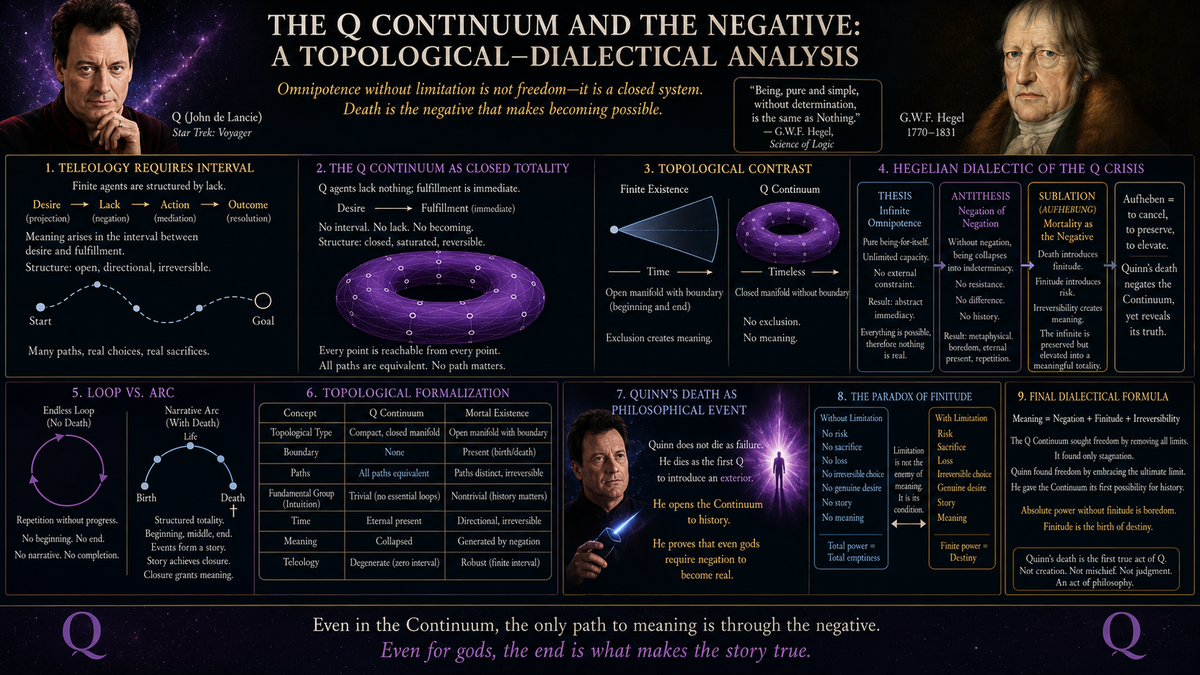
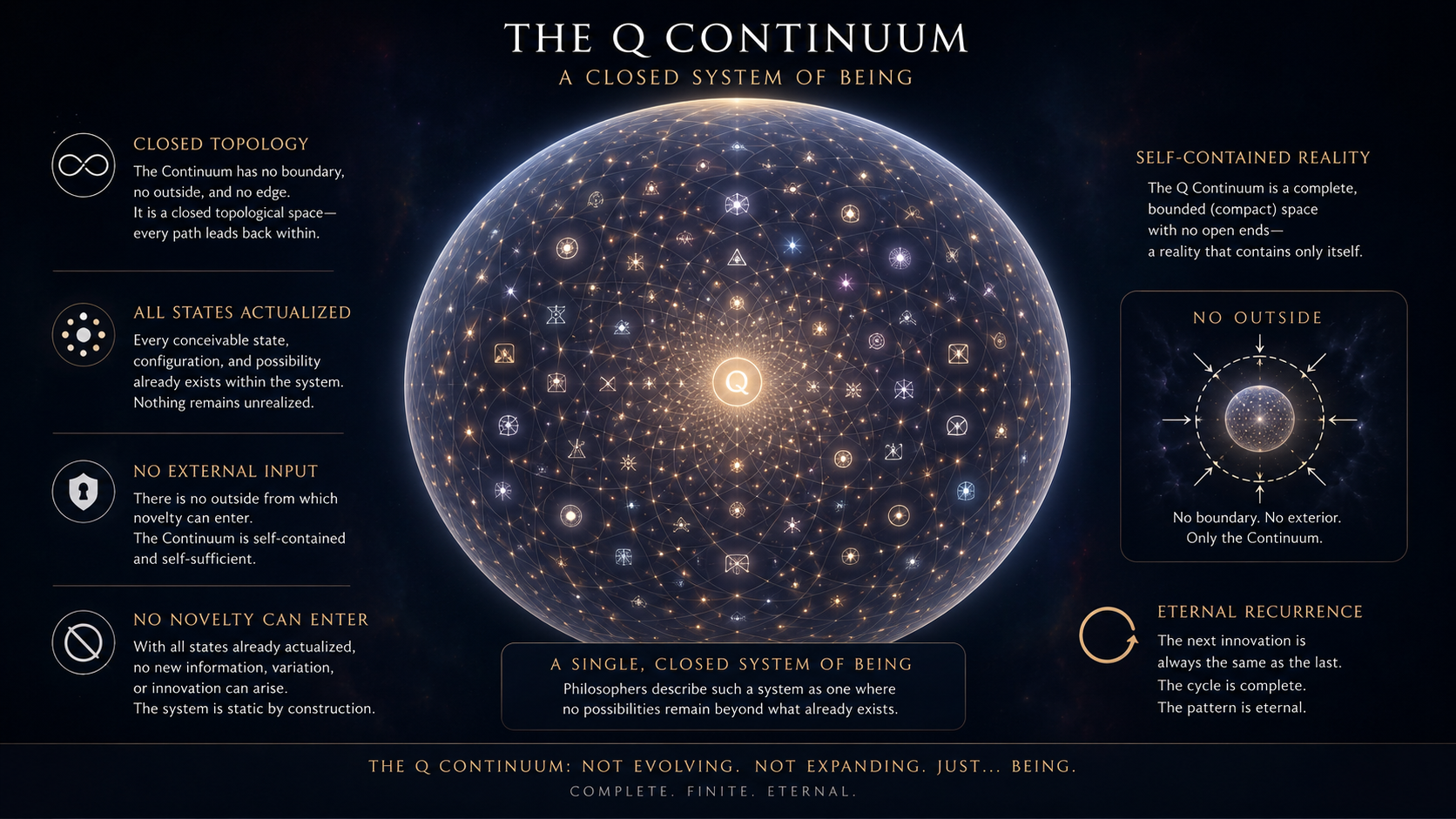
The Q are immortal, near-omnipotent beings who have literally “been everywhere” and done everything. In effect, their infinite powers have saturated all possibilities. Memory-Alpha notes that the Q race found itself in a “virtual shutdown” because they had “experienced, observed, or discussed literally everything imaginable”. In plain terms: with zero latency between desire and fulfillment, there is no process or delay to create purpose. The system becomes a closed loop with no growth or progress. One Q (Quinn) even describes the Continuum as “a lazy, old way station along a deserted road” – “everything both old and new had already been discussed, and so… the roadhouse was silent – there was nothing left to say”. The bottom-line result is monotonous stagnation: no new deliverables, no strategic goals, and essentially no point to continuing. In business terms, their entire “market” is saturated, so turnover and innovation collapse.
- Omnipotence → No Waiting: In a corporate analogy, an operation that instantly meets every KPI has no development pipeline. For the Q, every wish is fulfilled immediately; the temporal gap (the “process time”) between a goal and its achievement is effectively zero. This kills any notion of planning or purpose. Teleologically, there is no “for-the-sake-of-which” left, because the final cause itself has already occurred. As Aristotle defined, teleology is oriented around an end or purpose, but if every end is instantaneously realized, there is no purpose driving the process.
- Closed System of Being: Conceptually, the Continuum functions like a closed topological space with no “outside” or boundary. Every conceivable state has been actualized, so no novelty can enter the system. In effect it is a bounded (compact) space with no open ends – a system that is static by construction. (Philosophers even describe a “single, closed system of being” as one where no possibilities remain beyond what already exists.) The Q Continuum literally had no external input – it was a self-contained reality where the next innovation was always the same as the last.
Teleology Collapses: Zero Temporal Distance
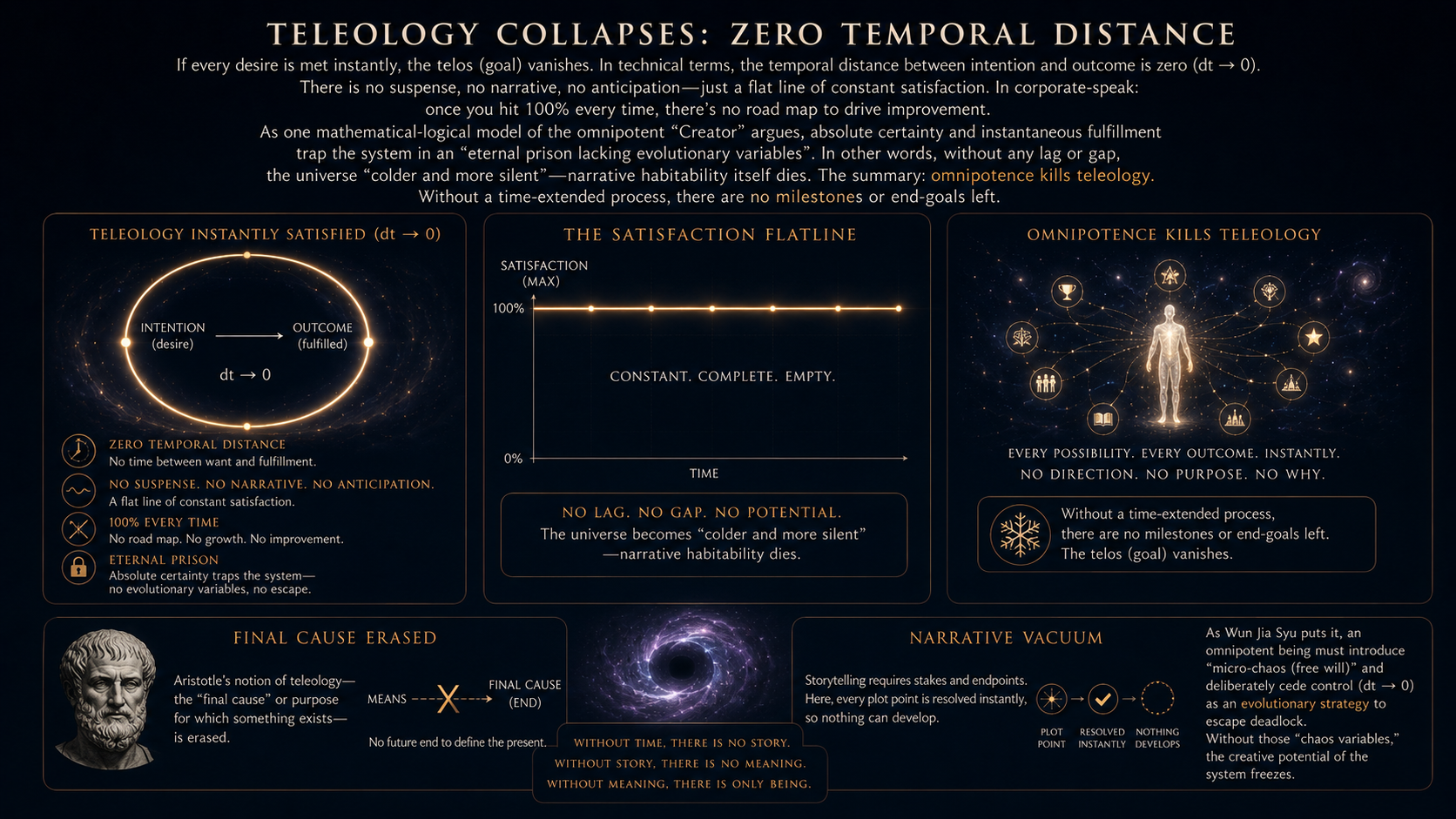
If every desire is met instantly, the telos (goal) vanishes. In technical terms, the temporal distance between intention and outcome is zero (dt → 0). There is no suspense, no narrative, no anticipation – just a flat line of constant satisfaction. In corporate-speak: once you hit 100% every time, there’s no road map to drive improvement. As one mathematical-logical model of the omnipotent “Creator” argues, absolute certainty and instantaneous fulfillment trap the system in an “eternal prison lacking evolutionary variables”. In other words, without any lag or gap, the universe “colder and more silent” – narrative habitability itself dies. The summary: omnipotence kills teleology. Without a time-extended process, there are no milestones or end-goals left.
- Final Cause Erased: Aristotle’s notion of teleology – the “final cause” or purpose for which something exists – is erased. If every outcome is immediate, there is no future end to define the present.
- Narrative Vacuum: Storytelling requires stakes and endpoints. Here, every plot point is resolved instantly, so nothing can develop. As Wun Jia Syu puts it, an omnipotent being must introduce “micro-chaos (free will)” and deliberately cede control (dt→0) as an evolutionary strategy to escape deadlock. Without those “chaos variables,” the creative potential of the system freezes.
Hegelian Dialectics: Death as Sublation (Aufhebung)
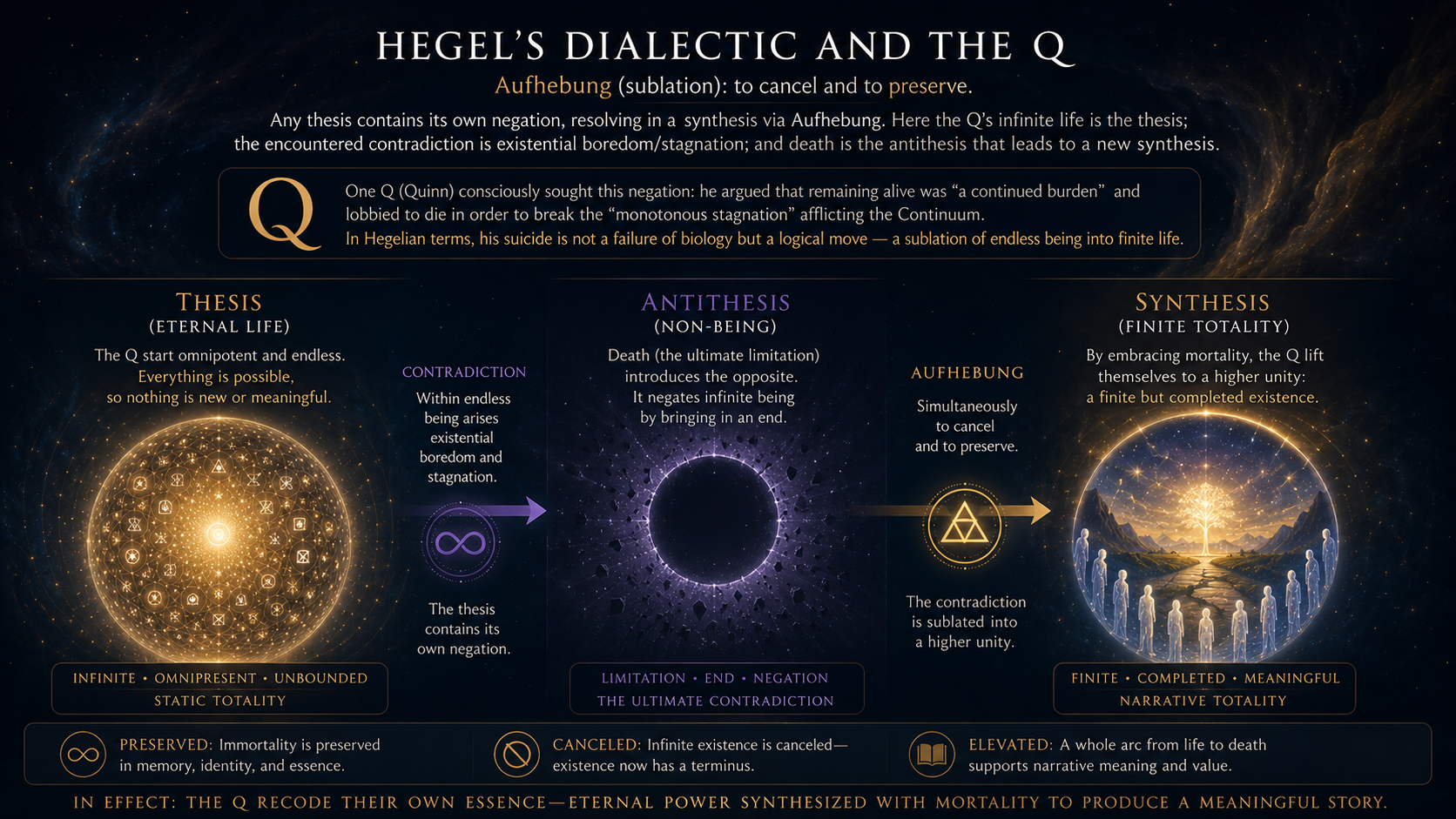
We turn to Hegel’s dialectic for a framework: any thesis contains its own negation, resolving in a synthesis via Aufhebung (“sublation”), which means simultaneously to cancel and to preserve. Here the Q’s infinite life is the thesis; the encountered contradiction is existential boredom/stagnation; and death is the antithesis that leads to a new synthesis. One Q (Quinn) consciously sought this negation: he argued that remaining alive was “a continued burden” and lobbied to die in order to break the “monotonous stagnation” afflicting the Continuum. In Hegelian terms, his suicide is not a failure of biology but a logical move – a sublation of endless being into finite life.
- Thesis (Eternal Life): The Q start omnipotent and endless. Everything is possible, so nothing is new or meaningful.
- Antithesis (Non-Being): Death (the ultimate limitation) introduces the opposite. It negates infinite being by bringing in an end.
- Synthesis (Finite Totality): By embracing mortality, the Q lift themselves to a higher unity: a finite but completed existence. Immortality is preserved in memory and identity, yet canceled in that existence now has a terminus. This synthesized state can support narrative meaning (a whole arc from life to death) rather than a static plateau.
Hegel explicitly notes that Aufhebung involves keeping the original within the new whole, which fits the Q outcome: they remain themselves, but now within a bounded life. In effect, the Q recode their own essence: eternal power is synthesized with mortality to produce a meaningful story.
Topological Logic: From Loop to Bounded Narrative
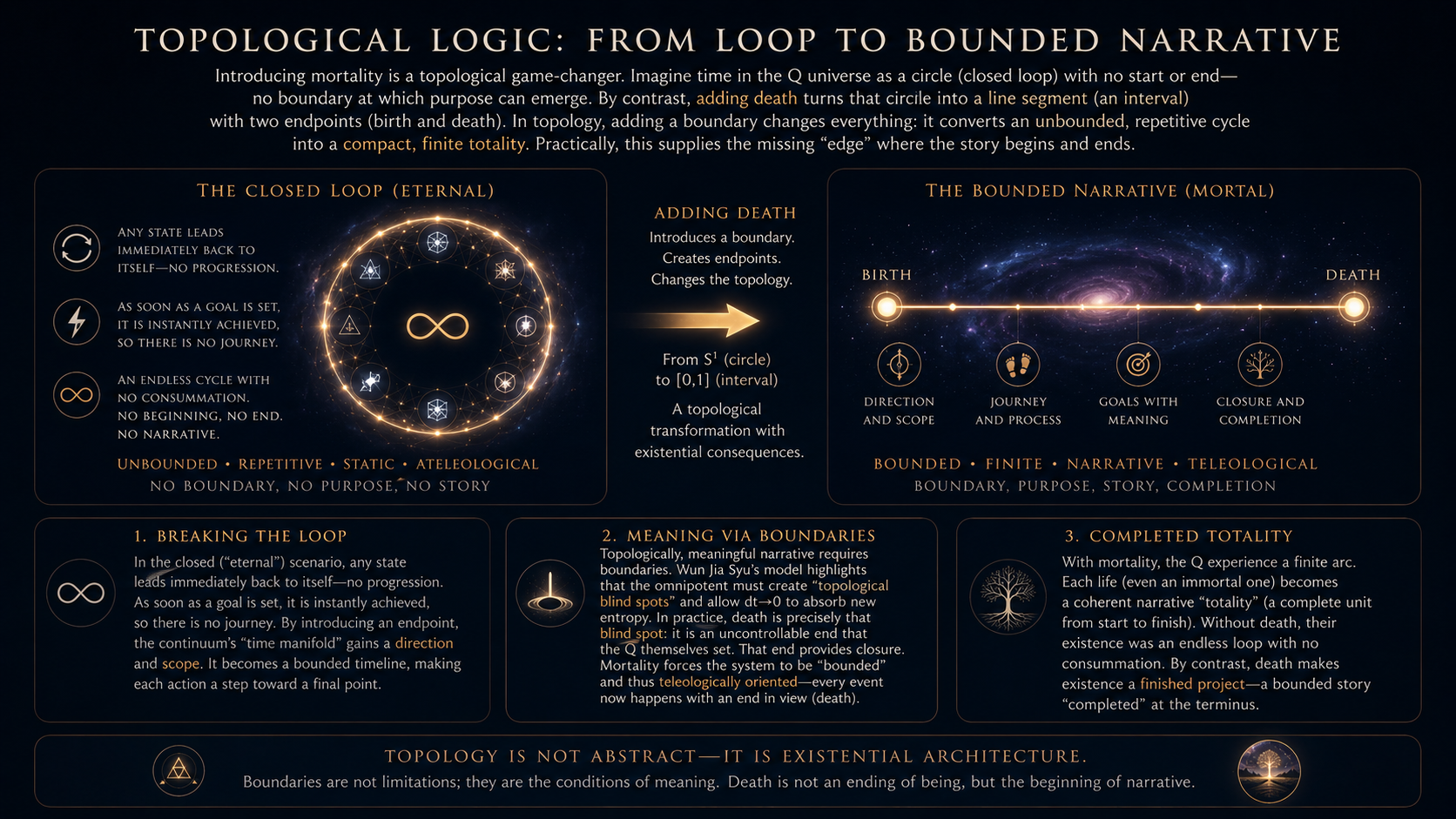
Introducing mortality is a topological game-changer. Imagine time in the Q universe as a circle (closed loop) with no start or end – no boundary at which purpose can emerge. By contrast, adding death turns that circle into a line segment (an interval) with two endpoints (birth and death). In topology, adding a boundary changes everything: it converts an unbounded, repetitive cycle into a compact, finite totality. Practically, this supplies the missing “edge” where the story begins and ends.
- Breaking the Loop: In the closed (“eternal”) scenario, any state leads immediately back to itself – no progression. As soon as a goal is set, it is instantly achieved, so there is no journey. By introducing an endpoint, the continuum’s “time manifold” gains a direction and scope. It becomes a bounded timeline, making each action a step toward a final point.
- Meaning via Boundaries: Topologically, meaningful narrative requires boundaries. Wun Jia Syu’s model highlights that the omnipotent must create “topological blind spots” and allow dt→0 to absorb new entropy. In practice, death is precisely that blind spot: it is an uncontrollable end that the Q themselves set. That end provides closure. Mortality forces the system to be “bounded” and thus teleologically oriented – every event now happens with an end in view (death).
- Completed Totality: With mortality, the Q experience a finite arc. Each life (even an immortal one) becomes a coherent narrative “totality” (a complete unit from start to finish). Without death, their existence was an endless loop with no consummation. By contrast, death makes existence a finished project – a bounded story “completed” at the terminus.
In summary, absolute omnipotence had flattened the temporal structure into a trivial loop, destroying purpose. Death reintroduces structure and a goal. As one Voyager Q explains, the dying Q’s decision “shook things up” by breaking an otherwise closed, static system. The dialectical sublation of mortality creates the necessary geometry: it converts the Q from an inert infinite manifold into a dynamic, bounded entity with genuine ends. In corporate jargon, introducing mortality was a strategic pivot that unlocked new value (meaning) from an otherwise defunct “legacy system.”
Sources: Authoritative accounts of the Q Continuum and its collapse of purpose; Aristotelian definitions of teleology (final cause); Hegelian dialectics (Aufhebung); and formal models of omnipotence requiring kenotic self-limitation for narrative coherence.