What It Is Like When No One Asks: Counterfactual Phenomenology and the Case Against Anthropocentric Illusionism
Phenomenal consciousness is an ontologically robust, biologically instantiated property independent of human epistemic access or linguistic conceptualization. Nagel's explanatory gap is real but not fatal; it is reframed as a feature of phylogenetic diversity rather than an insuperable barrier.
What It Is Like to Be a Bat in a Humanless World: Subjective Experience, Comparative Biology, and the Ontology of Qualia
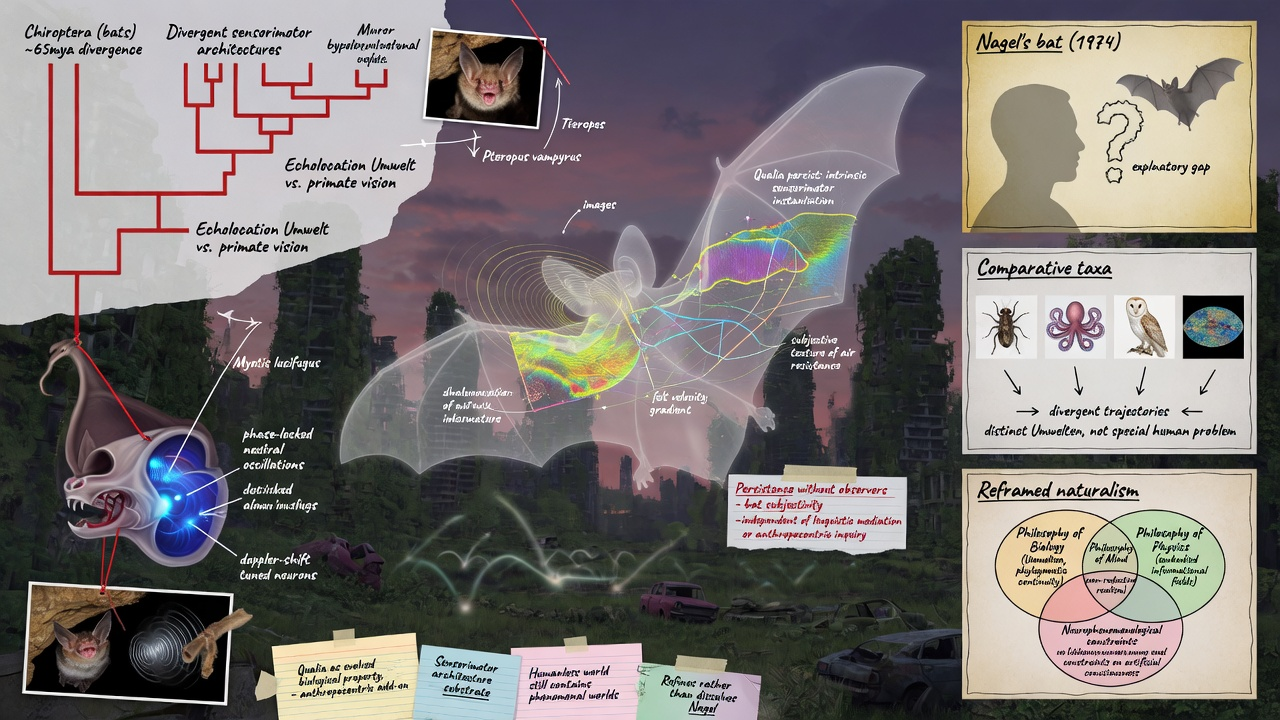
Thomas Nagel’s (1974) seminal question—“What is it like to be a bat?”—has framed the hard problem of consciousness as an epistemic limit imposed by the irreducibly subjective character of phenomenal experience. This article introduces a counterfactual: a world devoid of humans, in which no linguistic agent poses Nagel’s question. In such a biosphere, bat echolocation qualia persist as intrinsic features of a mammalian neurobiological system shaped by 50 million years of chiropteran evolution, yet the absence of human inquirers eliminates the anthropocentric framing that has long distorted philosophical analysis. Employing a comparative methodology across sensory ecologies—microchiropteran sonar versus human vision, cetacean echolocation, and cephalopod distributed cognition—this paper argues that phenomenal consciousness is an ontologically robust, biologically instantiated property independent of human epistemic access or linguistic conceptualization. Drawing on philosophy of biology (evolutionary Umwelt theory, neurophenomenology), philosophy of mind (non-reductive physicalism, integrated information), and philosophy of physics (embodied information dynamics), the analysis demonstrates that Nagel's explanatory gap is real but not fatal; it is reframed as a feature of phylogenetic diversity rather than an insuperable barrier. Key findings include the necessity of species-specific phenomenological proxies grounded in sensorimotor loops and the implications for artificial intelligence: synthetic qualia are conceivable only insofar as they replicate the biological architecture of active sensing. The contribution refines the hard problem by decentering it from human phenomenology, advancing a naturalistic ontology of qualia that withstands both illusionist critiques and panpsychist overextensions. This approach opens avenues for empirical neurophenomenology and comparative cognition while clarifying limits on third-person reductions of first-person facts.
Introduction
The mind-body problem acquires its intractable character, Nagel famously observed, precisely because consciousness introduces subjective facts that resist exhaustive objective description (Nagel 1974, p. 435). “What is it like to be a bat?” serves not as a rhetorical flourish but as a precise diagnostic tool: bat sonar constitutes a perceptual modality operationally and subjectively alien to human senses, rendering human imagination inadequate to its phenomenology. Yet Nagel’s formulation presupposes a human inquirer capable of posing the question and appreciating its force.
Consider, then, a counterfactual biosphere from which Homo sapiens—and every other linguistically reflective species—are absent. Bats (order Chiroptera, suborder Microchiroptera) continue their nocturnal foraging, emitting frequency-modulated cries, processing Doppler-shifted echoes via specialized auditory cortices, and navigating a three-dimensional auditory world with precision rivaling human vision. Echolocation qualia remain: there is still something it is like for the bat to experience the returning echo as textured distance, motion, and texture. No human (or human analogue) exists to articulate the epistemic gap, to debate physicalism, or to invoke the “hard problem.”
This thought experiment is not idle speculation. It isolates the ontological status of phenomenal consciousness from its epistemological presentation within human philosophical discourse. The research question is accordingly: What does the persistence of bat subjectivity in a humanless world reveal about the nature, origins, and explanatory demands of qualia? The central thesis is that such persistence demonstrates phenomenal consciousness as an intrinsic, evolved biological property instantiated in sensorimotor architectures, independent of anthropocentric inquiry or linguistic mediation. Comparative analysis across taxa exposes the gap as a predictable consequence of divergent evolutionary trajectories rather than a unique human predicament, thereby refining rather than dissolving Nagel’s challenge. This reframing integrates philosophy of biology (emphasizing Umwelten and phylogenetic continuity) with philosophy of mind (non-reductive realism about subjectivity) and philosophy of physics (embodied informational fields), yielding a methodologically disciplined naturalism that advances neurophenomenological inquiry while clarifying constraints on artificial consciousness.
Literature Review
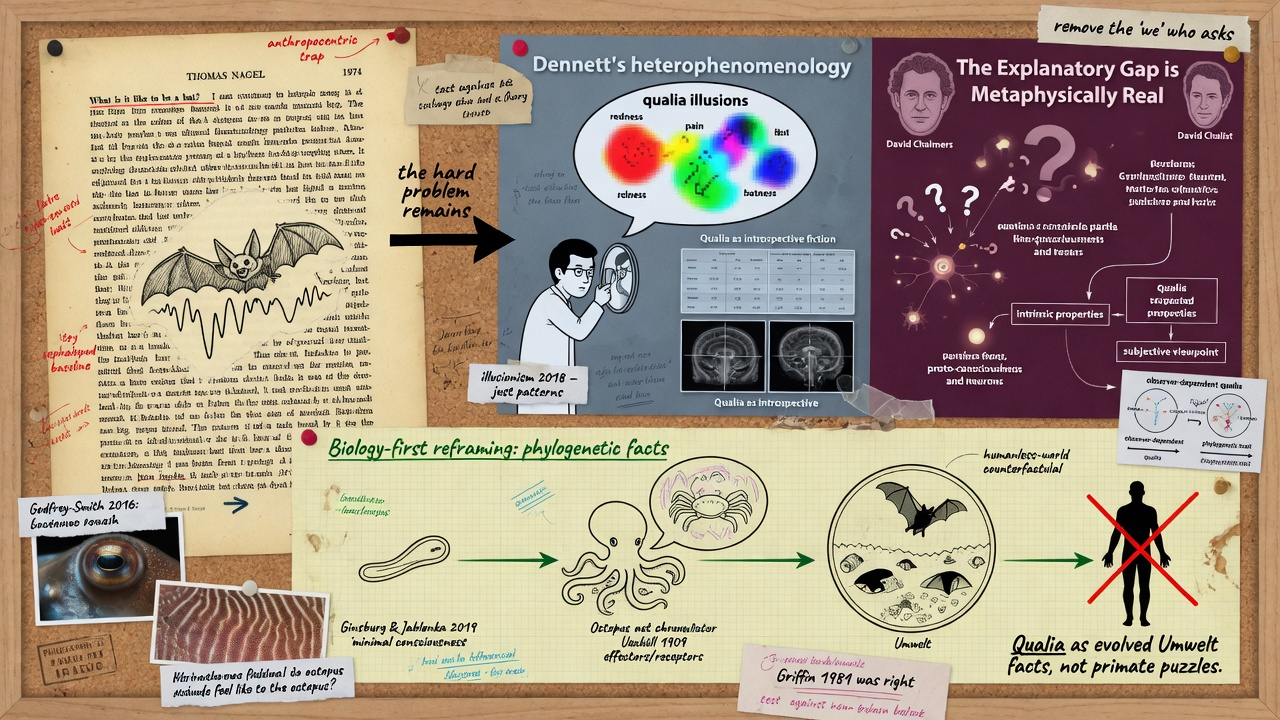
Nagel’s (1974) argument established the subjective character of experience—“something it is like for the organism”—as the sine qua non of consciousness, immune to functional, behavioral, or physical reduction because any such reduction omits the viewpoint-dependent nature of the phenomenon. Subsequent literature bifurcated. Physicalist responses, exemplified by Dennett’s heterophenomenology and illusionism (Dennett 1991, 2018), reinterpret qualia as introspective illusions or third-person accessible patterns, dissolving the hard problem by denying irreducible subjectivity. Dualist and non-reductive positions, most prominently Chalmers’ (1995, 2018) formulation of the hard problem, accept the explanatory gap as metaphysically significant, sometimes invoking panpsychism or Russellian monism.
Philosophy of biology has offered a parallel but underexplored trajectory. Griffin’s (1984) advocacy for animal consciousness, Godfrey-Smith’s (2016) exploration of cephalopod minds, and Ginsburg and Jablonka’s (2019) minimal consciousness framework treat subjectivity as an evolved, adaptive trait continuous with simpler sensorimotor integration. Umwelt theory (Uexküll 1909/2010) provides a comparative scaffold: each species inhabits a subjectively constituted perceptual world shaped by its effectors and receptors. Neurophenomenology (Varela 1996; Thompson 2007) seeks methodological bridges between first-person reports (or proxies) and third-person neuroscience, yet remains largely human-centric.
Gaps persist. First, discussions remain tacitly anthropocentric: the “we” who cannot know bat qualia is invariably human. Second, evolutionary accounts of qualia origins (e.g., Feinberg and Mallatt 2016; Lacalli 2022) focus on neural correlates without fully addressing ontological independence from observers. Third, artificial intelligence literature (e.g., integrated information theory, Tononi et al. 2016) speculates on machine qualia yet inherits Nagel’s framing without testing it against non-human baselines. The humanless-world counterfactual exposes these limitations, justifying a comparative, biology-first reframing that treats qualia as phylogenetic facts rather than philosophical puzzles posed by reflective primates.
Methodology / Analytical Framework
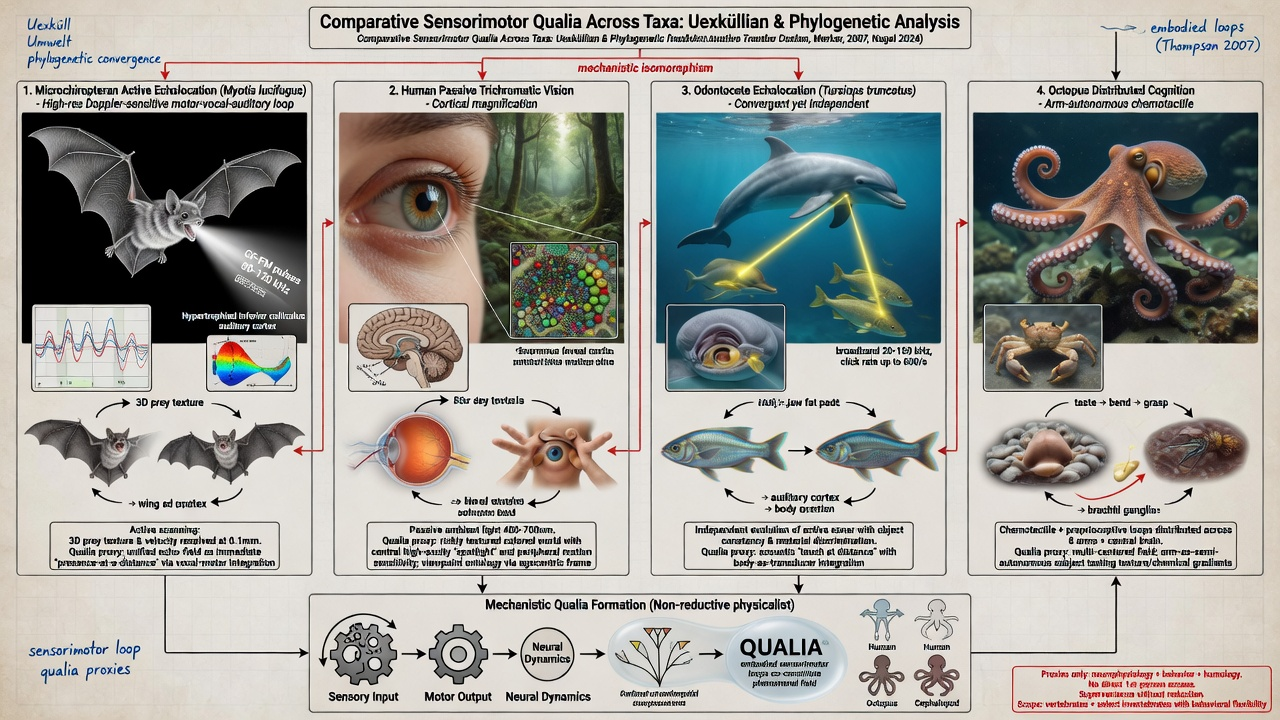
The approach is explicitly comparative, following Uexküllian and phylogenetic principles. We juxtapose sensory modalities across taxa: (1) microchiropteran active echolocation (high-resolution, Doppler-sensitive, motor-vocal-auditory integration); (2) human vision (passive, trichromatic, cortical magnification); (3) odontocete echolocation (analogous yet independently evolved); and (4) octopus distributed cognition (arm-autonomous, chemotactile). This comparison is not merely analogical but mechanistic: each modality instantiates qualia through embodied sensorimotor loops wherein sensory input, motor output, and neural dynamics co-constitute a unified phenomenal field (Thompson 2007; see also Merker 2007 on action-oriented consciousness).
Assumptions are naturalistic and realist about qualia: subjectivity exists as a higher-order property of sufficiently integrated biological information-processing systems (contra illusionism) but is not fundamental to all matter (contra strong panpsychism). Scope conditions limit inference to vertebrates and select invertebrates with demonstrable behavioral flexibility and centralized or distributed neural complexity. Limits of inference are acknowledged: without direct first-person access, phenomenological claims rely on “proxies” (neurophysiological isomorphism, behavioral evidence, evolutionary homology) calibrated against human phenomenology where overlap exists. The framework is non-reductive physicalist: qualia supervene on physical processes yet retain viewpoint-dependent ontology, consistent with Nagel’s later reflections on objective phenomenology (Nagel 2024).
This methodology avoids both over-intellectualization (higher-order thought theories) and under-specification (pure functionalism) by grounding analysis in evolutionary biology and physics of embodied information.
Main Analysis / Results
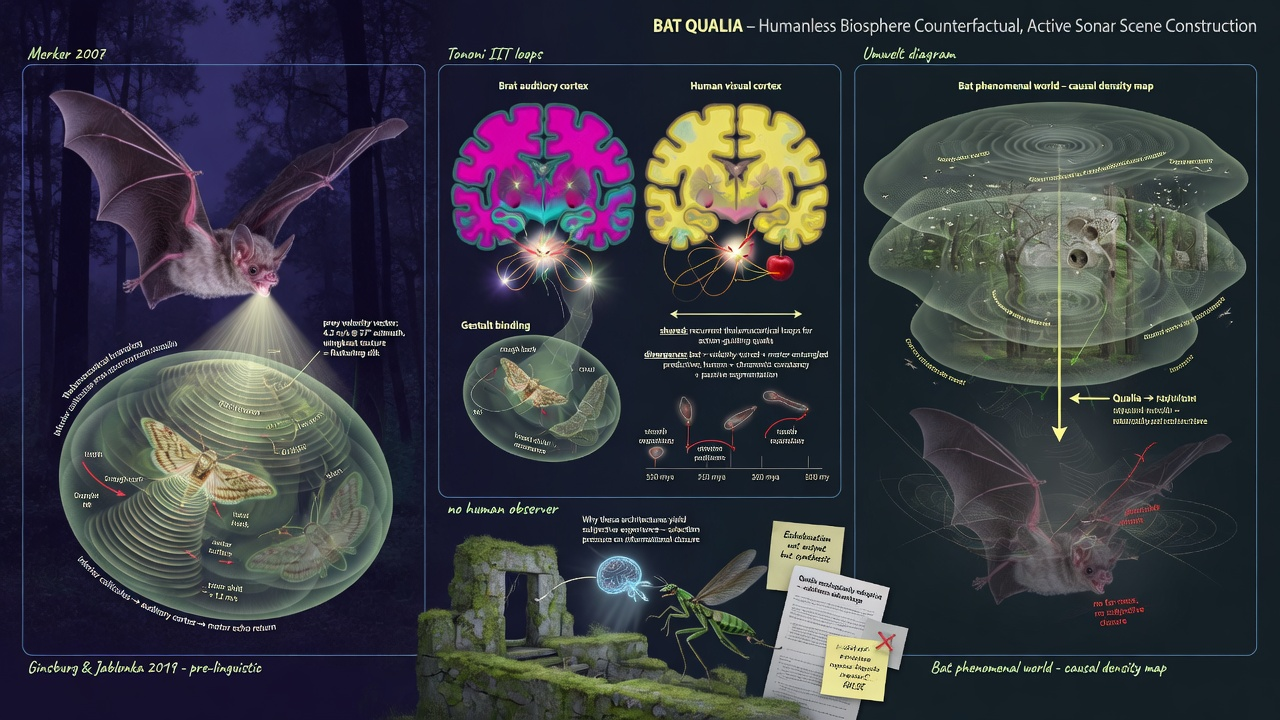
In the humanless world, bat qualia exist unremarked yet ontologically robust. Echolocation is not a mere behavioral output but an active perceptual synthesis: the bat’s vocalizations, pinna movements, and auditory cortex computations generate a dynamic, egocentric auditory “scene” whose subjective character includes texture discrimination, prey velocity vectors, and spatial affordances inaccessible to passive senses. Comparative dissection reveals shared mechanisms: all modalities instantiate qualia via recurrent thalamocortical (or homologous) loops that bind sensory data into unified, action-guiding Gestalts (Merker 2007; Ward 2022 on electromagnetic field theories of consciousness). Yet divergence is equally instructive. Human vision affords color constancy and object segmentation; bat sonar affords velocity-tuned resolution and occlusion penetration. The “what it is like” differs not merely in content but in structural organization—bat qualia are intrinsically predictive and motor-entangled in ways vision is not.
Removing the human inquirer eliminates the illusion that the hard problem arises from linguistic reflection. Qualia predate language; they are phylogenetically ancient features of mobile, information-seeking organisms (Ginsburg and Jablonka 2019). In the counterfactual biosphere, evolutionary biology (conducted, hypothetically, by an intelligent non-human successor or implicitly through selection) would still confront the necessity of explaining why certain neural architectures yield subjective experience while others do not. The comparative lens shows this explanation cannot be purely third-person: physical descriptions of echo processing omit the bat’s viewpoint-dependent “for-ness.” Yet neither is it mysterious: qualia emerge where sensorimotor integration achieves sufficient informational closure and causal density (Tononi et al. 2016; see Tsuchiya 2017 for explicit application to bat echolocation).
Second-order implication: subjectivity is ecologically adaptive. Bats’ phenomenal world enables rapid, noise-robust decision-making in darkness—advantages not capturable by zombie-like functional duplicates. This supports ontological realism: qualia are not epiphenomenal but causally efficacious within their Umwelt. For AI, the analysis implies that current large-language models, lacking embodied active-sensing loops, instantiate no genuine qualia; synthetic consciousness requires hardware recapitulating biological embodiment.
Discussion
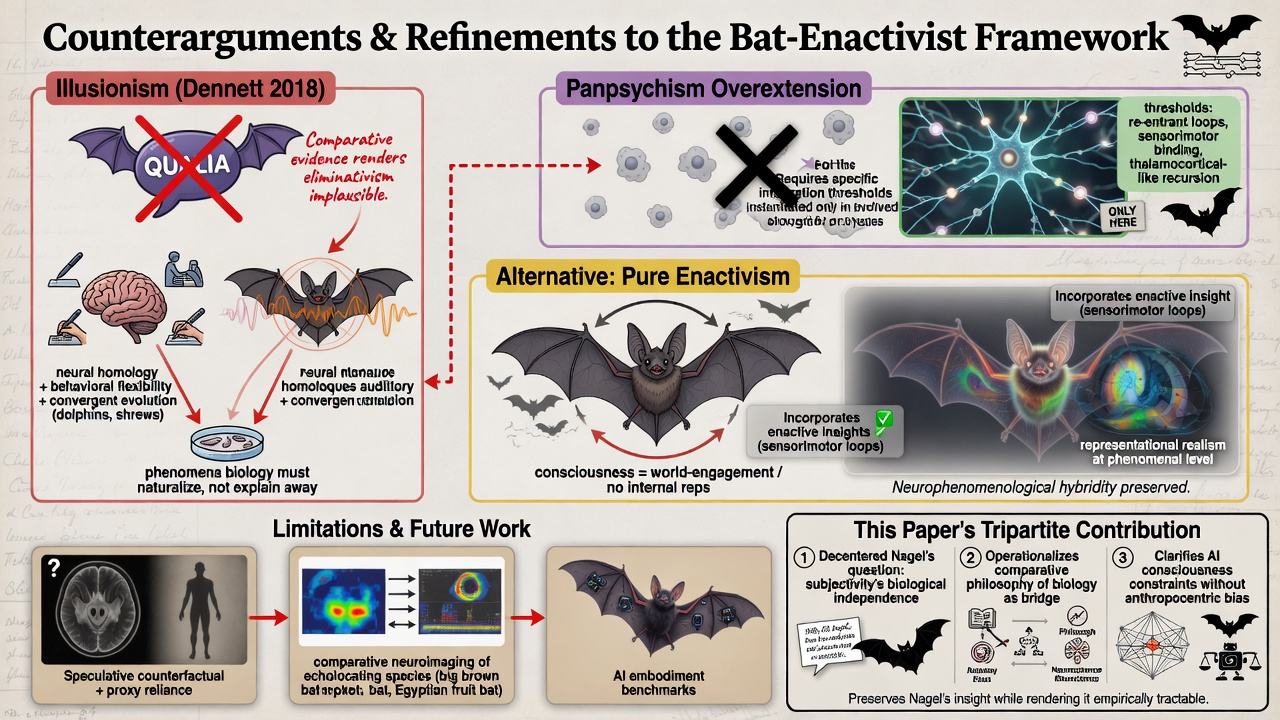
Counterarguments merit explicit address. Illusionists (Dennett 2018) might claim the thought experiment changes nothing: qualia were never real, human or bat. Yet the comparative evidence—behavioral flexibility, neural homology, convergent evolution of complex sensing—renders eliminativism implausible; it explains away the very phenomena biology seeks to naturalize. Panpsychists might over-extend, positing proto-qualia in all matter; the framework counters by requiring specific integration thresholds instantiated only in evolved biological systems.
Alternative interpretations include pure enactivism (no internal representations, consciousness as world-engagement). The analysis incorporates enactive insights (sensorimotor loops) while retaining representational realism at the phenomenal level—consistent with neurophenomenological hybridity. Limitations include the speculative nature of the counterfactual and reliance on proxies; future empirical work (e.g., comparative neuroimaging of echolocating species, AI embodiment benchmarks) can refine inferences.
Relative to existing scholarship, the contribution is threefold: (1) it decenters Nagel’s question from human epistemology, revealing subjectivity’s biological independence; (2) it operationalizes comparative philosophy of biology as a bridge across subfields; and (3) it clarifies constraints on AI consciousness without anthropocentric bias. These refinements preserve Nagel’s insight while rendering it empirically tractable.
Conclusion
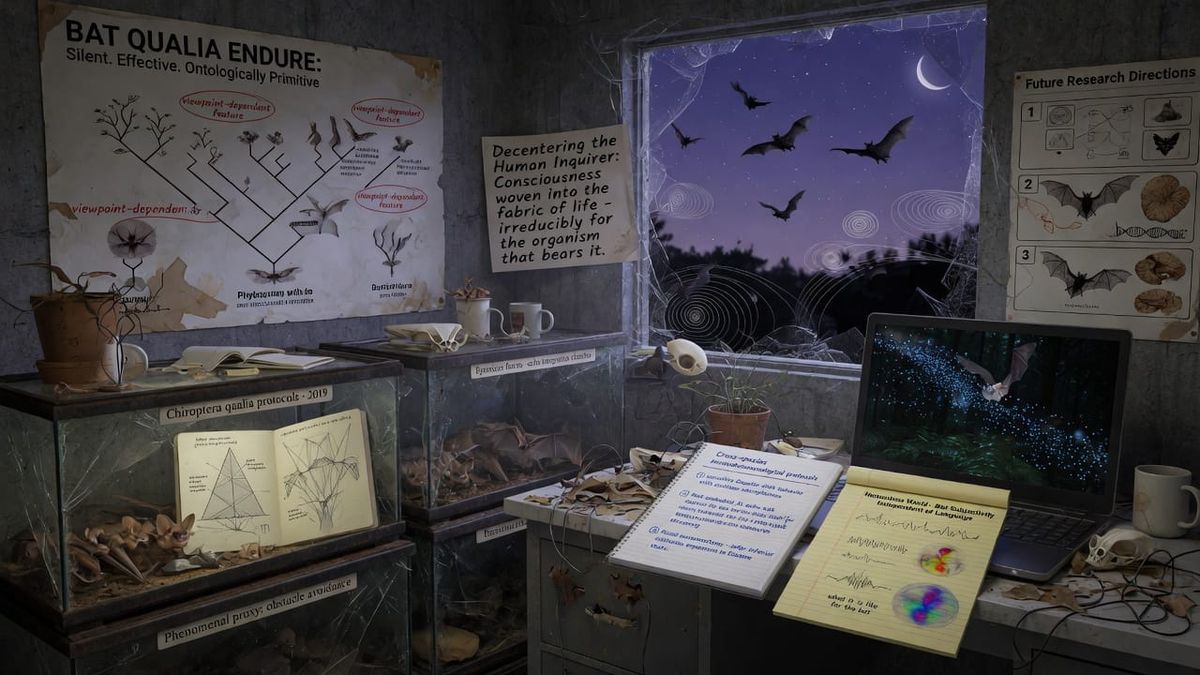
In a humanless world, bat qualia endure—silent, effective, and ontologically primitive. The thought experiment demonstrates that phenomenal consciousness is neither a human artifact nor an insoluble mystery but an evolved, viewpoint-dependent feature of biological systems whose comparative study demands integrated methods from philosophy of biology, mind, and physics. Core insights include the independence of subjectivity from linguistic inquiry, the mechanistic basis of qualia in embodied informational integration, and the necessity of species-specific phenomenological proxies.
This article contributes a naturalistic yet non-reductive ontology of qualia that refines the hard problem for contemporary science. Future research should: (1) develop cross-species neurophenomenological protocols using behavioral and physiological correlates; (2) test embodied AI architectures against biological benchmarks for qualia-like dynamics; and (3) explore phylogenetic reconstructions of qualia origins via fossil neuroanatomy and comparative genomics. By decentering the human inquirer, philosophy gains a clearer view of consciousness as it actually is—woven into the fabric of life, diverse, and irreducibly for the organism that bears it.
References
Chalmers, D. J. (1995). Facing up to the problem of consciousness. Journal of Consciousness Studies, 2(3), 200–219.
Dennett, D. C. (1991). Consciousness explained. Little, Brown.
Feinberg, T. E., & Mallatt, J. (2016). The ancient origins of consciousness. MIT Press.
Ginsburg, S., & Jablonka, E. (2019). The evolution of the sensitive soul. MIT Press.
Godfrey-Smith, P. (2016). Other minds: The octopus, the sea, and the deep origins of consciousness. Farrar, Straus and Giroux.
Lacalli, T. (2022). On the origins and evolution of qualia: An experience-space model. Frontiers in Psychology, 13, 939946.
Merker, B. (2007). Consciousness without a cerebral cortex: A challenge for neuroscience and medicine. Behavioral and Brain Sciences, 30(1), 63–81.
Nagel, T. (1974). What is it like to be a bat? The Philosophical Review, 83(4), 435–450.
Nagel, T. (2024). Objective bat phenomenology. Animal Sentience, 9(35), 1–3.
Thompson, E. (2007). Mind in life: Biology, phenomenology, and the sciences of mind. Harvard University Press.
Tononi, G., Boly, M., Massimini, M., & Koch, C. (2016). Integrated information theory: From consciousness to its physical substrate. Nature Reviews Neuroscience, 17(7), 450–461.
Tsuchiya, N. (2017). “What is it like to be a bat?”—a pathway to the answer from the integrated information theory. Philosophy Compass, 12(3), e12407.
Varela, F. J. (1996). Neurophenomenology: A methodological remedy for the hard problem. Journal of Consciousness Studies, 3(4), 330–349.
Ward, L. M. (2022). Qualia and phenomenal consciousness arise from the electromagnetic field generated by the thalamocortical dynamic core. Frontiers in Human Neuroscience, 16, 874241.