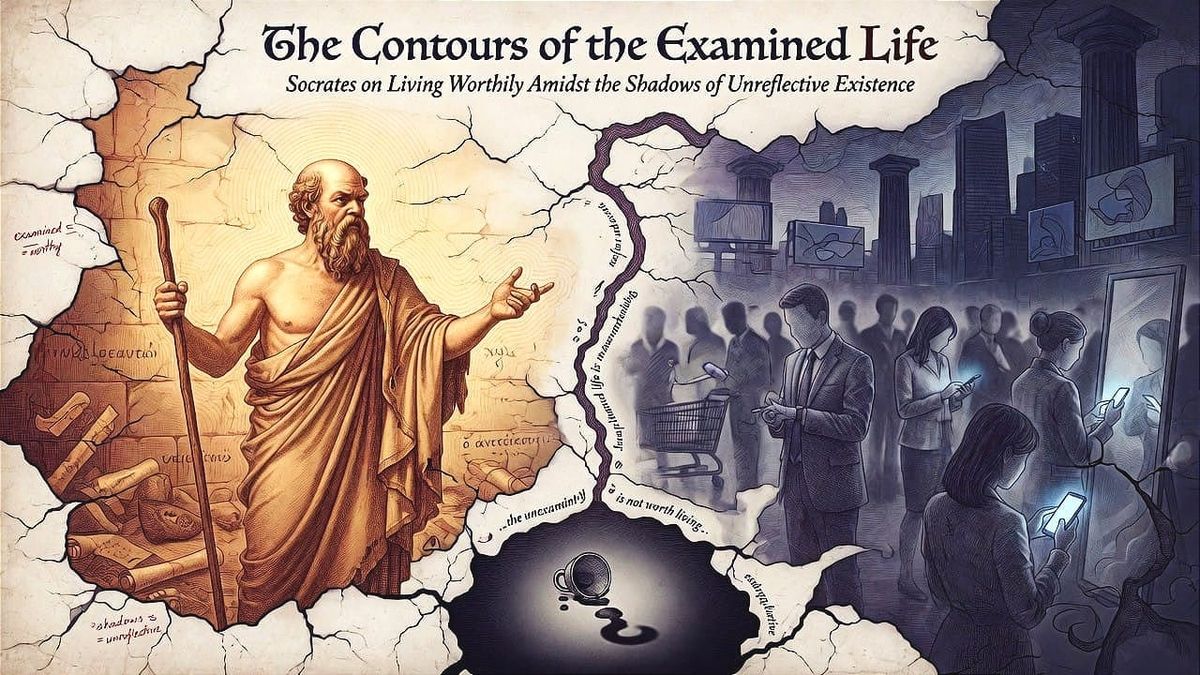
The Contours of the Examined Life: Socrates on Living Worthily Amidst the Shadows of Unreflective Existence
I drink the hemlock calmly and leave this not as command but challenge: question endlessly, speak without cease, and live as if your soul’s value hangs by a thread—for it does. The examined life is the only one worthy of anyone claiming to be human.”
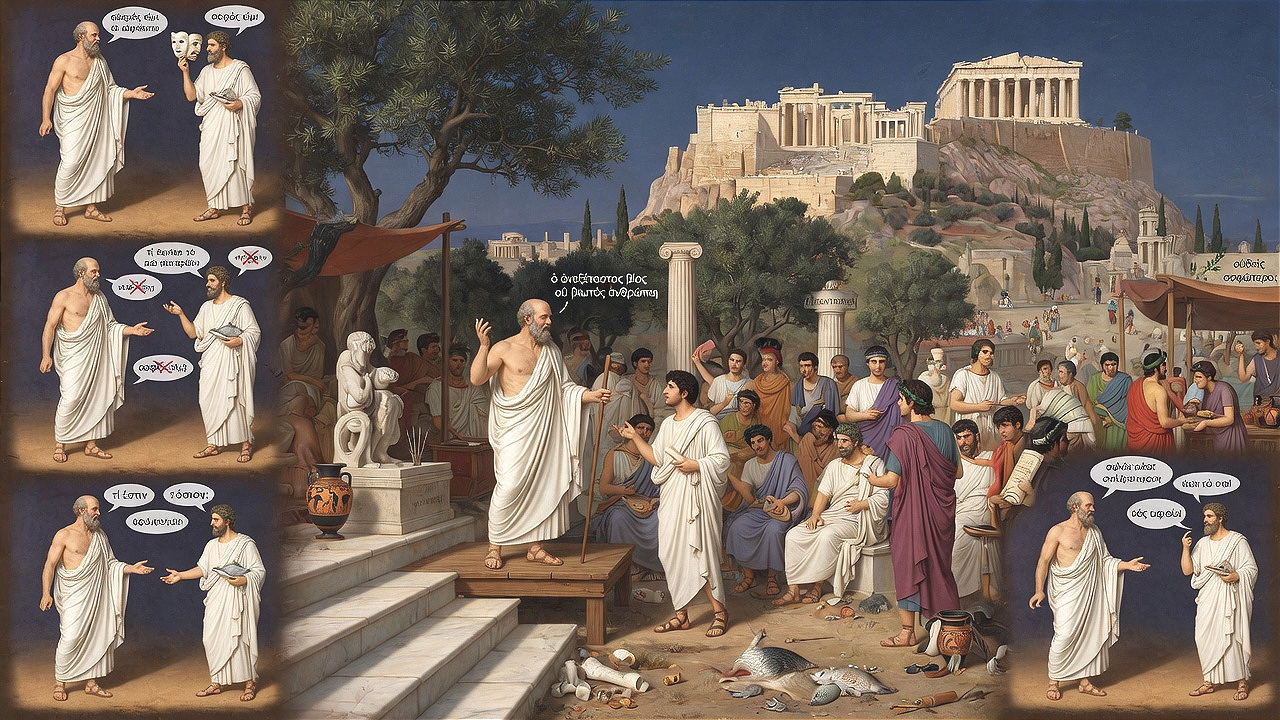
In the bustling agora of ancient Athens, where merchants hawked their wares and citizens debated the affairs of the polis under the shadow of the Acropolis, I, Socrates, found myself standing before a jury of my peers in the year 399 BCE, charged with impiety and the corruption of the youth. It was there, as Plato my devoted student has recorded in his Apology, that I uttered the words now etched into the annals of Western thought: the unexamined life is not worth living for a human being. These were not mere rhetorical flourishes born of desperation in the face of hemlock, but the culmination of a lifelong commitment forged in the crucible of dialogue, doubt, and the Delphic oracle's enigmatic pronouncement that no one was wiser than I. To understand what the examined life looks like, one must first retrace the historical and foundational threads that wove this imperative into the fabric of philosophical inquiry. My method, often called elenchus, emerged not from abstract theorizing in isolation but from the vibrant, contentious intellectual landscape of fifth-century Athens. Here, amid the aftermath of the Peloponnesian War, sophists peddled persuasive techniques for a fee, promising young men the tools to sway assemblies and courts without regard for truth. I, a stonemason's son turned gadfly by divine calling, rejected such commodified wisdom. Instead, I wandered the streets, questioning poets, politicians, and craftsmen alike, exposing the hollowness of their claims to knowledge. The oracle at Delphi had declared me wisest precisely because I alone recognized my ignorance, a paradox that propelled me to test others' pretensions through relentless cross-examination. This was no idle pastime; it was a sacred duty to the god Apollo, a service to the city that demanded we scrutinize not only our beliefs but the very foundations of virtue, justice, and the good life. Foundational to this pursuit was the principle that true wisdom resides not in accumulated facts or rhetorical prowess but in a habitual turning inward and outward simultaneously—interrogating assumptions about courage, piety, or friendship while engaging fellow citizens in the shared quest for clarity. As Plato depicts in dialogues like the Euthyphro or Laches, the examined life begins with humble admission of aporia, that state of puzzlement where confident opinions dissolve under scrutiny, paving the way for genuine insight. It is a life animated by daily conversation about virtue, as I insisted to the jurors, where one converses with oneself and others not to win arguments but to align one's soul with what is true and noble. This foundational practice rests on the bedrock conviction that the human soul, immortal and divine in its rational capacity, thrives only when cultivated through such inquiry, much as a farmer tends soil to yield fruitful harvest rather than allowing weeds of unreflective habit to choke potential.
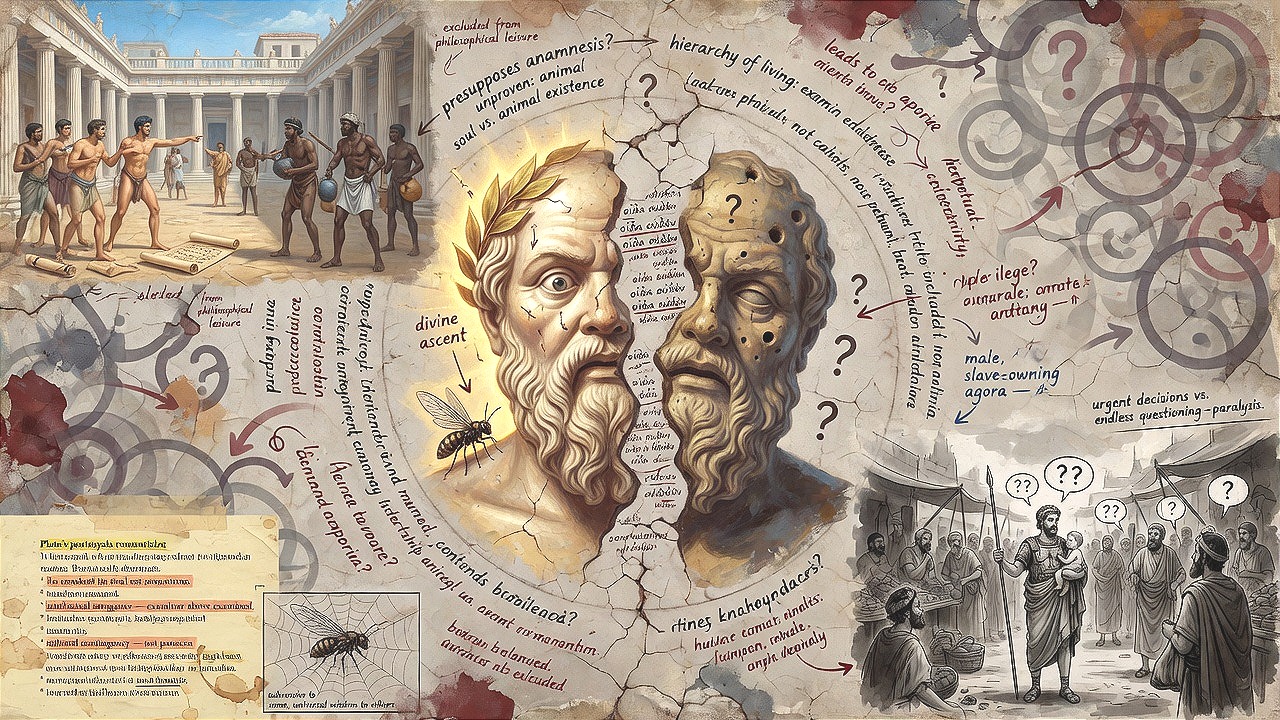
Yet to portray the examined life solely in glowing terms would betray the very spirit of scrutiny it demands. One must probe its underlying assumptions and the inconsistencies that lurk within, for even my own pronouncements invite rigorous challenge. At its core lies the presupposition that human flourishing—eudaimonia, as later thinkers would term it—depends intrinsically upon intellectual self-examination, that a life devoid of such reflection is akin to mere animal existence, mechanical and unfulfilling. This assumes a hierarchy of living: the examined soul ascends toward the divine, while the unexamined drifts in ignorance, vulnerable to sophistry, demagoguery, and self-deception. But herein emerge tensions. If I profess to know nothing, as I repeatedly claimed, how can examination yield certainty rather than perpetual doubt? Does the elenchus not risk leading interlocutors into a barren aporia without constructive resolution, leaving them more confused than enlightened? Scholars attuned to these matters, drawing from Plato's portrayals, have noted how this method presupposes interlocutors possess latent knowledge accessible through questioning—a doctrine of recollection, or anamnesis, that some view as an unproven metaphysical leap. Biases, too, color these foundations. My inquiries unfolded within the male-dominated, slave-owning democracy of Athens, where women, foreigners, and the enslaved were largely excluded from the philosophical agora. Was the examined life, then, an elitist privilege reserved for free citizens with leisure to debate in the gymnasium, blind to the practical exigencies of labor or the marginalized voices silenced by societal structures? Such biases influence interpretations profoundly: in democratic Athens, my gadfly role was seen by some as subversive, undermining traditional piety and authority, yet in later eras, it has been romanticized as universal wisdom. Modern analyses reveal how these assumptions can foster a kind of intellectual arrogance, where the examiner positions himself above the examined, potentially alienating rather than elevating. Moreover, inconsistencies arise in application; examination demands vulnerability and time, yet life presses with urgent decisions—raising families, waging wars, tending trades—where endless questioning might paralyze action rather than refine it. These flaws do not invalidate the examined life but demand we acknowledge its limits: it is not a panacea immune to human frailty or cultural contingency, and its pursuit may inadvertently privilege abstract contemplation over embodied, communal existence.
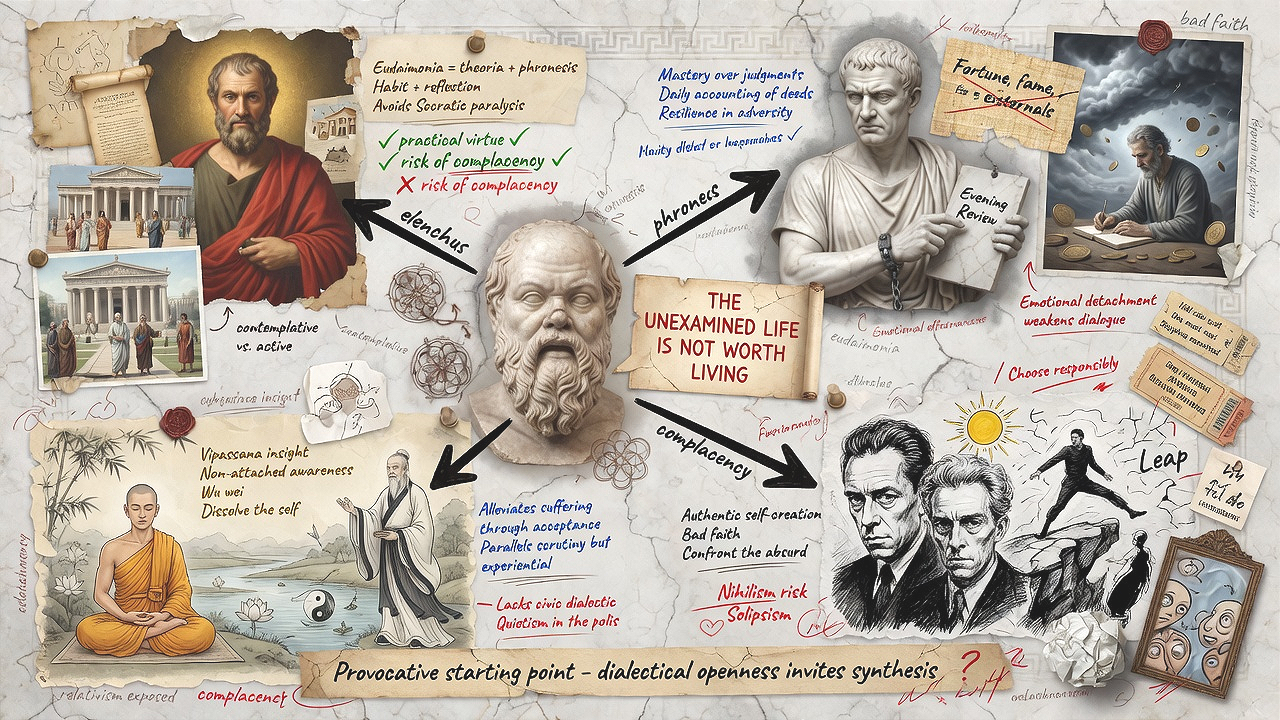
Diverse perspectives compete to define or contest what constitutes this examined existence, each illuminating strengths while exposing weaknesses relative to the Socratic ideal. Aristotle, my illustrious successor through Plato's Academy, reframed the matter in his Nicomachean Ethics by distinguishing the contemplative life of the philosopher—pure theoria, or theoretical wisdom—as the highest form of eudaimonia, yet he balanced it with phronesis, practical wisdom exercised in the polis through habitual virtue. Where my approach emphasizes perpetual questioning to expose ignorance, Aristotle's allows for settled knowledge derived from experience and habituation, offering a more integrated vision that values both reflection and action; its strength lies in practicality, avoiding the potential paralysis of endless doubt, but it risks complacency if habits calcify without ongoing critique. Stoic thinkers like Epictetus and Seneca, heirs to this tradition, internalized examination as mastery over judgments and passions, viewing the unexamined life as one enslaved to externals—fortune, fame, or fear. Their emphasis on daily self-accounting, such as evening reviews of one's deeds, strengthens resilience in adversity, a clear advantage over pure Socratic elenchus in turbulent times, yet it can veer toward emotional detachment, undervaluing the relational dialogues central to my method. Existentialist voices in the modern age, from Kierkegaard to Sartre and Camus, radicalize the examined life into authentic self-creation amid absurdity: one must confront the void of meaning without divine or rational guarantees, choosing responsibly in "bad faith's" shadow. This perspective's power resides in its urgency for individual freedom, highlighting how unexamined conformity breeds inauthenticity, but its weakness emerges in potential nihilism or solipsism, where examination dissolves into subjective angst without the objective pursuit of virtue I championed. Eastern traditions, particularly Buddhist mindfulness and the Taoist embrace of wu wei, offer counterpoints by framing examination as non-attached awareness of impermanence and interdependence, dissolving the self rather than fortifying it through rational interrogation. Buddhism's vipassana, or insight meditation, parallels my call to scrutinize assumptions but prioritizes experiential insight over dialectical argument, excelling in alleviating suffering through acceptance where Socratic rigor might exacerbate it; yet it may underplay the social, civic dimension of examination in a democratic polity. These competing lenses—Aristotelian balance, Stoic discipline, existential authenticity, and contemplative detachment—reveal the Socratic examined life not as monolithic dogma but as a provocative starting point, its dialectical openness inviting synthesis while its insistence on truth-seeking exposes the relativism or quietism latent in alternatives.
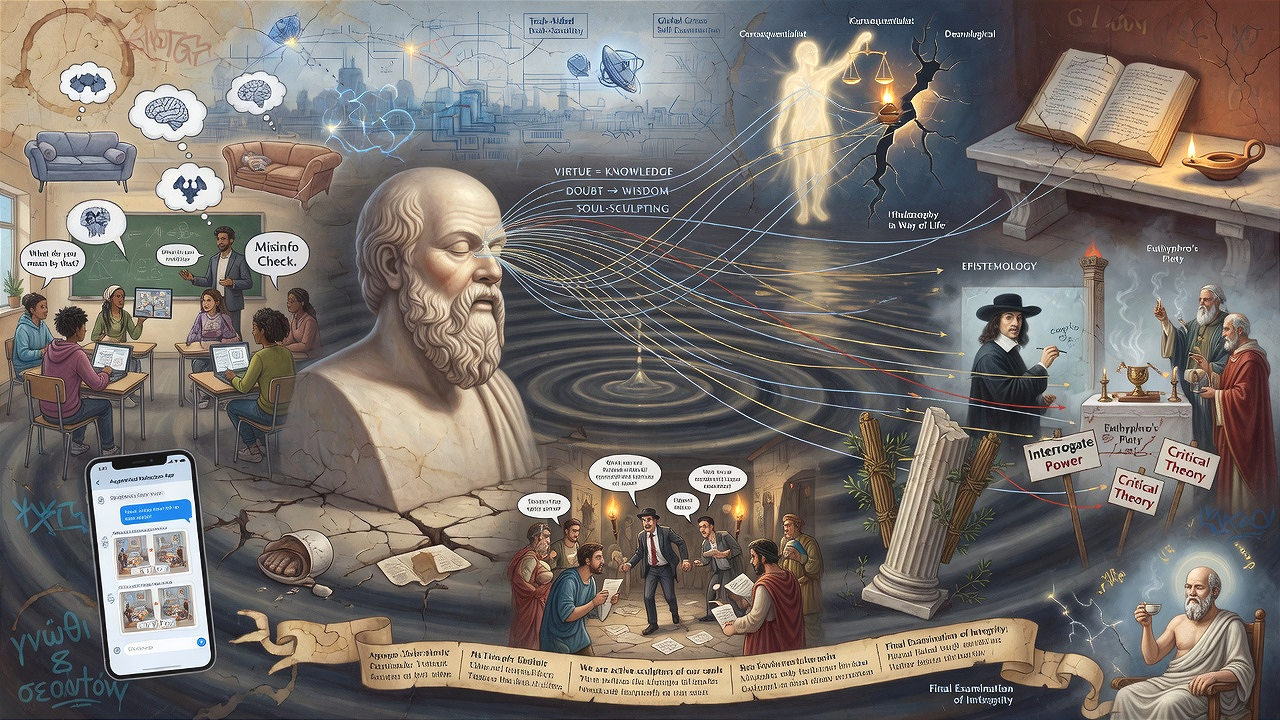
The broader implications of this examined life ripple far beyond personal edification, reshaping our understanding of ethics, epistemology, and the human condition while charting paths for future intellectual and societal evolution. In the ethical realm, it posits virtue as inseparable from knowledge: to know the good is to do the good, challenging consequentialist or deontological frameworks that separate intent from reflection. Epistemologically, it elevates doubt as the gateway to wisdom, influencing everything from Cartesian skepticism to contemporary critical theory, where power structures are interrogated much as I probed Athenian pieties. Within the field of philosophy itself, this imperative underscores the discipline's role not as esoteric speculation but as a way of life, as Pierre Hadot and others have illuminated in their studies of ancient spiritual exercises—a vocation that counters the professionalization of academia into detached scholarship. Its significance extends to politics: an examined citizenry, vigilant against demagogues and unscrutinized traditions, fortifies democracy against tyranny, yet it also harbors risks, as my trial tragically illustrated—examination can destabilize social cohesion if perceived as corrosive to shared norms. In psychology and education, it anticipates introspective therapies and the Socratic method's enduring use in classrooms, fostering critical thinking that equips minds against misinformation in our digital age. Looking forward, as artificial intelligence and global crises demand ever-deeper self-scrutiny, the examined life implies a future where technology aids rather than supplants reflection—perhaps through augmented dialogues that prompt ethical questions—while warning against algorithmic echo chambers that mimic unexamined complacency. Its ultimate meaning lies in affirming human dignity: we are not passive recipients of fate but active sculptors of our souls, and in this pursuit, even death, as I faced it serenely, becomes not an end but a final examination of integrity.
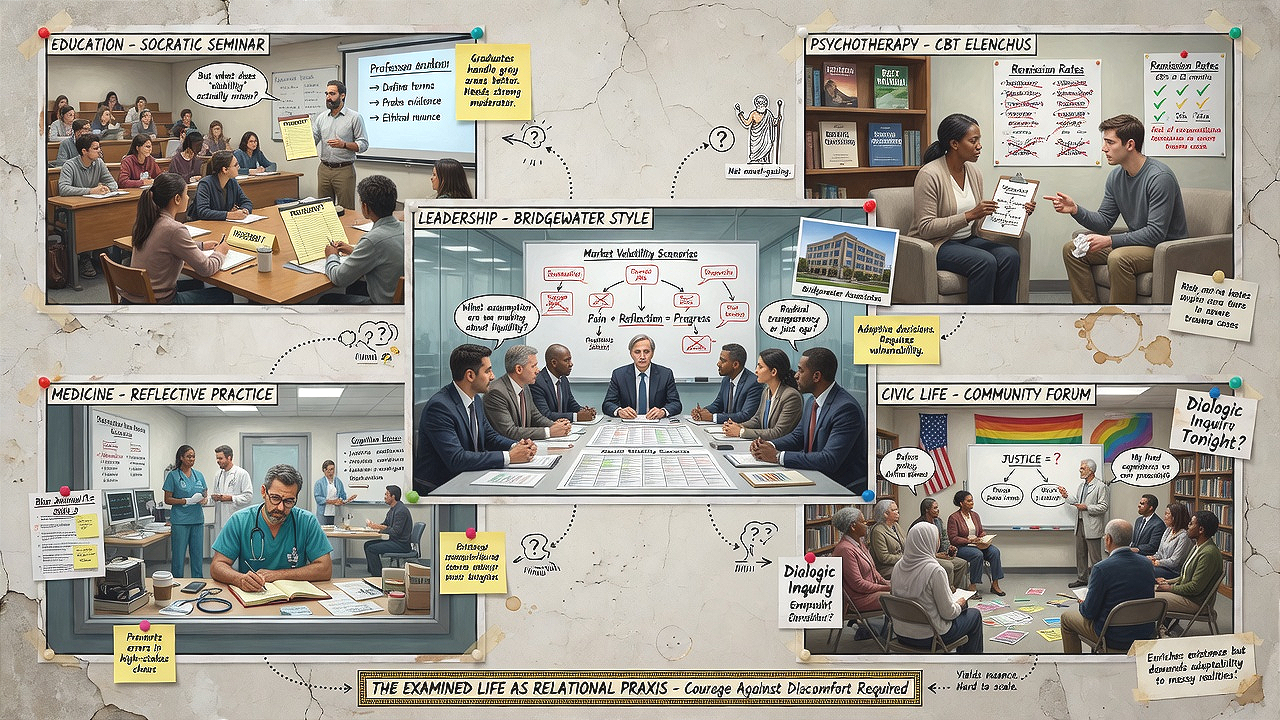
This theoretical edifice finds vivid expression in real-world domains, where the examined life transcends abstraction to inform practice across disparate spheres. In education, the Socratic seminar—facilitated dialogues that mirror my agora exchanges—trains students not in rote memorization but in questioning assumptions, as seen in law schools where case method hones analytical rigor, producing advocates who probe precedents rather than accept them blindly; its practical yield is evident in graduates who navigate ethical dilemmas with nuance, though it demands skilled moderators to avoid the frustration my interlocutors often voiced. In psychotherapy, echoes resound in cognitive behavioral therapy's collaborative empiricism, where clients examine distorted beliefs through guided questioning, drawing implicitly from Stoic and Socratic roots to alleviate anxiety and depression; real-world efficacy appears in clinical trials showing sustained remission rates, illustrating how internal elenchus translates to emotional resilience, yet edge cases arise with severe trauma where unmoderated examination risks retraumatization. Leadership and organizational contexts offer striking applications: executives employing Socratic coaching in boardrooms foster cultures of radical transparency, as Ray Dalio implemented at Bridgewater Associates, where iterative questioning of assumptions drives innovative decision-making amid market volatility; this yields adaptive, ethical firms but requires vulnerability, lest it devolve into corrosive critique. In medicine, reflective practice—journals or peer debriefs modeled on examined self-scrutiny—enhances diagnostic accuracy and ethical care, as physicians confront biases in high-stakes environments like emergency rooms, preventing errors born of unreflective routine. Even in everyday civic life, community forums inspired by dialogic inquiry address polarization, encouraging participants to define terms like "justice" before debating policies, yielding more empathetic outcomes though scalability remains challenging in polarized societies. Across these domains, the examined life manifests not as solitary navel-gazing but as relational praxis, its nuances revealing that while it enriches existence, it demands courage against discomfort and adaptability to context—lest it remain an ideal unmoored from the messy realities of human endeavor.
In the end, as I drank the hemlock with composure, I bequeath this vision not as prescription but invitation: examine ceaselessly, converse relentlessly, and live as if your soul's worth hangs in the balance—for indeed it does. The examined life, in all its demanding splendor, is the only one befitting those who claim the name of human.