The Philosophy of Marlon Brando
... used the apparatus of celebrity to attack celebrity itself, who spoke into microphones in order to question the value of speech, and who, in the end, understood that the only escape from the hall of mirrors was to shatter the glass entirely.
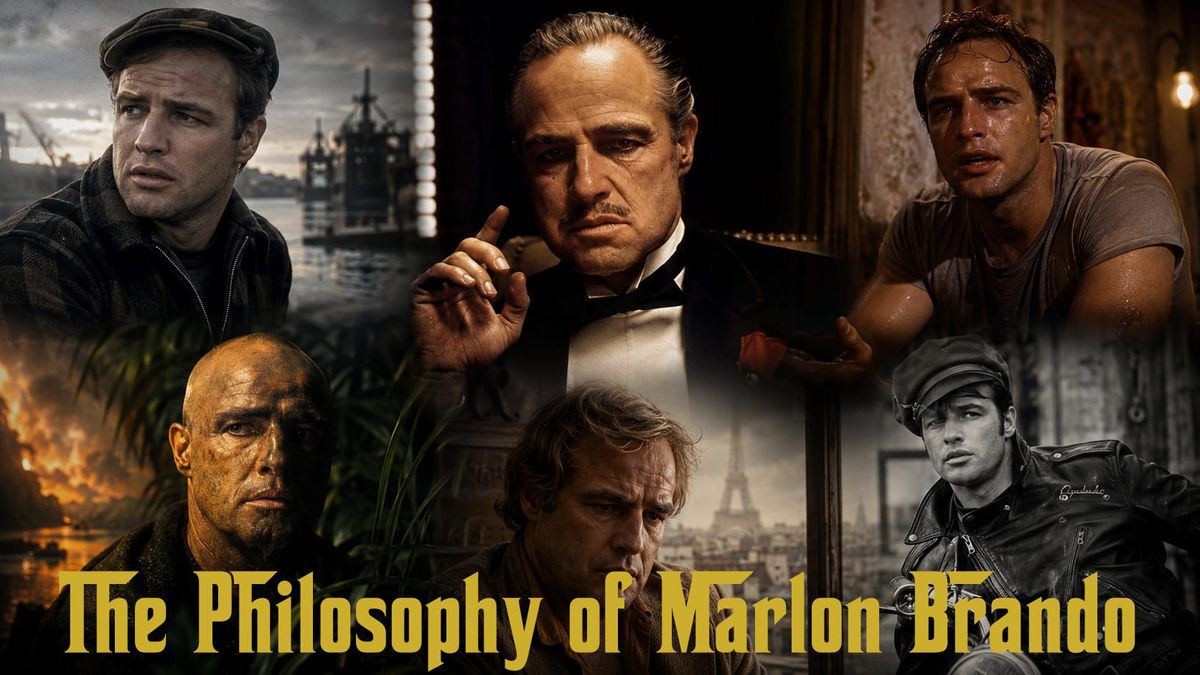
The Actor as Philosophe: Marlon Brando’s Search for Truth in a Hall of Mirrors
There's a line in the picture where he (Johnny - The Wild One) snarls, 'Nobody tells me what to do.' That's exactly how I've felt all my life.
Marlon Brando functions as a Janus-faced figure in twentieth-century culture: one visage belongs to the revolutionary artist who shattered the artifice of screen performance, while the other belongs to the reluctant public intellectual whose political commitments were as fiercely held as they were deliberately obscured. To treat Brando merely as an actor is to miss the coherence of his intellectual project. Beneath the mumbled lines and the studied indifference to his own celebrity lay a remarkably consistent worldview, one that fused a tragic understanding of human psychology with an uncompromising ethical demand for justice, all filtered through a profound skepticism toward the very medium that made his voice audible. This examination reconstructs Brando not as a performer who dabbled in ideas but as a thinker whose primary mode of philosophical expression was, paradoxically, the art of pretending.
Philosophy
Brando’s philosophical architecture rests on a single, uncompromising conviction: that truth is the only legitimate aim of human endeavor, and that most of what passes for civilized life is an elaborate evasion of it. He arrived at this position not through formal study but through the crucible of a Midwestern childhood marked by his mother’s alcoholism and his father’s cold brutality, experiences that taught him early that surfaces deceive and that authenticity is a rare and precious commodity. When Brando declared that acting was lying for a living, he was not being merely provocative; he was articulating a metaphysics in which performance and reality exist in a dialectical tension, each revealing the other’s contours precisely through their opposition. The actor who can lie with complete conviction paradoxically exposes the lies that ordinary people tell themselves daily.
This philosophical orientation drew Brando naturally toward the Stanislavski system as transmitted through Stella Adler, but he transformed it into something far more radical than a technique. Where Stanislavski sought emotional truth for the sake of the performance, Brando increasingly sought performance as a vehicle for ontological truth about the human condition itself. He spoke messianically of wanting to change the motion picture into something nearer the truth, a formulation that elevates acting from craft to a kind of epistemological mission. His insistence that there are no artists, there is no art, only money, reflected not cynicism but a deeply held belief that the commercial structures of Hollywood were intrinsically hostile to the truth-telling function he considered sacred.
The corollary of this position was Brando’s rejection of conventional moral categories. In preparing for his portrayal of Vito Corleone, he mused that we have an antiquated belief in good and evil, and that he did not believe in either one. This was not moral relativism in any simple sense but rather a conviction that ethical judgment must be suspended to achieve genuine understanding. The actor who wishes to portray a gangster truthfully cannot begin from the premise that the character is evil; he must instead locate the gentleness, the humanity, and the internal logic that makes the character comprehensible as a human being. This radical empathy was, for Brando, both an artistic method and a moral discipline.
His worldview was further shaped by an eclectic spiritual journey. Though he described himself as an atheist, he was drawn to mystical strains of Jungian psychotherapy and Eastern religious traditions, particularly Buddhism and Daoism, which he said he could relate to more than Western thought. He practiced meditation with sufficient discipline to claim control over his heart rate and blood pressure, achieving what he described as a very high yogic state of complete blissfulness. These practices were not mere hobbies but extensions of his fundamental philosophical project: the attempt to strip away the accumulated falsehoods of personality and culture to reach some bedrock of authentic being.
Beliefs
Brando’s core normative commitments flowed directly from his philosophical commitment to truth. If the primary moral failing is self-deception and the social structures that enforce it, then the primary moral obligation is to pierce those structures, regardless of personal cost. This principle animated his political activism, his artistic choices, and his personal relationships, though it often manifested in ways that appeared contradictory or self-destructive to outside observers.
His hatred of his father became a template for his relationship to all authority. The father who belittled his acting, who embodied the cold, distant, unloving patriarch, represented everything Brando opposed: the substitution of power for love, of appearance for substance, of domination for understanding. This personal wound became a political position, an instinctive siding with the powerless against the powerful that would later draw him to the civil rights movement, the American Indian Movement, and anti-colonial struggles worldwide. He believed deeply in the actor’s ability to achieve truth, and this belief carried with it a corollary responsibility: to use whatever platform that truth-telling ability provided to challenge the lies that sustain injustice.
Normatively, Brando held that conduct of business as usual during national moral crises would make him complicit in the problem. This was not a casual preference but a binding ethical imperative. When Martin Luther King was assassinated in 1968, a traumatized Brando announced he was resigning from a major film role to focus on the civil rights movement. He gave money to defend the militant Black Panthers, which resulted in Southern theatre chains boycotting his films and the creation of the Brando Black List, which shut him out of many movie opportunities. The willingness to sacrifice a career for principle was, for Brando, the only authentic measure of belief; anything less was mere performance.
Psychology
Brando’s model of the human mind was as dark as it was sophisticated. He regarded acting as the expression of a neurotic impulse, a self-indulgence, and this was not, in his lexicon, necessarily a criticism. Neurosis, for Brando, was simply the condition of being human, the inevitable residue of the damage inflicted by parents, by society, by the sheer difficulty of existing as a conscious being. The feeling of being unwanted, he later said, was crucial to his acting, locating the source of his creative power in the very wound that caused him the most pain.
His psychological framework was deeply informed by his extensive experience with psychoanalysis. Like many creative persons, Brando seemed to be by nature so sensitive to impressions from within as well as from without, of his own emotions as well as of the world around him, that he often had a hard time handling them. He claimed that if he entered a room with a hundred people and one of them disliked him, he would know it and have to leave, a hypersensitivity that made ordinary social existence nearly unbearable but that also constituted his primary artistic instrument.
The most systematic expression of Brando’s psychology appears in his recorded self-analyses, particularly the tapes that form the basis of the documentary Listen to Me Marlon. These recordings reveal a man engaged in a continuous project of self-investigation, using techniques ranging from traditional psychoanalytic reflection to self-hypnosis. The title of the documentary itself comes from one of these sessions: Listen to me, Marlon, this is one part of yourself speaking to another part of yourself. This internal dialogue was not a symptom of pathology but a deliberate method, a way of mapping the topography of his own consciousness in order to better navigate it.
His theory of motivation was strikingly deterministic. He believed that we spend all of our life trying to fix the bad habits picked up in the first ten years, and that only with a superhuman amount of effort could one change oneself. The neurotic individual’s entire self-esteem shrinks to nothing if he does not receive admiration; to be admired and to be respected is a protection against helplessness and against insignificance. Because he is continually sensing humiliations, it will be difficult for him to have anyone as a friend. This passage, which Brando recited in the documentary, reads as both self-diagnosis and universal statement, a theory of personality in which early deprivation creates a lifelong hunger that can never be fully satisfied.
His psychological model extended to his understanding of acting itself. He believed actors must strive for absolute psychological identification with the character being portrayed, and that this identification is at least as important as mastery of voice projection or body movement. This was a style of acting that demanded a performer look inward to his own emotions and his own sense memory. The artist who can access his own deepest wounds, his own most authentic responses, can then channel those into the portrayal of a character, creating a performance that is simultaneously deeply personal and universally recognizable.
Arguments
Brando’s intellectual positions did not take the form of systematic treatises; they emerged through aphorisms, interviews, and most powerfully through the arguments embedded in his performances themselves. Nevertheless, several distinct claims can be reconstructed from his public statements and artistic choices.
His central argument about acting was that truthful performance requires the actor to locate within himself the emotional reality of the character, not to imitate an external model. This claim, derived from Stanislavski but radicalized by Brando, amounts to an epistemology of emotion: the way to know another person’s inner life is not through observation alone but through the excavation of one’s own parallel experiences. The actor does not become the character; rather, the actor discovers the character already latent within himself. This argument carries the unsettling implication that Stanley Kowalski, Vito Corleone, and Colonel Kurtz were not external creations but aspects of Brando’s own psyche made visible.
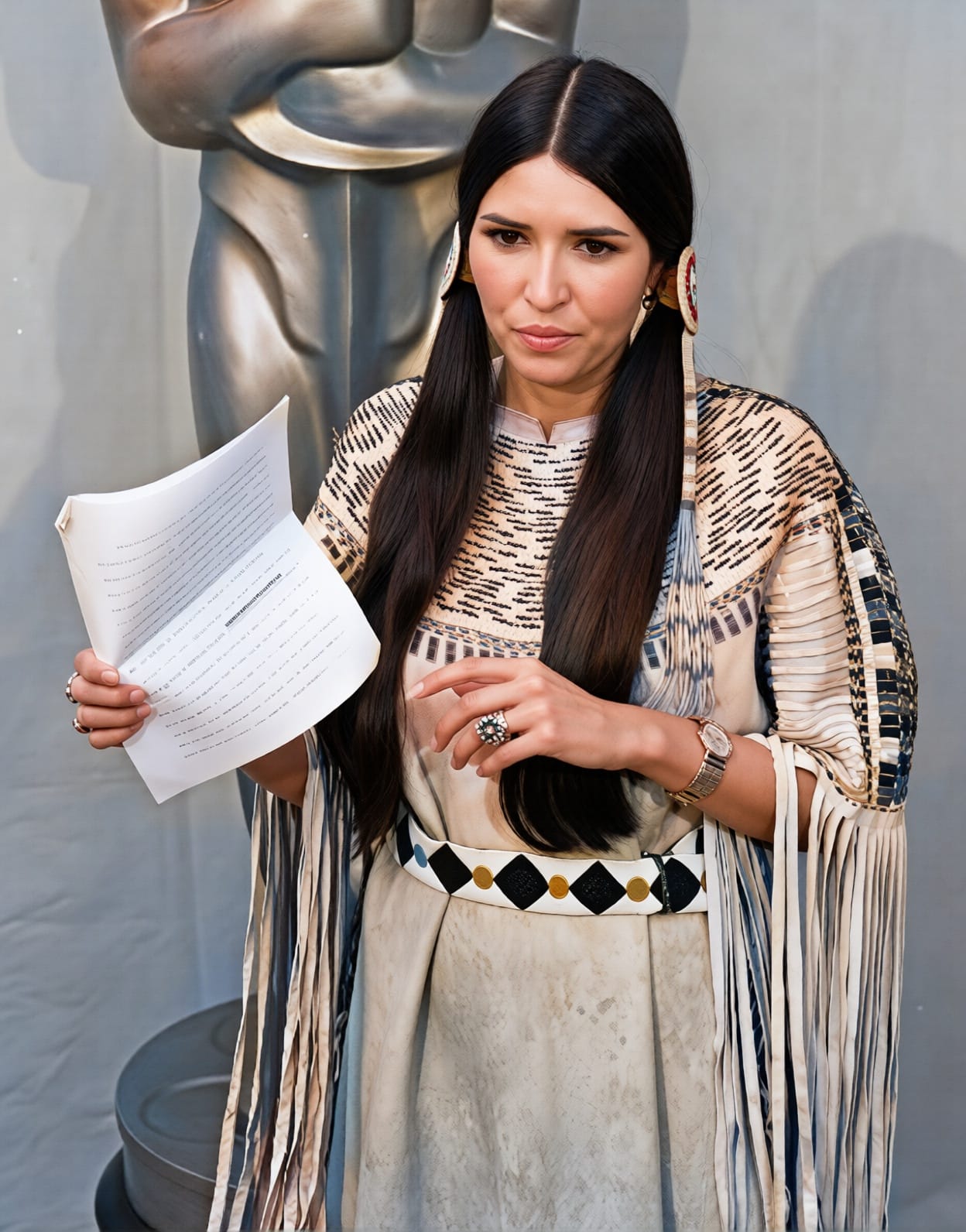
His political argument was equally stark: Hollywood’s representation of marginalized groups was not merely inaccurate but actively harmful, a form of ongoing violence that damaged the self-image of children in ways we can never know. At the 1973 Academy Awards, he sent Native American activist Sacheen Littlefeather to refuse his Oscar, taking aim at what he called the moral schizophrenia of an industry that made a mockery of Native Americans by portraying them only as savage, hostile, and evil. The argument here was structural: Hollywood did not simply reflect racial prejudice but actively produced and reproduced it, and anyone who participated in that system without protest was morally implicated.
His argument about the nature of his own profession was characteristically double-edged. On one hand, he insisted that acting was an illusion, a histrionic form of sleight of hand, and that there were no artists, only money-chasers. On the other hand, he devoted himself with obsessive intensity to the pursuit of perfect moments of performance, living with paralyzed war veterans for three weeks to prepare for The Men, and speaking admiringly of the ballerina Galina Ulanova, who said that if she could dance for one minute perfectly, that was all she would ever ask. The contradiction is only apparent: Brando’s argument was that art is possible only when the artist renounces all claim to artistic status, that truth emerges only when the performer stops performing and simply is.
Political Ideas
Brando’s political ideology resists easy classification within conventional American categories. He was neither a liberal in the institutional sense nor a radical in any doctrinaire Marxist tradition. His politics were best understood as a form of radical humanism grounded in an almost visceral identification with the oppressed and an equally visceral contempt for the structures of power that create and maintain oppression.
His political journey began in 1959, when he co-founded the Hollywood chapter of SANE, an anti-nuclear arms group. In the 1960s, he reduced his acting to focus on the civil rights movement’s demands for Black emancipation. In 1963, he marched arm in arm with James Baldwin at the March on Washington, a gesture that carried particular significance given Baldwin’s status as one of the very few openly gay Black men at the time. Brando was one of the freedom riders, joined by Paul Newman, who journeyed to the South to desegregate the bus lines.
The Native American cause became perhaps his most defining political commitment. He was arrested in 1964 during a protest for Native fishing rights, and in 1973 he became deeply involved with the American Indian Movement during its occupation of Wounded Knee. His refusal to accept the Oscar for The Godfather was not a spontaneous gesture but a carefully planned political intervention, coordinated with AIM leadership. He later deeded land he owned in the Santa Monica Mountains to Native American representatives. For Brando, the treatment of Native Americans was not a discrete issue but the paradigmatic instance of the American lie, the founding violence that the nation refused to acknowledge.
His anti-colonial commitments manifested in his film choices as well. He deliberately sought out projects that addressed colonial freedom struggles, including Burn!, which explored the mechanics of colonial exploitation and insurrection on a fictional Caribbean island, Viva Zapata, which examined the Mexican revolution, and A Dry White Season, which confronted South African apartheid. His decision to play Colonel Kurtz in Apocalypse Now represented, in part, an opportunity to embody the heart of darkness at the center of the imperial project.
Writings
Brando’s major written work is his autobiography, Songs My Mother Taught Me, published in 1994 with co-writer Robert Lindsey. The book’s title, with its evocation of maternal inheritance, signals its central preoccupation: the attempt to trace the origins of a self through the tangled legacies of childhood. The book provides a detailed historical record of both his life and career, together with comments on some of the people who shaped his art and influenced his personality.
The autobiography defies the conventions of the Hollywood memoir. Brando resolutely excludes any discussion of his wives or children and chivalrously refuses to name any living women among the hundreds he claimed to have slept with. He discusses his artistic life in modest and sometimes even derogatory terms, regarding his career as an easy way to make a lot of money for doing very little work, which allowed him to devote the rest of his time to more important matters, such as recreation, reading, or his favorite causes. This studied casualness about his professional achievements is itself a rhetorical strategy, a way of insisting that his true self resides elsewhere, in the private contemplations and political commitments that the public never fully saw.
One of the persistent themes in the book is the actor’s hatred of his father, whom he finally manages to punish and humiliate for all his sins. This Oedipal drama, played out across hundreds of pages, is not merely personal grievance but an argument about the transmission of damage across generations and the possibility, however slim, of breaking that cycle through conscious confrontation. The book also contains pronouncements on psychoanalysis, politics, and philosophy, revealing a mind that had ranged far beyond the soundstages of Hollywood.
The autobiography exists in dialogue with a more fragmentary but arguably more revealing textual corpus: the hundreds of hours of audio recordings Brando made throughout his life, in which he reflected on his work, his psychology, and his beliefs with a candor he rarely permitted in public. These tapes, which form the spine of Listen to Me Marlon, constitute a kind of oral autobiography more honest than the written one, a stream of consciousness in which Brando argues with himself, hypnotizes himself, and tries to make sense of the catastrophe of his own life.
Media Presence
Brando’s relationship with the media was adversarial, evasive, and yet, in its own peculiar way, deeply engaged. He gave interviews that were themselves performances, extensions of his acting in which he would play whatever role suited him for the occasion: earnest, playful, difficult, flirty, or droningly cause-specific. His 1973 appearance on The Dick Cavett Show became legendary, a strange and meandering conversation in which Brando seemed determined to dismantle the very conventions of the celebrity interview.
Marlon Brando Discusses Representation In Hollywood | Full Interview | The Dick Cavett Show
His early television appearances, including a 1955 interview with Edward R. Murrow on CBS’s Person to Person, captured the tension between his public persona and his private self, a tension made excruciatingly visible when his father appeared on camera and muttered his disdain for his son’s acting as Brando’s fake smile froze into a rictus of disbelief.
Person to Person with Marlon Brando 1955 avi
The posthumous documentary Listen to Me Marlon, directed by Stevan Riley, represents the culmination of Brando’s media legacy. Constructed from hundreds of hours of private audio recordings, film clips, home movies, television appearances, and even a holographic digital version of Brando’s head created in the 1980s, the documentary is an unprecedented act of cinematic autobiography. Brando reveals himself as almost painfully sensitive and self-aware, a man with a questioning intelligence who could be piercingly candid about his life and work.
Another significant documentary, Brando from 2007, runs nearly three hours and features interviews with Martin Scorsese, Al Pacino, Robert Duvall, John Travolta, Jane Fonda, and numerous others who testify to his revolutionary impact on the craft of acting. The documentary includes Brando’s political views and his civil rights activism, with never-before-seen footage and interviews.
Beyond formal documentaries, Brando’s media presence persists through YouTube archives, radio interviews, and the digitized traces of his public appearances. A particularly revealing interview exists with Studs Terkel, in which Brando discusses his views on mankind and, in a characteristic inversion, begins questioning the interviewer about his obsession with asking questions. These media artifacts collectively paint a portrait of a figure who used the apparatus of celebrity to attack celebrity itself, who spoke into microphones in order to question the value of speech, and who, in the end, understood that the only escape from the hall of mirrors was to shatter the glass entirely.