
From Isolation to Algorithmic Loneliness: Hannah Arendt, the Smartphone, and the Totalitarian Condition in the Digital Age
Totalitarianism thrives not on true believers but on people who can no longer tell fact from fiction or truth from falsehood. Smartphones train users into that condition through feeds, validation loops, and algorithmic reality. Seeing this as political is the first step to resisting.
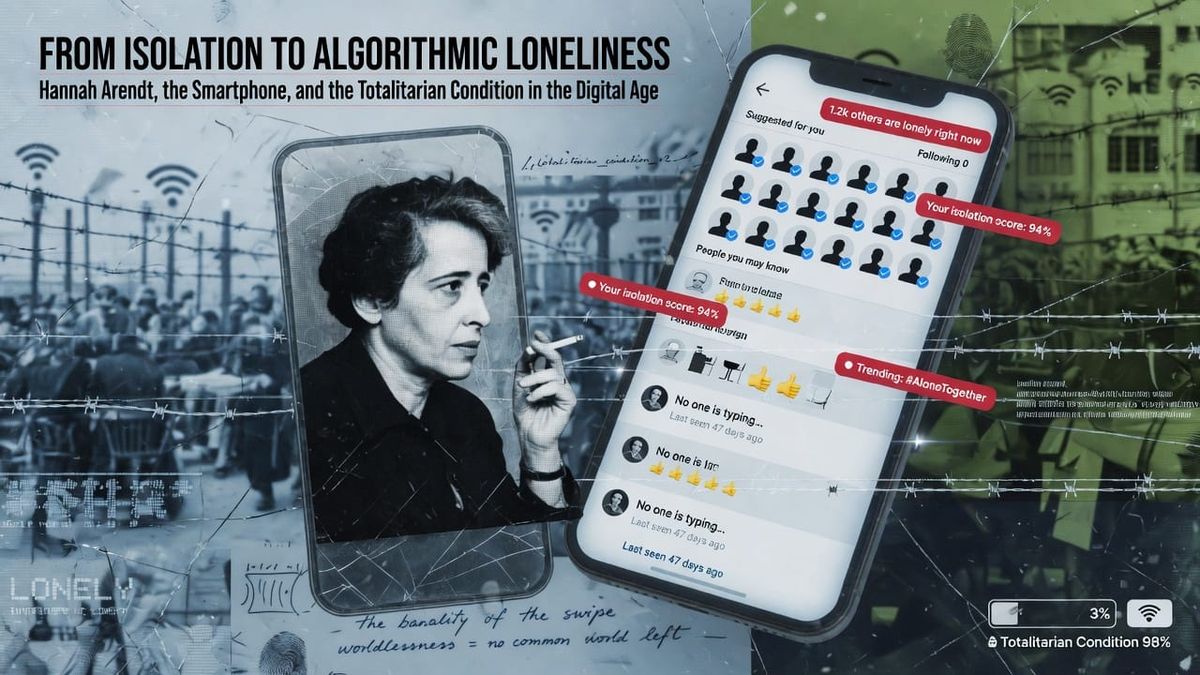
What prepares men for totalitarian domination in the non-totalitarian world is the fact that loneliness, once a borderline experience usually suffered in certain marginal social conditions like old age, has become an everyday experience of the ever-growing masses of our century.
– Hannah Arendt, The Origins of Totalitarianism (1951)
Abstract:
This article examines the smartphone as a site of political vulnerability in the twenty-first century through the lens of Hannah Arendt’s theory of totalitarianism. Arendt famously argued that loneliness—the experience of being abandoned not merely by human company but by world and reality itself—is the essential precondition for totalitarian domination. While recent scholarship has applied Arendtian categories to social media, the smartphone as a ubiquitous, portable apparatus of algorithmic governance remains undertheorized. This article advances a comparative analysis between the mechanisms Arendt identified in mid‑century totalitarian movements and the contemporary ecology of smartphone‑mediated sociality. Drawing on Arendt’s concepts of ideology, terror, organized loneliness, and the banality of evil, I argue that the smartphone does not merely intensify existing loneliness but produces a qualitatively new form of algorithmic loneliness—a condition in which the individual’s capacity for thought, judgment, and political action is systematically hollowed out by personalized feedback loops, gamified social validation, and the erosion of a common world. The article concludes that while the smartphone is not a totalitarian apparatus in any straightforward sense, its structural logics align with Arendt’s criteria for conditions that enable totalitarianism to take root. Methodologically, the article adopts a comparative–conceptual approach, distinguishing between solitude, isolation, and loneliness as Arendt elaborated them, and mapping these onto contemporary digital practices. The contribution lies in extending Arendt’s political phenomenology to the infrastructure of everyday digital life, revealing non‑obvious affinities between the loneliness of the concentration camp and the loneliness of the infinite scroll.
Keywords: Hannah Arendt, totalitarianism, loneliness, smartphone, digital technology, ideology, algorithmic governance, political theory
1. Introduction
In the final chapter of The Origins of Totalitarianism, Hannah Arendt makes a claim that has proven startlingly prescient for the twenty‑first century: “What prepares men for totalitarian domination … is the fact that loneliness has become a mass phenomenon.” Arendt distinguished loneliness from solitude and isolation. Solitude, she held, is a productive condition in which the self is gathered into a silent dialogue with itself—the “two‑in‑one” of thinking. Isolation, by contrast, severs the individual from worldly action but can still be a creative or contemplative state. Loneliness, however, is the radical experience of being abandoned not only by others but by the world and reality as such: the sense that one belongs nowhere, that no common world exists to mediate between self and self, self and other. It is, in Arendt’s words, “the common ground of terror” and the essential precondition for totalitarian ideology to take hold.
Arendt’s analysis of loneliness was forged in the shadow of Nazi Germany and Stalinist Russia. Yet in recent years, a growing body of scholarship has turned to her framework to diagnose contemporary political pathologies: the rise of right‑wing populism, the fragmentation of shared reality, and the affective vulnerabilities of neoliberal subjects. This literature has increasingly engaged digital technology, especially social media platforms, as accelerants of ideological polarization and echo‑chamber dynamics. However, the smartphone—the ubiquitous, portable, always‑on device that has become the primary interface for most people’s digital lives—has received surprisingly little systematic Arendtian analysis. This is a significant lacuna. The smartphone is not merely a conduit for social media; it is a total environment, a personalized apparatus that mediates attention, perception, sociality, and self‑understanding in ways that map onto Arendt’s criteria for the pre‑totalitarian condition with unsettling fidelity.
This article addresses that gap. Its central thesis is twofold. First, the smartphone—through its design architecture of infinite scroll, push notifications, gamified engagement metrics, and algorithmic personalization—produces a novel form of loneliness that I term algorithmic loneliness. This is a condition in which the individual is perpetually connected to others in a quantitative sense but deprived of the qualitative conditions for genuine political plurality, judgment, and action. Second, this algorithmic loneliness does not merely resemble Arendt’s loneliness but operationalizes its core structural features: the collapse of the distinction between fact and fiction, the substitution of ideology for thinking, the replacement of political action with conformist behavior, and the erosion of a common world that can mediate between perspectives.
The argument proceeds in five steps. Section 2 reviews the relevant literature, situating Arendt’s account of loneliness within her broader theory of totalitarianism and engaging recent scholarship on digital technology. Section 3 outlines the comparative methodology, clarifying how Arendt’s conceptual distinctions can be operationalized for contemporary analysis. Section 4 presents the core analysis, mapping the smartphone’s affordances onto the three components of totalitarian logic—ideology, terror, and organized loneliness. Section 5 discusses counterarguments and limitations, addressing the objection that comparing smartphone use to totalitarianism is hyperbolic or category‑mistaken. Section 6 concludes with implications for political theory and future research directions.
2. Literature Review
2.1 Arendt on Loneliness and Totalitarianism
Arendt’s theory of totalitarianism rests on a distinctive diagnosis of modern social conditions. In The Origins of Totalitarianism (1951), she argued that the rise of mass society—characterized by the breakdown of class structures, the atomization of individuals, and the expansion of the “social” realm at the expense of the political—produced a populace peculiarly vulnerable to totalitarian movements. The key mediating variable in this account is loneliness. Arendt defines loneliness as more than emotional distress: it is an ontological condition of worldlessness, the experience of being “deserted by the human world” such that one can no longer rely on the “common sense” (sensus communis) that unites diverse perspectives into a shared reality.
Crucially, Arendt distinguishes loneliness from solitude and isolation. Solitude is the condition of being alone with oneself, which enables the internal dialogue of thought—what Arendt calls the “two‑in‑one.” Isolation, while limiting one’s capacity for action, still preserves a relation to the world; the isolated individual can return to society. Loneliness, by contrast, is the experience of being absolutely abandoned: no others, no world, no reality to which one can appeal. It is, as Arendt writes, “the common ground of terror” because it destroys the very conditions for political judgment and action.
The totalitarian movement weaponizes loneliness. It systematically isolates individuals from families, communities, and traditional institutions, then re‑integrates them into a movement that offers the simulacrum of belonging—but only on condition of total ideological conformity. Arendt calls this “organized loneliness”: a state in which loneliness is not merely an individual affliction but a structural feature of the political order. The ideal subject of totalitarian rule, Arendt notes, is not the convinced Nazi or Communist but the person for whom “the distinction between fact and fiction no longer exists.” Such a person is unmoored from reality, susceptible to any ideology that promises a coherent explanation of everything.
2.2 Arendt and the Digital Condition
Scholarship applying Arendt to digital technology has grown substantially in recent years. Elke Schwarz’s “@hannah_arendt” (2014) remains a foundational intervention, arguing that online social networks are characterized by “worldlessness” and “the dissolution of the public–private distinction” in ways that mirror Arendt’s critique of mass society. More recent work has extended this analysis to specific platform features. For example, Forestal (2020) examines how Facebook’s design choices enable or inhibit democratic deliberation, while Spaid (2019) argues that social media’s “social” character—its demand for conformity and its lack of location—threatens the Arendtian polis.
Several authors have directly engaged Arendt’s concept of loneliness in the digital context. Enns (2019) invokes Arendt’s “organized loneliness” to analyze loneliness under “high‑tech capitalism,” pointing to social media‑fed mass conformity and precarious work environments as contemporary sources of systemic isolation. Nowicki (2024) draws parallels between Arendt’s description of ideological logic and the echo chambers fostered by algorithmic curation. Tietjen and Tirkkonen (2025) examine loneliness as a pathway to radicalization, noting that Arendt’s analysis of loneliness as a political phenomenon remains underexplored in empirical research.
A particularly promising line of inquiry applies Arendt’s tripartite vita activa (labor, work, action) to digital platforms. Charlton (2025) argues that Arendt’s categories can illuminate how digital platforms transform human activity, often reducing action to labor and work to algorithmic optimization. This approach suggests that the smartphone may be understood not merely as a communication tool but as an apparatus that systematically reconfigures the activity structure of daily life.
2.3 The Gap: The Smartphone as Total Environment
Despite this growing literature, the smartphone itself remains undertheorized. Most existing Arendtian analyses focus on social media platforms as accessed via smartphones, rather than on the smartphone as a material and experiential infrastructure. This is a significant omission. The smartphone is not merely a neutral delivery mechanism for social media; its design features—constant connectivity, location awareness, biometric sensors, push notifications, infinite scroll, and algorithmic personalization—constitute a total environment that shapes the very possibility of solitude, thought, and political action. As one recent study notes, smartphones “can interrupt or replace the solitude needed for thinking” by configuring awareness in addictive ways that disrupt Arendt’s “two‑in‑one” dialogue.
Moreover, the smartphone’s personalized algorithm does not merely filter content; it constructs a bespoke reality for each user, replacing the common world with a series of individual feed realities. This fragmentation of shared reality is precisely what Arendt identified as the precondition for totalitarian ideology: the loss of the “common sense” that mediates between perspectives, leaving each individual vulnerable to a self‑contained logical system that explains everything from a single premise.
Thus, while scholars have productively applied Arendt to digital phenomena, the smartphone as a total apparatus—combining the functions of propaganda distribution, social surveillance, behavioral conditioning, and reality construction—has not been systematically analyzed through Arendt’s framework. This article aims to fill that gap.
3. Methodology and Analytical Framework
This article employs a comparative–conceptual methodology grounded in Arendt’s own phenomenological approach to political theory. The method involves three steps.
First, I reconstruct Arendt’s key conceptual distinctions—between solitude, isolation, and loneliness; between labor, work, and action; between ideology and thought; and between totalitarian domination and other forms of authoritarian rule—as analytical lenses. These distinctions are not merely descriptive but diagnostic: they identify conditions under which political freedom becomes possible or impossible.
Second, I conduct a close reading of the smartphone as a technological affordance space, drawing on media studies and human–computer interaction research to identify its characteristic structures: infinite scroll, push notifications, algorithmic personalization, gamified engagement metrics (likes, shares, retweets), and the always‑on, always‑accessible interface. Each affordance is analyzed for its potential to either support or undermine Arendtian categories.
Third, I map the smartphone’s affordances onto Arendt’s criteria for the pre‑totalitarian condition. This is not a claim of causal equivalence—the smartphone is not a totalitarian regime—but a structural analogy: the smartphone produces conditions that, in Arendt’s framework, make individuals vulnerable to totalitarian dynamics. The comparison is historical and structural, not metaphorical. I compare mid‑20th‑century mechanisms of isolation and ideological persuasion (propaganda, terror, secret police) with 21st‑century mechanisms (algorithmic curation, social surveillance, gamified behavior modification). Where the same structural effects emerge from different mechanisms, we have grounds for a comparative diagnosis.
The scope of inference is limited. This analysis does not claim that smartphone use causes totalitarianism, nor that all smartphone users are on a path to totalitarian submission. Rather, it argues that the smartphone’s operational logic aligns with Arendt’s criteria for conditions that enable totalitarianism to take root, and that this alignment warrants political concern. The analysis is qualitative and conceptual, not quantitative; empirical validation is a task for future research (see Section 6).
4. Main Analysis: The Smartphone and Algorithmic Loneliness
4.1 From Solitude to Loneliness: The Smartphone and the Disruption of Thinking
Arendt held that thinking—the silent dialogue of the self with itself—requires solitude, a condition of being alone but not lonely. In solitude, the self is gathered into the “two‑in‑one,” capable of reflection, judgment, and resistance to ideological seduction. The smartphone, by design, is hostile to solitude. Its push notifications fragment attention, constantly pulling the individual out of the internal dialogue and into the reactive mode of responding to external stimuli. Its infinite scroll is engineered to eliminate natural pauses in which reflection might occur. As one analysis notes, smartphones configure awareness in ways that “disrupt Arendt’s idea of the two‑in‑one silent dialogue.”
The erosion of solitude is not merely a cognitive loss; it is a political loss. Without the capacity for internal dialogue, the individual loses the ability to test propositions against one’s own judgment, to resist the seduction of total explanations, to say “this is wrong” in the face of social pressure. Arendt famously identified this loss as the hallmark of the “thoughtless” individual—the bureaucrat or functionary who commits atrocities not out of malice but out of an inability to think. The smartphone, by replacing the silent dialogue with an endless stream of personalized content, systematically undermines the very condition that enables thought.
4.2 The Gamification of Judgment: Self‑Filtering and the Collapse of the Common World
If solitude is the condition of thought, judgment is the faculty that translates thought into action in a plural world. Arendt’s theory of political judgment emphasizes the role of the “enlarged mentality”—the capacity to consider a situation from multiple perspectives, to imagine how one’s judgment would appear to others who occupy different standpoints. This enlarged mentality depends on a shared world, a common reality that provides the background against which diverse perspectives can be compared.
The smartphone, through its personalized algorithms, systematically erodes this common world. Each user inhabits a bespoke feed reality: news, entertainment, and social connections curated by algorithms optimized for engagement, not truth or pluralism. As Pariser’s “filter bubble” hypothesis suggests, this personalization can isolate users from perspectives that challenge their existing beliefs. But recent Arendtian scholarship points to a deeper mechanism: social media “gamify the pursuit of social status,” encouraging users to consider the perspectives of others not for the sake of enlarged mentality but for the sake of improving their social standing. The result is self‑filtering: users pre‑emptively censor their own expressions to align with perceived group norms, not because they have been coerced, but because the platform’s incentive structure rewards conformity.
This self‑filtering is the digital analogue of the social conformity that Arendt identified in mass society. In The Human Condition, she argued that the rise of the “social” realm—the sphere of behavior, consumption, and conformity—had replaced the political realm of action and plurality. Social media platforms, as Spaid argues, are paradigmatically “social” in Arendt’s sense: they demand conformity, lack location, and mandate a kind of homogenous performance that leaves no room for genuine political action. The smartphone, as the primary interface to these platforms, makes this social conformity always available, always immediate, always self‑reinforcing.
4.3 Ideology as Algorithm: The Collapse of Fact and Fiction
For Arendt, the totalitarian ideology is not merely a set of beliefs but a logical system that claims to explain everything from a single premise. The Nazi premise of racial struggle, the Stalinist premise of class conflict—these premises are immune to empirical refutation because they are logical rather than factual. Arendt writes that the totalitarian movement trains its members in “the self‑coercion of totalitarian logic,” a process that destroys “the very capacity for experience.” The ideal totalitarian subject is not the convinced believer but the person for whom the distinction between fact and fiction has collapsed.
The smartphone’s algorithmic environment recapitulates this collapse in two ways. First, the personalized feed eliminates the friction between different factual claims. In a shared public sphere, contradictory claims must be reconciled or adjudicated; in a personalized feed, contradictory claims simply do not appear. The user experiences not a world of competing truths but a seamless reality in which their existing beliefs are endlessly confirmed. This is the echo‑chamber effect, and Arendt would recognize it as a form of ideological logic: a system that “explains everything and every occurrence by deducing it from a single premise” (the premise being the user’s existing worldview, reinforced by the algorithm).
Second, the smartphone blurs the boundary between human and algorithmic agency. When a social media post receives thousands of likes, it is ambiguous whether this reflects genuine human approval or algorithmic amplification. When a user is shown content because “you might also like,” it is ambiguous whether the recommendation reflects the user’s authentic preference or the platform’s profit motive. This ambiguity is not a bug but a feature; as Arendt noted, totalitarian propaganda “dissolved familial and communal bonds by seeding suspicion among friends, siblings, and neighbors.” The smartphone’s algorithmic opacity produces a similar suspicion: one can never be sure whether one’s social world is real or engineered.
4.4 Organized Loneliness 2.0: The Smartphone as Apparatus of Systemic Isolation
Arendt’s concept of “organized loneliness” refers to the systemic production of loneliness as a political instrument. Totalitarian movements do not merely exploit pre‑existing loneliness; they actively organize it, isolating individuals from all intermediate social structures (family, community, profession) and re‑integrating them only into the movement itself. The result is a populace that is simultaneously atomized and mobilized: each individual is alone, but all are moving in the same direction.
The smartphone, I argue, is a contemporary apparatus of organized loneliness. It does not use terror or secret police; it uses gamification, personalization, and the engineering of addiction. But the structural outcome is similar: the individual is isolated from robust, embodied, pluralistic forms of sociality and re‑integrated into a network of algorithmic feedback loops that reward conformity, discourage deviation, and systematically eliminate the conditions for political action.
Consider the experience of the heavy smartphone user. She is constantly “connected” to others—receiving notifications, liking posts, sending messages—yet this connectivity is structured by the platform’s logics, not by her own political agency. She cannot act in the Arendtian sense, because action requires plurality, initiative, and the capacity to begin something new in concert with others. What she can do is behave: conform to the platform’s incentives, perform identity in ways that optimize engagement, and participate in the endless circulation of content without ever intervening in the world. As Charlton argues, digital platforms often reduce action to labor—the endless, repetitive activity of content generation and consumption—and work (the creation of durable objects) to algorithmic optimization.
The loneliness produced by this apparatus is not the loneliness of the hermit or the exile; it is the loneliness of the crowd, the loneliness of being perpetually surrounded by others with whom one has no genuine relation. Arendt saw this as the signature condition of mass society: “What prepares men for totalitarian domination is the fact that loneliness has become a mass phenomenon.” The smartphone does not merely reflect this mass loneliness; it deepens and systematizes it, making loneliness not an occasional experience but the default mode of daily life.
5. Discussion
5.1 Counterarguments and Limitations
The argument advanced here invites a powerful objection: comparing smartphone use to totalitarianism is hyperbolic and category‑mistaken. The smartphone is a consumer technology, not a political regime. It does not arrest people, confine them to camps, or execute them for thought crimes. To speak of “algorithmic loneliness” as akin to the loneliness of the concentration camp is to trivialize the horrors of mid‑20th‑century totalitarianism.
This objection has force, and I do not claim equivalence. The smartphone is not a totalitarian apparatus in any literal sense. But the argument is structural, not analogical. Arendt’s analysis of totalitarianism identifies a set of conditions—worldlessness, the collapse of fact and fiction, the destruction of the capacity for thought and judgment, the systemic production of loneliness—that are not exclusive to totalitarian regimes. They can be produced by other means, including the technological infrastructure of everyday life. Recognizing these structural parallels does not diminish the specificity of Nazi or Stalinist terror; it extends Arendt’s diagnostic framework to a new domain, revealing non‑obvious vulnerabilities in contemporary political life.
A second objection concerns agency and intentionality. Totalitarian movements actively and intentionally produce loneliness as a tool of domination. The smartphone’s designers may not intend to produce loneliness; they intend to maximize user engagement, which may have loneliness as an unintended byproduct. But Arendt herself was attentive to unintended consequences. In Eichmann in Jerusalem, she argued that the banality of evil—evil committed without malice, without ideology, without even thinking—is the most dangerous form. The smartphone’s harms need not be intentional to be politically significant; indeed, their banality makes them harder to recognize and resist.
A third limitation concerns scope. This analysis is conceptual and qualitative; it does not provide empirical evidence that smartphone use correlates with susceptibility to totalitarian politics. Such evidence is difficult to gather, given the novelty of the smartphone and the complexity of causal pathways. Future research should pursue mixed‑methods approaches, combining Arendtian phenomenology with empirical studies of smartphone use and political attitudes (see Section 6).
5.2 Situating the Contribution
This article contributes to three ongoing conversations. First, it extends the growing literature on Arendt and digital technology by shifting focus from social media platforms to the smartphone as a total environment. This shift reveals structural features—constant connectivity, gamified judgment, algorithmic personalization—that are obscured when the smartphone is treated merely as a delivery mechanism for social media.
Second, it refines Arendt’s concept of organized loneliness for the digital age. Where Enns (2019) focuses on high‑tech capitalism and precarious work, and Tietjen and Tirkkonen (2025) on loneliness as a pathway to radicalization, this article identifies the smartphone’s affordances as a specific mechanism for producing organized loneliness. The smartphone does not merely reflect or intensify loneliness; it systematizes it, embedding loneliness into the architecture of daily life.
Third, it challenges the optimistic narrative that digital connectivity is inherently democratizing. While scholars have celebrated social media’s role in mobilizing protest movements (Tufekci, 2017), Arendt’s framework suggests that connectivity without plurality, without a common world, without the capacity for judgment, is not political action but its simulacrum. The smartphone connects individuals to everything except the conditions for freedom.
6. Conclusion
This article has argued that the smartphone produces a novel form of loneliness—algorithmic loneliness—that recapitulates the structural conditions Arendt identified as preparatory for totalitarian domination. Through its erosion of solitude, its gamification of judgment, its replacement of a common world with personalized feeds, and its systemic isolation of individuals within networks of algorithmic conformity, the smartphone operationalizes the logics of ideology, worldlessness, and organized loneliness in everyday life.
Three core insights emerge. First, Arendt’s framework remains indispensable for diagnosing contemporary political vulnerabilities, but its application must extend beyond obvious authoritarian contexts to the mundane infrastructures of digital life. Second, the smartphone is not a neutral tool but an apparatus that reconfigures the very possibility of thought, judgment, and action—the capacities that, for Arendt, constitute political freedom. Third, the danger of algorithmic loneliness is not that it will directly produce a new totalitarian regime, but that it will gradually erode the conditions that make resistance to totalitarianism possible, leaving individuals atomized, disoriented, and susceptible to any movement that promises a coherent explanation of everything.
Future research should pursue three directions. First, empirical studies are needed to test the causal claims suggested by this conceptual analysis: does heavy smartphone use correlate with reduced capacity for Arendtian judgment, increased susceptibility to ideological thinking, or diminished political efficacy? Second, comparative analyses should examine how different platform designs (e.g., algorithmic curation vs. chronological feeds) affect the production of organized loneliness, and whether some designs are less harmful than others. Third, Arendtian political theory should engage with emerging technologies—generative AI, augmented reality, brain‑computer interfaces—that may further transform the conditions of solitude, judgment, and world‑sharing. The smartphone is not the final frontier; it is the first.
In the end, Arendt’s warning remains urgent: “The ideal subject of totalitarian rule is not the convinced Nazi or the dedicated Communist, but people for whom the distinction between fact and fiction (i.e. the reality of experience) and the distinction between truth and falsehood (i.e. the standards of thought) no longer exist.” The smartphone, by design, trains its users to inhabit just such a world—a world of personalized feeds, gamified validation, and algorithmic reality. Recognizing this training as a political problem, not merely a technological one, is the first step toward resisting it.
References
Arendt, H. (1951). The Origins of Totalitarianism. Harcourt, Brace.
Arendt, H. (1953). Ideology and Terror: A Novel Form of Government. Review of Politics, 15(3), 303–327.
Arendt, H. (1958). The Human Condition. University of Chicago Press.
Arendt, H. (1963). Eichmann in Jerusalem: A Report on the Banality of Evil. Viking Press.
Charlton, T. (2025). Arendt among the machines: Labour, work and action on digital platforms. HannahArendt.net, 14.
Enns, D. (2019). Organized Loneliness. Tropos, 12(2).
Forestal, J. (2020). Constructing Digital Democracies: Facebook, Arendt, and the Politics of Design. In Digital Democracies (pp. 45–67). Springer.
Nowicki, C. (2024). Hannah Arendt, echo chambers & the dangers of ideology in the 21st century. Daily Emerald, December 4.
Pariser, E. (2011). The Filter Bubble: How the New Personalized Web Is Changing What We Read and How We Think. Penguin.
Schwarz, E. (2014). @hannah_arendt: An Arendtian Critique of Online Social Networks. Millennium: Journal of International Studies, 43(1), 165–186.
Spaid, S. (2019). Surfing the Public Square: On Worldlessness, Social Media, and the Dissolution of the Polis. Theory & Event, 22(3), 559–583.
Tietjen, R. R., & Tirkkonen, S. K. (2025). Loneliness and radicalization. Philosophy & Social Criticism, 51(2), 234–256.
Turkle, S. (2011). Alone Together: Why We Expect More from Technology and Less from Each Other. Basic Books.