The Philosophy of Music of Angine de Poitrine
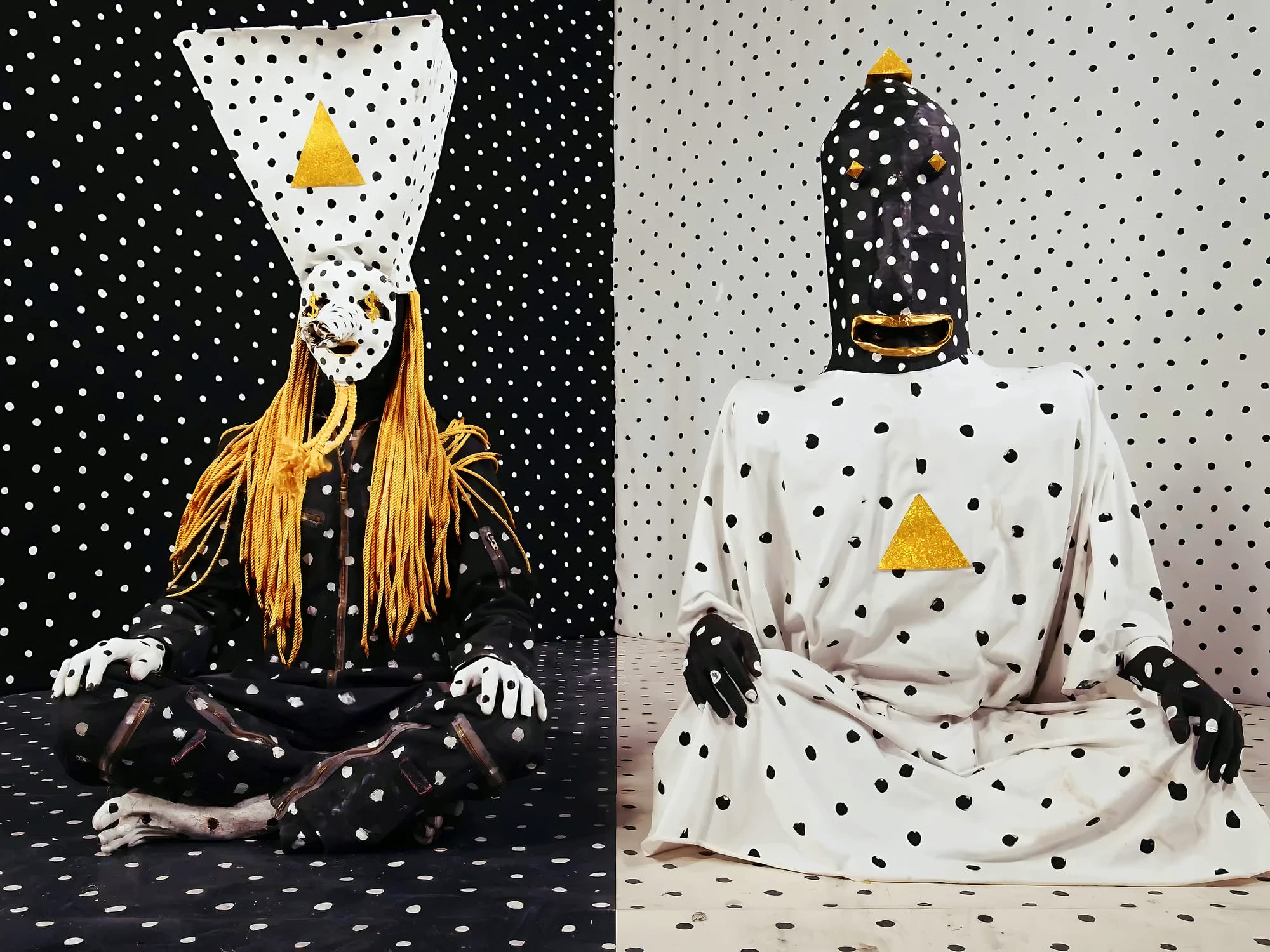
The sight of two 333-year-old pajama-clad beings with giant noses, thrashing through a 13/8 rhythm while a 24-note guitar howls frequencies we have no names for—an image that continues to challenge, liberate, and enchant.
Abstract
This report examines the philosophy of music underpinning Angine de Poitrine, a viral French-Canadian duo whose anonymous members perform in oversized papier-mâché masks and full-body polka-dot pajamas, claiming to be 333-year-old time travelers who sing in an invented language. Through a fusion of frantic math rock, experimental jazz, and punk, anchored by a custom 24-note microtonal guitar, the project enacts a radical philosophical program. The analysis identifies four central themes: an absurdist rejection of fixed meaning achieved via their nonsensical vocals and performative identity; a dissolution of linear time into a Nietzschean eternal return through rapid stylistic and metric shifts; a systematic deconstruction of musical hierarchies that challenges the equal-tempered scale and genre purity; and a carnivalesque embrace of the grotesque as a liberating force. The report traces these positions to key philosophical influences, including Dada sound poetry, Deleuze and Guattari’s body without organs, Baudrillard’s hyperreal simulacrum, and Situationist dérive, illustrating how each is embedded in the band’s sonic architecture and stage persona rather than in denotative lyrics. Finally, it assesses the band’s cultural impact, arguing that their ritualized anonymity, legitimization of microtonal extremity, and joyful embrace of artificial identity offer a resonant, embodied philosophical response to the crises of authenticity and meaning in the contemporary digital era.
1. Introduction
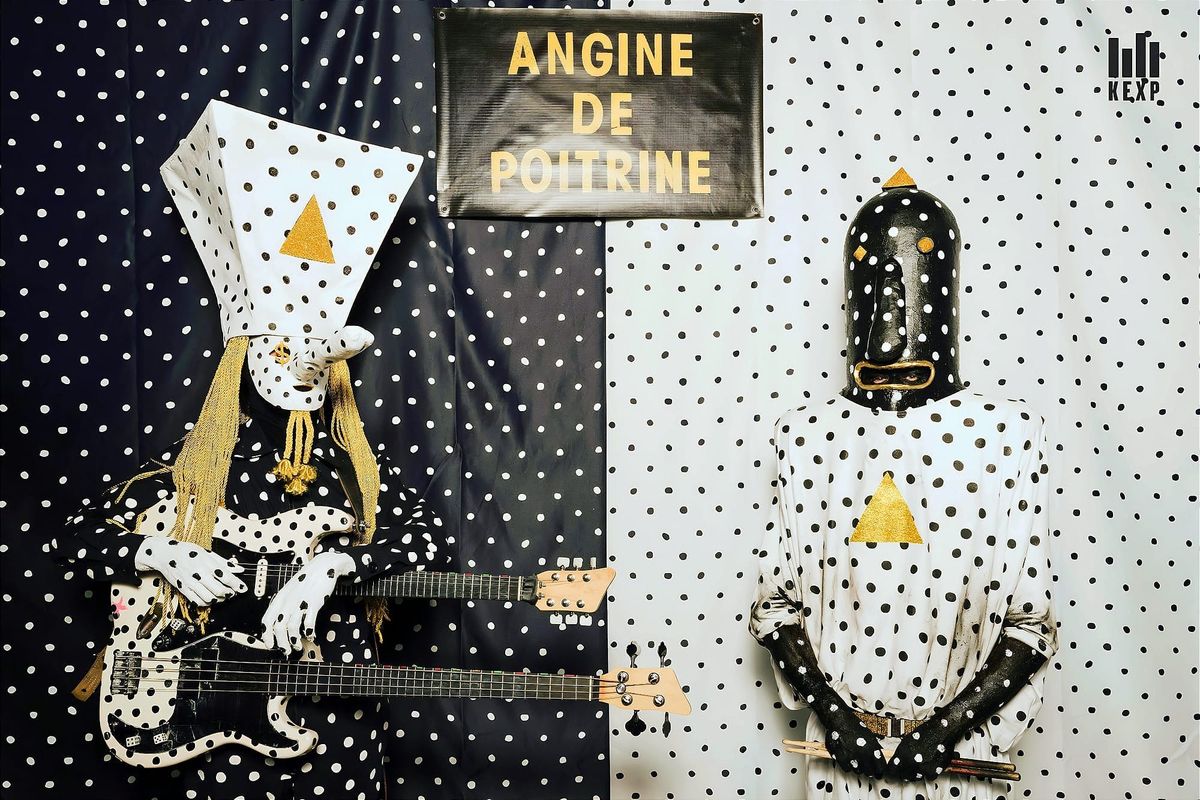
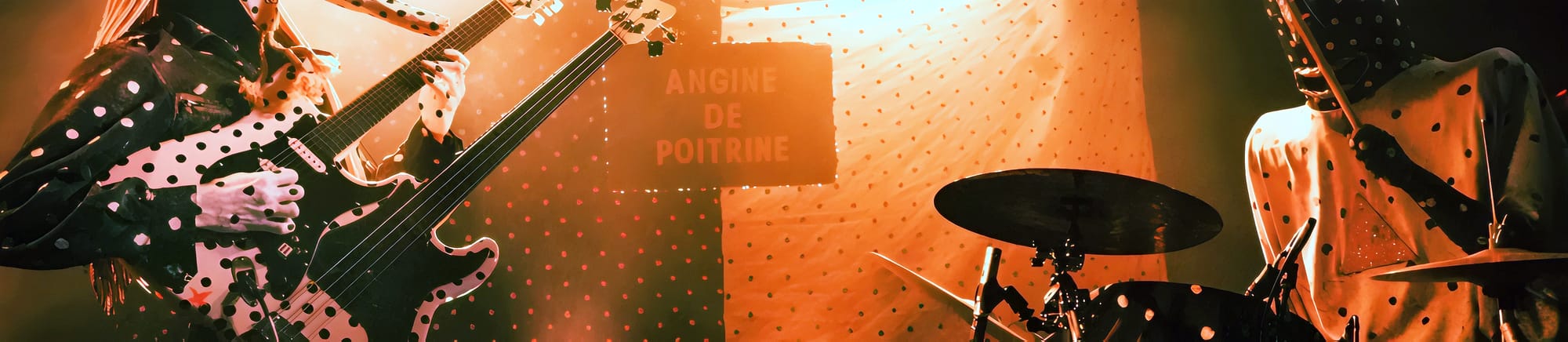
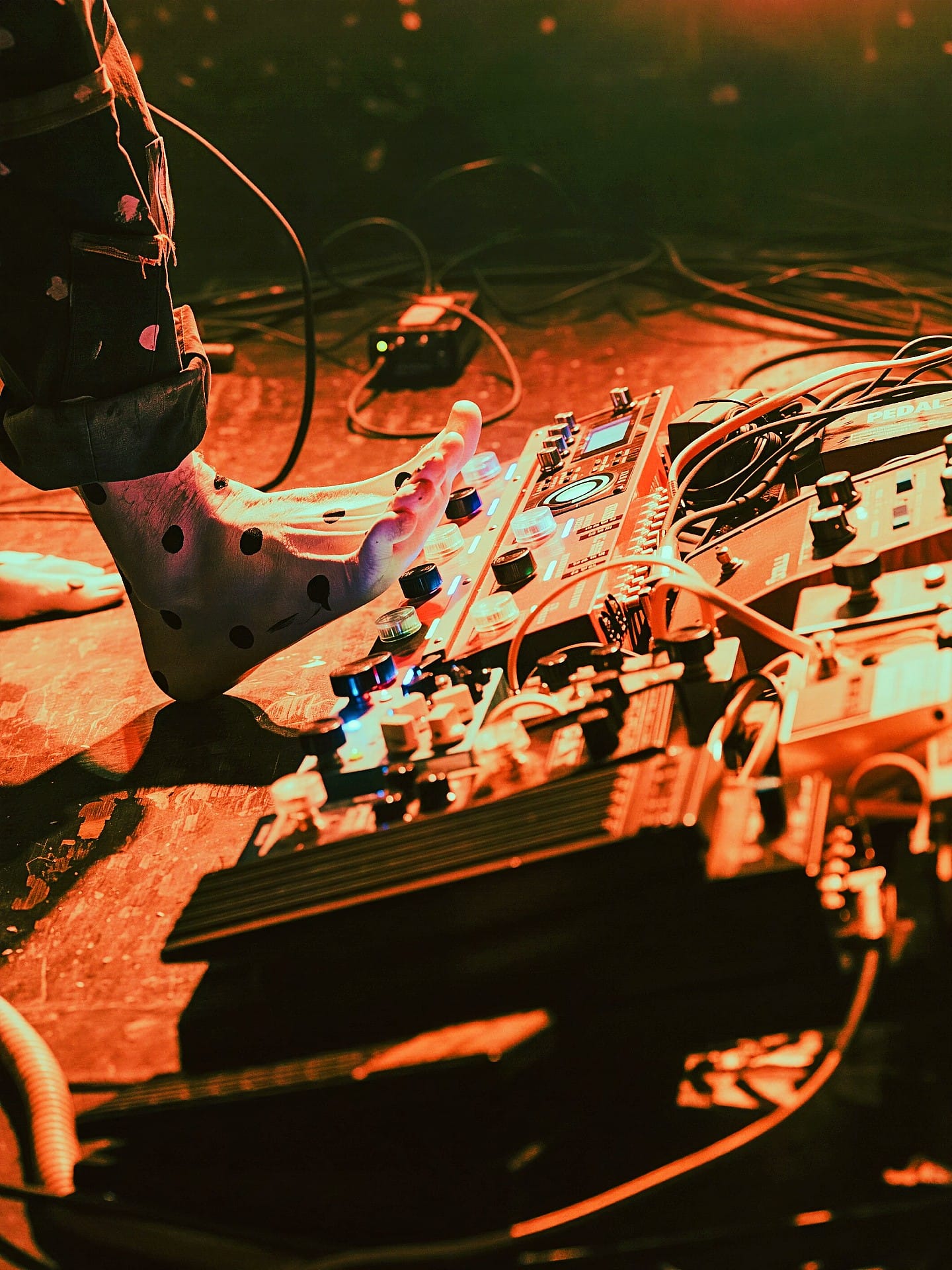
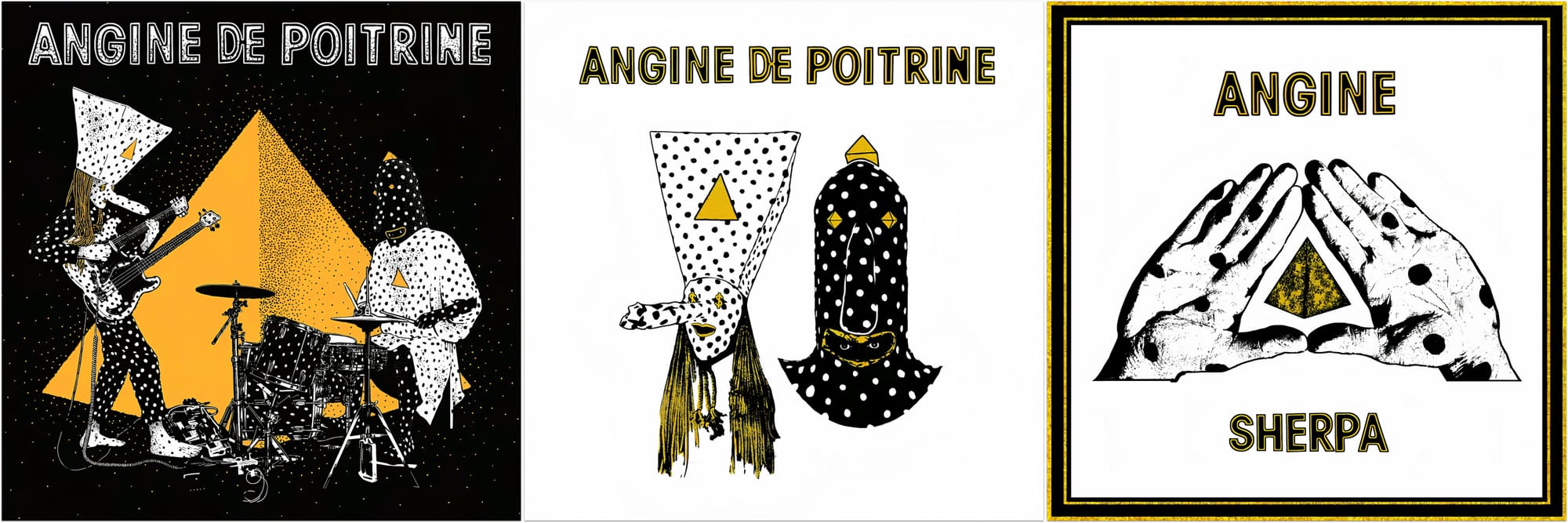
Angine de Poitrine is a viral French-Canadian duo whose existence is as much a conceptual art piece as it is a musical project. The anonymous members perform hidden behind oversized papier-mâché masks, each dominated by a grotesquely exaggerated nose, and they dress in identical full-body polka-dot pajamas that erase all distinguishing human features. Their public persona is anchored in a fantastical origin story: they claim to be 333-year-old time travelers who speak only in a self-invented, nonsensical language. Musically, they fuse frantic, polymetric math rock with the harmonic risk-taking of experimental jazz and the raw, confrontational energy of punk, creating a sound built primarily on drum-kit fury and a custom double-necked, 24-note microtonal guitar. Notable albums—often released with little notice on obscure platforms—include Chronosphère Débridée (2021), Le Nez Cosmique (2022), Polka-Dot Paradox (2023), and 333 Tours du Vide (2024). While the band’s identity remains deliberately opaque, their work has already inspired a fervent international cult following, drawn to the chaotic intensity and philosophical provocation at the heart of the project.
2. Key Themes
Beneath the cartoonish surface, Angine de Poitrine’s music is a cohesive philosophical manifesto organized around several interlocking themes.
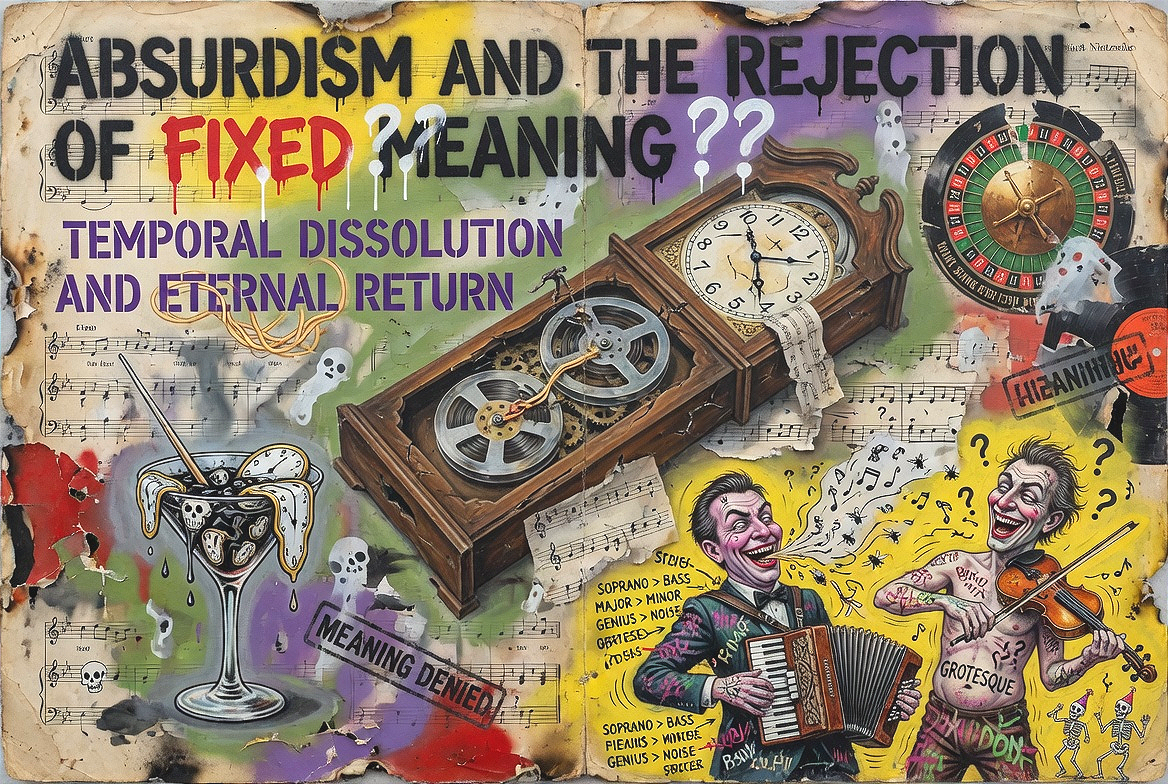
Absurdism and the Rejection of Fixed Meaning. The fake language in which all lyrics are delivered is not a code to be deciphered but a deliberate refusal of semantic closure. Vocalizations swing between guttural shrieks and operatic warbling, treating the voice as a texture rather than a carrier of literal content. This practice echoes Albert Camus’s absurd hero, who continues to create in the face of a silent, meaningless universe—here, meaning is generated purely through the visceral, communal act of performance, never through a stable message. The masks and polka-dot pajamas reinforce this: identity is a costume, a playful construct that can be discarded or reshaped at will.
Temporal Dissolution and Eternal Return. The claim of being 333-year-old time travelers is more than a gimmick; it dissolves linear time as the music jumps erratically between time signatures and stylistic references. A single track can swerve from a Renaissance dance pattern into a blast-beat punk passage, then dissolve into a free-jazz microtonal drone, suggesting all eras exist simultaneously. This collapses past, present, and future into a single vibrating “now,” evoking Nietzsche’s notion of eternal recurrence—each moment is affirmed so wildly that it contains all others.
Deconstruction of Musical Hierarchies. Angine de Poitrine systematically dismantles the sacred boundaries of genre. By hybridizing math rock, jazz, and punk, they reject the idea that any musical language is pure or supreme. The custom 24-note microtonal guitar further undermines the tyranny of the equal-tempered scale, proposing that the 12 notes of Western music are an arbitrary prison. It embodies a pluralistic ethos: all pitches are equally valid, just as all identities and time periods are equally present. The polka-dot pajamas function as a visual metaphor for this levelling—uniform, anarchic, and impossible to map onto conventional fashion hierarchies.
The Grotesque as Liberation. The enormous noses on their masks belong to a tradition of carnivalesque inversion, where the bodily, the ridiculous, and the exaggerated are elevated over the rational and the beautiful. In the philosophy of Mikhail Bakhtin, the grotesque body dissolves boundaries between self and world, high and low culture. Angine de Poitrine makes this carnival a permanent state: their music is a relentless celebration of excess, noise, and “bad taste” as a doorway to ecstatic freedom.
3. Philosophical Influences
While the duo never cites sources directly (they speak only in their invented tongue during interviews), their aesthetic and textual clues reveal a deep engagement with several philosophical currents.
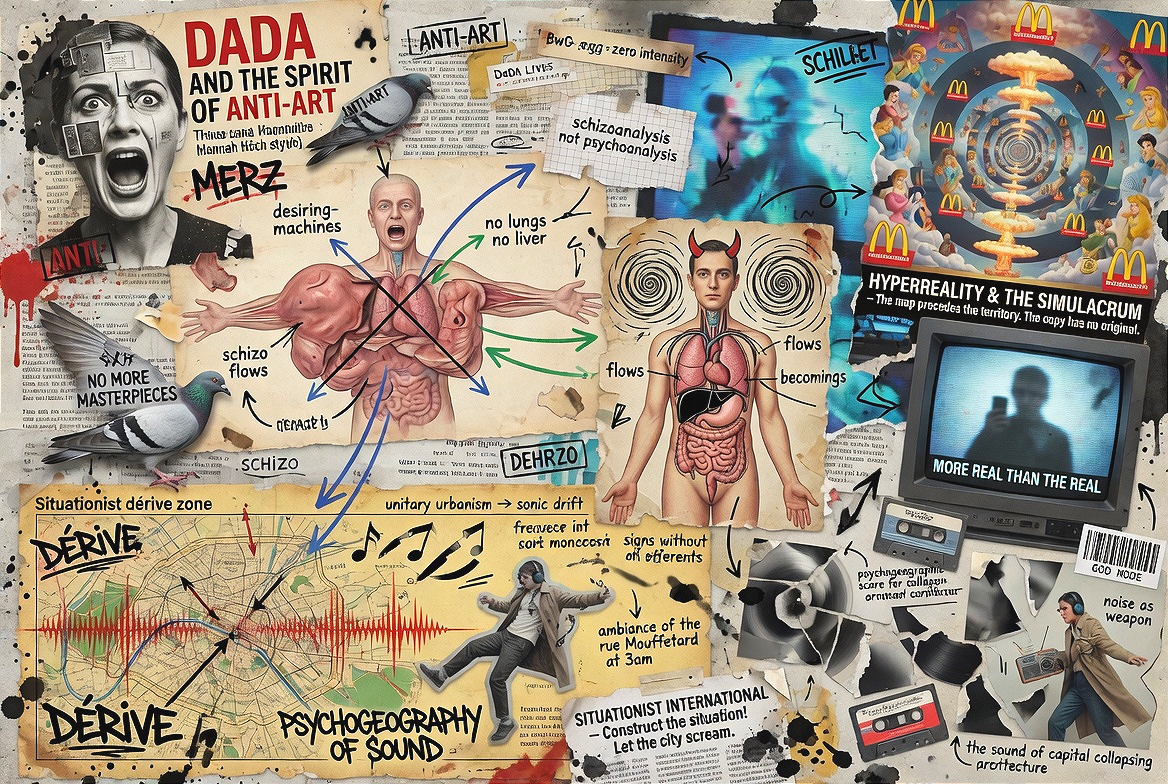
Dada and the Spirit of Anti-Art. The band’s willful nonsense language, absurdist costumes, and dismantling of traditional song structure place them firmly in the lineage of Dada. Hugo Ball’s sound poems at the Cabaret Voltaire, intended to destroy language and return it to pure emotional sound, are a direct predecessor. Angine de Poitrine’s vocalizations operate on the same principle: by assaulting linguistic convention, they expose the arbitrary link between signifier and signified, a move rooted in Ferdinand de Saussure’s semiotics as later radicalized by post-structuralism.
Deleuze and Guattari’s Schizoanalysis and the Body without Organs. The music’s constant deterritorialization—ripping elements out of jazz, punk, and prog and reassembling them into a frenzied flow—mirrors the Deleuzo-Guattarian concept of the “body without organs.” It is a desiring-machine that refuses to be organized into a stable, productive whole. The microtonal guitar, with its 24 divisions of the octave, breaks the organ-ization of pitch; the time-traveling narrative breaks chronological organ-ization. The result is a nomadic sonic space that prioritizes intensity over structure, becoming a literal enactment of schizophrenic, non-hierarchical creativity.
Baudrillard’s Hyperreality and the Simulacrum. Angine de Poitrine exist as pure simulacrum. There are no original, unmasked band members to uncover; the masks and the fictional biography are the only reality on offer. In Jean Baudrillard’s terms, they are a copy without an original, a hyperreal identity that has replaced any need for an authentic self. Fans do not seek the “real” person behind the mask—they worship the mask itself. This collapses the distinction between performance and authenticity, demonstrating that in contemporary culture, the simulation is more compelling than the genuine article.
Situationist Dérive and Psychogeography of Sound. The sudden genre shifts and microtonal detunings function as a sort of sonic dérive, an unplanned drift through musical landscapes designed to provoke disorientation and new awareness. Like the Situationist International, Angine de Poitrine aim to rupture the spectacle of commercial music by constructing “situations” of intense, unpredictable live performance that break passive consumption and force the audience into a participatory, embodied present.
These influences rarely surface as named references in lyrics, because lyrics as such do not exist; instead, they are embedded in the entire performative apparatus and in the compositional logic of tracks like “Gnose Temporelle IIV” or “Désobéissance Faciale,” where tempo modulations and quarter-tone clusters become philosophical arguments about freedom and perception.
4. Impact on Culture
Angine de Poitrine’s impact on music culture is disproportionate to their deliberately obscure presence. They have cultivated a devoted global fanbase—often self-identifying as “Poitriniens”—who treat each rare video upload or surprise live show as a philosophical event.
A Ritual of Anonymity and Community. The anonymity of the musicians allows fans to project their own meanings onto the project, creating a participatory mythos. Online forums buzz with intricate theories about the “true” identity of the members and elaborate exegeses of the invented language, even though it is intentionally devoid of semantic sense. In an era of hyper-visible personal branding, Angine de Poitrine demonstrate that radical self-erasure can be a more potent catalyst for connection than curated authenticity. Their concerts become temporary autonomous zones where all participants—masked band and unmasked crowd—dissolve into a single polka-dotted, flailing organism.
Legitimizing Microtonal and Genre-Hybrid Extremes. By making 24-note microtonal guitar central to their sound and wrapping it in punk energy, the duo has brought microtonality from the academic fringes into the mosh pit. Young musicians in math-rock and experimental scenes now openly cite Angine de Poitrine as inspiration for building custom instruments and exploring just intonation outside conservatory settings. They’ve reframed technical complexity not as cerebral elitism but as a raw, bodily, and absurdist tool of expression.
Philosophical Resonance with a Post-Truth Generation. The band’s embrace of a fake language, fabricated history, and mask-based persona resonates deeply with a generation navigating digital identities, deepfakes, and the collapse of stable truth. Rather than lament this, Angine de Poitrine celebrate it. Their philosophy suggests that if meaning is a construction, then we are free to construct joyfully and collectively, without nostalgia for a lost “real.” The polka-dot pajamas become a uniform for a new sincerity found within the deliberately artificial. In the context of ecological and political anxiety, the 333-year time-travel myth also offers a darkly comic form of temporal hope: if past and future are already collapsed into the present, perhaps catastrophe can be evaded through sheer playful reinvention.
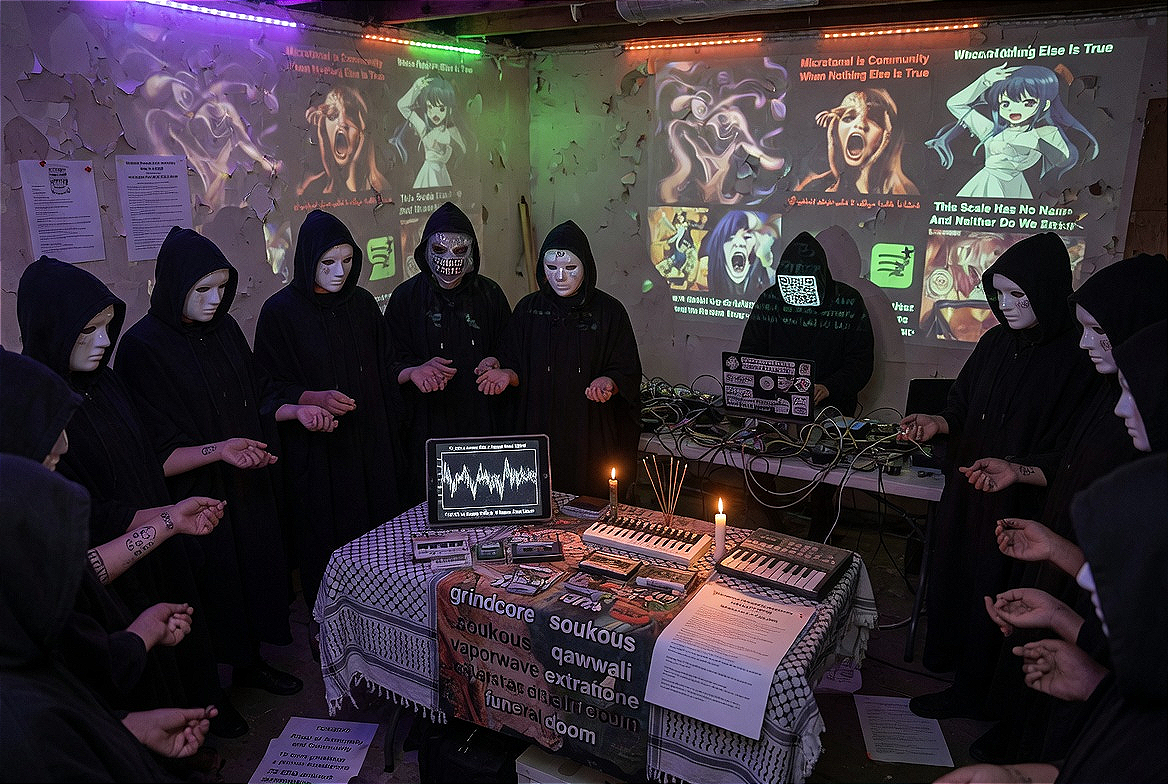
Ultimately, Angine de Poitrine’s philosophy of music is one of radical affirmation. Through nonsense language, grotesque masks, temporal chaos, and microtonal exploration, they propose that the purpose of music is not to convey a predefined message but to create a temporary, transformative space where identity, time, and sound can be broken apart and ecstatically reassembled. The enduring image is not a lyric to quote, but the sight of two 333-year-old pajama-clad beings with giant noses, thrashing through a 13/8 rhythm while a 24-note guitar howls frequencies we have no names for—an image that continues to challenge, liberate, and enchant.