1860 – The Vibe in America: The Splitting Season
America in 1860 was a house divided against itself not by a line on a map but by a fissure in the very definition of humanity, and every citizen walked through the year as if across a floor they could hear splintering beneath the carpet.
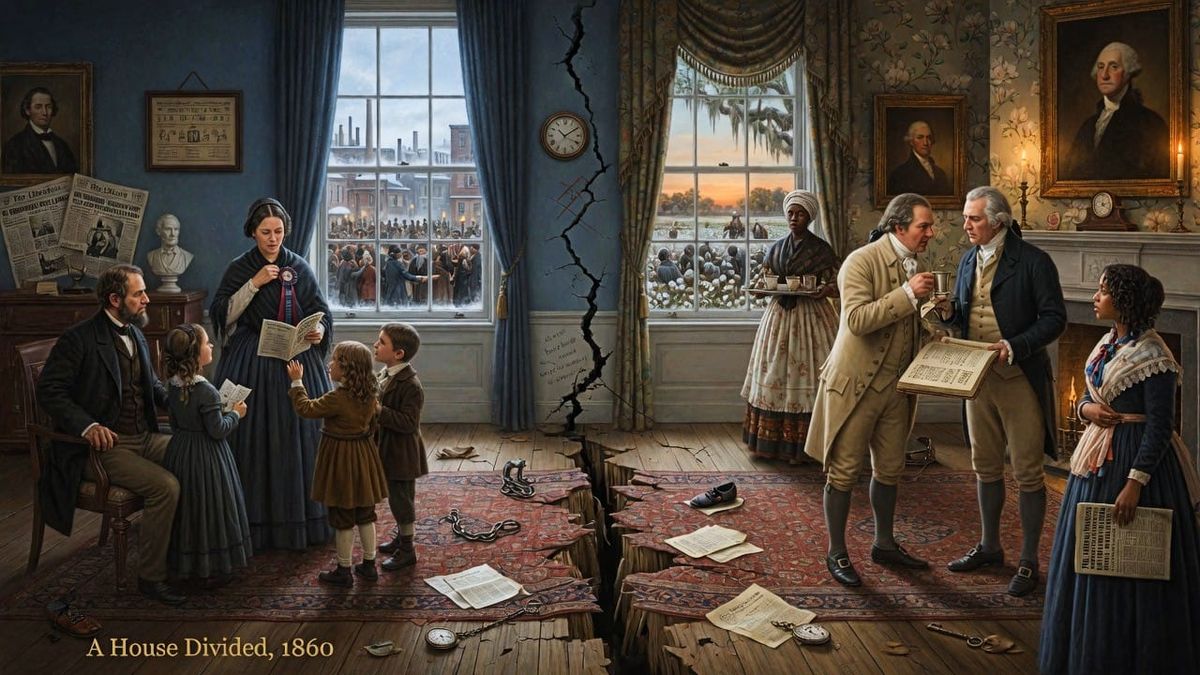
The year 1860 does not unfold; it tightens. To be alive in the United States during these twelve months is to feel the entire republic being winched toward a snapping point, the fibers of common cause popping one by one like the strands of a rope under too much strain. The national mood is not debate, not deliberation, not even dread—it is a wild, careening acceleration toward a cliff, and half the country seems to want to leap just to feel a different sensation than the waiting. Every conversation is a lit match held to a curtain. Every newspaper editorial reads like a declaration of war on its readers' neighbors. The Union is still legally intact, but psychologically it has already shattered into two, three, four shards, and no one can agree on the shape of the pieces.
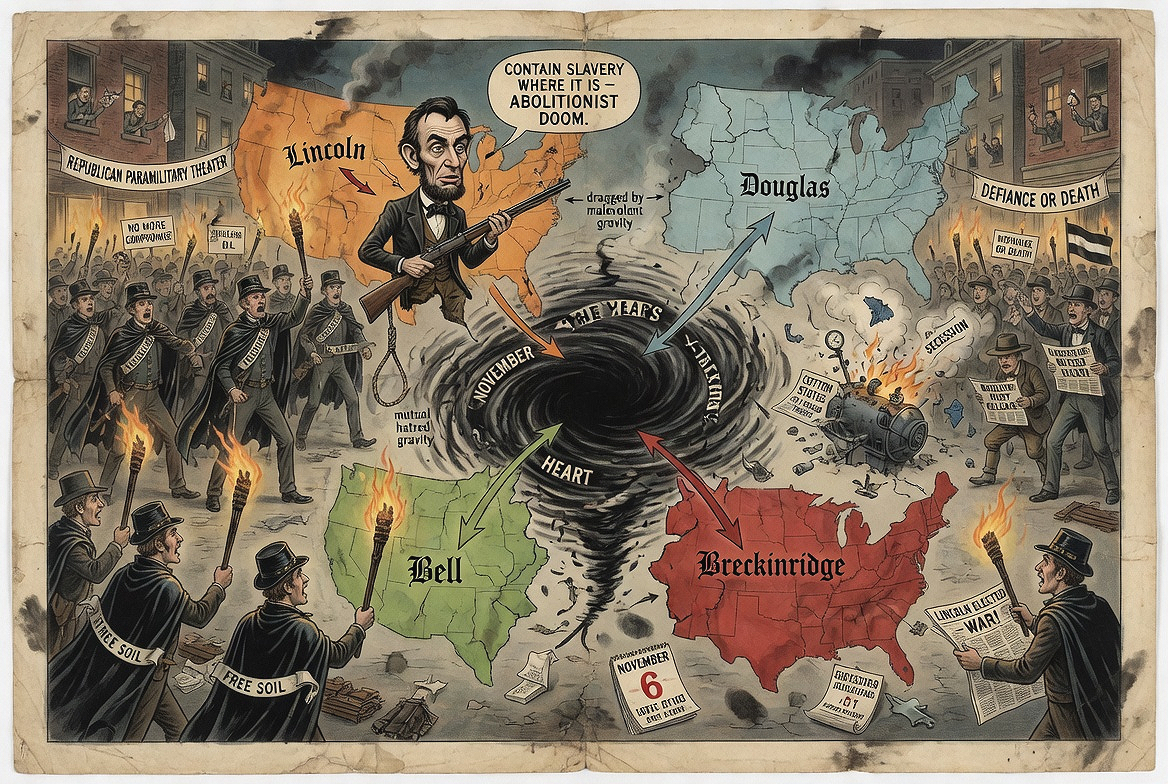
The election in November is the year’s black heart, the event toward which all other events are dragged as if by a malevolent gravity. Four candidates fracture the vote into a map of mutual hatred. Abraham Lincoln, a lanky Illinois lawyer with a face the cartoonists caricature as a baboon’s and a voice the South hears as the rasp of abolitionist doom, runs on a platform that merely seeks to contain slavery to where it already exists—and this moderation is taken as a declaration of war. He does not campaign for himself; that is not done. Instead, "Wide Awake" clubs of young Republican men march in torchlit parades through Northern cities, wearing oilcloth capes and carrying rails on their shoulders, a paramilitary theater of enthusiasm that is half carnival and half threat. In the South, the mere possibility of a Lincoln victory triggers a cascade of panic and defiance. The cotton states have been threatening secession for a decade, but now the threat has the feel of an engineering inevitability, a boiler pressure that must release.
Stephen Douglas, the Little Giant, crisscrosses the country on trains, delivering his own speeches in a ragged, exhausted voice, his doctrine of popular sovereignty—let the territories decide—now a middle ground that pleases no one. John Breckinridge carries the banner of the Deep South's unapologetic demand for slavery's perpetual expansion. John Bell, the Constitutional Union candidate, runs on a platform of saying nothing, a desperate wager that silence might heal. The vote in November is not an election; it is a census of irreconcilable worldviews. When Lincoln wins with a mere thirty-nine percent of the popular vote, all of it Northern, the South reads its own future in the numbers like a tea-leaf prophecy: you are a permanent minority. On December 20, South Carolina secedes by a unanimous vote in a Charleston hall festooned with bunting, and the calendar becomes a countdown clock.
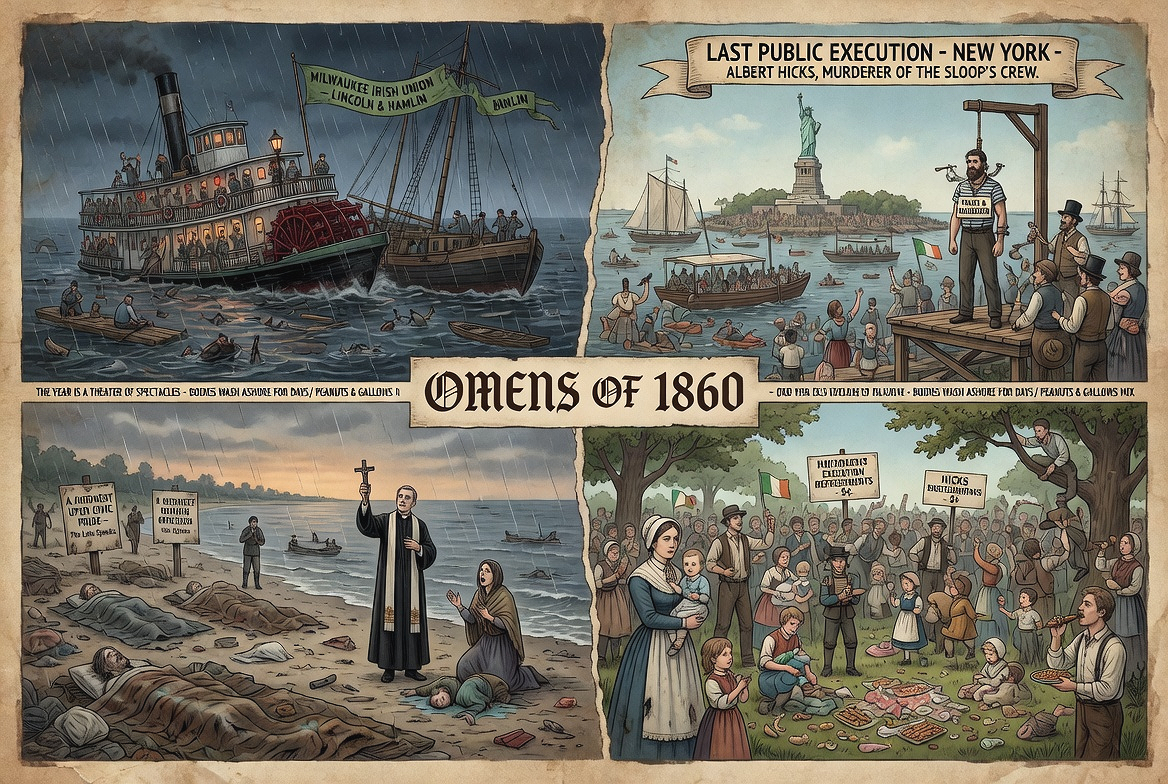
But before this political earthquake, the year is already a theater of spectacles that feel like omens. In September, the Lady Elgin, a passenger steamer packed with Milwaukee’s Irish Union Guard returning from a political rally, collides with a lumber schooner on Lake Michigan and sinks in a squall, drowning over three hundred people. The bodies wash ashore for days, and the tragedy is read in sermons as a judgment, a dark parable of civic pride meeting the cold indifference of the water. In New York, a man named Albert Hicks is hanged in July before a crowd of thousands on Bedloe’s Island—the last public execution in the city—for the brutal murder of a ship’s crew, and the spectacle draws a mob of picnicking families. The ghoulishness of the event, the mingling of peanuts and gallows, speaks to a nation that has grown intimate with violence as entertainment.
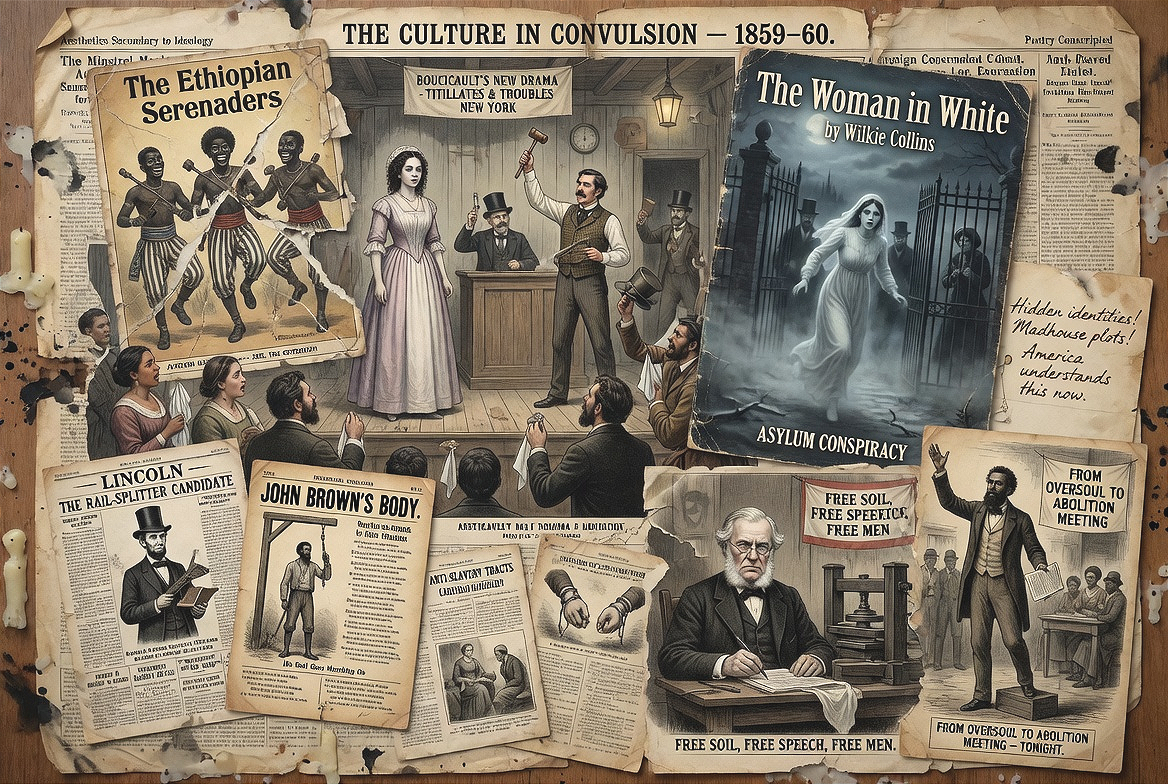
That entertainment is itself in the throes of a painful, pregnant transformation. The minstrel show still reigns, but its grinning masks are cracking. Dion Boucicault’s The Octoroon, a melodrama about a mixed-race woman sold into slavery, opens in New York and both titillates and troubles audiences with its frank, sentimental treatment of the auction block. The novel of the year is not American but British—The Woman in White by Wilkie Collins—but its sensation-fiction paranoia, its sense of hidden identities and madhouse conspiracies, finds a ready readership in a country that no longer trusts appearances. The true American bestsellers are the campaign biographies of Lincoln, the broadside ballads about John Brown, the pamphlets and tracts that flood the mails. The culture is all argument; aesthetics are secondary to ideology. Even poetry is conscripted: William Cullen Bryant edits the Evening Post as a Republican organ, and the transcendentalists who once sought the oversoul now find themselves organizing anti-slavery meetings.
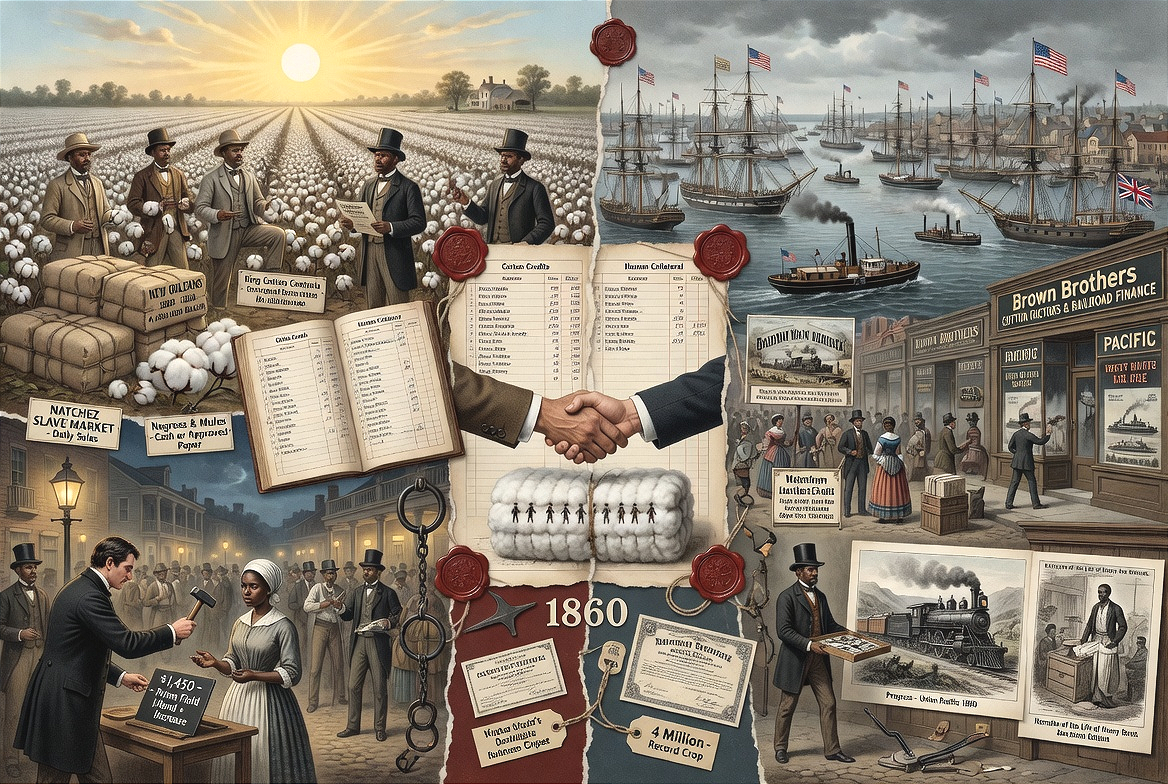
The economy of 1860 is a paradox of surging prosperity and structural terror. Cotton is still the engine, and the engine is running hotter than ever: the South exports four million bales this year, a record, and the planters’ confidence is the swagger of men who believe they hold the lever of the world’s textile mills. New York City is a furious hive of trade, its harbor a forest of masts, its banks financing both the cotton trade and the Western railroads that are stitching the free states to the Pacific. But this interdependence is a lie the balance sheets tell, because the real economy of the South is a closed loop of land and human flesh. Nearly four million enslaved people are held as property, their bodies the collateral on which the entire credit system rests. The slave market in Richmond, in Natchez, in New Orleans, is a brisk, well-lit business, the auctioneer’s hammer falling on a person with the same cadence as a gavel on a pewter lot. To walk through a Northern city in 1860 is to pass print shops selling engravings of the newest locomotive and the latest slave narrative; the two images, progress and bondage, do not yet acknowledge that they are headed for a collision.
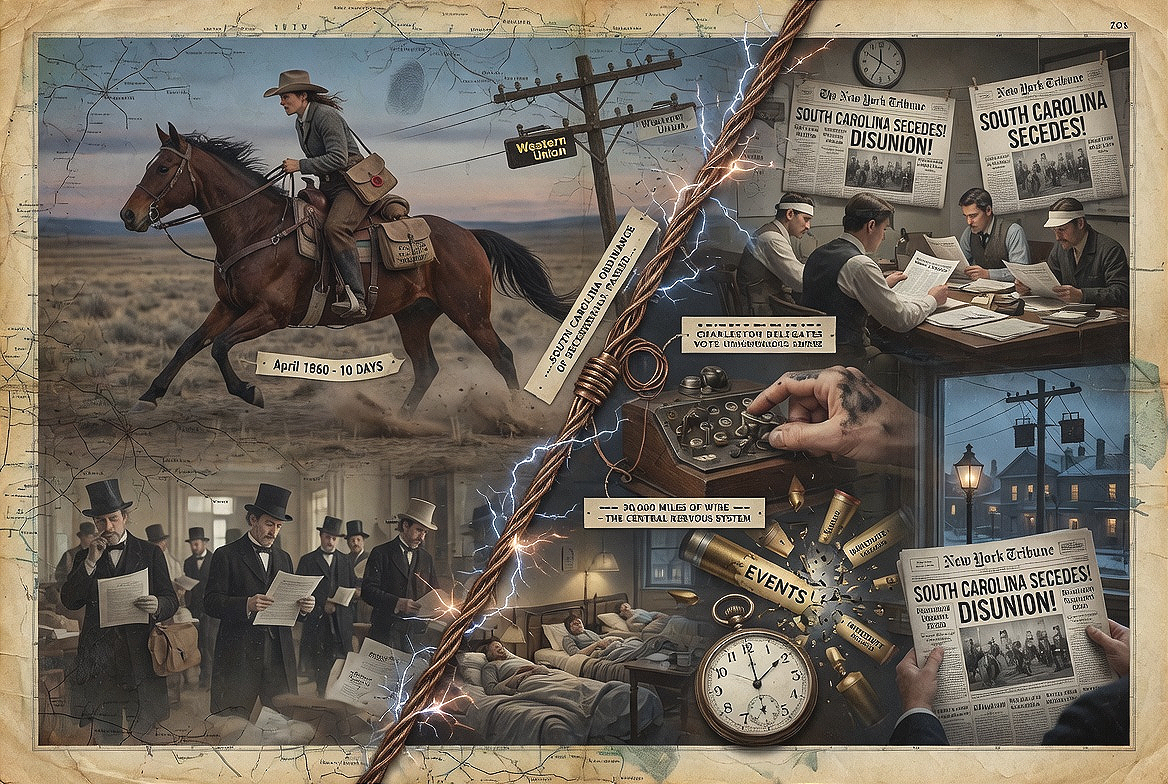
Technology is shrinking the space between crisis and awareness. The Pony Express, inaugurated in April, carries a letter from St. Joseph to Sacramento in ten days, a staggering feat of human and equine endurance that is almost instantly rendered obsolete by the telegraph. That network of humming copper wires, now thirty thousand miles strong, is the central nervous system of the year, and every spark along it carries the tremble of disunion. When South Carolina secedes, the news reaches New York in minutes, and the newspapers set it in type before the Charleston delegates have gone home to bed. The sense of time compresses; events that once would have unfolded over months now land like artillery shells, each one demanding an immediate emotional and political response.
For the ordinary body, the year is a grain of daily life in a grinding mill. The Northern farm family rises with the winter dark, lights the kerosene lamp, reads the latest Weekly Tribune with its Greeley-esque editorial demanding firmness against the slave power. The Southern yeoman, who owns no slaves but whose pride is hitched to the planter’s wagon, cradles a shotgun and listens to the rhetoric of honor and invasion, even as his land is eroding under the monoculture of cotton. The enslaved field hand knows the year by the texture of the soil and the tone of the overseer’s voice, a tone that grows harsher as the white world outside the plantation grows more anxious. And the woman of the house, North and South alike, feels the political crisis as a tremor in the domestic sphere: the price of cloth, the tenor of her husband’s prayers, the whispered conversations about what to pack if the worst comes.
The sensory world is a collage of sharp contrasts. It smells of printer’s ink and horse liniment, of pine tar on a ship’s rigging and the cloying sweetness of molasses in a slave mess. It sounds like the hiss of a torch at a Wide Awake rally, the slow creak of a cotton press, the fiddle and stamp of a campaign parade, the auctioneer’s practiced chant enumerating the teeth and muscles of a man for sale. It is the cold brass of a revolver being loaded, the crackle of a telegraph receiver printing dots and dashes that spell out the death of a country. The taste is the dust of a political rally in a dry autumn, the acrid coffee of a railroad station where the train, that great unifier, now carries passengers who refuse to meet the eyes of those bound in the opposite direction. The national texture is a flag being sewn—the thirty-three-star flag, with Kansas admitted in January as the thirty-fourth star but not yet represented on the banners—and then, in the year’s final weeks, the same flag being unpicked, thread by thread, by ladies in South Carolina making a palmetto banner.
Psychologically, 1860 is a year that feels historical even as it is lived. People write in their diaries with an acute self-consciousness, aware they are characters in a tragedy whose third act has not yet been written. The mood is not fear exactly, but the electric, nauseating moment before fear resolves into action—the sensation of standing on a cracking ice floe, watching the dark water well up around your boots, and knowing that you can neither jump nor stay still.
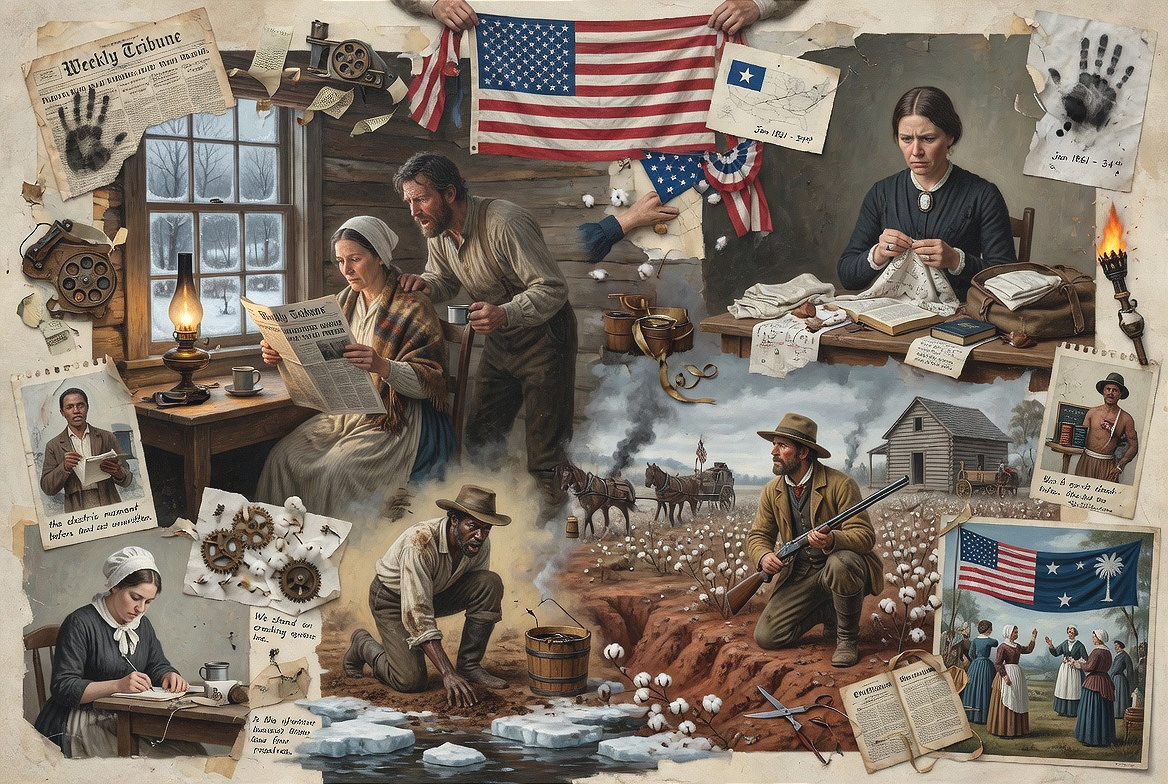
Mood-board
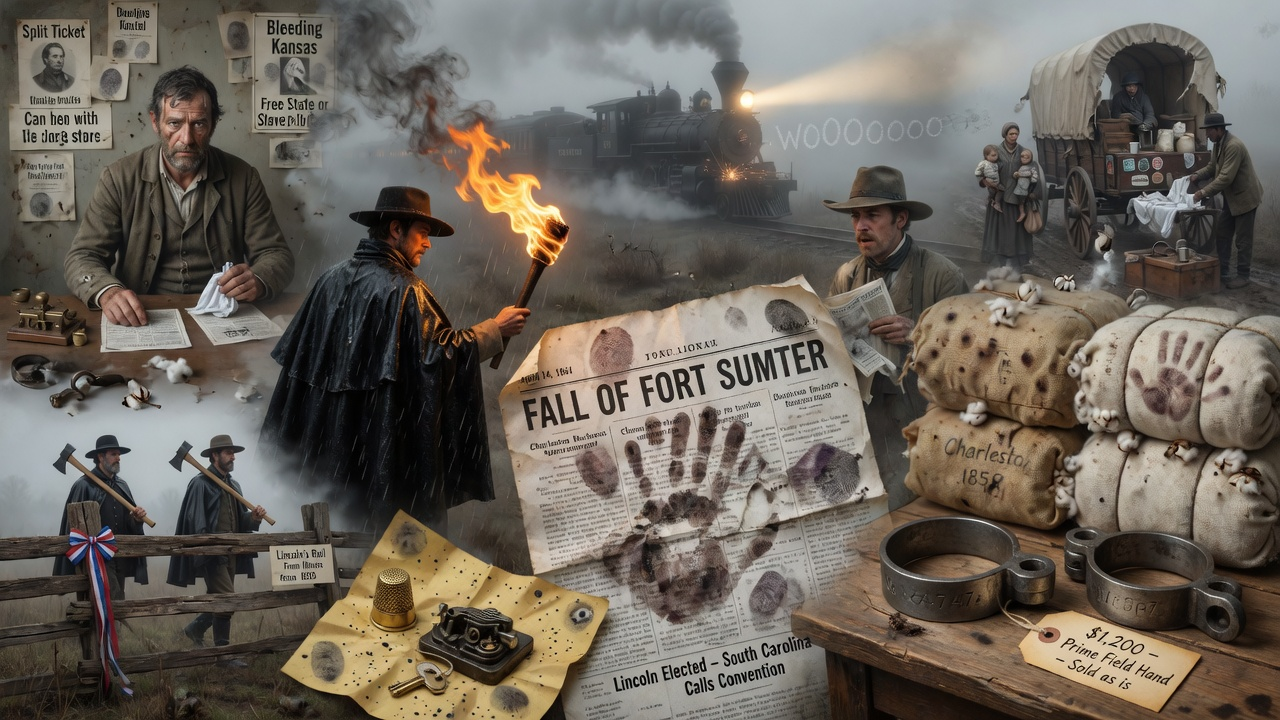
The color of a Wide Awake torch’s flame, a wobbling orange reflected in the slick black of an oilcloth cape. The texture of a newspaper extra, ink so fresh it smears the fingertips, the headline FALL OF FORT SUMTER not yet printed but already felt in the bones. The sound of a train whistle cutting through a November fog, a long mournful cry that could be going north or south, carrying delegates or fugitives. The dusty sweet of a cotton bale, a compressed weight of a million white puffs each attached to a scarred hand. The cold iron of a shackle, polished by decades of skin, sitting in a Charleston slave mart with a price tag. The archetype of the Split Ticket, the voter trying to knit the country back together with a ballot that pleases no one. The archetype of the Secessionist, a man in a wide-brimmed hat speaking of liberty while his valet packs his trunk. The symbol of the split rail, carried by Lincoln’s enthusiasts, a piece of frontier labor transformed into a holy relic of democracy. The creak of a wagon carrying a family out of the territory, away from the Bleeding Kansas that has drained them of everything but children and stubbornness. The press of a telegraph key, a gold thimble on a wire, spelling out the electoral votes state by state until the final click that sunders the map.