Black Masters in a Slave Society: William Ellison and the Moral Contradictions of African American Slaveholding
William Ellison was an ex-slave who became South Carolina's wealthiest Black slaveowner. He made a fortune building cotton gins and running a 900-acre plantation. For profit, he harshly overworked his 63 slaves and sold enslaved children. He even backed the Confederacy during the Civil War.
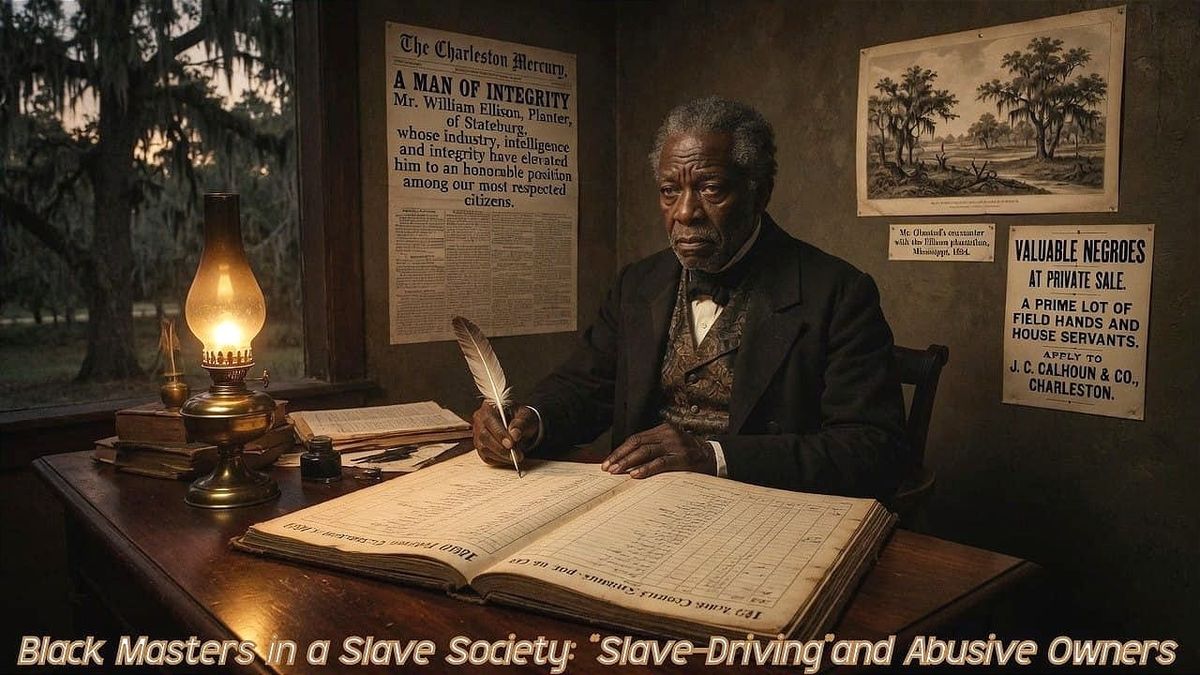
The existence of free Black slaveholders in the antebellum United States is historically established but frequently distorted. It is sometimes minimized to preserve a simplified account of racial solidarity; elsewhere, it is exaggerated to suggest that race was incidental to American slavery. Neither approach withstands scrutiny.
Some free Black people legally owned relatives whom they could not safely manumit. Others purchased enslaved people, extracted their labor, accumulated plantations, and participated in the buying and selling of human beings. Some individuals did both. William Ellison of South Carolina represents the most developed example of this contradiction: a man born enslaved who secured his freedom, became a highly skilled manufacturer, entered the planter class, owned sixty-three enslaved people at the end of his life, and materially supported the Confederacy.
Part 1: The Biography of William Ellison
From “April” to William Ellison Jr.
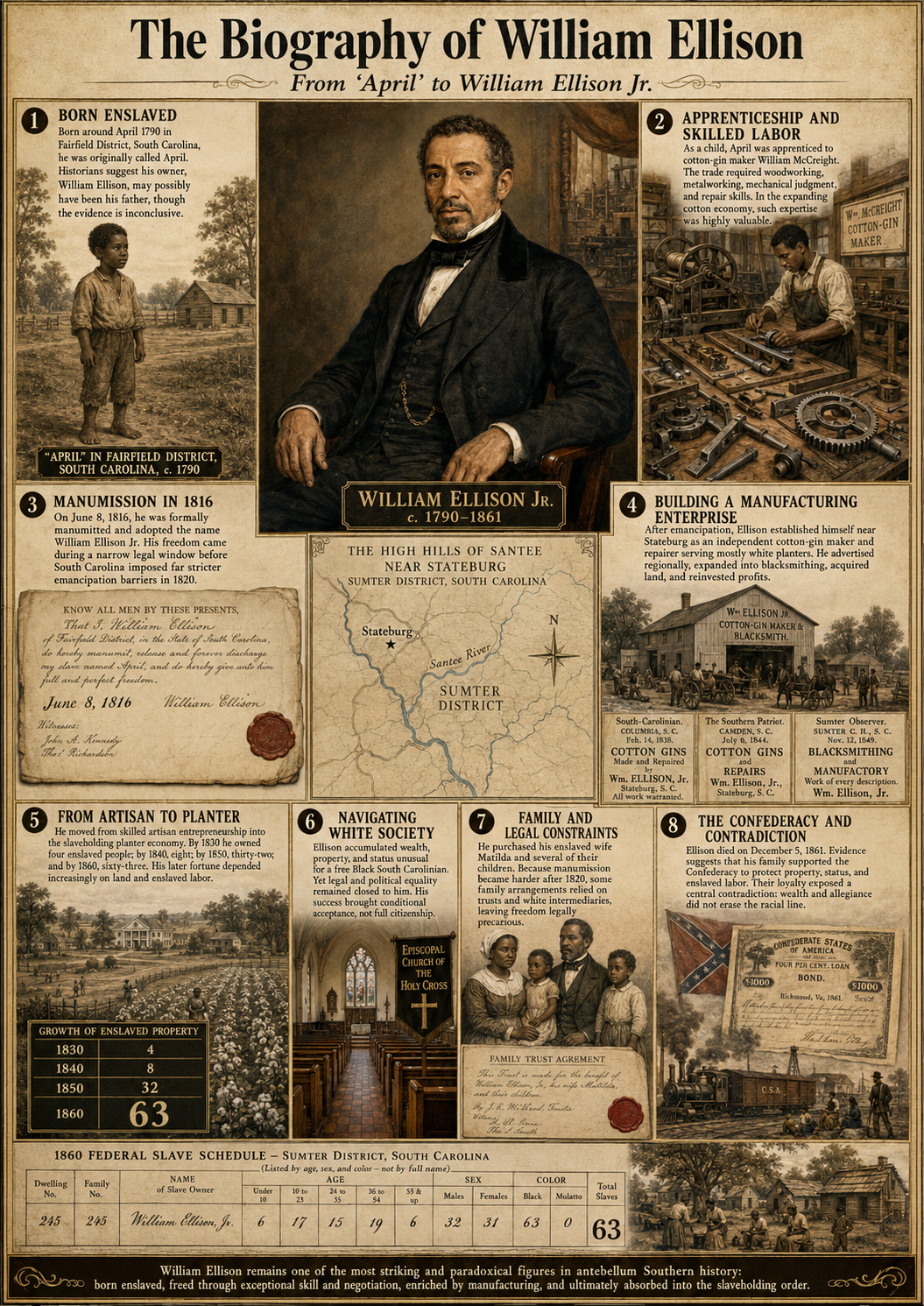
William Ellison was born enslaved in Fairfield District, South Carolina, around April 1790. He was originally called April, apparently after the month of his birth. He was owned by William Ellison, a white planter whose precise relationship to him remains uncertain. Historians Michael P. Johnson and James L. Roark consider it possible that the elder Ellison was also his biological father, although the surviving evidence does not prove this conclusively.
Around the age of ten, April was apprenticed to William McCreight, a white cotton-gin maker. This decision was decisive. Cotton-gin construction was not routine agricultural labor. It demanded woodworking, metalworking, mechanical judgment, knowledge of gearing and rollers, and the ability to repair expensive machinery on which plantation productivity depended. As short-staple cotton cultivation spread through South Carolina’s interior, men capable of manufacturing and maintaining gins occupied an economically valuable position.
April completed his apprenticeship and continued working in the trade. Like some enslaved artisans who were hired out, he apparently retained part of his earnings. On June 8, 1816, his owner formally manumitted him. He subsequently adopted the name William Ellison Jr., thereby associating himself publicly with the established white Ellison family rather than retaining the slave name April (Johnson and Roark 1984; Koger 1985).
How His Manumission Was Legally Possible
Ellison obtained his freedom during a narrowing legal window. Under South Carolina legislation enacted in 1800, an owner seeking to manumit an enslaved person had to follow a formal procedure and produce local white men who would attest that the person possessed good character and the capacity for self-support. The system was restrictive, but private manumission remained legally possible.
South Carolina substantially tightened this process in 1820. Thereafter, an individual manumission generally required legislative approval rather than merely a private deed or local proceeding. The change made emancipation considerably more difficult, particularly for children, elderly people, and others who could not satisfy expectations of economic independence.
Ellison’s 1816 emancipation therefore occurred before the most prohibitive restrictions took effect. His skill, accumulated earnings, reputation, and connections to white patrons enabled him to meet requirements that were beyond the reach of most enslaved people. His freedom was not simply bestowed by a liberal legal order. It was purchased and negotiated within a system designed to make manumission exceptional.
The later restrictions directly affected his family. Ellison purchased his enslaved wife, Matilda, and several of their children. His efforts to place his daughter Maria under a trust arrangement illustrate the legal contortions required to give a family member practical freedom without obtaining complete legal manumission. A trusted white associate nominally held legal title while Maria lived substantially as a free woman. Such arrangements could protect relatives, but they remained precarious because the person continued to exist in law as property (Johnson and Roark 1984; Berlin 1974).
Building a Manufacturing Enterprise
After his emancipation, Ellison established himself in the High Hills of Santee near Stateburg, in Sumter District. He first operated as an independent cotton-gin maker and repairer. His clientele was predominantly white because plantation owners controlled the region’s capital, cotton production, and machinery market.
Ellison’s business strategy combined specialized knowledge, disciplined reinvestment, enslaved skilled labor, land acquisition, and integration into white commercial networks. Initially, he hired enslaved artisans from white owners. He then began purchasing workers for his own shop. By 1830, he owned four enslaved people; by 1840, eight. Some possessed artisanal skills, while others cut timber, prepared components, transported materials, or performed supporting labor.
He advertised his services in regional newspapers, including the Black River Watchman, the Sumter Southern Whig, and the Camden Gazette. Advertising was significant because it publicly positioned a free Black tradesman as a dependable commercial supplier to white planters. His success depended on producing machinery of sufficient quality that racial prejudice did not prevent white customers from doing business with him.
Ellison expanded into blacksmithing and accumulated agricultural land. Manufacturing profits financed real-estate purchases; land and enslaved labor then produced cotton and other crops; plantation income enabled further purchases. He moved from artisan entrepreneurship into the slaveholding planter economy.
By 1850, he owned thirty-two enslaved people and hundreds of acres. During the following decade, he acquired additional plantation property and transferred portions of his holdings to his sons. The 1860 federal slave schedule recorded sixty-three enslaved people under his ownership. The schedule did not provide sixty-three personal names. As was customary, it generally classified enslaved people by age, sex, and color, reducing human beings to demographic entries under an owner’s name.
Ellison’s wealth therefore did not arise from cotton-gin making alone. The skilled trade supplied the initial capital, market access, and commercial reputation. His later fortune depended increasingly on the ownership of land and people—the standard foundation of planter wealth in the antebellum South (Johnson and Roark 1984; Koger 1985).
Navigating White Society
Ellison occupied an extraordinary but unstable social position. Wealth gave him privileges denied to most free Black South Carolinians. He owned substantial real estate, entered contracts, advertised in white newspapers, extended credit, employed skilled labor, and conducted business with prominent planters. His family purchased a pew at the Episcopal Church of the Holy Cross in Stateburg, an important local symbol of status and respectability.
White neighbors sometimes treated him less like an ordinary free Black laborer than like a subordinate member of the property-owning class. His craftsmanship was useful, his credit was valuable, and his economic behavior conformed to the region’s dominant standards. He cultivated restraint, reliability, Protestant respectability, family advancement, and property accumulation.
This acceptance had strict limits. Ellison could not vote, hold public office, serve on a jury, or claim political equality with white planters. South Carolina’s laws imposed registration, movement, migration, assembly, and employment restrictions on free people of color. Free Black people could be subjected to special taxes, surveillance, documentary requirements, and arbitrary suspicion. Their testimony against white people was restricted or disallowed in many legal contexts. The possibility of expulsion, reclassification, or additional legislation remained a continuing threat.
His wealth did not make him white. It secured conditional accommodation from selected white neighbors because he was economically useful, socially conservative, and invested in the same property system that sustained them. Even his sons’ later attempts to enlist in Confederate service encountered racial barriers. Their property and loyalty did not erase the legal color line.
Ellison’s unusual capacity for accumulation may also have been reinforced by his restricted social choices. Johnson and Roark argue that he could not safely display his wealth through the same political ambitions, public entertainments, conspicuous consumption, or elite competition available to white planters. Reinvestment in land, businesses, and enslaved labor became both an economic strategy and one of the few socially recognized routes through which he could enlarge his standing.
The Confederacy and the Defense of His Position
Ellison died on December 5, 1861, only months after the Civil War began. Evidence from his family’s conduct indicates substantial support for the Confederacy. Ellison reportedly offered the labor of fifty-three enslaved people to Confederate authorities and shifted agricultural production toward provisions useful to the war effort. His sons purchased Confederate bonds, contributed money, and attempted to enlist, although racial restrictions complicated or prevented their formal acceptance.
This support was not merely sentimental southern patriotism. Confederate victory promised to preserve the legal system on which the Ellison family’s wealth depended. Emancipation threatened the loss of their enslaved property, agricultural labor force, social distinction, and position within the Stateburg planter community.
Their support also reflected the politics of respectability. By demonstrating loyalty to South Carolina, the Ellisons could present themselves as dependable property owners rather than as members of a racially defined population suspected of sympathy with enslaved resistance or northern abolitionism. Confederate allegiance offered a means of protecting the family against white hostility.
The strategy failed at the most fundamental level. The Confederacy was established to defend a racial slave order that could accommodate the Ellisons only as exceptions. Their sons could invest in Confederate securities but could not demand equal citizenship. They could own Black people but remained subject to laws identifying them as free people of color. Their loyalty did not abolish the contradiction; it exposed it.
Part 2: Categorizing Black Slave Owners
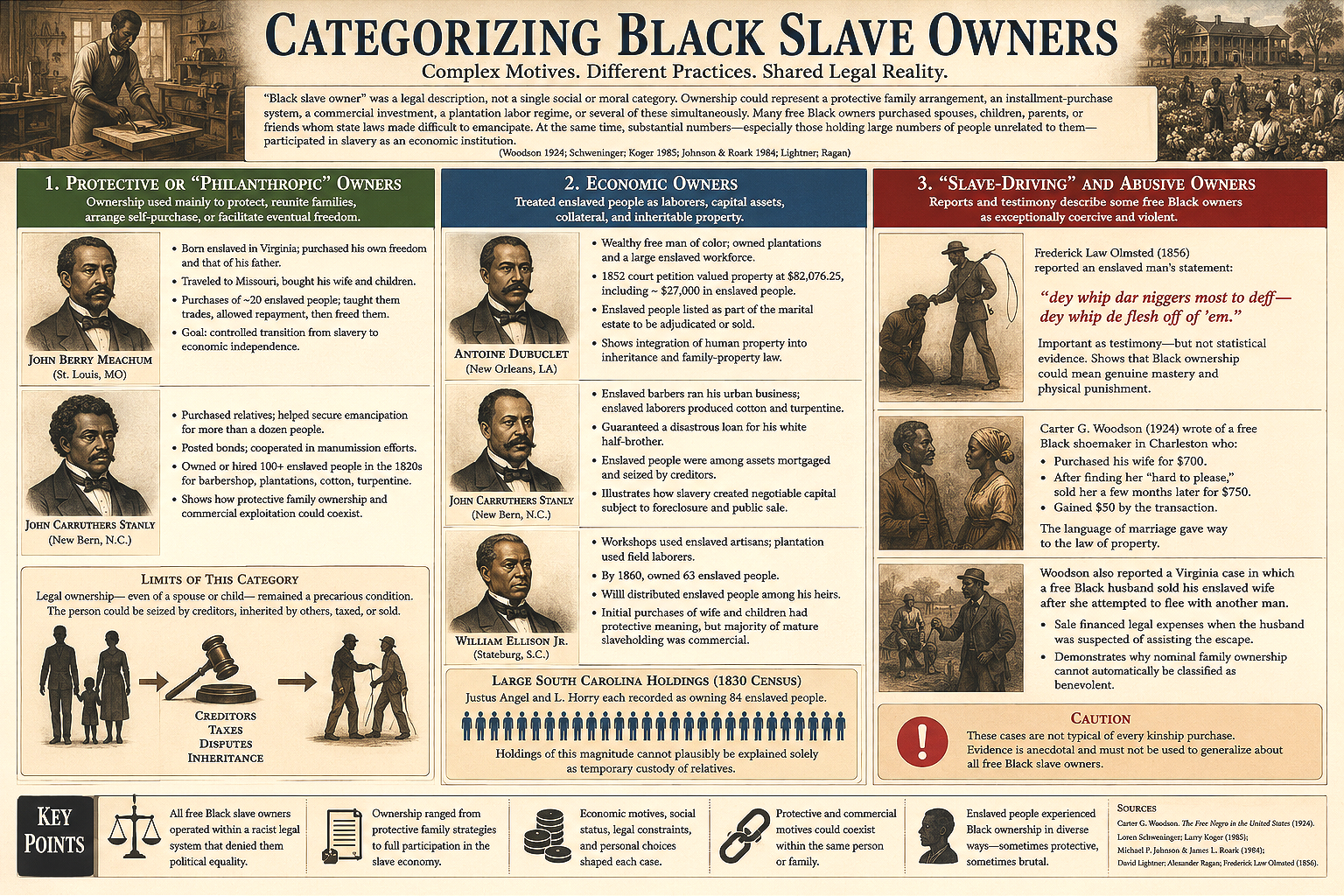
Any typology must be treated cautiously. “Black slave owner” was a legal description, not a single social or moral category. Ownership could represent a protective family arrangement, an installment-purchase system, a commercial investment, a plantation labor regime, or several of these simultaneously.
Carter G. Woodson’s early study of the 1830 census emphasized that many free Black owners held spouses, children, parents, or friends whom state laws made difficult to emancipate. Loren Schweninger, Larry Koger, Michael Johnson, James Roark, David Lightner, and Alexander Ragan subsequently demonstrated that kinship ownership cannot explain every case. Substantial numbers of free Black owners, particularly those holding numerous people unrelated to them, participated in slavery as an economic institution.
Protective or “Philanthropic” Owners
The term “philanthropic” describes owners who purchased enslaved relatives or other people principally to protect them, reunite families, arrange self-purchase, or facilitate eventual freedom. It does not mean that the legal relationship was harmless. A person retained as a spouse’s property remained vulnerable to creditors, inheritance disputes, taxation, forced sale, and changes in family relations.
John Berry Meachum of St. Louis represents a comparatively clear example. Born enslaved in Virginia, he purchased his own freedom and that of his father, then traveled to Missouri to find his enslaved wife. He used his earnings as a carpenter and cooper to purchase her and their children. Contemporary accounts also reported that he purchased approximately twenty enslaved people, taught them trades, permitted them to repay most of their purchase cost, and then freed them. Meachum’s purpose was not plantation exploitation but controlled transition from slavery to economic independence.
John Carruthers Stanly of New Bern, North Carolina, likewise purchased relatives and helped secure the emancipation of more than a dozen people. He posted bonds and cooperated with other owners seeking manumission. Yet Stanly cannot be confined to the philanthropic category. His barbershop, plantations, cotton cultivation, and turpentine production depended on enslaved labor. During the 1820s, he owned or hired more than one hundred enslaved people. His life demonstrates that protective family ownership and commercial exploitation could coexist within the same person.
Ellison’s initial purchases of his wife and children similarly had a protective dimension. They do not, however, explain his later acquisition of dozens of unrelated workers or his rise as a plantation owner.
Economic Owners
Economic owners treated enslaved people as laborers, capital assets, collateral, inheritable wealth, and commodities. Their practices were structurally comparable to those of white slaveholders, even if their political status remained inferior.
Antoine Dubuclet, a wealthy free man of color in Louisiana, owned plantation property and a large enslaved workforce. An 1852 court petition valued property belonging to Dubuclet and his children at $82,076.25, including approximately $27,000 in enslaved people. The petition discussed enslaved people as components of a marital estate to be adjudicated or sold, demonstrating the incorporation of human property into ordinary inheritance and family-property law.
John Carruthers Stanly also fits this category. Enslaved barbers operated his urban business, while plantation laborers produced cotton and turpentine. When he guaranteed a disastrous loan for his white half-brother, enslaved people were among the assets mortgaged and seized by creditors. His financial collapse illustrates how slavery converted people into negotiable capital subject to foreclosure and public sale.
Ellison is the clearest South Carolina example. His workshops used enslaved artisans; his plantation used field laborers; his will distributed human property among his heirs. Whatever protective meaning attached to his ownership of immediate relatives, the majority of his mature slaveholding was commercial.
The 1830 census also identified substantial South Carolina holdings by free people of color such as Justus Angel and L. Horry, each recorded as owning eighty-four enslaved people. Holdings of that magnitude cannot plausibly be explained solely as temporary custody of relatives (Woodson 1924; Koger 1985).
“Slave-Driving” and Abusive Owners
The third category concerns free Black owners remembered or reported as exceptionally coercive. The evidence must be handled carefully because some accounts were anecdotal, anonymous, or filtered through white observers. It would be methodologically unsound to generalize about all Black owners from isolated testimony.
Frederick Law Olmsted recorded a conversation with an enslaved man who claimed that some Black masters were worse than white masters and “whipped their slaves most to death.” In Olmsted’s printed rendering of the informant’s dialect, the statement appeared in even harsher form: “dey whip dar niggers most to deff—dey whip de flesh off of ’em” (Olmsted 1856).
The passage is important as testimony, but it is not a statistical finding. Olmsted did not identify the accused owners, independently investigate individual plantations, or establish that Black masters were generally more violent. The account shows that enslaved people could experience Black ownership as genuine mastery, complete with physical punishment, rather than as disguised emancipation.
Woodson supplied an equally disturbing example from Charleston. He wrote of a free Black shoemaker who purchased his wife for $700 but, after finding her “hard to please,” “sold her a few months thereafter for $750, gaining $50 by the transaction” (Woodson 1924, 41–42). Here, the language of marriage gave way to the law of property. A husband exercised legal ownership over his wife and converted marital conflict into a profitable sale.
Woodson also reported a Virginia case in which a free Black husband sold his enslaved wife after discovering that she had attempted to flee with another man. The sale reportedly financed legal expenses incurred when the husband was suspected of assisting the escape. These cases were not typical of every kinship purchase, but they demonstrate why nominal family ownership cannot automatically be classified as benevolent.
Part 3: The Moral and Historical Tension
Did Black Owners See Themselves as Oppressors?
There is no single answer. Free Black owners did not leave a collective manifesto explaining their conduct, and their motives varied.
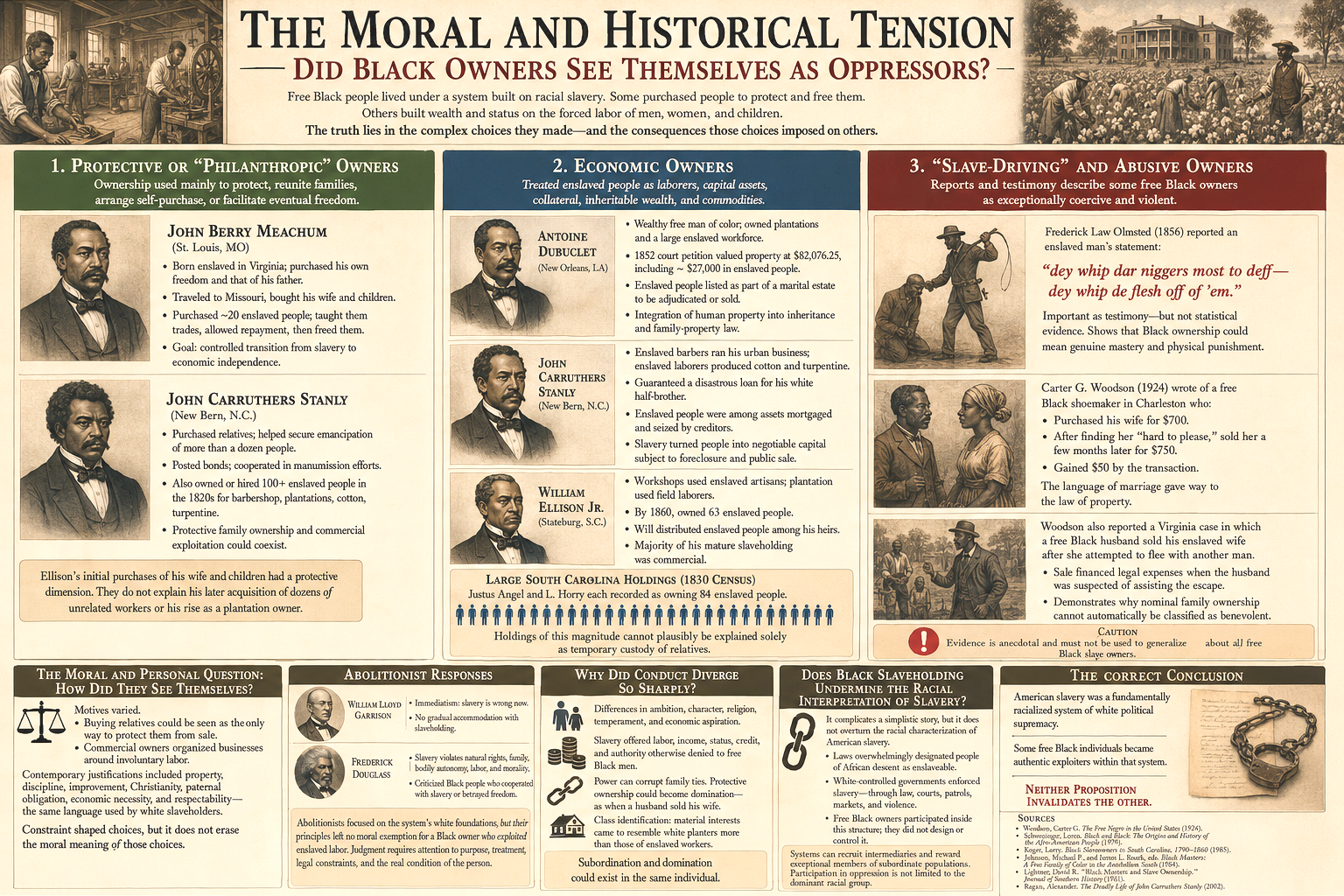
Those who purchased relatives may have regarded legal ownership as a protective fiction imposed on them by hostile law. They could reasonably argue that buying a wife, child, or parent was the only practical means of preventing sale to the Deep South. In such cases, legal ownership could conceal an informal condition approaching freedom.
Commercial owners were situated differently. Ellison, Stanly, Dubuclet, and other wealthy owners organized businesses around involuntary labor. They bought people unrelated to them, transmitted them through inheritance, used them as collateral, and benefited from their inability to leave. Whatever private rationalizations they adopted, these were the actions of slaveholders.
They may not have used the modern language of oppression. They probably described themselves through contemporary concepts such as property, household authority, discipline, improvement, Christianity, paternal obligation, economic necessity, and respectability. White slaveholders relied on the same vocabulary.
Some free Black owners may have believed that participation in slavery was necessary for survival in a society where economic advancement was tied to slave labor. Others clearly pursued wealth and status beyond what survival required. Constraint explains the limited choices available to free Black people; it does not erase the moral significance of choices made within those limits.
Abolitionist Responses
Black and white abolitionism rested on the proposition that human beings could not legitimately be property. William Lloyd Garrison’s immediatism rejected gradual accommodation with slaveholding. Frederick Douglass repeatedly treated slavery as an assault on natural rights, family integrity, bodily autonomy, labor, and moral responsibility. Under that reasoning, the owner’s race did not alter the nature of the institution.
Abolitionists generally focused on the system’s overwhelmingly white political, economic, and legal foundations rather than treating Black slaveholding as a separate national problem. This was rational in proportional and institutional terms: legislatures, courts, militias, patrols, interstate markets, and territorial expansion were controlled by white Americans.
Nevertheless, abolitionist principles left no moral exemption for a Black owner who exploited enslaved labor. Douglass’s criticism of Black people who cooperated with slavery, slave catchers, or colonization schemes reflected his broader insistence that racial identity did not excuse betrayal of freedom.
At the same time, abolitionists understood that a free Black man who purchased his wife but could not legally emancipate her was not equivalent to a large commercial planter. Moral judgment required attention to purpose, treatment, legal constraints, and the actual condition of the person nominally owned.
Why Did Conduct Diverge So Sharply?
Free Black people were no more uniform in ambition, character, loyalty, or moral judgment than white people. Shared exposure to racism did not eliminate differences of class, family interest, religion, temperament, or economic aspiration.
For some, ownership was an emergency instrument of family rescue. For others, it offered labor, income, status, credit, and a measure of authority otherwise denied to free Black men. The slave system rewarded people who treated human beings as assets. Once admitted into property ownership, some free Black participants adopted the incentives and habits of the surrounding planter society.
Power also transformed family relationships. A man who bought his wife to protect her acquired legal authority that could later be used against her. The Charleston shoemaker’s sale of his wife shows how a protective transaction could become domination when the relationship deteriorated.
Class identification further weakened racial solidarity. Ellison’s material interests came increasingly to resemble those of neighboring white planters rather than those of enslaved workers. He could remain racially subordinate to whites while simultaneously exercising near-total authority over other Black people. Subordination and domination existed in the same individual.
Does Black Slaveholding Undermine the Racial Interpretation of Slavery?
It complicates a simplistic formulation of slavery as nothing more than every white person individually enslaving Black people. It does not overturn the interpretation of American slavery as a racialized system of power.
The institution rested on laws that overwhelmingly designated people of African descent and their descendants as enslaveable. White-controlled governments defined slave status, enforced sales, captured fugitives, suppressed revolts, prohibited literacy, restricted manumission, excluded Black testimony, and protected slaveholders’ property claims. Free Black owners participated inside this structure; they did not design or control it.
Their existence proves that participation in oppression is not restricted absolutely to members of a dominant group. Systems can recruit intermediaries, reward exceptional members of subordinate populations, and align personal interests across a racial boundary. A Black slaveholder could benefit from slavery without becoming politically equal to white slaveholders.
The correct conclusion is therefore twofold. American slavery was a fundamentally racialized system of white political supremacy, and some free Black individuals became authentic exploiters within that system. Neither proposition invalidates the other.
Part 4: A Fictional but Historically Grounded Interview with William Ellison, 1860
Journalist: Mr. Ellison, you were born a slave. You now possess land, workshops, and more than sixty slaves. How do you reconcile those facts?
Ellison: I reconcile them as a man reconciles necessity. I was born without property, without standing, and without the protection that accompanies either. I learned a trade. I labored at it. I purchased my liberty, maintained my family, satisfied my creditors, and invested what I earned. Had I remained poor, no gentleman now questioning me would have praised my purity. He would have called me idle and worthless.
Journalist: But your prosperity depends upon people who possess no liberty.
Ellison: The agriculture of this state depends upon labor organized as the laws of this state provide. I did not enact those laws. I entered business under them. The planter who orders a gin from my shop does not ask whether every hand touching the timber is free. He asks whether the machine is sound and whether his cotton will be cleaned.
Journalist: Is that not the same defense made by white masters?
Ellison: A sound argument is not altered by the complexion of the man making it. Property is recognized by law. Labor must be directed. Land must be cultivated. Debts must be paid. My family cannot live upon declarations.
Journalist: You once knew the condition of bondage personally.
Ellison: I knew dependence. I also knew that skill and discipline could improve a man’s circumstances. I was apprenticed, learned machinery, and made myself useful. I do not claim that every condition is equal, but I reject the assumption that I must throw away everything I have built merely to satisfy men who bear none of the consequences.
Journalist: Critics say that you have betrayed your race.
Ellison: Those critics do not protect my sons, my daughter, my land, or my contracts. When danger comes, will they stand between my family and the law? A free colored man in South Carolina survives by prudence, property, reputation, and reliable friends. Poverty offers no shield.
Journalist: Does ownership make white society accept you?
Ellison: Acceptance is a word used by men who take security for granted. I conduct business. I meet my obligations. My neighbors know the quality of my work. I seek respect where it may be earned, not equality where it will not be granted.
Journalist: Would you willingly exchange places with one of your field hands?
Ellison: No man willingly exchanges his position for a lower one.
Journalist: Then you acknowledge their condition is inferior.
Ellison: I acknowledge differences in condition everywhere. The question for a responsible man is whether he governs his household and property with order.
Journalist: Is profit sufficient justification for owning another person?
Ellison: Profit alone justifies little. But a man must preserve what he has acquired, provide for his heirs, and operate within the world that exists. I did not create South Carolina. I have learned how to live in it.
Historian’s Commentary
No transcript of such an interview survives. Ellison’s words above are fictional.
The economic reasoning is historically plausible. His conduct demonstrates a strong commitment to property, reinvestment, family advancement, commercial reputation, and accommodation with white planters. His reluctance to challenge South Carolina’s racial order is consistent with the surviving record.
The references to insecurity are also plausible. As a free man of color, Ellison remained legally subordinate despite his wealth. Property and white patronage provided practical protection unavailable to poorer free Black people.
His precise feelings about his enslavement, racial betrayal, coercion, and the lives of the people he owned are speculative. The transcript gives him arguments consistent with antebellum proslavery paternalism and his observable choices; it should not be mistaken for his documented language.
Part 5: Historiography and Modern Relevance
Why the Subject Was Often Marginalized
Black slaveholding was not entirely absent from historical writing. Carter G. Woodson published census evidence in 1924, and John Hope Franklin discussed free Black property owners in his study of North Carolina. Nevertheless, the subject remained peripheral in textbooks and popular memory.
Several forces contributed to this neglect. Older white scholarship often ignored free Black life almost entirely or treated free people of color as marginal anomalies. Later corrective histories understandably concentrated on restoring the experiences of the millions who were enslaved, resisting myths that slavery had been mild or consensual.
The subject was also vulnerable to political misuse. Defenders of slavery and later apologists for the Confederacy could point to a small number of Black owners to deny the institution’s racial foundation. Historians therefore had reason to resist sensational claims detached from proportion, law, and context.
There was also a documentary problem. Census schedules recorded legal ownership but not necessarily the relationship between owner and enslaved person. A free woman listed as owning a man might have been his wife, mother, employer, exploiter, or nominal legal protector. Raw totals could not disclose treatment, motive, kinship, or actual living conditions.
Changing Interpretations
Woodson emphasized the frequency with which free Black people purchased relatives and acquaintances. His work was indispensable because it identified and published census evidence that later writers could not legitimately dismiss. At the same time, his interpretation encouraged a tendency to treat Black ownership as primarily benevolent.
Ira Berlin’s Slaves Without Masters placed free Black people within the larger caste structure of the antebellum South. Berlin emphasized that freedom was conditional, regionally variable, and constrained by the demands of slave society.
Johnson and Roark’s Black Masters made William Ellison central to the historiography. They did not reduce him either to a race traitor or to a helpless victim of circumstances. They reconstructed a family that pursued security by accumulating property, adopting planter values, distancing itself socially from poorer Black people, and aligning its interests with the slaveholding order.
Larry Koger’s Black Slaveowners examined South Carolina systematically and distinguished family-protective ownership from commercial mastery. His evidence made it difficult to maintain that all or nearly all free Black owners held only relatives.
Loren Schweninger shifted attention toward property formation, entrepreneurship, credit, landholding, and class. His work on John Carruthers Stanly showed that emancipation activity and large-scale exploitation could coexist. Stanly’s life did not fit a morally clean category: he helped relatives and strangers obtain freedom while deriving considerable wealth from enslaved labor.
David Lightner and Alexander Ragan later used quantitative methods to test the proposition that African American slaveholding was predominantly benevolent. They concluded that kinship and protective motives were significant but insufficient to explain the data. Larger holdings, demographic composition, and other characteristics indicated real economic exploitation in a meaningful portion of cases (Lightner and Ragan 2005, 535–557).
Recent scholarship has consequently moved away from two incompatible myths: that Black slaveholding was insignificant and therefore unworthy of examination, or that it somehow disproves the racial nature of American slavery. The stronger interpretation examines ownership at several levels simultaneously—law, family, class, labor, race, gender, market behavior, and personal agency.
Race, Agency, Victimhood, and Systemic Power
This history demonstrates that agency is not the same as freedom from structural constraint. Ellison exercised extraordinary agency. He mastered a trade, accumulated capital, negotiated white commercial networks, purchased property, protected parts of his family, and built an enduring enterprise. Yet his actions occurred within a racial state that denied him political equality.
It also demonstrates that victimization in one relationship does not prevent domination in another. Ellison had been enslaved and remained racially subordinated. He nevertheless became the legal owner of people who could be worked, punished, mortgaged, inherited, and sold.
The case challenges accounts that assign identical motives to every member of a racial category. Economic interest, family loyalty, status ambition, fear, self-preservation, religious respectability, and personal cruelty could cross racial lines even though political power did not.
At the same time, isolated Black participation cannot be used to transfer institutional responsibility away from the society that constructed and enforced racial slavery. The presence of a small number of Black owners did not make the enslaved population racially neutral, place Black people in control of southern government, or alter the fact that slave law was written and enforced primarily for the benefit of white owners.
William Ellison’s life therefore belongs neither in apologetic folklore nor in sanitized heroic history. He was a victim of slavery who became a slaveholder; a free Black man denied equal citizenship who accumulated planter-class wealth; a skilled entrepreneur whose later prosperity depended upon coerced labor; and a supporter of a Confederacy whose racial principles excluded him from full membership.
That combination is morally disturbing because it defeats comforting assumptions. Oppression does not always produce solidarity. Survival can develop into accommodation, and accommodation can develop into exploitation. People denied equality may seek security not by dismantling hierarchy but by obtaining a protected position within it.
References
Berlin, Ira. Slaves Without Masters: The Free Negro in the Antebellum South. New York: Pantheon Books, 1974.
Cummings, Lindy. “Stanly, John Carruthers.” NCpedia. State Library of North Carolina, 2020.
Douglass, Frederick. Narrative of the Life of Frederick Douglass, an American Slave, Written by Himself. Boston: Anti-Slavery Office, 1845.
Franklin, John Hope. The Free Negro in North Carolina, 1790–1860. Chapel Hill: University of North Carolina Press, 1943.
Garrison, William Lloyd. “To the Public.” The Liberator, January 1, 1831.
Johnson, Michael P., and James L. Roark. Black Masters: A Free Family of Color in the Old South. New York: W. W. Norton, 1984.
Johnson, Michael P., and James L. Roark, eds. No Chariot Let Down: Charleston’s Free People of Color on the Eve of the Civil War. Chapel Hill: University of North Carolina Press, 1984.
Koger, Larry. Black Slaveowners: Free Black Slave Masters in South Carolina, 1790–1860. Columbia: University of South Carolina Press, 1985.
Lightner, David L., and Alexander M. Ragan. “Were African American Slaveholders Benevolent or Exploitative? A Quantitative Approach.” Journal of Southern History 71, no. 3 (August 2005): 535–557.
Olmsted, Frederick Law. A Journey in the Seaboard Slave States, with Remarks on Their Economy. New York: Dix and Edwards, 1856.
Schweninger, Loren. “John Carruthers Stanly and the Anomaly of Black Slaveholding.” North Carolina Historical Review 67, no. 2 (April 1990): 159–192.
Schweninger, Loren. Black Property Owners in the South, 1790–1915. Urbana: University of Illinois Press, 1990.
United States Census Office. Eighth Census of the United States, 1860. Population, Agricultural, Property, and Slave Schedules for Sumter District, South Carolina. Entries for William Ellison, recorded in portions of the census as William Ellerson.
University of North Carolina at Greensboro. Digital Library on American Slavery. “Petition No. 20885231: Antoine Dubuclet, Iberville Parish, Louisiana, August 3, 1852.” Records of the Sixth Judicial District Court, Iberville Parish Courthouse.
Woodson, Carter Godwin, ed. Free Negro Owners of Slaves in the United States in 1830, Together with Absentee Ownership of Slaves in the United States in 1830. Washington, DC: Association for the Study of Negro Life and History, 1924.