Hydropolitics and the Arab-Israeli Conflict: Water Wars on the Road to the Six-Day War (1948–1967)
The term “water war” refers to conflict driven or intensified by competition over water resources. In the arid Middle East, control of water can be as critical as control of land. Nations that share rivers or aquifers find that water security is intertwined with national security.
Introduction
The term “water war” refers to conflict driven or intensified by competition over water resources. In the arid Middle East, control of water can be as critical as control of land. Nations that share rivers or aquifers find that water security is intertwined with national security. This is especially true in the Jordan River basin, where several newly independent states emerged after World War II with growing populations and agricultural needs. The concept of a water war became a strategic reality in this region: access to the Jordan River, its tributaries, and key water bodies like Lake Kinneret (the Sea of Galilee) became a focal point of hostility.
This analysis argues that competition over water resources was a foundational driver of regional conflict between Israel and its Arab neighbors in the two decades after 1948. Far from being a peripheral issue, hydropolitics played a central role in shaping interstate tensions and military strategies. In particular, disputes over water rights and projects in the Jordan River basin set the stage for broader geopolitical confrontations, culminating in the 1967 Six-Day War. The following sections trace this history from the post-1948 territorial arrangements through diplomatic failures and escalating skirmishes, highlighting how water competition acted as a critical precursor to war.
Geopolitical Context (1948–1964)
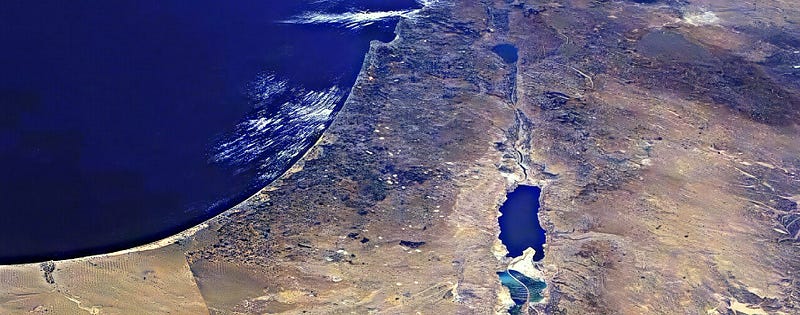
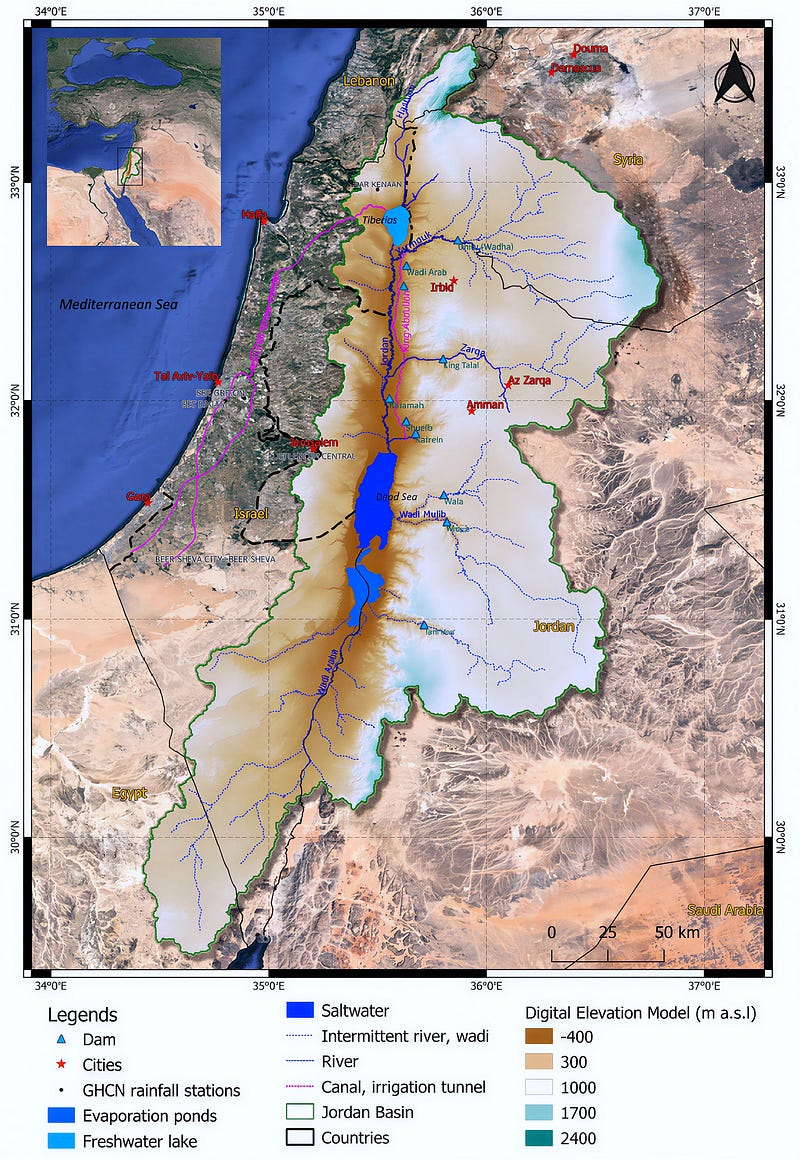
Post-1948 Boundaries and Water Geography: The 1948 Arab–Israeli War reshaped political boundaries and access to water in Palestine. The 1949 Armistice Agreements established armistice lines that left three demilitarized zones (DMZs) along the Israel–Syria frontier. The largest of these DMZs straddled the water-rich frontier east of the Sea of Galilee (Lake Kinneret), extending to the confluence of Israel, Syria, and Jordan at the Yarmuk River. This zone included portions of the upper Jordan River and its tributaries. Crucially, the new state of Israel controlled most of Lake Kinneret and the downstream Jordan River, while Syria held high ground to the northeast and several streams feeding the Jordan. Jordan (the country) lay to the river’s east bank, further south. This patchwork of control meant that the Jordan River basin became a shared resource without a clear, agreed-upon allocation among Israel and its Arab neighbors.
Strategic Importance of the Jordan River Basin: In the early 1950s, all riparian states recognized the Jordan River and its tributaries as lifelines for irrigation, drinking water, and energy. Lake Kinneret, fed by the upper Jordan River, was Israel’s largest freshwater reserve and central to its plans for developing the arid Negev region. The river’s headwaters rose in Lebanon (the Hasbani and Wazzani streams) and in the Syrian Golan (the Banias stream) before joining Israeli tributaries (like the Dan) to form the upper Jordan. Further downstream, the Yarmuk River (rising in Syria and flowing along the Syria-Jordan border into the Jordan River) was seen as vital for Jordan’s agricultural development. Each country’s efforts to utilize these waters inherently affected the others. This made water a strategic asset: whoever controlled the flow and diversion of the Jordan River system could influence national growth and security.
Early Water Skirmishes and UN Interventions: Almost immediately after 1949, disputes flared over water development in and around the DMZs. One notable flashpoint was Israel’s Hula Valley project in 1951. Israel undertook to drain the Huleh Lake and marshes (north of the Sea of Galilee) to reclaim farmland and reduce malaria. Parts of this project extended into the demilitarized zone, prompting armed Syrian objections. Syrian and Israeli forces exchanged fire amid Syrian accusations that Israel was encroaching beyond the armistice lines under the guise of drainage works. The United Nations Truce Supervision Organization (UNTSO) was drawn in to inspect and mediate these disputes. Although a full war was averted, the Hula episode underscored how water projects could trigger military confrontation in the tense borderlands.
Tensions escalated further in 1953 at a site known as the Daughters of Jacob Bridge (Gesher B’not Ya’akov) on the upper Jordan. In July 1953, Israel unilaterally began construction of a major water diversion intake at this location, aiming to channel Jordan River flow toward its planned National Water Carrier. Critically, the site lay in the demilitarized zone north of Lake Kinneret. Syria viewed this as a violation of the armistice and a direct threat to its water interests. Syrian artillery opened fire on the construction area, halting the work. The crisis went before the United Nations Security Council, where the U.S. and other nations supported Israel’s right to carry out development within agreed allocations. However, Cold War politics intervened — the Soviet Union vetoed a resolution that would have authorized Israel to resume the project. Facing both international pressure and the immediate Syrian military threat, Israel backed down and relocated its intake to the northwest shore of Lake Kinneret at Eshed Kinrot (later the site of the Sapir pumping station). This episode demonstrated the volatile intersection of water development with geopolitical rivalries. It also showed the UN’s limited ability to enforce solutions when major power interests clashed, leaving the underlying dispute unresolved.
By the mid-1950s, it was evident that without a regional agreement, water sharing in the Jordan basin would remain a source of friction. The small-scale clashes and UN interventions of 1949–1953 had highlighted how each side feared losing strategic water access. These fears only grew as Israel and its neighbors formulated ambitious schemes to use the Jordan River’s flow for national development. The stage was set for a larger diplomatic effort to defuse the water crisis before it led to wider war.
The Johnston Plan and Failed Water Diplomacy
In 1955, an American-led diplomatic initiative attempted to craft a comprehensive water-sharing accord. U.S. President Eisenhower, concerned that water disputes could spark war, dispatched special envoy Eric Johnston to the Middle East to negotiate a solution. After extensive shuttle diplomacy in 1953–1955 with technical committees from Israel and the Arab League, Johnston proposed the Jordan Valley Unified Water Plan (commonly known as the Johnston Plan). This plan provided an integrated development scheme for the Jordan River basin, treating the water resources as a unit to be fairly allocated among the riparian states.
Key Proposals of the Plan: The Johnston Plan essentially set national quotas for annual water usage based on agricultural needs surveys. It allocated roughly 36% of the Jordan-Yarmuk waters to Jordan, about 32% to Israel, 17% to Syria, and the remainder to Lebanon, with provisions for the future needs of Palestinian refugees. (Different versions of the plan varied slightly; one final version offered Israel approximately 400 million cubic meters per year, Jordan around 720 MCM, Syria 130 MCM, and Lebanon 35 MCM.) The plan also envisioned cooperative infrastructure: for example, dams and canals that would serve multiple countries’ irrigation projects. An international body would oversee compliance. Notably, the plan assumed Israel could make “out-of-basin” transfers (moving water out of the Jordan basin to its coastal plain and Negev desert) within its quota, while Jordan could harness the Yarmuk for its East Ghor Canal. By addressing all users’ “needs,” the scheme aimed to remove water as a zero-sum trigger for conflict.
Arab League Rejection and Partial Compliance: Initially, technical experts from each country reacted positively to the Johnston Plan’s balance. Even many Arab engineers and planners quietly saw merit in accepting the allocations, which promised Jordan and its Arab neighbors the lion’s share of the water. However, the plan ultimately faltered due to political opposition at the highest levels. On October 11, 1955, the Arab League Council — facing strong pan-Arab public sentiment against any deal seen as legitimizing Israel — formally rejected the plan. Arab states were unwilling to sign an agreement that implied recognition of Israel’s rights or permanence. From their perspective, the unity required to manage water was undermined by the broader refusal to normalize relations with Israel. Israel, for its part, had signaled acceptance of the plan, but without Arab concurrence, the agreement could not take effect as an international treaty.
Crucially, this rejection was not as absolute as it appeared. In practice, a de facto partial compliance emerged. Neither side wanted an immediate water war, and the Johnston allocations were regarded by engineers as a useful benchmark. Quietly, Israel and Jordan proceeded within the plan’s parameters. The United States had provided verbal assurances to Israel that its planned National Water Carrier — a massive pipeline and canal project to divert water from Lake Kinneret to the rest of Israel — would be tolerated up to the Johnston quota. Likewise, U.S. aid was extended to Jordan’s East Ghor Canal (later called the King Abdullah Canal) to irrigate the Jordan Valley with Yarmuk water, consistent with the plan. Syria and Lebanon, though publicly denouncing the Unified Plan, did not immediately embark on competing projects that would blatantly violate its numbers. This technical adherence without a formal treaty is telling: it reflected that all parties recognized some limits and balances were necessary to avoid all-out conflict.
Hardened Positions from Diplomatic Failure: Still, the failure to ratify the Johnston Plan left a legacy of mistrust and frustration. Arab leaders felt that even technical cooperation on water was impossible without addressing the underlying political conflict with Israel. The collapse of a negotiated solution hardened their resolve to resist Israel’s unilateral water projects by other means. On the Israeli side, leaders concluded that they would have to secure water unilaterally and be ready to defend their rights by force if necessary, since diplomacy had hit a dead end. The cooperative spirit of the Johnston negotiations gave way, by the late 1950s, to renewed unilateralism. Each country moved forward with national water schemes: Israel pressed on with building the National Water Carrier, Jordan accelerated the East Ghor Canal, and Syria considered how to utilize headwaters within its reach. Without a binding accord, water competition shifted from conference rooms back to the field, where guns and bulldozers would soon collide.
The War Over Water (1964–1967)
By the early 1960s, the latent “water war” erupted into open confrontation. This period, often termed the “War over Water,” saw Israel and the Arab states engage in a series of military clashes directly linked to water projects. While not a declared war, it was a protracted struggle (1964–1967) that significantly escalated regional tensions and helped pave the road to the Six-Day War.
Israel’s National Water Carrier Project: In 1964, Israel completed the National Water Carrier (NWC), the ambitious engineering project that had been in planning for a decade. The NWC consisted of pumping stations, canals, and pipelines to convey water from Lake Kinneret southwards to the densely populated coastal plain and the Negev desert. When full pumping began in June 1964, Israel started withdrawing roughly 320 million cubic meters annually from the lake — an amount within the earlier Johnston Plan quota for Israel. From Israel’s standpoint, this was a lifeline for development: it would green the desert, support agriculture, and supply its cities. However, to the Arab states, the very act of exploiting the Jordan waters for out-of-basin use was seen as a dangerous precedent. They viewed the Israeli diversion as both a violation of regional equity and a strategic threat — one that could enable Israel to sustain more immigrants and consolidate its statehood.
Arab League “Headwater Diversion” Decision: The Arab states turned to collective action in response. In January 1964, at the first Arab League Summit in Cairo, all Arab heads of state openly confronted the issue of Israel’s water project. The summit communiqués declared Israel’s diversion of the Jordan as an existential danger to Arab nations. Arab leaders agreed that they could not allow Israel to “steal” the water unchecked, as it would multiply the dangers to Arab existence. Yet, recognizing that a direct military strike on Israel’s Carrier might trigger a wider war they were not ready to win, they chose an indirect strategy: divert the sources of the Jordan River before they reach Israel. This became known as the Arab Headwater Diversion Plan.
Under this plan, Syria and Lebanon would undertake engineering works to alter the course of the upper Jordan tributaries. The Hasbani River in southern Lebanon would be diverted into the Litani River or a canal away from Israel’s border. Meanwhile, the Banias stream (in Syrian territory on the Golan) would be diverted to join the Yarmuk River before it could flow into Israel’s Sea of Galilee. Additionally, a dam was envisioned on the Yarmuk (at Maqarin/Adasiya) to maximize water storage for Jordan and Syria. If carried out, these diversions could significantly reduce the water flowing into Lake Kinneret and ultimately cut Israel’s anticipated water supply. Estimates at the time were that Israel could lose up to 30–35% of the water it planned to pump — a serious blow to its water budget.
The Arab League pledged funds (over $17 million) and established a unified military command to guard the projects, anticipating Israeli attempts to stop them. By late 1964 and early 1965, Syria and Lebanon began surveying and preliminary construction for the diversion canals and dams. This was effectively a race to re-engineer the hydrology of the region in favor of the Arab states, in parallel with Israel’s completed Carrier.
Military Confrontations and Sabotage Attempts: Israel’s government, led in 1964 by Prime Minister Levi Eshkol (who was incidentally a key figure in Israel’s water planning), declared the Arab diversion works to be an intolerable attack on its vital interests. Israeli leaders made it known that they regarded the headwater diversion as an infringement of Israel’s sovereign rights and would use force to prevent it. This stance set the stage for direct military clashes. Starting in late 1964, border incidents intensified dramatically:
- In November 1964, Syrian forces fired on Israeli patrols near the northern border, where NWC infrastructure lay. The Israelis returned fire, marking one of the first armed exchanges explicitly linked to the water project’s defense.
- In early 1965, as Syrian and Lebanese engineering teams moved earth for diversion channels, Israel launched a series of cross-border attacks. March 1965 saw Israeli armor and artillery strike Syrian construction sites, destroying earthmovers and tractors. Syria’s army responded with tank fire of its own. Skirmishes recurred in May and August 1965, each time Israeli Defense Forces targeting and halting work on the diversion before it could gain traction. These confrontations featured not only ground fire but also the use of airpower; Israel’s air force strafed construction areas and Syrian positions when artillery proved insufficient.
- Meanwhile, Palestinian guerrilla groups also entered the fray. The newly formed Fatah organization (led by Yasser Arafat) carried out its first armed operations in 1965, which notably included attempts to sabotage Israel’s water infrastructure. One such plot in January 1965 aimed to bomb the National Water Carrier pipeline inside Israel. Although Israel thwarted major damage, these efforts underscored how water became a rallying point for Arab opposition, from regular armies to irregular fedayeen fighters.
Through 1966, the pattern continued. Border firefights became routine, especially along the Syria–Israel frontier in the Golan Heights region. Israeli farmers in the northern Hula Valley and Galilee came under sniper and artillery fire from Syrian positions, ostensibly in defense against Israeli earth-moving near the DMZs. Israel, in turn, would retaliate with tanks and air strikes. One significant escalation occurred in July 1966, when Israeli aircraft bombed Syrian earthworks and, in the ensuing air battle, shot down a Syrian MiG fighter jet. This marked the first aerial dogfight between the two nations since the 1950s, signaling how high tensions had risen.
By early 1967, the conflict over water diversion had largely achieved its immediate military aims: the Arab Headwater Diversion Project had stalled under Israeli firepower. Sensing the high costs and technical difficulty, the Arab states quietly abandoned full-scale diversion efforts by 1967. However, the violence set off by the water dispute had taken on a life of its own. Frequent armed incidents continued, contributing to an atmosphere of crisis. In April 1967, an Israeli tractor working in a demilitarized zone (on disputed land near the Syrian border) drew Syrian shelling; Israel’s fierce response culminated in an air strike deep into Syrian territory on April 7, 1967, in which six Syrian MiG-21s were downed. This clash was a direct outgrowth of the cycle of provocation and retaliation originating with the water projects.
From Water Conflict to the Six-Day War: The War over Water was a crucial prelude to the broader war that erupted in June 1967. The chain reaction of border violence from 1964 onward played a significant role in poisoning relations and undermining the fragile regional stability. By May 1967, Syria and Israel were effectively in a shooting conflict, albeit an undeclared one. Misinformation and brinksmanship worsened the situation: the Soviet Union (a patron of Syria) erroneously warned the Egyptians that Israel was poised to invade Syria, citing the ongoing border clashes. This triggered Egyptian troop mobilizations into Sinai and the expulsion of UN peacekeepers there, which in turn led Israel to launch a preemptive attack. While many factors drove the Six-Day War — including inter-Arab rivalries and territorial disputes — the hydropolitical confrontation was undeniably a key accelerant. Leaders on all sides later acknowledged that the struggle over the Jordan River’s waters had pushed them toward the brink. In effect, the battles over the region’s water resources were the opening act of the 1967 war, helping to set in motion the political and military decisions that followed.
Strategic and Legal Implications
The 1948–1967 water conflict produced lasting strategic changes and legal debates that shaped Arab-Israeli relations.
Military Strategy and Border Changes: Water considerations influenced military strategy both before and during the Six-Day War. Israeli defense planners had long prioritized securing the nation’s key water sources. For example, the vulnerability of Lake Kinneret — Israel’s sole freshwater lake — to Syrian artillery from the Golan Heights underscored the strategic value of that high ground. Indeed, during the Six-Day War in 1967, Israel’s decision to capture the Golan Heights from Syria was motivated partly by the desire to end Syrian shelling of Israeli villages and to gain full control over the Banias spring and other Jordan headwaters. Similarly, when Israeli forces reached the Jordan River’s headwaters and the tributaries in the Golan, they eliminated the Arab diversion threat once and for all.
After 1967, Israel’s new de facto borders placed it in control of previously contested water resources: the upper Jordan River, the whole Sea of Galilee shoreline, the West Bank mountain aquifers, and the lower Jordan down to the Dead Sea. This gave Israel a tremendous hydrological advantage. Israeli water planners quickly integrated these sources, for instance, by taking over water wells in the West Bank and ensuring Israeli oversight of the vital Yarkon-Taninim aquifer that runs under the West Bank highlands. For the Arab side, the war’s outcome was strategically devastating: Jordan lost the West Bank (and access to its groundwater and the Jordan River’s west bank), and Syria lost the Golan Heights (and with it direct access to the Jordan’s sources). Control of water had not only been a cause of conflict but was now a prize of war.
Border policy in subsequent years often traced the lines of water control. Israel refused to withdraw from the Golan or the West Bank without security arrangements that would safeguard its water interests. Demands for “secure and recognized boundaries” (as worded in UN Security Council Resolution 242 after the war) implicitly included the notion that Israel would not return to indefensible lines where its primary water lifelines could be threatened. Thus, water security became entwined with territorial security in post-1967 peacemaking efforts.
International Law and Water Rights: The water conflict also highlighted the absence (at that time) of robust international legal frameworks to manage transboundary rivers. In the 1950s–60s, international law on shared watercourses was still nascent. Principles like “equitable and reasonable utilization” were being debated (the International Law Association’s Helsinki Rules on transboundary waters were only adopted in 1966), but there was no binding treaty among the Jordan basin states. Each side advanced its own legal claims: Arab states asserted that an upstream country (like Syria or Lebanon) had sovereignty to use water on its territory (sometimes citing the Harmon Doctrine of absolute territorial sovereignty), or that prior Arab use had precedence. Israel, as a downstream user for the upper Jordan but upstream on the lower Jordan, argued for equitable apportionment and no substantial injury to any state’s rights — effectively invoking a community-of-interests approach consistent with emerging international norms. The Johnston negotiations, while not yielding a treaty, did establish a rough consensus on what a fair share might be, and this informed each side’s legal stance.
After 1967, new legal questions arose regarding water in the occupied territories. Under international occupation law (notably the Fourth Geneva Convention), an occupying power must administer natural resources for the benefit of the local population and cannot permanently expropriate them. Israel’s control of the West Bank and Golan water resources drew scrutiny under these principles. Israel maintained that its water extractions remained within reasonable levels and that it invested in water systems benefiting all. Critics, including Arab states and later the Palestinians, argued that Israel was using disproportionate amounts of West Bank aquifer water for its own citizens and settlers, contrary to international law. This dispute over legal rights to water under occupation persists into present discussions on a final settlement.
Moreover, the events of 1948–1967 set precedents in international water law discourse. They illustrated the importance of having agreements to avoid unilateral actions. The conflict was frequently cited in United Nations debates and by scholars as a case where lack of cooperation nearly led to war — indeed, did lead to an armed conflict in effect. This case helped spur interest in global norms like the UN Watercourses Convention (which came much later, in 1997) that seek to manage shared rivers peacefully. In essence, the Jordan River saga became a textbook example of why clear legal frameworks for transboundary water are essential to regional stability.
Legacy and Continued Relevance
The legacy of the 1948–1967 water conflict is still palpable in Middle Eastern geopolitics. Water access remains a flashpoint in the Arab-Israeli conflict and has, if anything, grown in importance as populations increase and water resources dwindle under climate stress.
In the Israeli-Palestinian arena, water is a core issue intertwined with any two-state solution or other peace framework. Israel’s post-1967 control over the Mountain Aquifer under the West Bank means it controls roughly 80% of that aquifer’s output. Palestinians have consistently pressed for greater water rights, noting that per capita water usage for Palestinians in the West Bank is far lower than that of Israelis, due in part to restrictions and allocations set during the occupation. Agreements in the 1990s (as part of the Oslo Accords) created a Joint Water Committee and recognized Palestinian water rights in principle, but many Palestinians feel the arrangements froze in place an inequitable status quo established after 1967. The struggle over new well drilling, maintenance of water infrastructure, and supply cuts in the West Bank often leads to tension, illustrating that the hydropolitical imbalance originating in 1967 continues to breed conflict if unaddressed.
The Gaza Strip’s water crisis further highlights the issue’s humanitarian and political dimensions. Gaza’s tiny coastal aquifer has been over-pumped and contaminated, resulting in severe water scarcity for its population. Gaza relies on outside sources for drinkable water, including some purchases from Israel, but political strife has impeded sustainable solutions. Periodic conflicts between Israel and Gaza (ruled by Hamas) have also seen water and power infrastructure damaged or blockaded, showing how water security and human security are intimately linked. The very desperation over water and electricity in Gaza feeds instability, which can spiral into violence — a microcosm of how resource scarcity can perpetuate conflict.
Beyond the Israeli-Palestinian context, Israel’s water relations with its neighbors have seen both improvements and continued friction. On one hand, Israel and Jordan signed a peace treaty in 1994 that included a detailed water-sharing agreement. In it, Israel agreed to supply Jordan with a fixed quantity of water annually from the Sea of Galilee and Jordan River, while both nations pledged cooperation on developing new water (through desalination, for example). This treaty was a direct outcome of lessons learned from earlier decades: it showed that former adversaries could codify water rights and thereby remove a perennial source of discord. Jordan and Israel today coordinate on water transfers seasonally, and while there are occasional disputes (especially in drought years), the arrangement has largely held, demonstrating the benefits of hydrodiplomacy.
On the other hand, Israel and Syria have not reached any comparable accord. The Golan Heights remains occupied by Israel, and the two countries technically remain in a state of war. Water is one of the issues at stake: any future negotiation over the Golan would need to address rights to the Banias spring, the Sea of Galilee shoreline, and the Yarmuk tributaries. Syria’s civil war since 2011 has put such talks on indefinite hold. Similarly, Lebanon and Israel have no water agreement; Lebanon occasionally voices concern over Israeli usage of the Hasbani or ventures regarding the Litani River (though the Litani is entirely in Lebanon, some in the past feared Israel coveted it). Hydropolitical leverage is still apparent — for instance, Israel’s superior water technology (desalination and reuse) gives it more flexibility, whereas its neighbors remain more vulnerable to drought, potentially increasing dependency on cooperative arrangements that can be politicized.
In sum, the rivalries that played out in the 1950s and 1960s over the Jordan River laid the groundwork for how water is perceived in the conflict today: not as a neutral resource, but as a strategic commodity and a symbol of sovereignty. The same dynamics that made water a catalyst of conflict then — competition for limited supplies, lack of trust, and linkage to national survival — continue to operate. This makes water both a potential source of friction and, conversely, a compelling area for confidence-building if parties choose to cooperate.
Conclusion
The history from 1948 to 1967 shows unequivocally that water conflict was not a peripheral sideshow to the Arab-Israeli dispute, but a central thread weaving through its origins and escalation. Competition over the Jordan River basin served as a critical precursor to broader hostilities. The struggle for water informed military planning, fueled border clashes, and became entangled with nationalist narratives on all sides. By the time of the Six-Day War, years of “water wars” had helped erode diplomatic relations and establish patterns of confrontation that tipped the region into a full-scale conflict. In retrospect, it is clear that whoever controlled the water held not just the key to economic development, but also a significant tactical advantage — a reality both Israel and its neighbors acted upon.
Reaffirming the thesis, water resource competition was indeed a foundational driver of the mid-20th-century Middle East conflict. This does not mean water was the sole cause of wars; ideology, territory, and security all played major roles. However, the hydropolitical dimension was deeply interwoven with those factors, turning water into both a trigger and a target in the conflict.
The implication for the future is that any lasting peace in the region must confront the water issue head-on. Agreements must ensure equitable sharing and joint management of water to remove the incentive for unilateral action or coercion. Innovations like regional desalination partnerships, water trading, and drought contingency plans could transform water from a zero-sum contest into a mutual gain. The lessons of 1948–1967 suggest that without such proactive resource diplomacy, even a political peace could be undermined by resource scarcity and mistrust. Conversely, successful cooperation over water could build confidence that spills into other areas of peacemaking. In a region where water is life, ensuring fair access to this vital resource remains indispensable for any comprehensive resolution of the Arab-Israeli conflict.