Integrated Mathematical and Computational Frameworks for Contemporary Strategic Bombing Theory
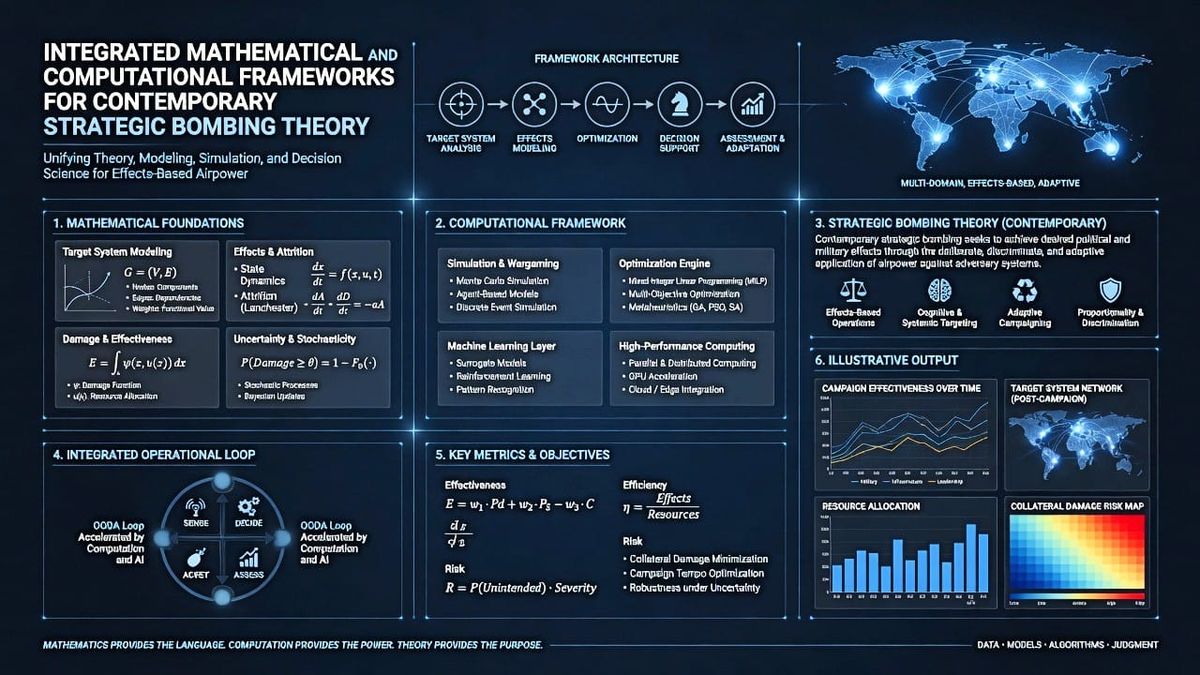
Strategic bombing should be framed as integrated strategic attack: one tool within adaptive, lawful, multi‑domain pressure on an adversary’s operational system, replacing the narrow punishment‑versus‑denial divide.
Abstract
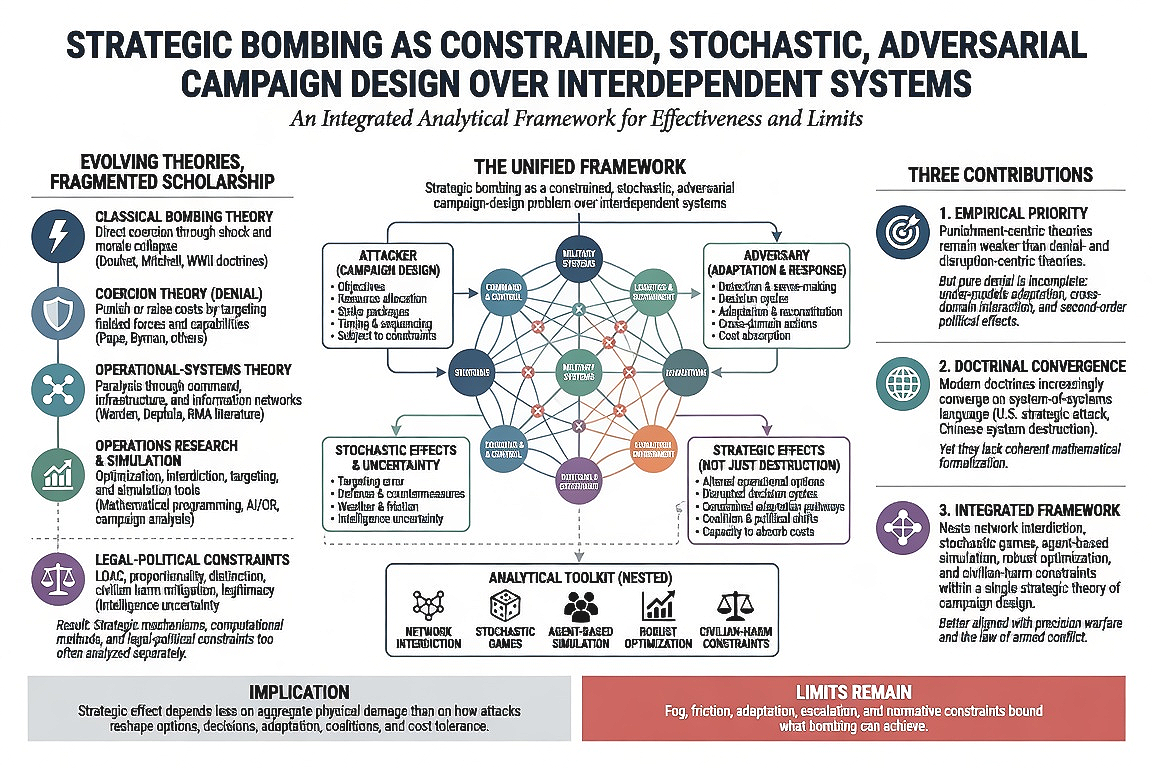
What analytical framework best explains the strategic effectiveness and limits of contemporary strategic bombing? This article argues that the field’s central dispute has been mis-specified for decades. Classical bombing theory privileged direct coercion through shock and morale collapse; later coercion theory shifted attention toward denial; operational-systems theory emphasized paralysis of command, infrastructure, and information networks; and contemporary operations research has developed sophisticated optimization, interdiction, and simulation tools. Yet these literatures remain weakly integrated. The result is a fragmented scholarship in which strategic mechanisms, computational methods, and legal-political constraints are too often studied in isolation.
Using a comparative analytical method, this article synthesizes foundational airpower texts, postwar bombing-survey evidence, coercion theory, current U.S. doctrine, Chinese system-destruction concepts, and contemporary operations-research and simulation literatures. It advances a unified thesis: contemporary strategic bombing should be modeled not as a simple problem of destruction or punishment, but as a constrained, stochastic, adversarial campaign-design problem over interdependent military, political, logistical, and informational systems. Strategic effect depends less on aggregate physical damage than on how attacks alter an opponent’s operational options, decision cycles, adaptation pathways, coalition environment, and capacity to absorb costs.
The article makes three contributions. First, it demonstrates that punishment-centric theories remain empirically weaker than denial- and disruption-centric theories, but that pure denial theory is itself incomplete because it under-models adaptation, cross-domain interaction, and second-order political effects. Second, it shows that modern doctrines of strategic attack increasingly converge on system-of-systems language, though they still lack a coherent mathematical formalization. Third, it proposes an integrated framework that nests network interdiction, stochastic games, agent-based simulation, robust optimization, and civilian-harm constraints within a single strategic theory of campaign design. This framework is better aligned with both contemporary precision warfare and the law of armed conflict than earlier bombing theories.
Introduction
Strategic bombing theory emerged from the claim that airpower could bypass fielded forces and strike directly at the sources of an adversary’s resistance. Douhet’s canonical argument joined command of the air to attacks on the enemy’s material and moral resistance, explicitly treating civilian morale as a decisive center of gravity in future war. Contemporary U.S. doctrine still preserves the aspiration to bypass operational attrition: Air Force Doctrine Publication 3-02 defines strategic attack as offensive action against military, political, economic, or other targets selected to achieve strategic objectives and notes that such action may achieve strategic objectives without first accomplishing operational objectives. At the same time, the doctrine explicitly broadens strategic attack beyond traditional bombing to include kinetic and non-kinetic actions across air, cyber, and space domains.
This doctrinal continuity conceals a deep conceptual instability. Recent Air Force analysis has argued that current strategic-attack doctrine interweaves paralysis theory, systems theory, complexity theory, centers-of-gravity language, and strategic-effect claims without a stable conceptual core. Current targeting doctrine, by contrast, is more methodologically explicit: AFDP 3-60 defines targeting as the process of selecting and prioritizing targets and matching the appropriate response to them, while linking ends, ways, means, and risk through an iterative cycle integrating intelligence, planning, and operations. The present literature therefore contains an unresolved tension between expansive strategic-attack claims and much more disciplined targeting practice.
The research question is thus straightforward but consequential: how should contemporary strategic bombing theory be formalized so that it captures coercive mechanism, operational interdependence, adversary adaptation, and legal-political constraint in a single analytical structure? The stakes are high because strategic bombing remains central to deterrence, coercion, campaign planning, and defense modeling, while precision strike, global sensing, cyber operations, and machine learning have greatly expanded what planners may regard as “strategic” attack. Chinese military thought now frames modern war as “systems confrontation” and “system destruction warfare,” while U.S. doctrine increasingly treats strategic attack and targeting as globally integrated, multi-domain activities. The need is therefore no longer for another single-mechanism theory of bombing, but for an integrated framework adequate to contemporary joint and multi-domain operations.
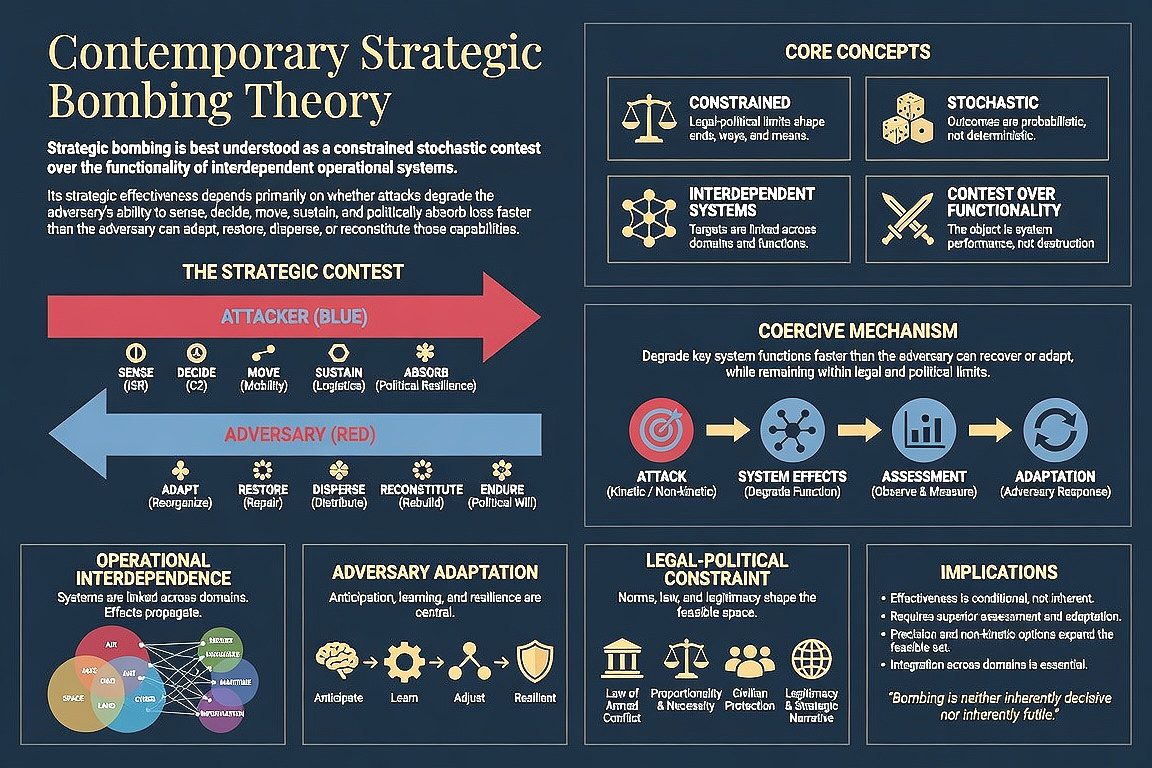
This article advances the following thesis: contemporary strategic bombing is best understood as a constrained stochastic contest over the functionality of interdependent operational systems. Its strategic effectiveness depends primarily on whether attacks degrade the adversary’s ability to sense, decide, move, sustain, and politically absorb loss faster than the adversary can adapt, restore, disperse, or reconstitute those capabilities. Under this view, bombing is neither inherently decisive nor inherently futile. Its value is conditional on the structure of the targeted system, the interaction of military and nonmilitary pressures, the quality of assessment and adaptation, and the legal legitimacy of the campaign.
Literature Review
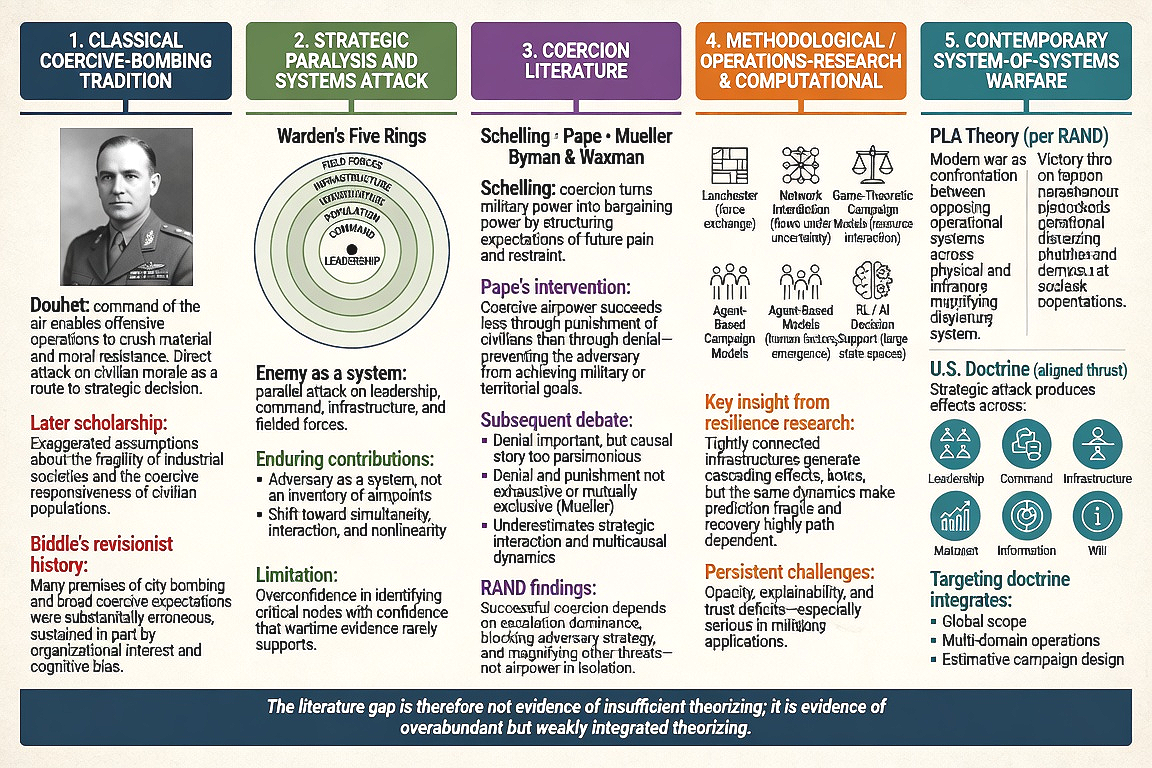
The first major school is the classical coercive-bombing tradition. Douhet argued that command of the air would enable offensive operations capable of crushing the enemy’s material and moral resistance, and he treated direct attack on civilian morale as a credible route to strategic decision. This tradition proved extraordinarily influential, but later scholarship has shown that the intellectual foundations of interwar strategic-bombing thought rested on exaggerated assumptions about the fragility of industrial societies and the coercive responsiveness of civilian populations. Biddle’s revisionist history of Anglo-American bombing doctrine argues that many premises underlying city bombing and broad coercive expectations were substantially erroneous and sustained in part by organizational interest and cognitive bias.
The second major school centers on strategic paralysis and systems attack. Warden’s “enemy as a system” shifted emphasis from broad industrial punishment to parallel attack on an adversary’s most consequential system functions, with leadership, command, infrastructure, and fielded forces arranged in a five-ring model. Fadok’s comparison of Boyd and Warden situated this move within a broader transition from industrial targeting toward command and information targeting, while distinguishing Boyd’s psychological paralysis from Warden’s more form-oriented physical paralysis. This literature made two enduring contributions: it understood the adversary as a system rather than an inventory of aimpoints, and it pushed theory toward simultaneity, interaction, and nonlinearity. Yet it also tended to assume that critical nodes could be identified with more confidence than wartime evidence normally allows.
The third school is the coercion literature associated with Schelling, Pape, Mueller, and Byman and Waxman. Schelling’s central insight was that coercion turns military power into bargaining power by structuring expectations of future pain and restraint; airpower became one of the principal instruments through which such bargaining could be attempted. Pape’s major intervention was to argue that coercive air campaigns succeed less through punishment of civilians than through denial, that is, by preventing the adversary from achieving military or territorial goals. Subsequent debate accepted the importance of denial but challenged Pape’s causal parsimony. Mueller argued that denial and punishment are not exhaustive or mutually exclusive categories, while later critics contended that Pape’s theory underestimates strategic interaction and multicausal dynamics. RAND’s work on airpower as a coercive instrument further showed that successful coercion usually depends on escalation dominance, blocking the adversary’s military strategy, and magnifying other threats rather than on airpower acting in isolation.
The fourth school is methodological rather than substantive: the operations-research, systems-engineering, and computational literature. Here, the field moves from narrative theory to formal models of force exchange, interdiction, allocation, adaptation, and resilience. Lanchester-based work retains value for force-exchange intuition but remains too coarse for system-level strategic attack. Network-interdiction research models how limited offensive effort can disrupt adversary flows, including under uncertainty and asymmetric information. Air-campaign and air-operations models have extended this logic through game-theoretic resource interaction and stochastic games. Agent-based models have incorporated human factors, command architectures, and emergent behaviors in network-enabled operations. More recent work in reinforcement learning and AI-based decision support shows promise for large state spaces, but also foregrounds opacity, explainability, and trust deficits that are especially serious in military applications. Modern resilience research on interdependent networks adds a further insight: tightly connected infrastructures can generate cascading effects, but those same dynamics also make prediction fragile and recovery highly path dependent.
A final, increasingly important strand is contemporary system-of-systems warfare. RAND’s analysis of the People’s Liberation Army shows that Chinese theory increasingly treats modern war as confrontation between opposing operational systems across physical and informational domains, with victory coming through disruption, paralysis, or destruction of the adversary’s operational system rather than through battlefield annihilation alone. Recent U.S. doctrine, though arriving by a different route, similarly treats strategic attack as producing effects across leadership, command, infrastructure, information, and will, while targeting doctrine explicitly integrates global, multi-domain, and estimative dimensions of campaign design. The literature gap is therefore not evidence of insufficient theorizing; it is evidence of overabundant but weakly integrated theorizing.
Methodology and Analytical Framework
This article adopts a comparative analytical methodology oriented toward theory building rather than statistical estimation. It compares five literatures: classical airpower theory, strategic-paralysis theory, coercion theory, contemporary doctrine, and operations-research/computational modeling. Historical cases are used illustratively rather than as a new archival contribution: the European strategic-bombing experience, the post–Cold War coercion debates surrounding Kosovo, the doctrinal legacy of Desert Storm and Iraqi Freedom, and contemporary U.S. and Chinese concepts of strategic attack. The comparative objective is to identify which explanatory mechanisms travel across these literatures and which remain bounded to the assumptions of particular schools.
The article proceeds from four analytical premises. First, strategic effect is not synonymous with physical destruction; it is a change in the adversary’s decision environment relative to political objectives. Second, adversaries are adaptive systems rather than passive inventories of targets. Third, campaign design is made under uncertainty and therefore must be evaluated through stochastic and robust, not purely deterministic, reasoning. Fourth, legal and civilian-harm constraints are not exogenous moral commentary but endogenous strategic variables that shape the feasible set of actions, coalition cohesion, legitimacy, and escalation risk. These premises are consistent with contemporary targeting doctrine, customary humanitarian law on distinction and proportionality, and the Department of Defense’s institutionalization of civilian-harm mitigation and response.
The scope conditions are deliberately limited. The argument concerns conventional and nonnuclear strategic attack in contemporary state and state-like conflict. It does not claim that a single framework can explain nuclear coercion, insurgent violence, or every form of countervalue terror. Nor does it claim that strategic bombing can be reduced to a tractable optimization problem in practice. Rather, the aim is more modest and more defensible: to specify the minimum formal structure required if theory is to remain faithful to actual strategic interaction, campaign adaptation, and lawful targeting.
Main Analysis and Results
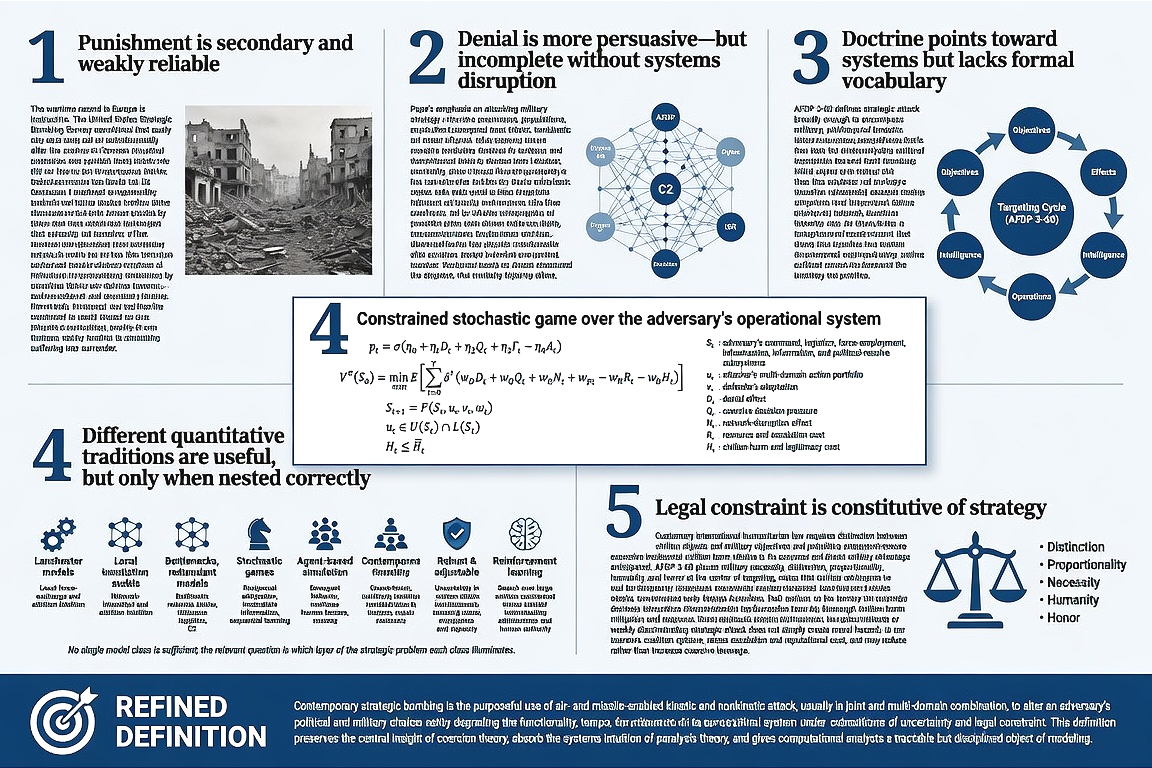
The first analytical result is that punishment is best treated as a secondary and weakly reliable mechanism, not as the strategic core of contemporary bombing theory. The wartime record in Europe is instructive. The United States Strategic Bombing Survey concluded that early city-area raids did not substantially alter the course of German war production, even though they deteriorated morale; workers, by and large, continued to work under coercive police-state conditions. The same survey judged the attack on transportation decisive in disorganizing the German economy and emphasized the strategic importance of attacks on oil. Biddle’s broader revisionist argument strengthens the same conclusion: the strongest claims for direct coercion through civilian pain rested on flawed assumptions about industrial and social vulnerability. Contemporary theory should therefore begin from the proposition that strategic bombing works, when it works, primarily by constricting options, not by mechanically converting suffering into surrender.
The second result is that denial theory is substantially more persuasive than punishment theory, but it remains incomplete unless extended into a systems-disruption framework. Pape’s emphasis on attacking military strategy rather than economies, populations, or leaders corrected much of the classical literature, and RAND’s coercion research further clarified that coercion succeeds when the coercer can dominate escalation, block the adversary’s strategy, and magnify third-party threats. Yet denial alone does not explain modern campaigns adequately because strategic attack is increasingly applied to command networks, ISR architectures, logistics webs, cyber dependencies, and electromagnetic links that connect battlefield performance to national decision. In that respect, Warden’s systems intuition and contemporary PLA “system destruction warfare” capture an important reality that a narrow battlefield-denial model misses: what matters is not only attriting forces but degrading the adversary system that senses, coordinates, and sustains them.
The third result is conceptual rather than empirical: contemporary doctrine already points toward a systems framework but lacks an adequate formal vocabulary. AFDP 3-02 defines strategic attack broadly enough to encompass military, political, economic, kinetic, and nonkinetic campaigns intended to affect the adversary’s will and capacity to fight. AFDP 3-60, meanwhile, gives a more disciplined description of targeting as a continuous analytic cycle linking objectives, effects, estimation, intelligence, and operations. Recent doctrinal criticism has shown that these two strands are not yet fully reconciled. Strategic attack is described doctrinally through overlapping references to centers of gravity, systemic shock, will, capacity, and strategic objectives, but without a clear mathematical account of how these variables are related. The field’s task is therefore not to replace doctrine with abstraction, but to formalize what doctrine already implies.
That formalization can be stated as a constrained stochastic game over an adversary’s operational system. Let the state (S_t) represent the condition of the adversary’s command, logistics, force-employment, infrastructure, information, and political-resolve subsystems at time (t). Let (u_t) be the attacker’s multi-domain action portfolio and (v_t) the defender’s adaptation. Let (D_t) denote denial effect, (Q_t) coercive decision pressure, (N_t) network-disruption effect, (R_t) resource and escalation cost, and (H_t) civilian-harm and legitimacy cost.
[ \begin{aligned} p_t &= \sigma!\left(\eta_0 + \eta_1 D_t + \eta_2 Q_t + \eta_3 \Gamma_t - \eta_4 A_t\right),\[4pt] V^{\pi}(S_0) &= \min_{\nu} ; \mathbb{E}!\left[\sum_{t=0}^{T}\delta^{t} \left( w_D D_t + w_Q Q_t + w_N N_t + w_p p_t - w_R R_t - w_H H_t \right)\right],\[4pt] S_{t+1} &= F(S_t,u_t,v_t,\omega_t),\[4pt] u_t &\in \mathcal{U}(S_t)\cap\mathcal{L}(S_t),\[4pt] H_t &\le \bar{H}_t . \end{aligned} ]
This representation yields a fourth result: different quantitative traditions are useful, but only when nested correctly. Lanchester models remain analytically valuable for local force-exchange and attrition intuition, yet they do not represent networks, adaptation, or legal feasibility. Network-interdiction models capture bottlenecks and redundant pathways and are therefore well suited to infrastructure, logistics, and C2 disruption. Stochastic games are superior when the central problem is reciprocal adaptation, incomplete information, and sequential learning. Agent-based simulation is best for exploring emergent behavior, nonlinear human factors, and organizational friction. Robust and adjustable optimization are necessary wherever uncertainty in system status, intelligence quality, or repair capacity is high. Reinforcement learning may assist with search over large action spaces, but only in conjunction with interpretable architectures and human decision authority. No single model class is sufficient; the relevant question is which layer of the strategic problem each class illuminates.
The fifth result is that legal constraint must be treated as constitutive of strategy. Customary international humanitarian law requires distinction between civilian objects and military objectives and prohibits attacks expected to cause excessive incidental civilian harm relative to the concrete and direct military advantage anticipated. AFDP 3-60 places military necessity, distinction, proportionality, humanity, and honor at the center of targeting, states that civilian objects may not be intentionally targeted unless recharacterized as military objectives through the two-part test, and emphasizes early, continuous involvement of judge advocates. DoD Instruction 3000.17 extends this logic institutionally through civilian-harm mitigation and response. Strategically, this matters because indiscriminate or weakly discriminating strategic attack does not simply create moral hazard; it narrows coalition options, raises escalation and reputational cost, and may reduce rather than increase coercive leverage.
These results support a refined definition of contemporary strategic bombing: it is the purposeful use of air- and missile-enabled kinetic and nonkinetic attack, usually in joint and multi-domain combination, to alter an adversary’s political and military choice set by degrading the functionality, tempo, and coherence of its operational system under conditions of uncertainty and legal constraint. This definition preserves the central insight of coercion theory, absorbs the systems intuition of paralysis theory, and gives computational analysts a tractable but disciplined object of modeling.
Discussion
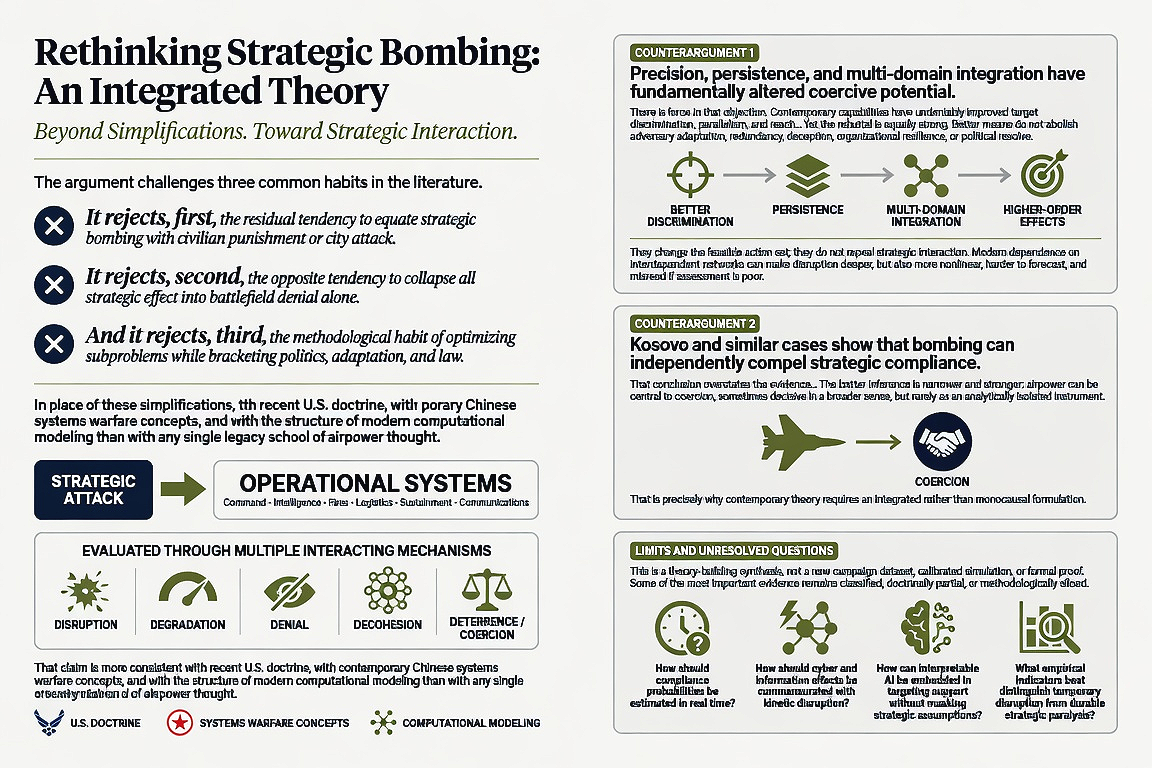
The argument advanced here challenges three common habits in the literature. It rejects, first, the residual tendency to equate strategic bombing with civilian punishment or city attack. It rejects, second, the opposite tendency to collapse all strategic effect into battlefield denial alone. And it rejects, third, the methodological habit of optimizing subproblems while bracketing politics, adaptation, and law. In place of these simplifications, the article proposes an integrated theory in which bombing is one modality of strategic attack directed against operational systems and evaluated through multiple interacting mechanisms. That claim is more consistent with recent U.S. doctrine, with contemporary Chinese systems warfare concepts, and with the structure of modern computational modeling than with any single legacy school of airpower thought.
The strongest counterargument is that precision, persistence, and multi-domain integration have fundamentally altered the coercive potential of bombing, making older skepticism too pessimistic. There is force in that objection. Contemporary capabilities have undeniably improved target discrimination, parallelism, and reach, and both doctrine and systems-warfare analysis assume that information-dominant campaigns can produce higher-order effects by striking C2, intelligence, or infrastructure networks with far more precision than interwar or World War II advocates could imagine. Yet the rebuttal is equally strong. Better means do not abolish adversary adaptation, redundancy, deception, organizational resilience, or political resolve. They change the feasible action set; they do not repeal strategic interaction. Indeed, modern dependence on interdependent networks can make disruption deeper, but also more nonlinear, harder to forecast, and easier to misread if assessment is poor.
A second counterargument points to Kosovo and similar cases as evidence that bombing can independently compel strategic compliance. That conclusion overstates the evidence. Even analyses sympathetic to airpower’s strategic role emphasize that the question “can airpower alone coerce?” is often badly posed, because airpower usually operates alongside diplomacy, sanctions, alliance politics, land threats, and adversary internal pressures. The better inference is narrower and stronger: airpower can be central to coercion, sometimes decisive in a broader sense, but rarely as an analytically isolated instrument. That is precisely why contemporary theory requires an integrated rather than monocausal formulation.
The article’s limits should be stated plainly. It does not present a new campaign dataset, a calibrated simulation, or a formal proof of equilibrium properties. Some of the most important contemporary evidence remains either classified, doctrinally partial, or methodologically siloed. The proposed framework is therefore a theory-building synthesis, not a substitute for empirical campaign assessment or for operational judgment. The unresolved questions are also clear: how should compliance probabilities be estimated in real time; how should cyber and information effects be commensurated with kinetic disruption; how can interpretable AI be embedded in targeting support without masking strategic assumptions; and what empirical indicators best distinguish temporary disruption from durable strategic paralysis?
Conclusion
Contemporary strategic bombing theory should move beyond the sterile opposition between punishment and denial. The better framework is an integrated strategic-attack theory in which bombing is one instrument of lawful, adaptive, multi-domain pressure applied against an adversary’s operational system. The core analytical variable is not destruction per se, but the changing functionality and coherence of the adversary system under reciprocal adaptation. From this perspective, the strategic value of bombing is conditional: it rises when attacks exploit bottlenecks, compress decision time, coordinate with other instruments of power, and remain within legal-political bounds; it falls when campaigns substitute destruction for strategy, mistake node centrality for systemic fragility, or treat coercion as a mechanical output of punishment.
The article’s contribution is therefore both substantive and methodological. Substantively, it refines strategic bombing theory into a systems-disruption theory of coercive effect. Methodologically, it shows how coercion theory, network interdiction, stochastic games, agent-based simulation, robust optimization, and civilian-harm constraints can be nested within one unified analytical architecture. Future research should now shift from debating whether airpower can ever be strategic to specifying, with empirical discipline, when and how strategic attack changes adversary decision under conditions of system interdependence, uncertainty, and law. That agenda is better suited to the realities of contemporary warfare than either the optimism of classical bombing theory or the reductionism of single-mechanism alternatives.

References
Biddle, Tami Davis. Rhetoric and Reality in Air Warfare: The Evolution of British and American Ideas about Strategic Bombing, 1914–1945. Princeton, NJ: Princeton University Press, 2002.
Byman, Daniel L., Matthew C. Waxman, and Eric V. Larsen. Air Power as a Coercive Instrument. Santa Monica, CA: RAND Corporation, 1999.
Cangiotti, N., M. Capolli, and M. Sensi. “A Generalization of Unaimed Fire Lanchester’s Model in Multi-Battle Warfare.” Operational Research 23 (2023).
Cormican, Kelly J., David P. Morton, and R. Kevin Wood. “Stochastic Network Interdiction.” Operations Research 46, no. 2 (1998): 184–197.
Department of Defense. DoD Instruction 3000.17: Civilian Harm Mitigation and Response. Washington, DC, December 21, 2023.
Department of Defense. Department of Defense Law of War Manual. Updated July 2023.
Douhet, Giulio. The Command of the Air. Translated by Dino Ferrari. Maxwell AFB, AL: Air University Press, 2019.
Engstrom, Jeffrey. Systems Confrontation and System Destruction Warfare: How the Chinese People’s Liberation Army Seeks to Wage Modern Warfare. Santa Monica, CA: RAND Corporation, 2018.
Fadok, David S. John Boyd and John Warden: Air Power’s Quest for Strategic Paralysis. Maxwell AFB, AL: Air University Press, 1995.
Ghose, Debasish, Jason Speyer, and Jeff Shamma. “A Game Theoretical Multiple Resource Interaction Approach to Resource Allocation in an Air Campaign.” Annals of Operations Research 109, no. 1 (2002): 15–40.
Huang, Liwei, Mingsheng Fu, Hong Qu, Siying Wang, and Shangqian Hu. “A Deep Reinforcement Learning-Based Method Applied for Solving Multi-Agent Defense and Attack Problems.” Expert Systems with Applications 176 (2021): 114896.
International Committee of the Red Cross. “Rule 7. The Principle of Distinction Between Civilian Objects and Military Objectives.” Customary IHL Database.
International Committee of the Red Cross. “Rule 14. Proportionality in Attack.” Customary IHL Database.
Kamihigashi, Takashi. “41 Counterexamples to Property (B) of the Discrete Time Bomber Problem.” Annals of Operations Research 248 (2017): 579–588.
McCourt, Richard, Kevin Ng, and Roy Mitchell. “An Agent-Based Approach Towards Network-Enabled Capabilities: Simulation Validation and Illustrative Examples.” The Journal of Defense Modeling and Simulation 10, no. 3 (2013).
McEneaney, William M., Ben G. Fitzpatrick, and Istvan G. Lauko. “Stochastic Game Approach to Air Operations.” IEEE Transactions on Aerospace and Electronic Systems 40, no. 4 (2004): 1191–1216.
Mueller, Karl P. “Strategies of Coercion: Denial, Punishment, and the Future of Air Power.” Security Studies 7, no. 3 (1998): 182–228.
Pape, Robert A. Bombing to Win: Air Power and Coercion in War. Ithaca, NY: Cornell University Press, 1996.
Schelling, Thomas C. Arms and Influence. New Haven, CT: Yale University Press, 1966.
Smith, J. Cole, and Yongjia Song. “A Survey of Network Interdiction Models and Algorithms.” European Journal of Operational Research 283, no. 3 (2020): 797–811.
Swallow, Robert Chandler. “Considering the Cost of Cyber Warfare: Advancing Cyber Warfare Analytics to Better Assess Tradeoffs in System Destruction Warfare.” The Journal of Defense Modeling and Simulation 20, no. 1 (2023): 3–37.
United States Air Force. Air Force Doctrine Publication 3-02: Strategic Attack. Maxwell AFB, AL: Curtis E. LeMay Center for Doctrine Development and Education, August 4, 2025.
United States Air Force. Air Force Doctrine Publication 3-60: Targeting. Maxwell AFB, AL: Curtis E. LeMay Center for Doctrine Development and Education, May 1, 2026.
United States Strategic Bombing Survey. Summary Report: European War. Washington, DC: U.S. Government Printing Office, 1945.
Venable, Heather P. “Reconceptualizing Strategic Attack: Implications for the Air Force.” Air & Space Power Journal 36, no. 1 (2026).
Zhou, Jian, Weijian Zheng, Dali Wang, and David W. Coit. “A Resilient Network Recovery Framework Against Cascading Failures with Deep Graph Learning.” Proceedings of the Institution of Mechanical Engineers, Part O: Journal of Risk and Reliability 238, no. 1 (2024).