Masks of the Mind: Psychological Themes, Philosophical Analysis, and the Human Nature Duality in…
Hyde is not an intruder from outside; he is the concentrated residue of appetites Jekyll has learned to sequester. The tale becomes a case study in what happens when repression acquires a beaker and a lockable door.
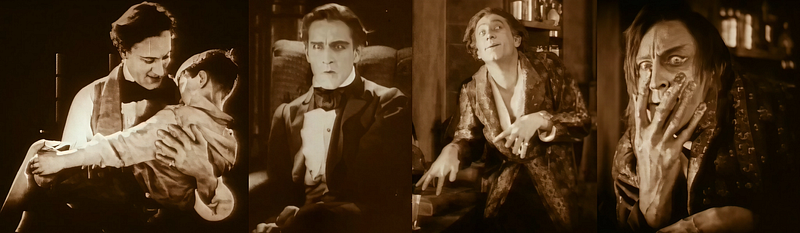
Masks of the Mind: Psychological Themes, Philosophical Analysis, and the Human Nature Duality in Robert Louis Stevenson’s Dr. Jekyll and Mr. Hyde
Why did you wake me? I was dreaming a fine bogey tale!
I had long been trying to write a story on this subject, to find a body, a vehicle, for that strong sense of man’s double being which must at times come in upon and overwhelm the mind of every thinking creature… I had even written one, The Travelling Companion, which was returned by an editor on the plea that it was a work of genius and indecent, and I burned it… But then I dreamed a scene, and that was the little scene that I wrote out in the morning… the scene of the transformation of Jekyll into Hyde. Man is not truly one, but truly two… I hazard the guess that man will be ultimately known for a mere polity of multifarious, incongruous, and independent denizens. I had learned to dwell with pleasure… on the thought of the separation of these elements… The unjust might go his way, delivered from the aspirations and remorse of his more upright twin. The characters in the tale forced themselves on me without my will.
Freud arrived after Stevenson, but the novella practically invites psychoanalytic mapping. The compulsion that drives Henry Jekyll to split himself registers as a laboratory version of the mind’s everyday compartmentalization. Hyde is not an intruder from outside; he is the concentrated residue of appetites Jekyll has learned to sequester. The tale becomes a case study in what happens when repression acquires a beaker and a lockable door.
The id appears in Hyde’s unmediated drives, his quickness to violence, his relish for anonymity and night, his willingness to trample a child and murder Sir Danvers Carew. Hyde’s body itself reads like instinct made flesh: smaller, hairier, simian at a glance, and repellent in ways observers cannot rationally specify. The ego operates through the respectable persona of Dr. Jekyll, who calibrates appearances, schedules experiments, drafts rationalizations, and manages the logistics of a double life, from the separate Soho lodgings to the careful instructions given to Poole and Lanyon. The superego sounds in the narrative’s moral atmosphere and in Jekyll’s conscience, which never dissolves even as Hyde tightens his grip. Jekyll’s confession frames the experiment as a failed ethical project to isolate the good from the bad, an ambition he articulates in sober, clinical prose that cannot quite hide the thrill of release. When he declares that “man is not truly one, but truly two,” the sentence functions as diagnosis, credo, and defense. The catastrophe that follows is the ego’s loss of arbitration power: Hyde begins to emerge without the potion, and the demands of instinct stop asking permission.
The story’s meditation on good and evil rejects simple arithmetic. Stevenson denies that virtue is a permanent possession and vice a removable stain. Goodness in Jekyll depends on constraint, habit, reputation, and fear of shame; evil requires only opportunity, secrecy, and the promise of impunity. Jekyll’s early narrative casts Hyde as a technical solution to an ethical problem, a tidy arrangement by which a gentleman may sin without consequence. The murder of Carew collapses that illusion. Evil is not a detachable mask but a potential sovereign. Once granted its own name and address, it stops returning the keys.
Societal hypocrisy is the novella’s oxygen. Polite London facilitates Hyde as efficiently as it applauds Jekyll. Lawyers exchange sealed envelopes, servants observe but do not ask, physicians insist on a veneer of professional discretion even when reality strains credulity. Jekyll’s house itself operates as an allegory: the handsome front with its respectable door gives onto a rear entry that Hyde alone uses, a spatial grammar of two-faced urban virtue. Enfield’s rule never to inquire into “the moral side” of another man’s affairs is less a principle than a conspiracy of silence. Respectability is portrayed as a performative contract whose first clause forbids looking too closely.
The duality of human nature is not presented as a balance but as a contest with asymmetrical weapons. Jekyll’s better self is articulate, philanthropic, and eager for esteem; Hyde’s worse self is efficient, shameless, and physiologically gratifying. The transformation scenes dramatize the pull of embodiment. Hyde offers the illicit relief of “you may” where Jekyll’s life has been a constant “you must not.” Stevenson anchors that drama in the body, describing the physical “grinding” and “deadly nausea” that accompany metamorphosis. The mind does not merely choose; it buckles, craves, and adapts.
The text’s relation to alcohol surfaces both literally and metaphorically. The potion is repeatedly described as a “tincture” and a “drug,” terms that sit within the Victorian pharmacological world that included ethanol, laudanum, and house-made cordials. Jekyll’s pattern maps uncannily onto the arc of substance misuse. He begins with controlled doses that promise freedom from inhibition. He rationalizes the practice as experimental and hygienic, as if technique could absolve motive. He develops tolerance, requiring repeated recourse to the cabinet. He experiences loss of control, finding the transformation to Hyde occurring without ingestion, as if the body had learned a shortcut. He confronts supply-chain panic when the salt no longer works, searching chemists for the exact impure compound on which his relief depends. Withdrawal appears not as shakes but as moral terror, the dread that the public self will be permanently eclipsed by the private craving made visible.
The social ecology around the potion resembles the culture around drinking. Jekyll entertains with decorum, performs benevolence, and then retires to the laboratory, as if moving from drawing room to back room mirrored the path from social glass to secret bottle. Hyde haunts alleys and late hours in the way a binge haunts the margins of the day. The novella treats intoxication less as a specific vice and more as a grammar of self-division: stimulus, release, secrecy, repetition, and the gradual rerouting of the will. If alcohol is not named as the culprit, the narrative borrows its logic to stage how a respectable life can become a ceremony of concealment.
Across these strands, the book refuses both moralism and moral relativism. It shows the truth of appetite and the cost of indulgence. It exposes public virtue’s dependence on private denial while refusing to sentimentalize transgression as liberation. The laboratory does not invent the split in Jekyll; it strips away the courtesies that kept the split from ruling him. What remains at the end is a city of watchers who did not want to know, a body that remembered what pleasure taught it, and a gentleman who discovered that the worst parts of himself were not alien but at home.
Stevenson’s Reasons for Dr. Jekyll and Mr. Hyde
Although Robert Louis Stevenson offered no single reason for writing The Strange Case of Dr. Jekyll and Mr. Hyde, his various explanations point to a powerful convergence of influences. The initial spark was a vivid dream, which he cited as the direct source of the story’s most chilling scenes. This dream, however, tapped into his deep philosophical fascination with the duality of human nature, a theme brought to life by his knowledge of real-world figures like the criminal Deacon William Brodie (an Edinburgh councilor by day and criminal by night) and the murderer Eugene Chantrelle (a French teacher who led a double life as a murderer). His friendships with individuals grappling with repressed identities, such as Walter Jekyll (a gay man who renounced his religious vocation) and John Addington Symonds (a homosexual writer), further informed this exploration.
Walter Jekyll was a close friend of Stevenson’s who provided the surname for the protagonist. More importantly, he was a real-life example of a divided self: an Anglican clergyman who renounced his religious vocation, embodying the theme of a public identity in conflict with a private one. John Addington Symonds, a historian and literary critic, was another acquaintance whose work and life explored repressed homosexuality. He wrote candidly, though privately, about the duality of living a concealed life in a repressive Victorian society. Stevenson’s familiarity with these men’s struggles with identity and societal expectations deeply informed the philosophical and psychological underpinnings of Jekyll and Hyde’s plight.
While he crafted the tale as a gripping “shilling shocker” designed to captivate a mass audience, he also intended it as a serious critique of Victorian society’s hypocrisy and repression. This ethical dimension was so potent that his wife noted he burned his first draft for being “too allegorical,” leading him to refine the story to emphasize psychological and social consequences over mere moralizing. Finally, though he downplayed the connection, his own personal struggles with chronic illness and the powerful medications he took likely colored the story’s visceral themes of bodily transformation and a loss of control, making the fantastical tale feel unnervingly real.