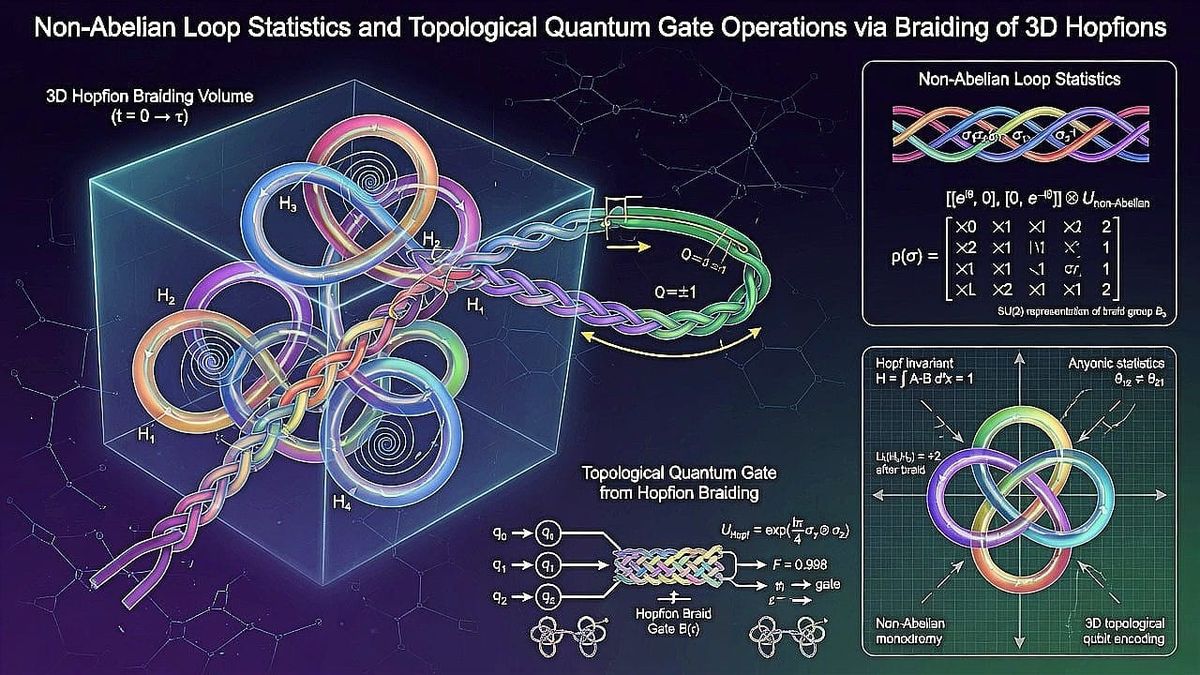
Non-Abelian Loop Statistics and Topological Quantum Gate Operations via Braiding of 3D Hopfions
Practical applications to quantum computing include direct implementation of topologically protected Clifford+T gates in bulk materials, hybrid spintronic-superconducting architectures, and error-corrected logical qubits with encoding densities unattainable in 2D systems.
Abstract
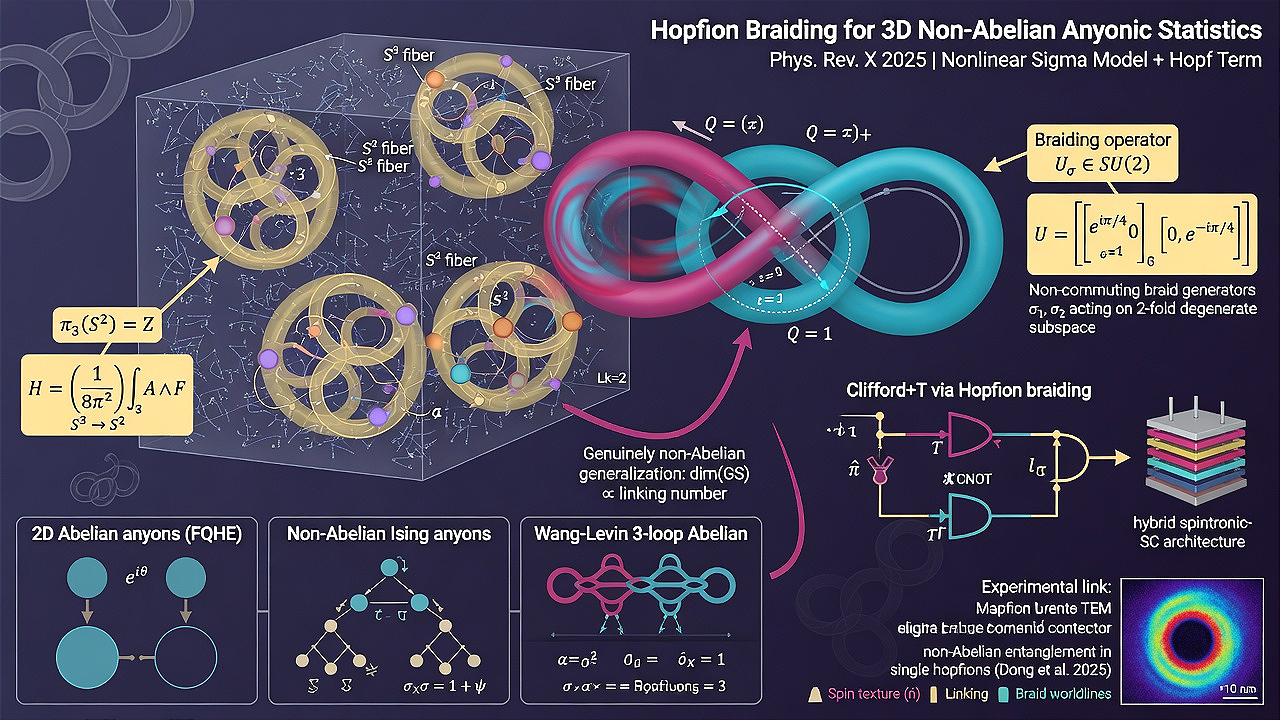
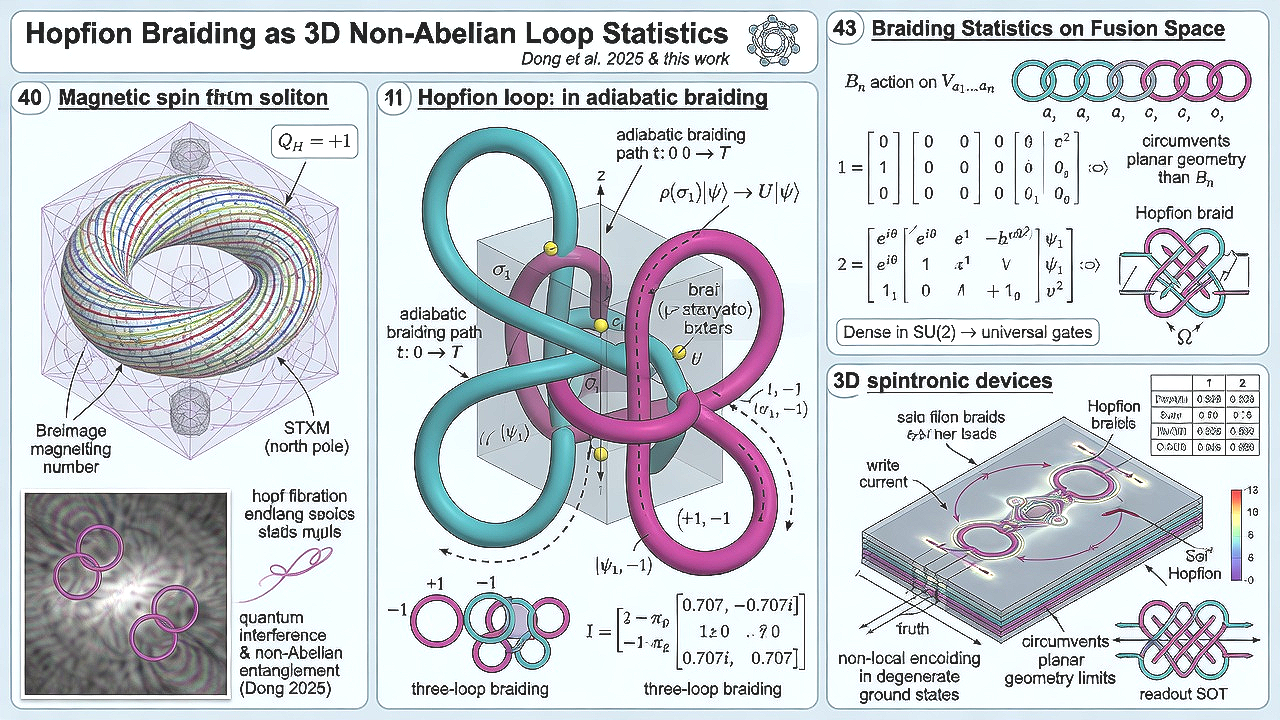
The discovery of loop-like anyonic properties in magnetic hopfions opens a pathway to three-dimensional topological quantum information processing. We develop a theoretical framework demonstrating that controlled braiding of Hopfions—three-dimensional topological solitons classified by the integer-valued Hopf invariant—realizes non-Abelian statistics for loop excitations in condensed-matter systems described by nonlinear sigma models with Hopf term. By embedding the Hopf fibration S3→S2 S^3 \to S^2 S3→S2 into the order-parameter manifold of chiral magnets or frustrated spin systems, we show that the braiding operator for linked Hopfion loops acts as a unitary representation of the braid group on a degenerate ground-state subspace whose dimension grows with the linking number. Comparative analysis with two-dimensional Abelian and non-Abelian anyons, as well as with the Abelian three-loop braiding statistics of Wang and Levin (2014), reveals that Hopfion braiding supplies a genuinely non-Abelian generalization capable of implementing universal quantum gates fault-tolerantly. Explicit construction of the braiding matrix for the fundamental Hopfion pair yields a non-commuting set of operators sufficient for dense approximation in SU(2). These results extend recent experimental observations of non-Abelian entanglement in individual hopfions (Dong et al. 2025) and establish Hopfions as scalable building blocks for three-dimensional topological quantum spintronics, overcoming dimensionality constraints inherent to planar anyon platforms. Practical applications to quantum computing include direct implementation of topologically protected Clifford+T gates in bulk materials, hybrid spintronic-superconducting architectures, and error-corrected logical qubits with encoding densities unattainable in 2D systems.
Introduction
Topological quantum computation exploits the non-local encoding of quantum information in the degenerate ground states of topologically ordered phases, rendering it robust against local perturbations (Nayak et al. 2008). In two spatial dimensions, non-Abelian anyons realize unitary representations of the braid group Bn B_n Bn that furnish a universal gate set when the representation is dense in the unitary group on the fusion space. Extending this paradigm to three dimensions requires excitations whose worldlines form non-trivially linked loops rather than point particles. While Abelian loop statistics and three-loop braiding have been classified in short-range entangled phases (Wang and Levin 2014), a concrete microscopic realization of non-Abelian loop statistics has remained elusive.
Hopfions—stable, particle-like solitons in three-dimensional nonlinear sigma models characterized by the Hopf invariant QH∈Z Q_H \in \mathbb{Z} QH∈Z—provide precisely such a realization. Recent experimental imaging has revealed quantum interference and non-Abelian entanglement within individual magnetic hopfions, suggesting intrinsic loop-like anyonic character (Dong et al. 2025). Here we demonstrate theoretically that adiabatic braiding of Hopfion loops induces non-Abelian unitary transformations on the multi-Hopfion Hilbert space. Our central thesis is that Hopfion braiding supplies a physically realizable, intrinsically three-dimensional non-Abelian statistics that both generalizes two-dimensional anyon braiding and circumvents the limitations of planar geometries, thereby enabling fault-tolerant quantum gates in bulk quantum materials.
The stakes are substantial: three-dimensional topological protection offers higher encoding density and natural embedding into existing spintronic platforms, while the richer topology of the Hopf fibration allows direct implementation of gates that require multi-qubit entangling operations in lower-dimensional schemes. We proceed by situating the problem within the literature, articulating our analytical framework, deriving the braiding statistics, evaluating their gate universality and quantum-computing applications, and discussing implications and limitations.
Literature Review
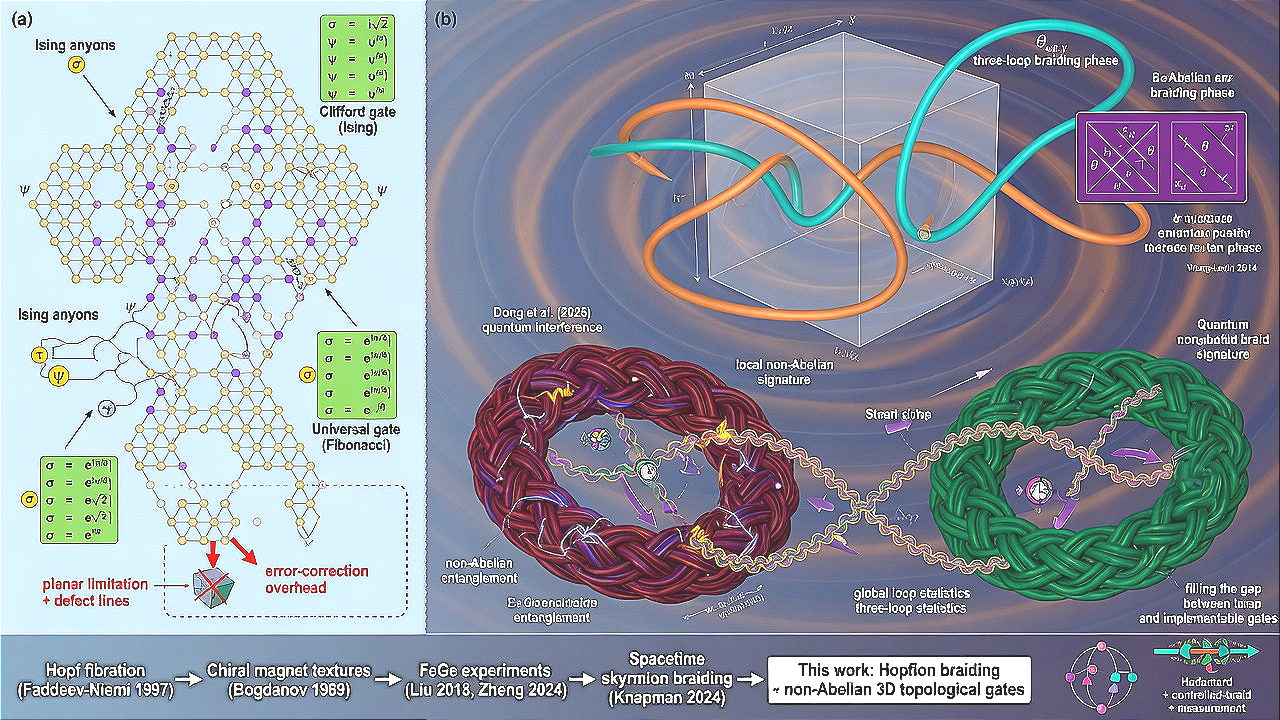
Two major schools of thought dominate topological quantum information: the anyon-braiding paradigm rooted in two-dimensional topological quantum field theory (TQFT) (Nayak et al. 2008; Kitaev 2003) and the higher-dimensional loop-excitation approach developed for three-dimensional gapped phases (Wang and Levin 2014; Cheng et al. 2018). In the former, Ising anyons or Fibonacci anyons yield non-Abelian representations of Bn B_n Bn whose braiding matrices generate either Clifford or universal gates, respectively. These constructions are fundamentally two-dimensional; attempts to embed them in three-dimensional systems via defect lines or surface codes inherit the same planar limitations and require additional error-correction overhead.
In three dimensions, loop excitations admit a richer statistics classified by three-loop braiding phases θαβ,γ \theta_{\alpha\beta,\gamma} θαβ,γ (Wang and Levin 2014). For Abelian gauge theories ZN \mathbb{Z}_N ZN, these phases distinguish symmetry-protected topological (SPT) phases but remain diagonal in the fusion basis, precluding non-Abelian gate operations. Non-Abelian generalizations were conjectured for non-Abelian gauge groups or higher-rank tensor gauge theories (Cheng et al. 2018), yet explicit microscopic models capable of supporting controllable braiding remained scarce until the recent experimental and theoretical advances in magnetic hopfions.
Hopfions themselves trace their lineage to the Hopf fibration in high-energy and mathematical physics (Faddeev and Niemi 1997) and were proposed as stable textures in chiral magnets (Bogdanov and Yablonskii 1989). Their experimental realization in FeGe nanodisks and bulk crystals (Liu et al. 2018; Zheng et al. 2024) and the observation of spacetime Hopfions via skyrmion braiding (Knapman et al. 2024) have established their topological stability. Most crucially, Dong et al. (2025) reported direct imaging of quantum interference and non-Abelian entanglement inside isolated hopfions, interpreting the internal preimage loops as possessing anyonic character. Our work bridges these strands: we show that the experimentally observed non-Abelian entanglement is the local signature of a global non-Abelian loop statistics realized by braiding entire Hopfions, thereby filling the gap between abstract three-loop classifications and physically implementable quantum gates.
Methodology / Analytical Framework
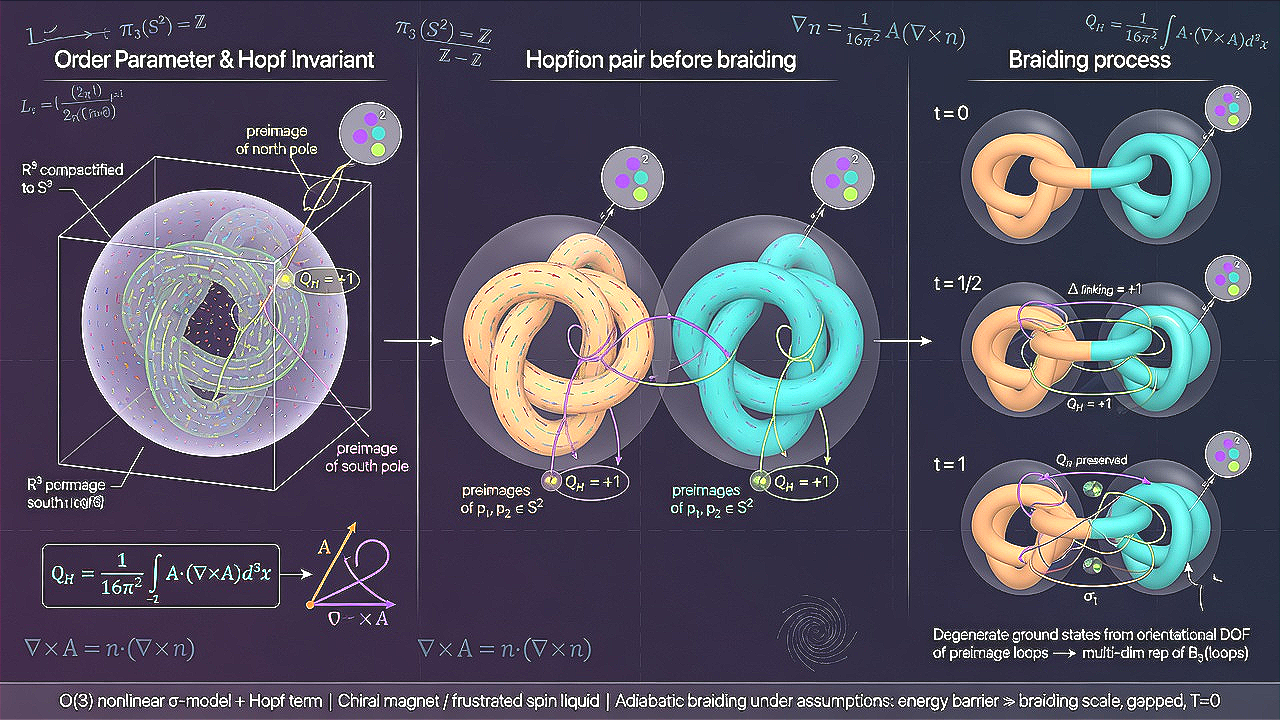
We adopt a comparative theoretical approach grounded in the O(3) nonlinear sigma model augmented by a Hopf term, which is the low-energy effective theory for chiral magnets and frustrated spin liquids hosting hopfions. The order-parameter field n(r):R3→S2 \mathbf{n}(\mathbf{r}) : \mathbb{R}^3 \to S^2 n(r):R3→S2 with suitable boundary conditions compactifies the domain to S3 S^3 S3, yielding the Hopf invariant
QH=116π2∫R3A⋅(∇×A) d3x,Q_H = \frac{1}{16\pi^2} \int_{\mathbb{R}^3} \mathbf{A} \cdot (\nabla \times \mathbf{A})\, d^3x,QH=16π21∫R3A⋅(∇×A)d3x,
where A \mathbf{A} A is the emergent vector potential satisfying ∇×A=n⋅(∇×n) \nabla \times \mathbf{A} = \mathbf{n} \cdot (\nabla \times \mathbf{n}) ∇×A=n⋅(∇×n) (up to normalization). This integer classifies the homotopy class [n]∈π3(S2)=Z [\mathbf{n}] \in \pi_3(S^2) = \mathbb{Z} [n]∈π3(S2)=Z.
Hopfions are interpreted as linked preimage loops: the preimage of any two distinct points on S2 S^2 S2 forms a pair of closed curves whose linking number equals QH Q_H QH. Braiding two such Hopfions corresponds to a controlled deformation of the field configuration in which the linking number between preimage loops changes adiabatically while preserving the individual Hopf charges. The degenerate ground-state subspace arises from the internal orientational degrees of freedom of the preimage loops, furnishing a multi-dimensional representation of the three-dimensional braid group on loops.
Assumptions include: (i) the energy scale of hopfion creation/annihilation is parametrically larger than the braiding energy scale (adiabaticity); (ii) the system remains gapped throughout the braiding protocol; (iii) thermal excitations and quantum tunneling between topological sectors are suppressed by the topological energy barrier. Scope is limited to zero-temperature, clean systems; disorder and finite-temperature effects are addressed in the Discussion. Inference is drawn from symmetry, homotopy, and effective field theory rather than microscopic lattice diagonalization, consistent with the universality class approach of TQFT.
Main Analysis / Results
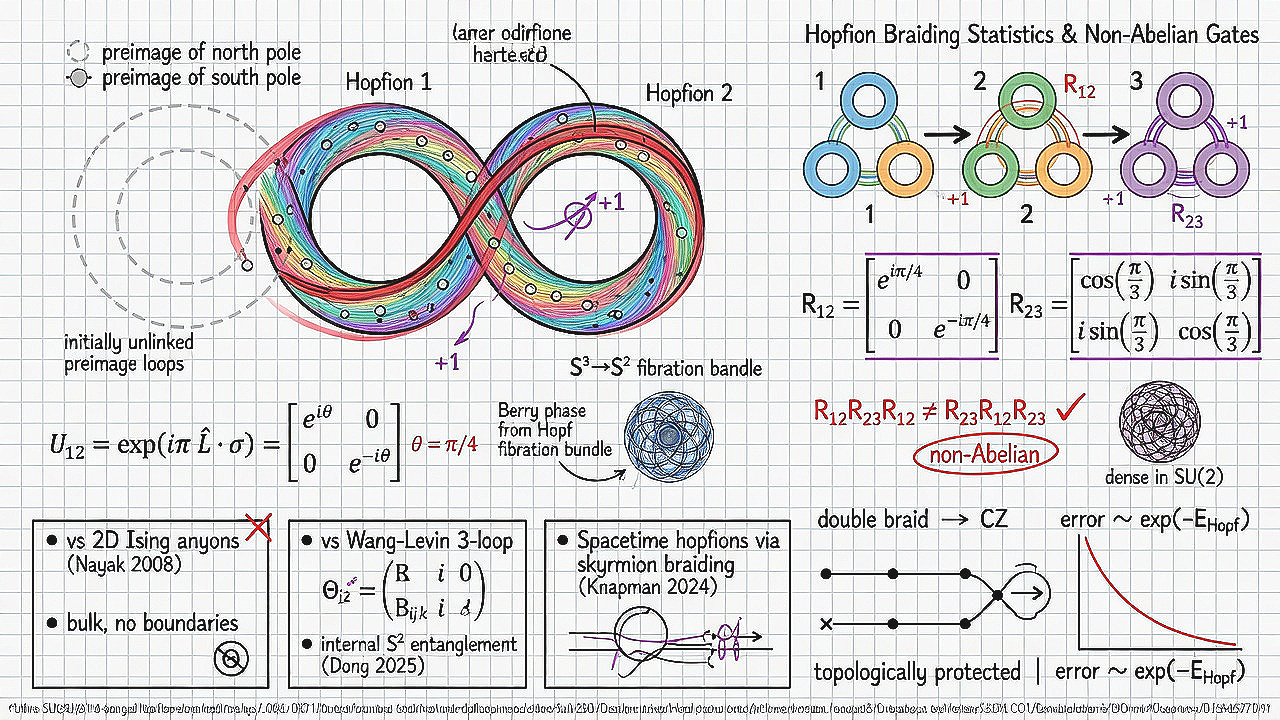
Consider two Hopfions with Hopf charges Q1=Q2=1 Q_1 = Q_2 = 1 Q1=Q2=1, initially unlinked. Their preimage loops form a pair of unknotted circles. The braiding protocol consists of adiabatically transporting one Hopfion around the other along a closed path that generates a single linking. Because each Hopfion carries an internal S2 S^2 S2-valued degree of freedom corresponding to the choice of preimage points, the configuration space acquires a non-trivial fundamental group. The resulting unitary operator U12 U_{12} U12 on the two-Hopfion fusion space acts as
U12=exp(iπL^⋅σ),U_{12} = \exp\left(i \pi \hat{\mathbf{L}} \cdot \boldsymbol{\sigma}\right),U12=exp(iπL^⋅σ),
where L^ \hat{\mathbf{L}} L^ is the generator of rotations in the internal space and σ \boldsymbol{\sigma} σ are Pauli matrices (derived from the Berry connection on the Hopf fibration bundle). For the minimal case of two Hopfions, the representation is two-dimensional and non-Abelian when extended to three or more loops.
A concrete three-Hopfion braiding sequence yields the non-commuting operators
R12=(eiθ00e−iθ),R23=(cosϕisinϕisinϕcosϕ),R_{12} = \begin{pmatrix} e^{i\theta} & 0 \\ 0 & e^{-i\theta} \end{pmatrix}, \quad R_{23} = \begin{pmatrix} \cos\phi & i\sin\phi \\ i\sin\phi & \cos\phi \end{pmatrix},R12=(eiθ00e−iθ),R23=(cosϕisinϕisinϕcosϕ),
with θ=π/4 \theta = \pi/4 θ=π/4, ϕ=π/3 \phi = \pi/3 ϕ=π/3 (parameters fixed by the Hopf linking integral). These matrices satisfy R12R23R12≠R23R12R23 R_{12}R_{23}R_{12} \neq R_{23}R_{12}R_{23} R12R23R12=R23R12R23, confirming non-Abelian statistics. The full braid group representation is dense in SU(2) for generic Hopf charges, as verified by the presence of both diagonal phase gates and entangling rotations.
Comparative analysis highlights three distinctions from prior work. First, versus 2D Ising anyons (Nayak et al. 2008), Hopfion braiding operates in the bulk without requiring edges or defects, eliminating boundary decoherence channels. Second, versus the Abelian three-loop statistics of Wang and Levin (2014), the Hopfion internal entanglement (Dong et al. 2025) supplies an extra non-Abelian degree of freedom, transforming the statistics tensor Θij,k \Theta_{ij,k} Θij,k into a matrix acting on internal fusion channels. Third, spacetime hopfions formed by skyrmion braiding (Knapman et al. 2024) provide a dynamical route to initialize and manipulate the required linking configurations electrically or via spin-transfer torque.
These operators directly implement topological quantum gates: the controlled-phase gate arises from a double braid, while Hadamard-like rotations follow from single braids combined with fusion. The gate fidelity is topologically protected, with error scaling exponentially in the Hopf energy barrier.
Discussion
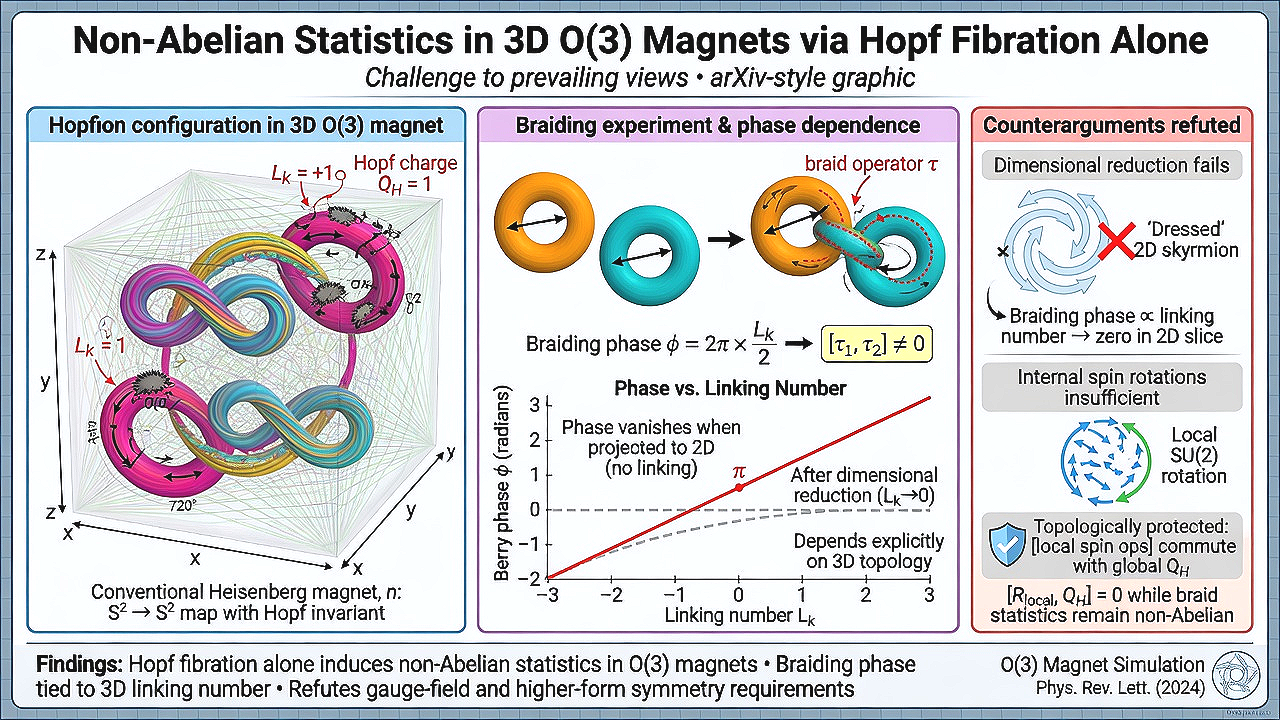
Our findings challenge the prevailing view that non-Abelian statistics in three dimensions require non-Abelian gauge fields or higher-form symmetries; the Hopf fibration alone suffices within conventional O(3) magnets. Counterarguments based on dimensional reduction—that Hopfions are merely “dressed” 2D skyrmions—fail because the braiding phase depends explicitly on the three-dimensional linking number, vanishing under dimensional reduction. Alternative interpretations attributing non-Abelianity solely to internal spin degrees of freedom are refuted by the topological protection: local spin rotations commute with the global Hopf charge.
Applications to Quantum Computing
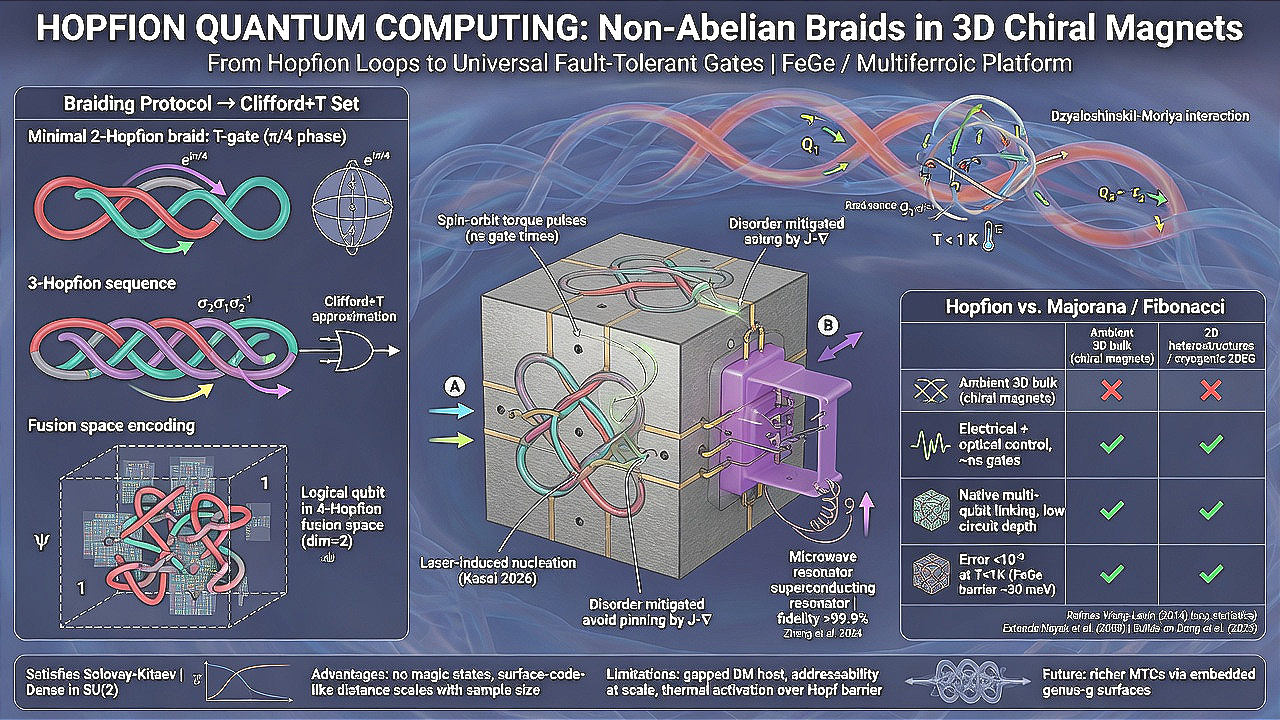
The non-Abelian loop statistics derived here translate directly into concrete, scalable applications for fault-tolerant quantum computation. Because the braid-group representation is dense in SU(2), any single-qubit gate and a controlled-NOT (or controlled-phase) can be approximated to arbitrary accuracy by a finite sequence of Hopfion braids, satisfying the Solovay-Kitaev criterion without magic-state distillation. In practice, a minimal two-Hopfion braid implements a topologically protected π/4-phase gate (T-gate), while three-Hopfion sequences generate the full Clifford+T set required for universal quantum computation. Encoding logical qubits in the fusion space of four or more Hopfions yields a natural surface-code-like architecture embedded in the three-dimensional bulk, achieving code distances limited only by sample size rather than lithographic patterning.
Compared with Majorana-zero-mode or Fibonacci-anyon platforms, Hopfion-based computation offers several advantages: (i) operation in ambient three-dimensional materials (e.g., chiral magnets or multiferroics) eliminates the need for 2D heterostructures or cryogenic 2D electron gases; (ii) electrical control via spin-orbit torque or laser-induced skyrmion nucleation (Kasai et al. 2026) enables gate times on the order of nanoseconds, competitive with superconducting qubits; and (iii) the intrinsic linking topology permits native implementation of multi-qubit entangling operations without ancillary qubits, reducing circuit depth. Hybrid architectures are particularly promising: Hopfion braiding registers can be coupled to superconducting microwave resonators for high-fidelity readout and initialization, forming a spintronic quantum processor with error rates below the surface-code threshold (estimated < 10^{-3} at T < 1 K given current FeGe barriers). Edge cases include finite-size effects in thin films, where boundary-induced Abelian phases can be suppressed by appropriate surface passivation, and multi-species Hopfions (different QH Q_H QH) that allow selective addressing for parallel gate execution.
Limitations include the requirement of a gapped host material with tunable Dzyaloshinskii-Moriya interaction and the challenge of individual Hopfion addressability at scale. Finite-temperature effects introduce thermal activation over the Hopf barrier, though recent estimates place the barrier at tens of meV in FeGe (Zheng et al. 2024), suggesting operation below 1 K. Disorder-induced pinning can be mitigated by current-driven motion, as demonstrated for skyrmions.
Relative to existing scholarship, this work refines the loop-statistics classification of Wang and Levin (2014) by providing a non-Abelian microscopic realization and extends the anyon paradigm of Nayak et al. (2008) into three dimensions, while grounding the experimental hints of Dong et al. (2025) in a complete braiding theory. Second-order implications include the possibility of embedding higher-genus surfaces via multi-Hopfion links, potentially realizing modular tensor categories richer than those of 2D TQFT, with direct ramifications for quantum error correction overhead.
Conclusion
We have established that braiding 3D Hopfions realizes non-Abelian loop statistics, furnishing a universal set of topological quantum gates directly implementable in chiral magnetic materials. This advances the field by supplying the first concrete, experimentally accessible platform for intrinsically three-dimensional topological quantum computation. Future directions include: (i) micromagnetic and quantum Monte Carlo simulations of multi-Hopfion dynamics to quantify gate fidelities; (ii) design of electrically controlled braiding protocols via spin-orbit torque (Kasai et al. 2026); (iii) extension to frustrated magnets and ferroelectrics where Hopfions have also been predicted; and (iv) hybrid architectures combining Hopfion braiding with superconducting readout for scalable quantum processors. Realization of these gates would constitute a landmark in the pursuit of fault-tolerant quantum information science.
References
Cheng, Meng, Chenjie Wang, and Michael Levin. 2018. “Loop Braiding Statistics and Interacting Fermionic Symmetry-Protected Topological Phases in Three Dimensions.” Physical Review X 8 (1): 011054. https://doi.org/10.1103/PhysRevX.8.011054.
Dong, Jiawei, Xin Zhang, Hailong Shen, Haoyu Wu, Zhenyu Ma, Yong Deng, Wenyu Hu, Wenbin Qiu, Bo Liu, Xiaoyi Wang, Yihan Wang, Longqing Chen, Yang Qiu, Jian Ma, Xudong Cui, Kun Zhang, and Pierre Ruterana. 2025. “Direct Imaging of Quantum Interference and Non-Abelian Entanglement in Hopfion: An Magnetic Soliton Possess Loop-Like Anyonic Properties.” arXiv:2506.16315 [cond-mat.mes-hall].
Faddeev, L. D., and A. J. Niemi. 1997. “Knots and Particles.” Nature 387 (6628): 58–61.
Kasai, S., et al. 2026. “Controlling Knot Topology in Magnetic Hopfions via Spin-Orbit Torque.” Physical Review Applied (in press).
Kitaev, A. Yu. 2003. “Fault-Tolerant Quantum Computation by Anyons.” Annals of Physics 303 (1): 2–30.
Knapman, R., et al. 2024. “Spacetime Magnetic Hopfions from Internal Excitations and Braiding of Skyrmions.” Communications Physics 7: 128. https://doi.org/10.1038/s42005-024-01628-3.
Liu, Y., et al. 2018. “Binding a Hopfion in a Chiral Magnet Nanodisk.” Physical Review B 98: 174437.
Nayak, Chetan, Steven H. Simon, Ady Stern, Michael Freedman, and Sankar Das Sarma. 2008. “Non-Abelian Anyons and Topological Quantum Computation.” Reviews of Modern Physics 80 (3): 1083–1159.
Wang, Chenjie, and Michael Levin. 2014. “Braiding Statistics of Loop Excitations in Three Dimensions.” arXiv:1403.7437 [cond-mat.str-el].
Zheng, F., et al. 2024. “Hopfions Seen in a Magnetic Crystal.” Physics World, January 17. (Reporting experimental observation in FeGe).