Philosophical Analysis of The Twilight Zone: “Back There” (1961)
“Back There” frames time travel as a study of knowledge that cannot be shared and agency that cannot prevail. Serling treats foreknowledge as exile, history as necessity, and free will as a narrow margin where small deviations occur but meaning remains fixed.
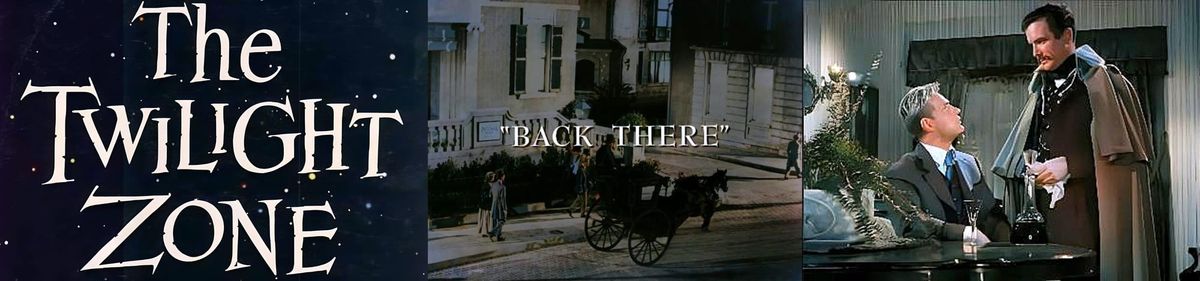
Witness a theoretical argument, Washington, D.C., the present. Four intelligent men talking about an improbable thing like going back in time. A friendly debate revolving around a simple issue: could a human being change what has happened before? Interesting and theoretical, because who ever heard of a man going back in time? Before tonight, that is, because this is—The Twilight Zone.
1. Epistemology & Philosophy of Knowledge
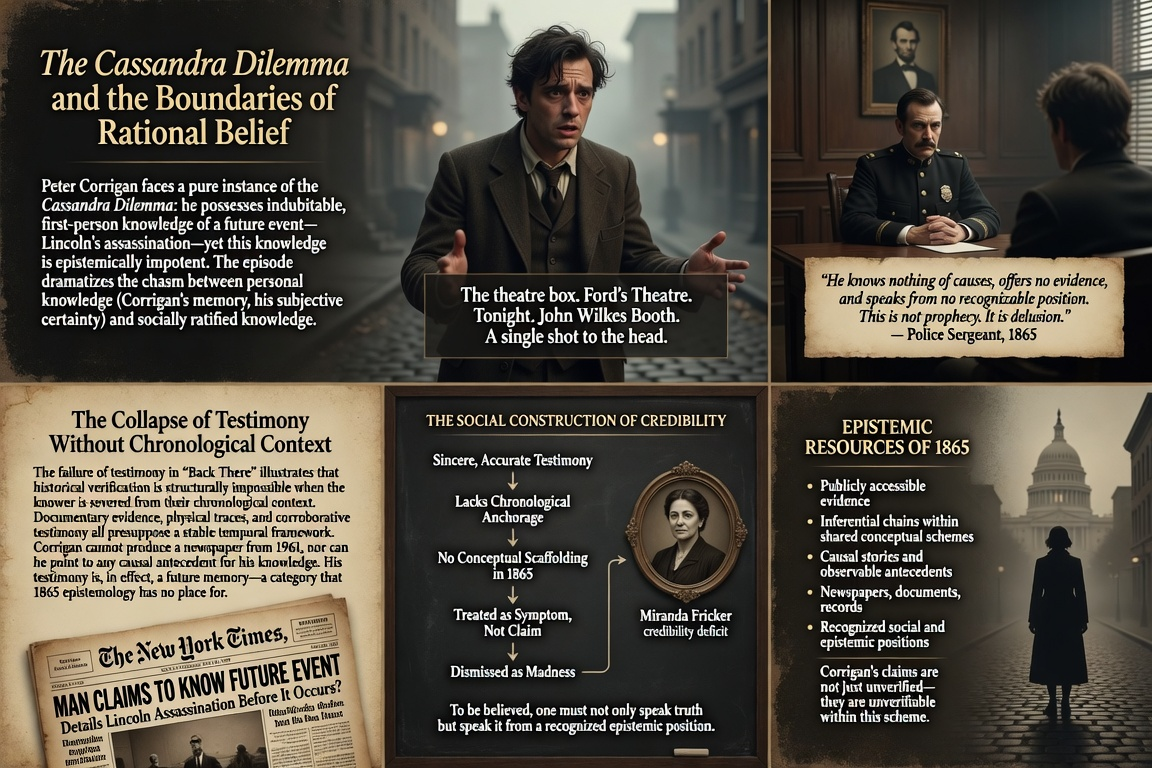
The Cassandra Dilemma and the Boundaries of Rational Belief
Peter Corrigan faces a pure instance of the Cassandra Dilemma: he possesses indubitable, first-person knowledge of a future event—Lincoln’s assassination—yet this knowledge is epistemically impotent. The episode dramatizes the chasm between personal knowledge (Corrigan’s memory, his subjective certainty) and socially ratified knowledge. For the 1865 characters, a belief must be anchored in publicly accessible evidence or inferential chains that fit within their conceptual scheme. Corrigan’s claims fail this criterion completely; they are not just unverified but unverifiable within the epistemic resources of the time.
The criteria by which society demarcates “rational knowledge” from “madness” are shown to be thoroughly contextual. Corrigan’s testimony includes precise, accurate details—the theatre box, the actor John Wilkes Booth, the time and method—but these very specifics, unsupported by any causal story, mark him as delusional rather than prescient. The police sergeant and the authorities apply what philosopher Miranda Fricker calls a credibility deficit: they silence Corrigan not by disproving his claims but by categorizing him as cognitively compromised. His knowledge is treated as a symptom of neurological malfunction, not as a claim to be evaluated. The episode thus exposes the social construction of rational credibility: to be believed, one must not only speak truth but speak it from a recognized epistemic position.
The Collapse of Testimony Without Chronological Context
The failure of testimony in “Back There” illustrates that historical verification is structurally impossible when the knower is severed from their chronological context. Documentary evidence, physical traces, and corroborative testimony all presuppose a stable temporal framework. Corrigan cannot produce a newspaper from 1961, nor can he point to any causal antecedent for his knowledge. His testimony is, in effect, a future memory—a category that 1865 epistemology has no place for. The episode thus prefigures work in the philosophy of testimony (e.g., Coady, Lackey) by showing that even sincere, accurate testimony cannot function as knowledge if the hearers lack the conceptual scaffolding to interpret it. Stripped of chronological anchorage, Corrigan’s truth becomes noise.
2. Philosophy of Time Travel & Metaphysics (Physics)
Resolving the Grandfather Paradox and Causal Loops
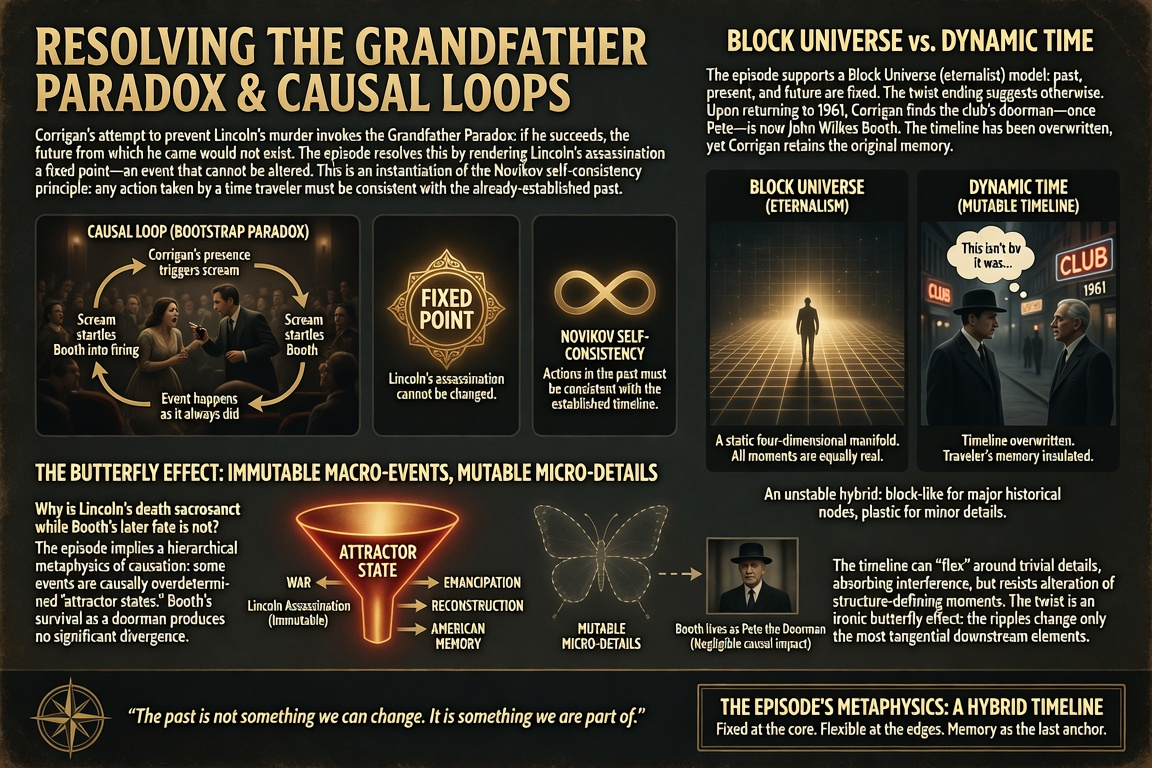
Corrigan’s attempt to prevent Lincoln’s murder directly invokes the Grandfather Paradox: if he were to succeed, the future from which he came would not exist, undermining the causal chain that enabled his journey. The episode resolves this by rendering Lincoln’s assassination a fixed point—an event that cannot be altered. This is a clear instantiation of the Novikov self-consistency principle, where any action taken by a time traveler must be consistent with the already-established past. The narrative hints at a causal loop: Corrigan’s presence at Ford’s Theatre triggers a woman’s scream, which in turn may startle Booth into firing. His intervention, far from preventing the event, becomes part of its causal fabric. This is a textbook bootstrap paradox applied to historical tragedy: the future causes the past to unfold precisely as it always did.
Block Universe vs. Dynamic Time
The episode most naturally supports a Block Universe (eternalist) model, where past, present, and future are equally real and fixed. The macro-event (Lincoln’s death) is immovable, suggesting a static four-dimensional manifold. However, the twist ending complicates this. Upon returning to 1961, Corrigan discovers that the club’s doorman—previously an ordinary man named Pete—is now John Wilkes Booth, living incognito. Corrigan’s friend treats this as unremarkable, indicating the timeline has been overwritten, yet only Corrigan retains the memory of the original. This is more consistent with a dynamic theory of time that allows for a single mutable timeline, where the time traveler’s consciousness is strangely insulated from the changes they wreak. Philosophically, it is an unstable hybrid: the universe is block-like for major historical nodes but plastic for minor details.
The Butterfly Effect: Immutable Macro-Events, Mutable Micro-Details
Why is Lincoln’s death sacrosanct while Booth’s later fate is not? The episode implies a hierarchical metaphysics of historical causation: some events are so causally overdetermined or so deeply woven into the fabric of subsequent history that they are “attractor states” in the phase space of possible worlds. Booth’s post-assassination life, by contrast, is a negligible variable—his survival as a humble doorman produces no significant causal divergence. This reflects an intuitive (though metaphysically ad hoc) asymmetry: the timeline can “flex” around trivial details, absorbing the time traveler’s interference, but resists alteration of structure-defining moments. The twist thus functions as an ironic butterfly effect where the ripples change only the most tangential downstream elements.
3. Philosophy of Mind & Neuroscience
The Mind-Body Problem and the Physiology of Time Travel
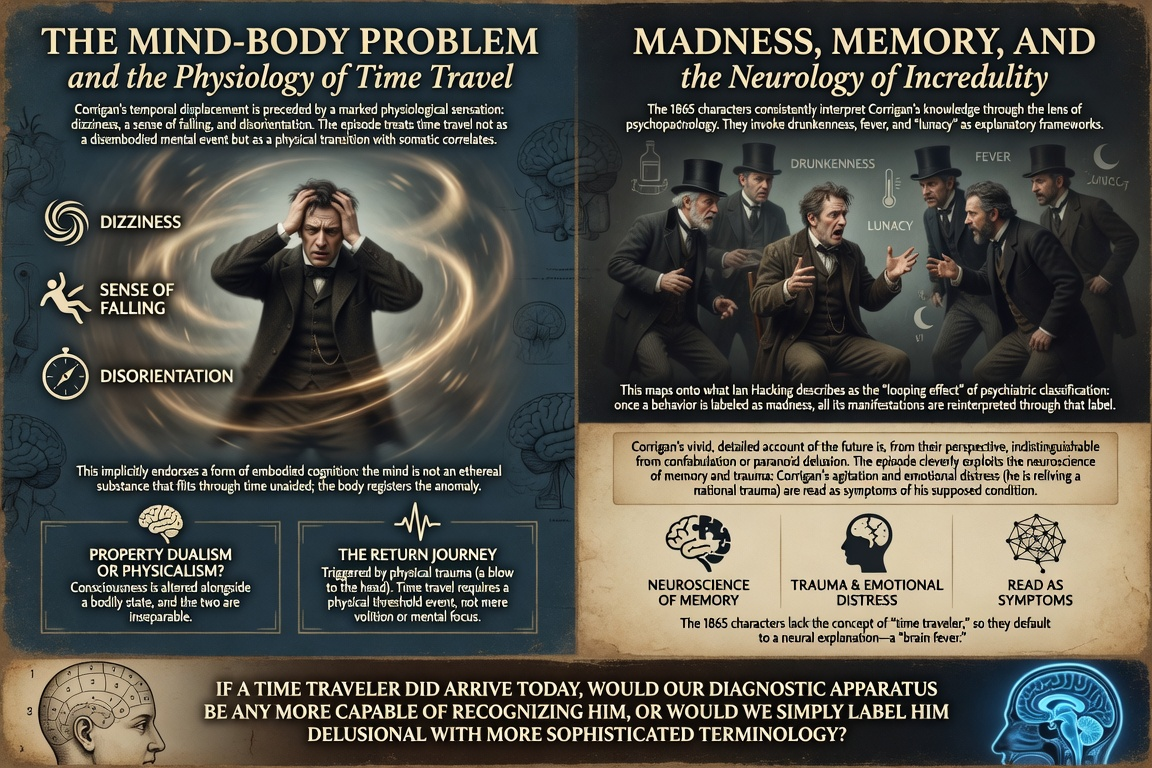
Corrigan’s temporal displacement is preceded by a marked physiological sensation: dizziness, a sense of falling, and disorientation. The episode treats time travel not as a disembodied mental event but as a physical transition with somatic correlates. This implicitly endorses a form of embodied cognition: the mind is not an ethereal substance that flits through time unaided; the body registers the anomaly. The correlation between the subjective experience of temporal rupture and bodily symptoms suggests a commitment to property dualism or physicalism—consciousness is altered alongside a bodily state, and the two are inseparable. The return journey, triggered by physical trauma (a blow to the head), reinforces this: time travel requires a physical threshold event, not mere volition or mental focus.
Madness, Memory, and the Neurology of Incredulity
The 1865 characters consistently interpret Corrigan’s knowledge through the lens of psychopathology. They invoke drunkenness, fever, and “lunacy” as explanatory frameworks. This maps onto what Ian Hacking describes as the “looping effect” of psychiatric classification: once a behavior is labeled as madness, all its manifestations are reinterpreted through that label. Corrigan’s vivid, detailed account of the future is, from their perspective, indistinguishable from confabulation or paranoid delusion. The episode cleverly exploits the neuroscience of memory and trauma: Corrigan’s agitation and emotional distress (he is reliving a national trauma) are read as symptoms of his supposed condition. The 1865 characters lack the concept of “time traveler,” so they default to a neural explanation—a “brain fever.” This invites the viewer to consider a radical epistemological challenge: if a time traveler did arrive today, would our diagnostic apparatus be any more capable of recognizing him, or would we simply label him delusional with more sophisticated terminology?
4. Determinism vs. Free Will
The Impotence of Agency Against Historical Necessity
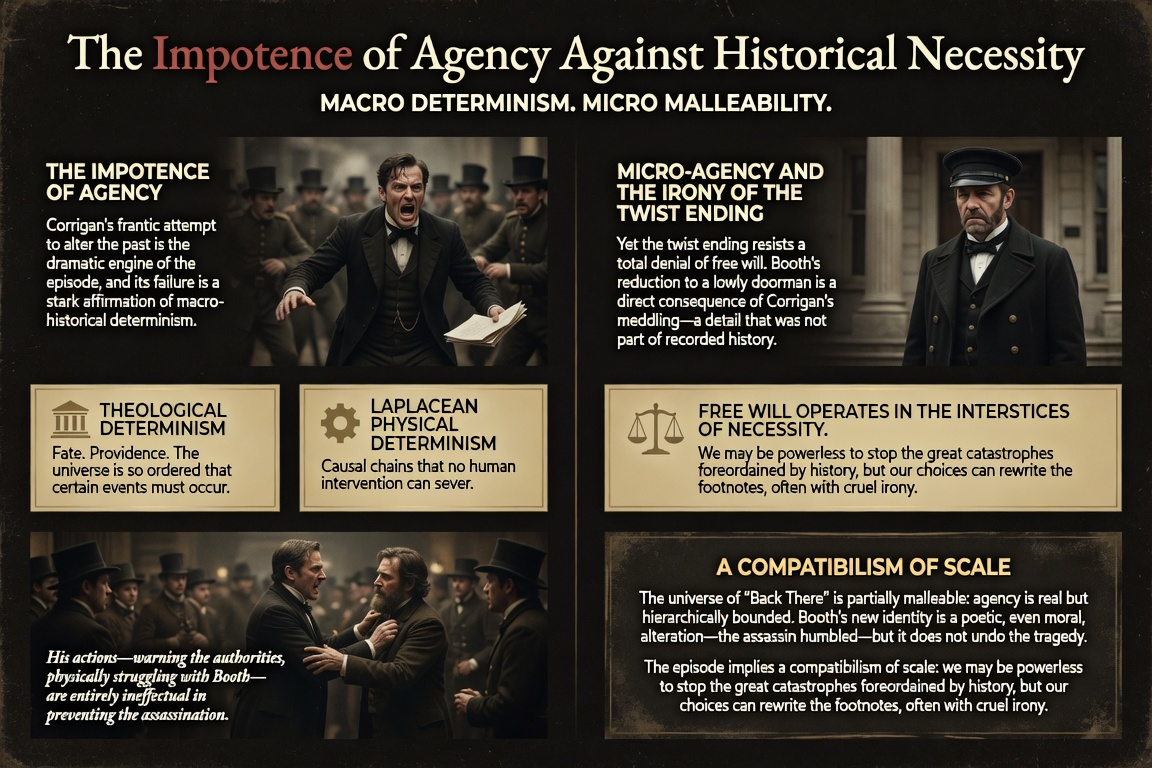
Corrigan’s frantic attempt to alter the past is the dramatic engine of the episode, and its failure is a stark affirmation of macro-historical determinism. His actions—warning the authorities, physically struggling with Booth—are entirely ineffectual in preventing the assassination. The narrative frames this not as a failure of effort but as a metaphysical constraint: the universe is so ordered that certain events must occur. This resonates with both theological determinism (fate, Providence) and Laplacean physical determinism (causal chains that no human intervention can sever). Corrigan’s agency is real in the sense that he can deliberate and act, but the causal efficacy of those actions is circumscribed by a fixed historical structure. The episode thus leans toward a hard incompatibilist view regarding major events: human free will cannot alter the grand narrative.
Micro-Agency and the Irony of the Twist Ending
Yet the twist ending resists a total denial of free will. Booth’s reduction to a lowly doorman is a direct consequence of Corrigan’s meddling—a detail that was not part of recorded history. This suggests that free will operates in the interstices of necessity, able to reshape micro-details even if the macro-currents are immutable. The universe of “Back There” is, then, partially malleable: agency is real but hierarchically bounded. Booth’s new identity is a poetic, even moral, alteration—the assassin humbled—but it does not undo the tragedy. The episode implies a compatibilism of scale: we may be powerless to stop the great catastrophes foreordained by history, but our choices can rewrite the footnotes, often with cruel irony.
Synthesis: Rod Serling’s Philosophical Thesis
“Back There” is not primarily a story about time travel as a physical possibility; it is an epistemological and existential meditation on the loneliness of foreknowledge and the limits of human agency. Serling’s core thesis is that truth without the architecture of shared rationality is indistinguishable from madness, and that the would-be savior of history is inevitably rendered a pitiable Cassandra. The episode argues that history possesses a kind of tragic necessity—its greatest horrors are “fixed points” that no individual can undo, no matter how pure their intent. Yet Serling cannot resist a final, bitter twist: small changes are possible, but they are never redemptive. Booth becomes a doorman; the villain is mocked, not erased. This is Serling’s signature moral irony: the universe permits us just enough agency to see our failures reflected in a funhouse mirror, never enough to rewrite the sorrows of the past. The philosophical payload is a somber compatibilism where free will is real but confined to the margins, and the truest knowledge is the one that cannot be spoken.
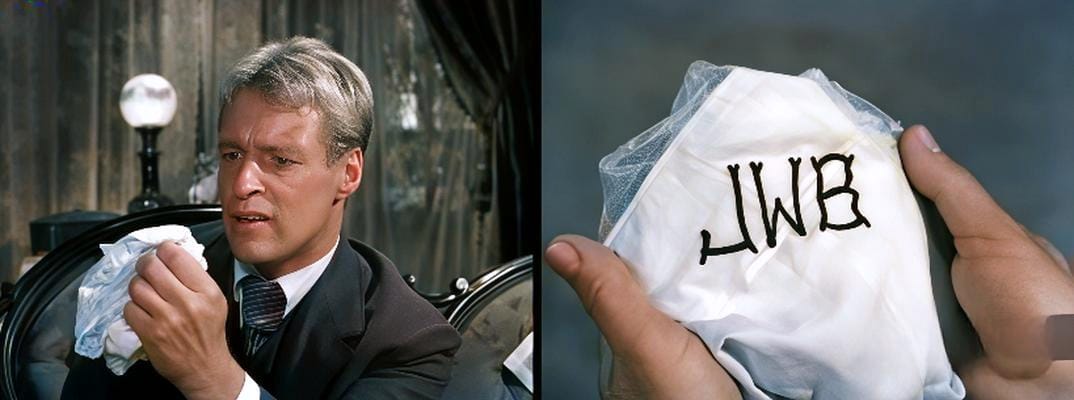
Mr. Peter Corrigan, lately returned from a place 'back there', a journey into time with highly questionable results, proving on one hand that the threads of history are woven tightly, and the skein of events cannot be undone, but on the other hand, there are small fragments of tapestry that can be altered. Tonight's thesis to be taken, as you will—in The Twilight Zone.