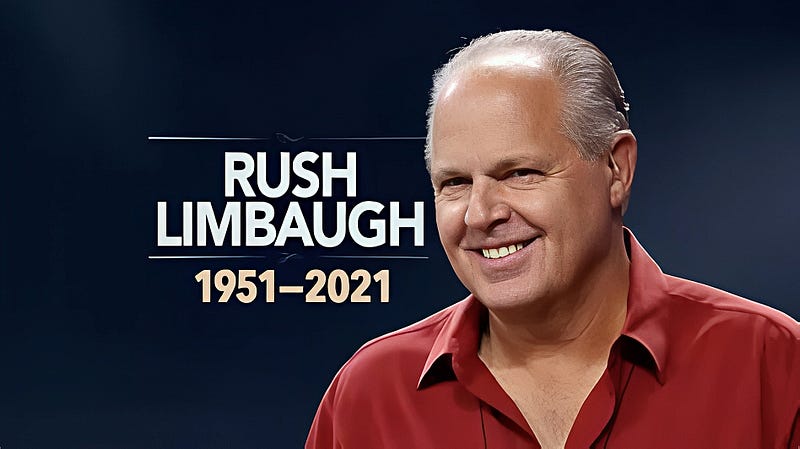
Rush Limbaugh: The Conservative Firebrand’s Writings, Worldview, and Legacy
Rush Limbaugh’s worldview and words profoundly influenced the course of American intellectual and political life for over a generation.
Introduction
Rush Hudson Limbaugh III (1951–2021) was a towering figure in American conservative media, best known as the host of The Rush Limbaugh Show. His nationally syndicated radio program, which launched in 1988, grew to air on nearly 600 stations with an audience of roughly 15 million weekly listeners, making Limbaugh the most listened-to talk-radio personality in the United States. Over a career spanning more than three decades, Limbaugh transformed talk radio into a powerful platform for conservative politics. He blended news, entertainment, and provocation in a unique style that galvanized a loyal base of listeners who proudly called themselves “Dittoheads.” To his fans, Limbaugh was the unapologetic voice of conservative America, championing patriotism, free enterprise, and traditional values. To his detractors, he was a peddler of divisive rhetoric. Understanding Limbaugh’s impact requires exploring his writings, his central arguments and theories, the psychology behind his appeal, his philosophical and political ideas, and his core personal beliefs. Together, these facets paint a holistic picture of how an outspoken radio host became an icon of American conservatism.
Writings: Major Works and Key Themes
Limbaugh extended his influence beyond the airwaves through bestselling books that articulated his conservative vision. His first two books — The Way Things Ought to Be (1992) and See, I Told You So (1993) — both became #1 New York Times best-sellers and helped cement his status as a leading voice of the American right. In these works, written at the height of his early 1990s fame, Limbaugh blended humor, personal anecdotes, and political commentary to advance core conservative ideas. Key themes included a vigorous defense of free-market capitalism, skepticism toward big government, and scathing criticism of liberal “politically correct” culture. For example, Limbaugh argued that many social problems were exacerbated by liberal policies he felt rewarded dependency or victimhood. He championed the idea that individual liberty and personal responsibility — “the way things ought to be,” in his view — were the remedies for America’s ills. These books showcased Limbaugh’s bombastic yet plainspoken style, presenting complex issues in punchy, relatable terms for a mass audience. They also introduced some of his signature coinages and concepts (such as the term “feminazi” for certain feminists, which would become a lightning rod for critics).
Later in his career, Limbaugh turned to writing for a younger audience, penning a series of popular children’s history books. Starting with Rush Revere and the Brave Pilgrims (2013), he authored five “Rush Revere” adventure novels that used time-traveling characters to teach American colonial and Revolutionary War history. While light-hearted in tone, these stories reflected Limbaugh’s patriotic reverence for the Founding Fathers and America’s founding principles. They conveyed his belief in American exceptionalism — the idea that the United States was founded on uniquely freedom-loving, divinely inspired ideals. Indeed, Limbaugh often said he wanted to counter what he viewed as revisionist or unpatriotic narratives in education. This foray into children’s literature earned him the Children’s Choice Author of the Year Award in 2014, demonstrating his ability to influence not just political discourse but cultural and educational realms as well.
Across all his writings, Limbaugh’s contributions lay in distilling conservative viewpoints into plain language and punchy arguments accessible to millions of readers. Whether through satirical critiques of liberal politics or enthusiastic retellings of American history, his books amplified the core messages he espoused on the radio. They reinforced his larger-than-life persona as a commentator who could be both an entertainer and an educator for the conservative movement.
Arguments: Central Arguments and Notable Theories
Throughout his broadcasting career, Rush Limbaugh advanced a set of central arguments that came to define modern conservative rhetoric. At heart, Limbaugh contended that American conservatism stood for self-reliance, constitutional liberties, and traditional moral values — and that these were under constant assault by liberal “big government” agendas. One of his recurring arguments was that liberalism corrupts the individual and society. He famously wrote that “modern-day liberalism is like a disease or an addiction,” even asserting that “liberalism poisons the soul” by fostering victimhood and dependency. In Limbaugh’s view, liberal policies — from expansive welfare programs to excessive business regulation — destroyed individual initiative and personal responsibility. By contrast, he argued, conservative principles encouraged empowerment through hard work, faith, and family. This stark moral dichotomy between conservatism (“what is right, proper, decent, and moral,” as he put it) and liberalism (portrayed as inherently destructive) was a cornerstone of Limbaugh’s ideology.
Limbaugh did not just speak in generalities; he coined provocative theories and phrases to advance his arguments. Perhaps his most notorious term was “feminazi,” which he used to describe extreme feminists whom he accused of valuing abortion rights above all else. This coined epithet, meant to shock, encapsulated his broader claim that mainstream feminism was not truly about equality but about an anti-male, left-wing agenda (a claim that drew fierce criticism, even as it resonated with portions of his audience). In the realm of environmental policy, he routinely derided environmental activists as “environmentalist wackos.” Limbaugh argued that issues like climate change were exaggerated hoaxes used to justify greater government control. He rejected the scientific consensus on global warming, claiming it was driven by political ideology rather than empirical data, and scoffed at environmental regulations as economically ruinous. For instance, when discussing climate initiatives such as cap-and-trade policies, he posited conspiratorially that they were schemes to enrich elites like investment banks at the expense of ordinary Americans. These arguments — dismissing climate science and depicting environmentalism as a cover for socialism — became standard talking points in the conservative movement, owing in no small part to Limbaugh’s megaphone.
Another notable theory Limbaugh popularized was what he dubbed the “Limbaugh Theorem.” This idea, which he articulated during Barack Obama’s presidency, attempted to explain what Limbaugh saw as President Obama’s uncanny ability to avoid political accountability. According to the Limbaugh Theorem, Obama perpetually campaigned as an outsider and cast himself as an opponent of Washington’s problems — even as he led the government — thus making the public view him as detached from any policy failures. Limbaugh argued that this strategy allowed President Obama to escape blame for his administration’s outcomes by appearing “above” the fray, as if he were constantly running against his own government. While political analysts debated the fairness of this characterization, the concept caught on in right-wing circles as a way to rationalize Obama’s personal popularity despite conservative opposition to his policies. It exemplified Limbaugh’s talent for creating easy-to-grasp frameworks that his listeners could use in everyday political discussions.
Limbaugh’s central arguments often extended into charged cultural commentary, which sometimes veered into controversy. He was an outspoken opponent of what he saw as excessive “political correctness” and the liberal social movements of his time. On race, immigration, and LGBTQ issues, Limbaugh frequently adopted combative stances. He railed against illegal immigration, portraying it as an “invasion” threatening American culture and sovereignty. In fact, he went so far as to compare undocumented immigrants to an “invasive species,” a dehumanizing metaphor that critics condemned as xenophobic. Likewise, Limbaugh’s commentary on LGBTQ matters was harshly critical — in the 1980s, he even hosted a recurring “AIDS Update” segment that callously mocked the deaths of gay men from AIDS, underscoring the extent to which he would push the boundaries of decency to ridicule what he considered liberal causes or sensitivities. While he later expressed regret for the AIDS segments, this aspect of his legacy illustrates how his arguments were often deliberately provocative. Limbaugh believed he was calling out hypocrisy and speaking uncomfortable “truths” that the mainstream media and liberal elites wanted to suppress. In doing so, he energized listeners who felt their own frustrations and politically incorrect sentiments were finally being voiced openly. However, the style of these arguments — saturated with sarcasm, inflammatory jokes, and slurs — also cemented Limbaugh’s reputation as a deeply polarizing figure.
In summary, Limbaugh’s rhetorical arsenal revolved around a few core contentions: that liberalism in government and culture was fundamentally harmful; that conservative values represented a return to truth, common sense, and the vision of America’s founders; and that much of what liberals champion (from feminism to climate action to multiculturalism) was a guise for accumulating power and undermining traditional American identity. By broadcasting these arguments daily to millions, Limbaugh profoundly shaped the conservative narrative in late 20th-century and early 21st-century America. Many of his talking points — once considered fringe or outrageous — became orthodoxy among the Republican base, paving the way for the party’s increasingly hard-line positions in the 1990s and beyond.
Psychology: The Appeal and Influence of His Communication Style
While Rush Limbaugh was not a psychologist, he instinctively understood the psychological dynamics of mass communication and persuasion. Part of his success lay in his ability to forge an emotional bond with his audience, tapping into their feelings of frustration, alienation, pride, and hope. Limbaugh often referred to his listeners as “my family” or “my audience of one”, conveying intimacy despite speaking to millions. He created an interactive experience — listeners would call in with “dittos” (expressions of complete agreement), reinforcing a sense of community among like-minded conservatives. This culture of “Dittoheads” reflected a psychological insight: people crave validation of their beliefs and a feeling of belonging to something bigger. Limbaugh offered both. He gave his followers a shared identity and lexicon. Simply by saying “ditto,” a caller signaled tribal solidarity with Limbaugh’s worldview. This tight bond meant that his audience didn’t just listen to him — they felt represented by him.
From a rhetorical standpoint, Limbaugh was a master at engaging emotions. He recognized that political arguments are often won not merely by facts, but by the passion and conviction with which those facts are delivered. On air, he exuded confidence and fervor: his voice could shift from amused chuckles to righteous indignation, keeping listeners emotionally invested. He used humor as a disarming tool — parody songs, witty analogies, and absurd satire were staples of his show. By making people laugh, he made his message more palatable and memorable. For instance, he would adopt comical personas or play sound effects (like absurd “updates” with music) to lampoon liberal figures and causes. This ability to entertain gave listeners a dopamine hit of enjoyment, intertwining political commentary with genuine amusement. As one commentator observed, Limbaugh brought “a sense of sheer fun, of lightness, humor, and wit” to talk radio that previously might have been dominated by dry monologues or perpetual outrage. Even when dealing in anger or controversy, Limbaugh knew how to balance it with showmanship, which psychologically kept his audience engaged rather than fatigued.
Another psychological aspect of Limbaugh’s appeal was his skill in simplifying complex issues into relatable, common-sense terms. He prided himself on breaking down policy debates into language “the average person could understand,” without (in his words) “dumbing it down.” For example, he often framed economic issues with vivid metaphors drawn from everyday life or popular culture, avoiding wonky jargon. This not only made his arguments accessible, but it also flattered his audience’s sense of their own practical wisdom. Listeners felt that Rush tells it like it is, cutting through the confusing technocratic details that experts or politicians use. By presenting himself as a straight-talking truth-teller, Limbaugh tapped into the psychological need for cognitive clarity and certainty. Many in his audience came to trust him as a reliable filter of reality — a “doctor of democracy” who would diagnose the nation’s problems bluntly and prescribe the conservative cure. This trust was reinforced by Limbaugh’s consistent messaging over the years: he was perceived as unswayed by elite opinion or political correctness, someone who held firm to his beliefs regardless of criticism. There was a sense of security in that for listeners, who felt buffeted by rapid social changes and media narratives they distrusted. Limbaugh’s unwavering confidence (summed up by his tongue-in-cheek catchphrase about broadcasting with “half my brain tied behind my back, just to make it fair”) gave his followers psychological reassurance that their worldview was not only valid but superior.
Finally, Limbaugh understood the psychology of grievance and belonging. He often spoke to an undercurrent of resentment among middle-American conservatives who felt belittled or ignored by coastal “elites” and liberal institutions. By constantly vilifying the mainstream media, academia, Hollywood, and Washington insiders, Limbaugh validated the feeling shared by many listeners that the “establishment” was condescending or outright hostile to their values. This us-versus-them framing had profound psychological resonance. It stoked a collective anger and also a solidarity — Limbaugh and his audience were in the fight together, battling the forces of political correctness, secularism, or socialism (as they defined it). He frequently told listeners that they were “not alone” and that millions of Americans agreed with them, even if the media didn’t acknowledge it. This encouragement was empowering for his base. It transformed personal frustrations into a kind of group mission. In psychological terms, Limbaugh served as a cathartic outlet and a motivator: he articulated grievances (about taxes, cultural change, etc.) that listeners struggled to express, and then he rallied them to feel proud rather than ashamed of their anger. He would say that their anger was legitimate patriotism — a desire to defend America from those who would change it fundamentally. By channeling negative emotions (rage at “liberal elites”) into a positive self-concept (“defenders of liberty and truth”), Limbaugh performed a sort of mass cognitive reframing. This helps explain why his audience remained fiercely loyal through various controversies. They felt he understood them psychologically at a deep level, when few others in media or politics did.
In sum, the psychology behind Limbaugh’s success lay in his ability to resonate emotionally and build a community. He made listeners feel heard, entertained, and united in purpose. His communication style was an effective blend of passion, humor, relatability, and unshakable self-assurance. These qualities allowed him to influence not only what his audience thought, but how they felt about the issues — and about themselves as conservatives in a rapidly changing society.
Philosophy: Underlying Ideas and Principles
Although Rush Limbaugh was not a philosopher in the academic sense, he espoused a distinct philosophical outlook rooted in traditional American conservatism. At its core was a firm belief in absolute truth and moral clarity. Limbaugh rejected the relativism that he believed permeated liberal thought. Instead, he argued that certain principles are timeless and non-negotiable — foremost among them, the principles enshrined in America’s founding documents. He often spoke with reverence about the Declaration of Independence and the Constitution, regarding them as almost sacred texts inspired by divine providence. In his view, the Founding Fathers were wise, God-fearing men who established a republic based on natural rights, limited government, and individual liberty. Limbaugh’s philosophy held that deviating from those founding principles led to social and moral decay. This belief in the exceptional nature of America’s founding ideals imbued much of his commentary with a quasi-religious zeal: he cast modern political debates as a battle between those who want to preserve the founders’ vision and those who seek to undermine it.
One key tenet of Limbaugh’s philosophical perspective was a strong emphasis on individualism and personal responsibility. He believed that human dignity and happiness are achieved when individuals are free to pursue their own success, accountable for their own choices, and unencumbered by excessive state interference. This modern iteration of classical liberal philosophy (paradoxically called “conservatism” in the American context) meant that Limbaugh was deeply skeptical of collectivist or utopian schemes. Whether discussing socialist economies or even moderate welfare-state policies, he would invoke fundamental human nature: to Limbaugh, people thrive on freedom and incentive, and they stagnate or become corrupt under dependency and control. He echoed sentiments from thinkers like Alexis de Tocqueville and the Founders by warning that the more a government does for its citizens, the more it saps the citizens’ spirit and virtue. In one of his oft-quoted lines, Limbaugh asserted that “the Constitution only works in a moral society.” By this, he meant that liberty is sustainable only if individuals govern themselves with moral restraint and self-reliance. Thus, he contended, expanding government beyond its minimal duties encourages immorality — because it allows individuals to abdicate responsibility and erodes the ethical fiber that binds communities.
Limbaugh’s philosophy was also shaped by a kind of populist distrust of elite authority, tying into a long tradition of American thought skeptical of concentrated power. He frequently argued that ordinary Americans possessed more common sense and virtue than Ivy League experts or career bureaucrats. This belief manifested in his constant attacks on the “ruling class” in Washington and the intelligentsia in universities or the media. He championed the wisdom of the regular working person and cast himself as their spokesman against arrogant elites. In doing so, Limbaugh tapped into a Jeffersonian philosophical strain — the celebration of the yeoman citizenry and suspicion of entrenched aristocracy (even if the “aristocracy” in modern terms was cultural rather than hereditary). This aspect of his thinking held that truth is often plain and accessible, not the exclusive domain of technocrats. For instance, when climate scientists or economists presented complex models calling for government action, Limbaugh’s philosophical instinct was to question their motives and elevate the “gut feelings” of laypeople who sensed something amiss. He posited that reality conforms to basic, self-evident principles (e.g., spending beyond one’s means leads to ruin, or human sexes are fundamentally different — both points he would claim liberals deny). Thus, in Limbaugh’s philosophy, educated elites often obscured truth with complexity, whereas average Americans, guided by traditional values and life experience, saw things more clearly. This inversion of authority — placing the wisdom of the “folks” above the claims of experts — became a hallmark of conservative talk radio’s ethos.
Morally, Limbaugh grounded his ideas in what he saw as Judeo-Christian values, although he spoke of them more in cultural terms than theological ones for most of his career. He upheld concepts of good and evil and frequently described his political battles in moral language. For example, he described conservatism itself not as a partisan stance but as “what is right and moral”. In his words, “Conservatism isn’t even really an ideology; it’s just what is right, proper, decent, and moral.” This almost Manichaean framing (conservatism = good, liberalism = bad) reveals how absolute his philosophy was on certain points. He saw little room for gray area or compromise on core issues; one side upheld virtue and truth, the other propagated falsehood and vice. Such a rigid moral dichotomy is rooted in an almost Puritanical clarity of conscience, combined with Cold-War-era anti-totalitarianism. Indeed, Limbaugh came of age during the latter years of the Cold War, and his worldview was heavily colored by anti-communism. He inherited from that era a belief that expansive government (especially socialist or Marxist-inspired government) was not just inefficient but fundamentally tyrannical and evil. The collapse of the Soviet Union in 1991 only reinforced his faith that free-market democracy was morally and practically superior — a point he hammered whenever he felt the U.S. was drifting “leftward.”
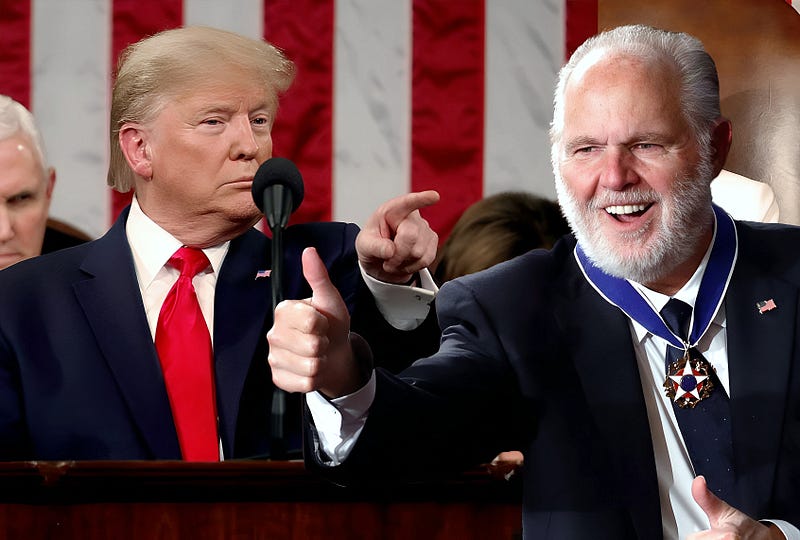
Finally, it’s worth noting that Limbaugh’s philosophy evolved somewhat over time, especially in his later years as he increasingly supported the populist nationalism embodied by Donald Trump. In earlier decades, Limbaugh was more aligned with Reaganite conservatism — emphasizing tax cuts, a sunny optimism about America’s future, and a focus on defeating liberal ideas in the realm of policy. By the 2010s, he, like much of the Republican base, grew more openly pessimistic and combative about America’s direction. He philosophically embraced a kind of civilizational struggle — framing issues like immigration, political correctness, and globalism as existential threats to American identity. Nonetheless, the underlying principles he espoused remained consistent: faith in God and country, the primacy of individual liberty, mistrust of centralized power, and a conviction that objective truth and morality are on the side of conservatism. In this sense, Limbaugh’s philosophical outlook can be seen as a fusion of America’s founding Enlightenment ideals with its religious-cultural heritage — all channeled through a partisan lens that casts modern liberalism as antithetical to both.
Political Ideas: Views and Ideologies in Practice
Limbaugh’s political ideas were firmly rooted in American conservative ideology and helped both reflect and shape the Republican Party’s platform over the years. On economic matters, he was a staunch advocate of capitalism and limited government intervention. Limbaugh consistently championed tax cuts for both individuals and businesses, arguing that lower taxes spur economic growth and expand personal freedom. He opposed high government spending (except perhaps on defense) and was fiercely critical of welfare programs that he believed incentivized dependency. In fact, one of his talking points was that liberals “measure compassion by how many people are on welfare, whereas conservatives measure it by how many people no longer need welfare.” This encapsulated his idea that good policy should aim to make citizens self-sufficient rather than comfortable in poverty. He cheered the market reforms and deregulation efforts of Republican presidents like Ronald Reagan and later Donald Trump. Conversely, he lambasted Democratic initiatives — from Bill Clinton’s tax hikes to Barack Obama’s stimulus spending and the Affordable Care Act — as steps toward socialism that would, in his view, bankrupt the nation and erode individual choice.
On social issues, Limbaugh took traditionally conservative, and often hardline, positions. He was vocally anti-abortion, describing himself as pro-life without exceptions. On air, he frequently framed abortion as a moral tragedy and condemned organizations like Planned Parenthood. In one controversial stunt early in his career, he even “celebrated” what he called “National Condom Week” by performing pretend “caller abortions” — abruptly cutting off calls amid vacuum sounds — to dramatize the moral stakes of abortion (a tactic widely criticized as cruel and flippant). Limbaugh’s opposition to abortion was intertwined with his disdain for modern feminism; he argued that abortion rights advocates were less interested in women’s freedom than in a radical agenda to upend gender relations. Thus, politically, he aligned strongly with the religious right on issues of abortion, marriage, and family. He opposed legal recognition of same-sex marriage, and although he didn’t dwell on the issue every day, he made it clear he believed marriage should remain between a man and a woman. When the Supreme Court’s cultural winds began shifting, Limbaugh grimly acknowledged by 2013 that same-sex marriage was likely to become law, but he attributed that outcome to conservatives “losing the language” of the debate. Even in accepting a political loss, he framed it as a failure of messaging rather than a reconsideration of principle.
Limbaugh was also an unabashed hawk in foreign policy. Influenced by the Reagan era’s peace-through-strength doctrine, he generally supported a robust U.S. military posture. He backed the Gulf War in 1991 and later the 2003 invasion of Iraq. In the run-up to the Iraq War, Limbaugh echoed the Bush administration’s arguments about weapons of mass destruction and even after those claims fell apart, he floated theories that such weapons had existed or been moved, refusing to fully concede the point. His reflex was to trust the U.S. military and distrust narratives that cast American actions as wrong. When reports emerged of prisoner abuses by U.S. troops at Abu Ghraib, for example, Limbaugh downplayed the scandal, infamously comparing it to harmless fraternity hazing — a stance that aligned with a broader worldview that America should not cripple itself with guilt or self-doubt in conducting war against its enemies. In the post-9/11 context, he supported aggressive tactics in the War on Terror, from surveillance expansions to the drone strike that killed Iranian general Qasem Soleimani in 2020, which he praised while denouncing critics as appeasers of Iran. Through these stances, Limbaugh’s political ideas consistently emphasized patriotism and an assertive defense of American interests, coupled with a rejection of what he saw as liberal “weakness” or “apology” in foreign affairs.
Perhaps the most influential aspect of Limbaugh’s political ideology was his relentless focus on the culture war — the ongoing conflict over social values, national identity, and the direction of American society. He took strong stands against multiculturalism and affirmative action, arguing that liberals used race and identity to divide Americans or to claim unearned victimhood. He insisted on colorblindness in theory, yet often courted controversy with remarks about race. For instance, he suggested that the media wanted to see Black quarterbacks succeed in the NFL for reasons of social politics rather than merit, a comment that led to his resignation from a brief stint on an ESPN show. And during President Obama’s tenure, Limbaugh gave voice to many fringe conspiracy theories, from questions about Obama’s birthplace to insinuations that Obama had a hidden radical agenda to weaken America. This willingness to traffic in what others labeled as misinformation was part of his approach: he would say he was simply asking questions or reflecting what “real Americans” were worried about, thereby injecting those ideas into mainstream discourse. By normalizing such claims, Limbaugh nudged the Republican base toward a more populist, confrontational style of politics.
In terms of formal ideology, Limbaugh described himself plainly as a conservative and a “Reagan Republican.” He rejected the term “far-right” and disavowed racists or true extremists, positioning himself as an advocate of mainstream conservative principles. However, by the 2010s, the populist-nationalist elements in his rhetoric became more pronounced. He ardently supported Donald Trump’s candidacy and presidency, seeing in Trump a vindication of the combative, no-compromise approach that he had long championed. Where earlier Limbaugh might have celebrated free trade as inherently good, under Trump, he endorsed tariffs against China and a renegotiation of NAFTA, mirroring the shifting mood on the right that prioritized economic nationalism. This indicates that while Limbaugh’s core ideas (low taxes, strong defense, traditional values) stayed consistent, he was flexible in tactics and emphasis to align with the evolving conservative base. In a sense, he helped lead those evolutions. By railing against immigration, lambasting “establishment” Republicans he deemed too moderate, and stoking grassroots anger, Limbaugh’s political ideas paved the way for the Republican Party’s turn toward Trumpism. Elected Republicans often found themselves needing his approval or fearing his on-air wrath if they deviated from the hard line. A telling anecdote: after the GOP’s 1994 landslide victory in Congress, the new Republican freshmen made Limbaugh an honorary member of their caucus, acknowledging his role in mobilizing voters. This exemplifies how Limbaugh wasn’t just a commentator on politics — he was, in effect, a political force in his own right, shaping agendas and policing the boundaries of conservative orthodoxy.
Beliefs: Core Beliefs and Personal Values
Beneath his politics and showmanship, Rush Limbaugh’s core beliefs and values were a blend of patriotism, faith (especially later in life), and an unyielding conviction in his worldview. One of his deepest beliefs was in the goodness and greatness of America. He often spoke of the United States as “the greatest nation in human history,” not out of blind nationalism but because he truly believed the American experiment — based on liberty, equality of opportunity, and God-given rights — was singular and precious. This patriotic fervor manifested in his constant tributes to the U.S. military, his support for law enforcement, and his reverence for national symbols and holidays. He decried those he felt disrespected the flag or the country’s heritage, and he saw the preservation of America’s founding values as almost a sacred duty. This ties into another core value for Limbaugh: freedom. He cherished individual freedom not just as a policy preference but as a moral imperative. Whether it was the freedom to start a business without onerous regulation, the freedom to bear arms (he was a strong Second Amendment supporter, seeing it as the safeguard of all other freedoms), or the freedom to practice one’s religion openly, Limbaugh held personal liberty as a non-negotiable virtue. In his personal life, having found enormous success as an entrepreneur of his own brand, he exemplified the self-made man and valued that independence highly.
Another fundamental belief for Limbaugh was the importance of faith and morality as guiding forces in private and public life. While he was not known as a religious broadcaster for most of his career, Limbaugh was raised a Methodist and identified as a Christian. He generally aligned with the Christian conservative viewpoint on social issues (opposing abortion, defending the role of religion in public life, etc.), and he often argued that America’s constitutional system assumes a moral, religious citizenry. He would cite, for example, John Adams’ famous quote that the Constitution is fit only for a moral and religious people. In the later years of his life, especially after his 2020 diagnosis of advanced lung cancer, Limbaugh became more open about his personal faith. He spoke movingly about relying on God and Jesus for strength during his illness, and he expressed gratitude “to God” for each day he was still alive. He even said publicly, “God is a profound factor; Jesus Christ is a profound factor. I have a personal relationship.” This candid sharing of his faith was notable because he admitted he had kept it mostly private before, not wanting to be seen as proselytizing on air. His belief in God also intertwined with his political beliefs in interesting ways: Limbaugh controversially claimed, for instance, that if you truly believe in God’s omnipotence, “then intellectually you cannot believe in manmade global warming.” In his view, believing that human beings could destroy the climate was a kind of secular hubris incompatible with a worldview that God controls the Earth. This illustrates how his religious faith buttressed his skepticism of certain scientific or progressive claims and reinforced his broader conviction that divine order, rather than human government, ultimately guides the world.
Limbaugh’s core values also included a strong sense of personal loyalty and gratitude. He was known to be fiercely loyal to friends and those who supported him. For example, he frequently praised his audience for their loyalty and often stated that he loved and appreciated them. In moments of reflection, Limbaugh said he felt “blessed” by God and by the opportunities he had, and that he had “no regrets” because of the wonderful life he’d been given. Such statements reveal a belief in counting one’s blessings and maintaining a positive, thankful outlook, a trait he likely inherited from his Midwestern upbringing. Despite the often harsh and negative tone of his political talk, those close to him described Limbaugh off-air as someone who believed in optimism and the power of a positive attitude. He admired Ronald Reagan’s sunny optimism and often tried to emulate it in reminding listeners to be hopeful about America. Indeed, amid his cutting critiques, Limbaugh would at times deliver impromptu sermons on gratitude, hard work, and hope — reminding listeners to “stay hopeful, work hard, and count their blessings as Americans.” This aspect of his message resonated as much as the anger did: it reinforced the value of American exceptionalism (we should be grateful to be Americans) and also the personal ethic of positivity and perseverance.
Another deeply held belief of Limbaugh’s was in the virtue of courage and conviction. He revered figures who stood by their principles under fire — whether it was President Reagan standing firm against the Soviet Union or, say, Justice Clarence Thomas weathering attacks during his confirmation. Limbaugh aspired to the same steadfastness. One of his proudest traits was that he “held to his beliefs, whether they were popular or not.” He often said that he wouldn’t trim his message to chase ratings or appease critics. This reflected a personal value on integrity and authenticity. He encouraged his audience likewise not to be swayed by peer pressure or media narratives, but to trust their own convictions. In a sense, Limbaugh’s entire career was a case study in a man unapologetically being himself, and he took that as a point of honor. It’s why even many who disagreed with him acknowledged his influence — he was unwavering in a world of flip-flopping politicians. That unwavering quality was, at root, a reflection of faith: faith in his ideals, faith in his country, faith in his abilities, and faith in a higher power.
In summary, Rush Limbaugh’s core beliefs can be encapsulated as faith, freedom, and fervent patriotism. He believed in God and the guiding hand of providence, in the dignity and capability of the individual, and in the unmatched greatness of the American experiment. He valued honesty (as he understood it), courage, and loyalty, and he despised what he saw as the corrosive effects of moral relativism, collectivism, and cynicism. These values made him a beacon for millions of Americans who felt the same. Even as critics accused him of spreading cynicism or hate, Limbaugh would argue that he was motivated by love — love for country, love for truth, and even love for the audience he considered extended family. His impact, therefore, was not just in the realm of policy or elections, but in instilling a set of beliefs and attitudes in his listeners: to be proud of their conservatism, unafraid of controversy, and steadfast in the face of a changing cultural tide.
Conclusion
Rush Limbaugh’s intellectual contributions and personal beliefs left an indelible mark on American political culture. Through his writings and daily broadcasts, he mainstreamed conservative ideas in a brash new way, effectively creating the template for modern talk radio and partisan media personalities. His central arguments — about the perils of liberalism, the sanctity of the Constitution, and the battle between “real Americans” and elitist forces — became defining narratives for the American right. Psychologically, he forged a deep connection with his audience, using entertainment and empathy to sustain a movement that felt under siege and unheard. Philosophically, he stood on the bedrock of America’s founding principles and Judeo-Christian values, interpreting contemporary issues through that moral lens. Politically, he pushed the Republican Party toward a more confrontational, populist stance, helping to shape elections and policy debates from the Reagan era through the Trump era. And at the level of core beliefs, Limbaugh remained a man of faith, patriotism, and conviction, whose confidence in his values never wavered even as he polarized the nation.
To understand Rush Limbaugh is to grasp how one individual’s ideas and voice galvanized millions. Admirers credit him with giving conservatism a mass appeal it hadn’t had since Reagan, teaching them to articulate their views with humor and conviction. Detractors blame him for coarsening public discourse and spreading disinformation and intolerance. Both views acknowledge his power. In the end, Limbaugh saw himself as a tireless defender of what he held to be true — that America is greatest when it remains true to its founding ideals, that individuals, not government, drive human progress, and that his audience’s values were worth fighting unapologetically for. His legacy is a complex tapestry of influence: a revitalized conservative movement on one hand, and a more divided political landscape on the other. But there is no doubt that Rush Limbaugh’s worldview and words profoundly influenced the course of American intellectual and political life for over a generation.