The Arrogance of Not Knowing: The Dunning–Kruger Effect, Human Stupidity, and the Intellectual Revolt Against Knowledge
The Dunning–Kruger Effect shows that lacking skill often means lacking the insight to see that lack. Confidence can mask incompetence; wisdom begins with admitting one might be wrong, and refusing that step marks the start of intellectual decline.

Abstract
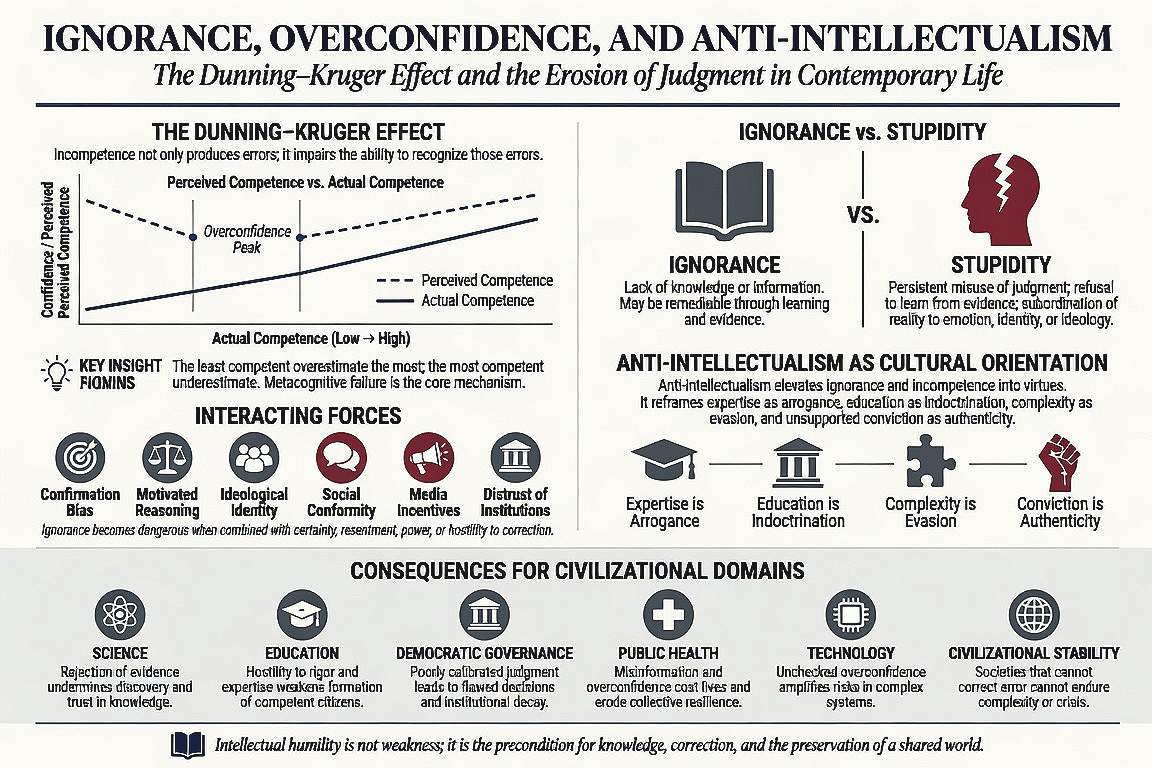
The relationship between ignorance, cognitive incompetence, intellectual overconfidence, and anti-intellectualism constitutes one of the most consequential problems in contemporary psychology and political philosophy. Human beings are not merely vulnerable to error; they are frequently unable to recognize the deficiencies that produce their errors. The psychological phenomenon commonly called the Dunning–Kruger Effect describes a pattern in which people with limited knowledge or skill in a particular domain may substantially overestimate their competence because they lack the metacognitive ability required to evaluate their own performance accurately. The problem is therefore recursive: insufficient knowledge produces mistakes, while the same insufficiency obstructs recognition of those mistakes.
The Dunning–Kruger Effect does not establish that unintelligent people always believe themselves to be geniuses, nor does it provide a scientific license for dismissing political opponents as stupid. It identifies a more precise and disturbing mechanism: incompetence can impair self-assessment, producing confidence that is poorly calibrated to actual ability. This mechanism interacts with confirmation bias, motivated reasoning, ideological identity, social conformity, media incentives, and distrust of institutions.
Ignorance becomes socially dangerous when it is combined with certainty, resentment, institutional power, or ideological hostility toward correction. Stupidity, understood philosophically rather than merely as low intelligence, involves the persistent misuse of judgment, the refusal to learn from evidence, or the subordination of reality to emotion and identity. Anti-intellectualism elevates these failures from individual weaknesses into a cultural and political orientation. It treats expertise as arrogance, education as indoctrination, complexity as evasion, and unsupported conviction as a form of authenticity.
This report examines the empirical foundations and limitations of the Dunning–Kruger Effect, distinguishes ignorance from stupidity, analyzes the philosophical history of intellectual humility, explores the psychological and sociological foundations of anti-intellectualism, and evaluates the consequences of cognitive overconfidence for science, education, democratic governance, public health, technology, and civilizational stability.
Introduction
Civilization depends upon a deceptively simple intellectual achievement: the ability to distinguish between what is known, what is probable, what is uncertain, and what is false. Every scientific institution, court of law, university, medical system, engineering profession, and functioning government depends upon this distinction. When the distinction collapses, opinion becomes indistinguishable from evidence, confidence substitutes for competence, and emotional certainty acquires the status of knowledge.
Human beings have always been ignorant. No individual can master more than a small fraction of the world’s accumulated information. Ignorance is therefore unavoidable and, by itself, morally neutral. The central problem is not that people lack knowledge. The problem is that they often do not know that they lack it.
A person who recognizes ignorance can ask questions, consult evidence, seek instruction, and revise conclusions. A person who mistakes ignorance for understanding has no obvious reason to do any of these things. Such a person is not merely uninformed but cognitively insulated from correction.
The Dunning–Kruger Effect offers a scientific framework for understanding this insulation. It proposes that poor performers may lack both the skills necessary to perform well and the metacognitive skills necessary to recognize poor performance. Their incompetence conceals itself.
This phenomenon becomes particularly dangerous in a culture that prizes personal expression but neglects standards of verification. Modern communication systems allow nearly every individual to publish opinions instantly, reach mass audiences, and construct communities around unsupported claims. Access to information has expanded dramatically, but access does not guarantee comprehension. The result is a society in which people can retrieve facts without understanding context, repeat technical terminology without mastering concepts, and confuse familiarity with expertise.
Anti-intellectualism converts this confusion into ideology. It does not merely question particular experts, which may be reasonable. It rejects the legitimacy of expertise itself. It presents disciplined knowledge as elitist domination while celebrating intuition, common sense, personal experience, or ideological loyalty as superior alternatives.
The consequences extend beyond academic debate. Medical misinformation can kill. Engineering incompetence can destroy infrastructure. Economic ignorance can produce destructive policies. Historical illiteracy can permit old fanaticisms to return under new names. Political overconfidence can transform complex institutions into instruments of impulse and resentment.
The central danger is therefore not ignorance alone. It is ignorance fortified by confidence, identity, power, and hostility toward correction.
The Dunning–Kruger Effect
The Dunning–Kruger Effect emerged from psychological research examining the relationship between competence and self-evaluation. Participants completed tasks involving areas such as logical reasoning, grammar, and humor and then estimated their own performance relative to others.
Poor performers tended to overestimate their relative ability. They did not necessarily believe they had performed perfectly, but their estimates were substantially more favorable than their actual results justified. High performers, by contrast, sometimes underestimated how unusually well they had performed because they assumed that tasks they found manageable would also be manageable for others.
The theoretical explanation centered on metacognition. Metacognition is the capacity to monitor and evaluate one’s own thinking. It includes the ability to recognize errors, estimate confidence, identify gaps in knowledge, and determine when additional information is required.
Many forms of competence require overlapping skills for performance and evaluation. The grammatical knowledge required to construct a correct sentence is also needed to identify why another sentence is incorrect. The logical knowledge required to solve a reasoning problem is also necessary to inspect the validity of the solution. A person who lacks the relevant knowledge may therefore fail twice:
- The person produces an incorrect answer.
- The person lacks the competence necessary to recognize that the answer is incorrect.
This is the core logic of the Dunning–Kruger Effect. The phenomenon is not merely overconfidence. It is overconfidence partly produced by deficient self-monitoring.
The effect is often oversimplified in popular culture. It is frequently represented by a cartoon graph in which confidence rises dramatically with minimal knowledge, crashes after modest learning, and then gradually recovers with expertise. Labels such as “Mount Stupid” and “Valley of Despair” are often attached to this graph. Although the image expresses a plausible learning pattern, it is not the original scientific formulation of the effect and should not be mistaken for a validated universal law.
The research does not prove that every ignorant person is highly confident, that every expert is humble, or that low intelligence always produces arrogance. It indicates a recurring statistical relationship between poor performance and inaccurate self-assessment under certain conditions.

Scientific Qualifications and Criticisms
The Dunning–Kruger Effect is real as a pattern of miscalibration, but its magnitude and interpretation remain subjects of scientific debate. Some researchers argue that part of the observed pattern may result from statistical artifacts rather than metacognitive incompetence alone.
Regression toward the mean can contribute to the effect. Participants with extremely low observed scores are likely to have experienced some combination of low ability and random error. Their self-estimates may be less extreme, producing the appearance of substantial overconfidence. Conversely, extremely high performers may produce estimates closer to the average, creating apparent underconfidence.
Measurement noise also matters. No test perfectly measures competence. When imperfect performance scores are compared with imperfect self-estimates, systematic distortions may emerge.
Researchers have therefore proposed several mechanisms that may jointly produce the observed pattern:
- Genuine metacognitive deficits among low performers
- Regression toward the statistical mean
- Measurement error in performance and self-assessment
- General human tendencies toward self-enhancement
- Limited knowledge of how other people perform
- Ambiguity in task difficulty
- Differences between absolute and relative self-evaluation
- Social desirability and reluctance to rate oneself harshly
These criticisms do not eliminate the central insight. People often misjudge their abilities, and poor performers frequently misjudge themselves more severely. The scientific dispute concerns how much of this pattern should be attributed specifically to metacognitive incompetence.
The effect is also domain-specific. A person may be highly competent and self-aware in one field while displaying profound ignorance and overconfidence in another. An accomplished surgeon may speak recklessly about constitutional law. A successful engineer may misunderstand epidemiology. A distinguished historian may make elementary errors in statistics.
General intelligence does not provide universal immunity. Expertise is usually narrow, and the habits that produce competence in one area do not automatically transfer to another.
Ignorance as a Human Condition
Ignorance is the absence of relevant knowledge, but this simple definition conceals several distinct forms. Not all ignorance has the same psychological cause or moral significance.
Major forms of ignorance include:
- Simple ignorance: The person lacks information and does not claim otherwise.
- Recognized ignorance: The person understands that knowledge is missing and remains open to instruction.
- Mistaken knowledge: The person possesses inaccurate information and believes it to be correct.
- Willful ignorance: The person deliberately avoids evidence that could create discomfort, responsibility, or obligation.
- Motivated ignorance: The person resists information because it threatens identity, ideology, status, or emotional security.
- Strategic ignorance: An individual or institution avoids acquiring knowledge in order to preserve plausible deniability.
- Pluralistic ignorance: Members of a group privately reject a belief or practice but assume that others accept it.
- Manufactured ignorance: Powerful actors deliberately create confusion, uncertainty, or doubt for political or commercial purposes.
- Cultural ignorance: A community lacks awareness of experiences, histories, or knowledge outside its dominant worldview.
- Epistemic closure: A belief system becomes insulated from contrary evidence by treating all criticism as confirmation of persecution or conspiracy.
Recognized ignorance is intellectually productive. It motivates questions and learning. Willful and motivated ignorance are more dangerous because they transform not knowing into a defended psychological position.
Ignorance can be corrected only when the individual accepts some external standard by which beliefs may be tested. These standards may include observation, logic, evidence, replication, documentation, expert analysis, or practical consequences. When a person rejects every standard that could challenge a belief, ignorance becomes self-sealing.

Stupidity Beyond Intelligence
Stupidity is commonly treated as a synonym for low intelligence, but this definition is inadequate. Intelligence tests measure limited dimensions of reasoning, memory, processing speed, verbal ability, and spatial performance. They do not fully measure wisdom, judgment, integrity, self-control, practical competence, or openness to correction.
A person can possess substantial intelligence and still behave stupidly. Highly intelligent people may use sophisticated reasoning to defend irrational conclusions. Their intelligence can make them more effective at rationalization rather than more committed to truth.
Stupidity is better understood as a failure in the use of cognitive ability. It may involve:
- Refusing to revise beliefs after decisive contradiction
- Confusing emotional intensity with evidentiary strength
- Repeating conduct that predictably produces failure
- Rejecting expertise without understanding the relevant field
- Treating slogans as substitutes for analysis
- Mistaking confidence for competence
- Applying simplistic explanations to complex systems
- Ignoring long-term consequences in favor of immediate gratification
- Allowing group loyalty to override observable reality
- Interpreting correction as personal humiliation
- Persistently acting against one’s own interests without recognizing the pattern
This conception distinguishes stupidity from honest error. Intelligent and careful people make mistakes because information is incomplete and reality is complex. Stupidity begins when a person becomes incapable of learning from mistakes or unwilling to examine the reasoning that produced them.
The problem is therefore not the possession of a wrong belief at a particular moment. It is the structure by which the belief is defended.

Cognitive Bias and the Architecture of Self-Deception
The Dunning–Kruger Effect operates within a broader network of cognitive biases. Human reasoning is not an impartial machine designed solely to discover truth. It is influenced by emotion, identity, habit, social pressure, memory limitations, and evolutionary shortcuts.
Important mechanisms include:
- Confirmation bias: Preference for information that supports existing beliefs.
- Motivated reasoning: Evaluation of evidence according to desired conclusions.
- Availability bias: Overestimation of events that are vivid or easily recalled.
- Anchoring: Excessive reliance on initial information.
- Self-serving bias: Attribution of success to ability and failure to external circumstances.
- Belief perseverance: Retention of beliefs after their original evidence has been discredited.
- Backfire reactions: Strengthening of identity-based beliefs when they are challenged.
- Illusory truth effects: Increased belief in claims through repetition.
- Authority bias: Acceptance of claims because they come from a prestigious source.
- Anti-authority bias: Rejection of claims merely because they come from institutions or experts.
- Group polarization: Movement toward more extreme positions after discussion with like-minded people.
- Identity-protective cognition: Interpretation of evidence in ways that defend group membership.
- Illusion of explanatory depth: Belief that one understands a system until required to explain it in detail.
These biases do not operate independently. They reinforce one another. A person may encounter a false claim that confirms an existing belief, repeatedly see it within an ideological community, interpret expert correction as institutional hostility, and then become more confident because the community praises resistance.
The resulting belief is no longer merely factual. It becomes moral, emotional, and social. Abandoning it may threaten friendships, status, identity, and self-respect. Under those conditions, correction becomes psychologically expensive.

The Illusion of Explanatory Depth
People often believe they understand ordinary objects and complex systems more deeply than they actually do. The illusion becomes visible when they are asked to explain mechanisms step by step.
A person may claim to understand how a toilet, zipper, financial market, vaccine, electrical grid, criminal trial, or constitutional institution works. When required to provide a detailed causal explanation, the person frequently discovers substantial gaps.
The illusion persists because recognition is mistaken for comprehension. Familiar terms create a feeling of knowledge. Repeated exposure produces fluency, and fluency is interpreted as understanding.
This helps explain why public debates are often dominated by slogans. Slogans create the appearance of explanation without the burden of mechanism. Statements such as “just print more money,” “just enforce the law,” “just trust the science,” “just follow common sense,” or “just let the market decide” may conceal extraordinary complexity.
A serious explanation requires the speaker to identify causal processes, competing variables, trade-offs, uncertainties, and possible unintended consequences. The demand for explanation therefore functions as a practical test of knowledge.
Intellectual Humility
Intellectual humility is not weakness, indecision, or relativism. It is the disciplined recognition that one’s beliefs may be incomplete or mistaken. It involves confidence calibrated to evidence rather than to emotion.
A person with intellectual humility may hold strong conclusions while remaining open to revision. The relevant question is not whether conviction exists but whether the conviction can survive honest examination.
Intellectual humility includes:
- Awareness of the limits of one’s knowledge
- Willingness to distinguish fact from inference
- Readiness to state uncertainty
- Openness to correction
- Ability to separate personal worth from factual accuracy
- Recognition that expertise has boundaries
- Willingness to consult qualified sources
- Capacity to change one’s mind without treating revision as humiliation
- Proportional confidence based on evidence
- Respect for complexity without using complexity as an excuse for paralysis
Humility is essential to science because scientific knowledge is provisional. Even strongly supported theories remain open to refinement. This does not mean that all claims are equally uncertain. The evidence for gravity is not equivalent to speculation about supernatural forces. Intellectual humility requires discrimination, not indiscriminate doubt.
Philosophical Origins of the Problem
The conflict between wisdom and false certainty is ancient. Socratic philosophy placed recognition of ignorance at the foundation of wisdom. Socrates’ intellectual superiority consisted not in possessing answers to every question but in understanding the difference between knowledge and pretended knowledge.
Plato treated ignorance as a condition in which appearances are mistaken for reality. In the allegory of the cave, prisoners accept shadows as the whole of existence because they have never encountered anything else. Liberation is painful because it requires adjustment to a reality that contradicts familiar experience.
Aristotle distinguished theoretical knowledge from practical wisdom. A person may possess abstract intelligence while lacking judgment about how to act. Practical wisdom requires experience, character, attention to circumstances, and the ability to balance competing goods.
Francis Bacon emphasized the systematic correction of error. His analysis of the “idols” of the mind anticipated modern theories of cognitive bias. Human beings distort reality through tribal assumptions, personal habits, linguistic confusion, and inherited doctrines.
The Enlightenment advanced the ideal that public reason could challenge superstition and arbitrary authority. Yet Enlightenment thinkers also recognized that reason is vulnerable to vanity, passion, and social pressure.
Immanuel Kant defined intellectual maturity as the courage to use one’s own understanding. This principle did not mean rejecting expertise. It meant refusing passive submission while accepting the responsibility to reason carefully.
Later philosophers examined stupidity as a moral and political force. Stupidity was not merely a private deficiency but a condition intensified by institutions, propaganda, conformity, and obedience. Under authoritarian conditions, people may surrender independent judgment while becoming increasingly certain that they are thinking for themselves.
The philosophical tradition therefore treats ignorance as more than absence. It becomes dangerous when joined to pride, obedience, resentment, or power.

Anti-Intellectualism as a Cultural Philosophy
Anti-intellectualism is not identical to skepticism. Skepticism asks whether a claim is supported. Anti-intellectualism assumes that specialized knowledge is inherently suspect.
Nor is anti-intellectualism simply opposition to educated elites. Experts and institutions can be arrogant, corrupt, politically biased, or wrong. Scientific fraud exists. Universities can become ideologically conformist. Government agencies may conceal failure. Professional organizations can defend their own interests.
Criticism of expertise is therefore necessary. The question is whether criticism is informed and evidence-based or whether it rejects expertise as such.
Anti-intellectualism commonly exhibits several attitudes:
- Suspicion of abstract reasoning
- Hostility toward universities and scholars
- Preference for instinct over analysis
- Celebration of “common sense” as universally sufficient
- Belief that education corrupts authenticity
- Assumption that complexity is deliberately invented to deceive the public
- Resentment toward specialized language
- Confusion of political equality with equality of knowledge
- Treatment of expertise as an illegitimate form of social power
- Belief that personal experience outweighs systematic evidence
- Dismissal of uncertainty as weakness
- Admiration for forceful conviction regardless of accuracy
Anti-intellectualism often appeals to legitimate grievances. Experts sometimes speak beyond their competence, hide normative judgments behind technical language, or present contested conclusions as settled facts. Institutions frequently communicate poorly and respond defensively to criticism.
These failures create opportunities for demagogues who claim that all expertise is fraudulent. The abuse of authority becomes an excuse to abolish intellectual standards rather than reform institutions.

The Politics of Resentment
Anti-intellectualism frequently grows from status conflict. Experts possess credentials, specialized language, institutional access, and cultural prestige. People who feel ignored or humiliated may interpret expert authority as a declaration of personal inferiority.
A political entrepreneur can exploit this resentment by transforming epistemic conflict into social struggle. The question ceases to be whether a claim is true and becomes whether the speaker belongs to the right group.
Experts are then portrayed as:
- Detached from ordinary life
- Hostile to tradition
- Financially self-interested
- Protected from the consequences of their recommendations
- Politically partisan
- Contemptuous of the public
- Loyal to institutions rather than communities
- Manipulators of technical language
- Members of an insulated ruling class
Some of these criticisms may be justified in particular cases. The danger arises when justified criticism becomes indiscriminate rejection.
Populist anti-intellectualism offers psychological compensation. It tells the resentful citizen that lack of expertise is not a limitation but evidence of moral purity. Ignorance becomes authenticity. Complexity becomes deception. Refusal to learn becomes independence.

Democratic Equality and Epistemic Inequality
Democracy is founded on political equality. Citizens possess equal legal dignity and equal rights. This does not mean that all citizens possess equal knowledge about every subject.
The distinction between political equality and epistemic equality is indispensable. A physician and a layperson are equal before the law, but they are not equally qualified to diagnose a rare disease. An engineer and a voter possess equal civic worth, but they do not have equal competence to determine the load-bearing capacity of a bridge.
Democratic societies must reconcile two principles:
- Public power must remain accountable to citizens.
- Complex decisions often require specialized knowledge.
Technocracy fails when experts become insulated from public values, democratic control, and practical consequences. Populism fails when public preference is treated as a substitute for technical competence.
A functional democracy requires institutions that translate expertise into publicly accountable decisions. Experts must explain evidence, disclose uncertainty, distinguish scientific findings from political judgments, and remain open to scrutiny. Citizens must recognize that disagreement with an expert conclusion does not automatically invalidate the underlying knowledge.
The problem becomes severe when democratic participation is interpreted as a right to redefine reality. Voting can choose leaders, laws, and priorities. It cannot repeal biological processes, mathematical relationships, or physical constraints.

Education and the Failure to Teach Thinking
Educational systems often emphasize information retention while neglecting intellectual self-evaluation. Students learn answers but not how to determine whether an answer is reliable.
A person can accumulate credentials without developing intellectual humility. Education may even intensify overconfidence if it teaches terminology without depth or rewards ideological conformity instead of independent reasoning.
Effective education should cultivate:
- Logical reasoning
- Statistical literacy
- Scientific method
- Source evaluation
- Historical context
- Recognition of cognitive bias
- Distinction between correlation and causation
- Understanding of probability and uncertainty
- Ability to reconstruct opposing arguments fairly
- Willingness to revise conclusions
- Separation of identity from belief
- Recognition of the boundaries of expertise
Students should also learn that expertise requires sustained effort. The idea that every difficult subject can be mastered through a brief video or summary encourages superficial confidence.
Education should make ignorance visible without making the learner feel worthless. Humiliation often produces defensiveness rather than improvement. The objective is to establish error as a normal part of inquiry while maintaining rigorous standards for correction.

The Internet and the Democratization of False Authority
The internet removed many traditional barriers to information. This development produced enormous educational benefits. It also eliminated barriers that once limited the reach of ignorance.
Before digital media, mass publication required access to institutions, editors, broadcasters, or printing systems. These gatekeepers were imperfect and sometimes biased, but they imposed at least minimal standards of verification.
Modern platforms allow any individual to present opinions with the visual appearance of authority. A polished video, confident voice, professional background, and technical vocabulary can produce credibility without competence.
Digital systems reward content that generates attention. The most effective content often possesses the following characteristics:
- Emotional intensity
- Moral outrage
- Certainty
- Simplicity
- Personal conflict
- Fear
- Tribal affirmation
- Novelty
- Conspiracy
- Humiliation of opponents
Careful scholarship is often slower, qualified, and less dramatic. Experts distinguish between established findings, plausible interpretations, and unresolved questions. These distinctions can appear weak beside the absolute claims of an amateur.
Algorithms do not need to determine whether content is true. They need only determine whether users continue watching. Falsehood can therefore outperform truth because it is optimized for psychological stimulation rather than accuracy.

Conspiracy Thinking
Conspiracy theories provide a powerful illustration of overconfidence combined with anti-intellectualism. They offer simple intentional explanations for complex events. Instead of confronting uncertainty, institutional failure, chance, and competing causes, the believer attributes events to a hidden coordinating power.
Conspiracy systems often become self-sealing:
- Absence of evidence proves the conspiracy is well hidden.
- Contradictory evidence is treated as fabricated.
- Expert disagreement is interpreted as complicity.
- Failed predictions are reinterpreted rather than abandoned.
- Criticism is regarded as proof that the theory threatens powerful interests.
- Internal inconsistencies are dismissed as deliberate disinformation.
- Believers who leave the movement are labeled agents or traitors.
This structure makes correction nearly impossible because no conceivable evidence is permitted to count against the claim.
Conspiracy theories also satisfy psychological needs. They transform chaos into intention, uncertainty into explanation, powerlessness into secret knowledge, and social isolation into membership within an enlightened minority.
The believer no longer regards ignorance as a deficit. The believer sees rejection by experts as evidence of superior insight.

Expertise, Institutions, and Legitimate Distrust
Respect for expertise must not become blind obedience. Institutions can fail through corruption, ideological conformity, financial incentives, bureaucratic self-protection, or ordinary human error.
Legitimate scrutiny asks:
- What evidence supports the conclusion?
- Was the method appropriate?
- Can the findings be replicated?
- Were conflicts of interest disclosed?
- Are alternative explanations plausible?
- Does the speaker possess relevant expertise?
- Is the conclusion scientific, political, ethical, or some combination?
- What degree of uncertainty remains?
- What evidence would change the conclusion?
- Have critics been answered substantively?
Anti-intellectualism asks a different question: “Why should I trust experts at all?” It often begins with an institutional failure and generalizes it into universal suspicion.
The answer is not unconditional trust. It is calibrated trust. Reliable knowledge emerges from transparent methods, independent verification, professional accountability, and competition among explanations.
The strength of science lies not in the moral perfection of scientists but in procedures designed to expose error. Peer review, replication, methodological disclosure, falsification, and statistical analysis are mechanisms for correcting human weakness.
Intelligence, Wisdom, and Moral Character
Intelligence does not guarantee wisdom. A technically gifted person may lack restraint, judgment, empathy, or moral courage. Intelligence can be used to discover truth or to justify desire.
Wisdom requires more than cognitive power. It includes:
- Accurate perception of reality
- Awareness of uncertainty
- Long-term judgment
- Recognition of human limitations
- Emotional regulation
- Capacity to learn from failure
- Understanding of consequences
- Ethical responsibility
- Ability to integrate competing perspectives
- Discipline in the use of knowledge
A society that values intelligence without wisdom may produce sophisticated forms of destruction. Technological capacity amplifies both competence and folly.
The same scientific knowledge that cures disease can create biological weapons. The same artificial intelligence that expands education can industrialize propaganda. The same psychological research that improves treatment can manipulate consumers and voters.
Civilization therefore requires not merely greater intelligence but better judgment regarding its use.
Artificial Intelligence and Automated Overconfidence
Artificial intelligence may intensify the illusion of knowledge. Systems can generate fluent explanations, summaries, code, arguments, and technical language within seconds. Users may mistake access to these outputs for personal mastery.
The danger is especially acute when the system produces plausible but incorrect information. A user lacking relevant expertise may be unable to detect the error. The machine’s fluency becomes a substitute for verification.
AI can therefore create a new form of delegated Dunning–Kruger behavior. The individual does not know the subject, does not recognize the limitations of the tool, and cannot adequately evaluate the generated answer.
Potential consequences include:
- Rapid production of persuasive misinformation
- False confidence in legal or medical guidance
- Automated repetition of fabricated claims
- Decline in independent research skills
- Confusion between linguistic fluency and factual accuracy
- Increased dependence on systems users do not understand
- Amplification of ideological propaganda
- Erosion of professional standards
- Substitution of summaries for primary evidence
Artificial intelligence can also reduce ignorance when used properly. It can explain concepts, compare sources, identify contradictions, and assist research. The determining factor is whether the user treats the system as an aid to judgment or a replacement for judgment.

Public Health and Scientific Misinformation
Public health illustrates the practical consequences of anti-intellectualism. Medical decisions involve probability, population-level evidence, individual variation, and evolving knowledge. These complexities create opportunities for confusion and manipulation.
People may privilege personal anecdotes over controlled evidence because stories are psychologically vivid. One adverse experience can appear more convincing than data drawn from thousands of cases.
Medical misinformation frequently relies on:
- Selective anecdotes
- Misrepresentation of statistical risk
- Confusion between temporal sequence and causation
- Citation of isolated studies
- Appeals to suppressed knowledge
- Claims that all institutions share a coordinated motive
- Emotional testimony presented as scientific proof
- Misuse of technical terminology
- False equivalence between expert consensus and fringe speculation
Institutional arrogance can worsen the problem. When authorities communicate uncertainty poorly, dismiss legitimate questions, or alter recommendations without explaining why, public trust declines.
Scientific revision is not evidence that science is fraudulent. It is evidence that conclusions change when evidence improves. Nevertheless, institutions must explain this process clearly. Otherwise, reasonable revision appears to the public as incompetence or deception.

Anti-Intellectualism in Political Life
Political discourse is especially vulnerable to cognitive overconfidence because political beliefs are closely tied to identity, morality, and group loyalty.
Citizens often evaluate claims according to whether they benefit their side. Evidence that would be accepted when it harms an opponent may be rejected when it harms an ally.
Common political manifestations include:
- Reduction of complex policy questions to slogans
- Certainty about economic outcomes without economic knowledge
- Selective concern for constitutional principles
- Acceptance of misinformation favorable to one’s faction
- Rejection of unfavorable facts as propaganda
- Confusion of popularity with truth
- Treatment of compromise as betrayal
- Attribution of disagreement to evil rather than competing interests
- Reliance on charismatic certainty
- Belief that personal conviction constitutes evidence
Anti-intellectual politics does not belong exclusively to the political left or right. It appears wherever ideological loyalty overrides standards of evidence.
Different movements may reject different forms of expertise. One faction may dismiss biological science, another economic constraints, another historical evidence, another criminological data, and another constitutional limits. The common structure is the subordination of reality to identity.
Language, Jargon, and the Performance of Intelligence
Technical language serves legitimate purposes. Specialized fields require precision that ordinary vocabulary cannot always provide. However, jargon can also conceal weak reasoning.
Intellectual performance occurs when people use complex terminology to project authority rather than clarify meaning. This is the academic counterpart of populist anti-intellectualism.
Pseudo-intellectualism and anti-intellectualism are not true opposites. Both substitute performance for knowledge.
The anti-intellectual says complexity is unnecessary.
The pseudo-intellectual uses complexity to avoid scrutiny.
A reliable explanation should be capable of moving between technical precision and clear language. Experts should not eliminate necessary complexity, but they should be able to explain central concepts without using obscurity as protection.
Indicators of pseudo-intellectualism include:
- Undefined technical terminology
- Excessive abstraction
- Avoidance of concrete examples
- Refusal to state falsifiable claims
- Equating obscurity with depth
- Citation of authorities without explaining relevance
- Constant shifting between definitions
- Moral condemnation used in place of argument
- Presentation of ordinary ideas in unnecessarily elaborate language
The cure for anti-intellectualism is not intellectual pretension. It is disciplined clarity.
The Social Power of Certainty
Confidence influences perception. People often assume that a confident speaker is knowledgeable. Hesitation, qualification, and uncertainty may be interpreted as weakness.
Experts face a communication disadvantage because genuine expertise often increases awareness of complexity. The expert knows the exceptions, limitations, and unresolved questions. The amateur sees only a simple answer.
This creates an asymmetry:
- Ignorance can produce certainty.
- Knowledge often produces qualification.
- Audiences frequently reward certainty.
- Public platforms therefore elevate the least cautious voices.
The most persuasive person may not be the most accurate. The speaker who says “there is no doubt” may defeat the speaker who says “the evidence currently suggests,” even when the second speaker is vastly more informed.
A mature intellectual culture must learn to interpret calibrated uncertainty as a sign of competence rather than cowardice.
Consequences for Civilization
Widespread cognitive overconfidence and anti-intellectualism produce consequences far beyond individual embarrassment.
Major risks include:
- Degradation of public discourse: Argument becomes a contest of identity and aggression rather than evidence.
- Institutional paralysis: Complex policies become impossible when technical facts are treated as partisan preferences.
- Public-health failure: Misinformation undermines prevention, treatment, and emergency response.
- Economic mismanagement: Simplistic policies ignore incentives, trade-offs, and delayed effects.
- Scientific decline: Research institutions lose legitimacy and funding.
- Educational deterioration: Standards are lowered to avoid confronting failure.
- Technological vulnerability: Citizens become dependent on systems they cannot evaluate.
- Legal instability: Constitutional and procedural constraints are reduced to political convenience.
- Conspiracy radicalization: Self-sealing belief systems encourage isolation and extremism.
- Authoritarian opportunity: Demagogues exploit resentment toward expertise while presenting themselves as sole sources of truth.
- Loss of historical memory: Societies repeat failures they no longer understand.
- Collapse of shared reality: Groups operate from incompatible factual worlds.
Civilization is not sustained merely by technology. It requires cultural habits that preserve knowledge across generations. These habits include teaching, documentation, criticism, apprenticeship, verification, and institutional memory.
Anti-intellectualism attacks these transmission mechanisms. It treats inherited knowledge as oppression and personal intuition as sufficient. The result is cultural amnesia combined with technological dependence.

Correcting Overconfidence
The Dunning–Kruger problem contains a paradox. People most in need of correction may be least capable of recognizing that need.
Direct confrontation often fails because it threatens status and identity. Calling someone stupid rarely produces intellectual humility. It more often produces defensiveness, resentment, and stronger attachment to the disputed belief.
More effective strategies include:
- Asking individuals to explain mechanisms in detail
- Requesting predictions that can later be evaluated
- Distinguishing personal identity from factual claims
- Presenting evidence without unnecessary humiliation
- Encouraging comparison among multiple sources
- Teaching probability and uncertainty
- Requiring people to identify what evidence would change their minds
- Exposing learners gradually to the complexity of a field
- Rewarding revision rather than treating it as defeat
- Demonstrating expert disagreement without implying that all conclusions are equally valid
- Encouraging adversarial collaboration between opposing viewpoints
- Making errors visible through practical feedback
Education can improve self-assessment. When low performers receive instruction and develop genuine competence, they often become better able to recognize their previous errors. Knowledge not only improves performance; it improves the ability to evaluate performance.
Building an Intellectual Culture
A society capable of resisting anti-intellectualism must support both expertise and accountability. It must reject the false choice between blind trust and universal suspicion.
An intellectually serious culture would promote:
- Respect for evidence
- Freedom of inquiry
- Open disagreement
- Clear standards of proof
- Accountability for experts
- Protection against ideological coercion
- High educational expectations
- Historical literacy
- Statistical competence
- Public access to reliable information
- Clear communication of uncertainty
- Institutional transparency
- Intellectual humility
- Social permission to change one’s mind
Such a culture would also distinguish credentials from competence. Degrees and titles are useful indicators but not infallible guarantees. Expertise must demonstrate itself through knowledge, method, evidence, and performance.
At the same time, criticism must meet a standard. The fact that experts can be wrong does not make every amateur opinion equally credible. Fallibility does not erase competence.

Conclusion
The Dunning–Kruger Effect exposes a fundamental weakness in human cognition: the knowledge required to perform well is often also required to recognize poor performance. Incompetence can therefore conceal itself behind confidence.
The popular caricature that “stupid people think they are smart” is too crude. The scientific reality is more subtle. Self-assessment is difficult, performance measures are imperfect, and statistical effects contribute to observed patterns. Nevertheless, the central insight remains powerful. People frequently lack awareness of the limits of their own understanding, especially in domains where their knowledge is weakest.
Ignorance is universal and unavoidable. It becomes dangerous when it is denied, defended, or transformed into a source of pride. Stupidity is not simply low intelligence. It is the persistent failure to use reason responsibly, learn from evidence, or recognize the consequences of one’s own judgment.
Anti-intellectualism turns these individual failures into a cultural program. It portrays knowledge as domination, expertise as corruption, complexity as deception, and certainty as authenticity. It thrives when institutions become arrogant, when experts communicate poorly, when citizens feel humiliated, and when political movements convert resentment into epistemic rebellion.
The defense of knowledge does not require worship of experts. It requires standards by which expertise can be tested. Nor does intellectual humility require indecision. It requires confidence proportionate to evidence and willingness to revise conclusions when reality demands it.
The deepest divide in modern society may not be between intelligence and stupidity, the educated and uneducated, or experts and ordinary citizens. It may be between those who regard correction as a necessary condition of knowledge and those who regard correction as an intolerable threat to identity.
Civilization survives only when reality retains the authority to overrule opinion. When societies lose the ability to distinguish knowledge from conviction, they do not become more democratic or liberated. They become easier to deceive, harder to govern, and increasingly incapable of correcting their own mistakes.
The first step toward wisdom is not possessing all the answers. It is recognizing the possibility that one may be wrong. The refusal to take that step is the beginning of intellectual decay.