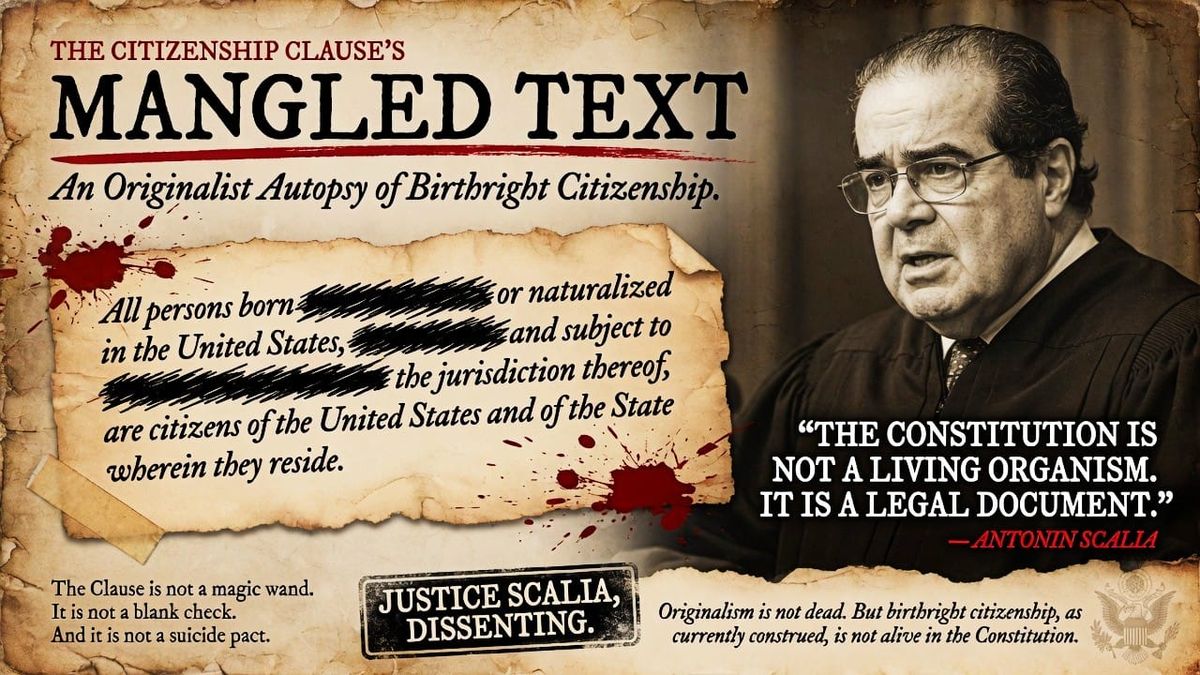
The Citizenship Clause’s Mangled Text: An Originalist Autopsy of Birthright Citizenship. Justice Scalia, dissenting.
The dissent argues the Court rewrote the Fourteenth Amendment by ignoring “subject to the jurisdiction,” which originally required full political allegiance. Wong Kim Ark is narrow, not a mandate for universal birthright citizenship. The executive order reflected the Amendment’s fixed meaning.
Abstract
The Fourteenth Amendment’s Citizenship Clause has been transformed into an engine of automatic birthright citizenship for virtually any child born on American soil, regardless of the parents’ allegiance, lawful status, or even temporary presence. This interpretation, now deeply embedded in the public consciousness and in policy, rests not on the original meaning of the Constitution’s text but on a century of judicial drift, political inertia, and a lamentable refusal to grapple with what the ratifying generation actually understood. I propose to dissect the Clause as an originalist—the only legitimate method of constitutional interpretation—and demonstrate that the phrase “subject to the jurisdiction thereof” was a term of art, deliberately chosen to exclude persons who owe no permanent, undivided allegiance to the United States. The widespread assumption that birthplace alone sufficed under the common law is a myth, one that ignores the fundamental rupture with feudal notions of allegiance wrought by the American Revolution and the carefully bounded language of the Fourteenth Amendment itself. The living constitutionalists and textual contortionists have given us a policy that the Framers never authorized, the people never ratified, and the Republic can ill afford.
Introduction: The Originalist’s Duty
An honest judge, confronted with the majestic phrases of the Constitution, does not begin by asking what result a decent and compassionate society would prefer. He begins, and he ends, with the text as it was understood by those who made it law. The Citizenship Clause reads, “All persons born or naturalized in the United States, and subject to the jurisdiction thereof, are citizens of the United States and of the State wherein they reside.” Every word must be given effect, and no phrase may be treated as surplusage. Yet the dominant modern reading reduces the limiting clause “and subject to the jurisdiction thereof” to a triviality, a piece of throat-clearing that excludes only the children of foreign diplomats and hostile occupying armies. That reading is not merely questionable; it is a judicial invention, a willful erasure of the Framers’ handiwork.
The originalist approach to the Citizenship Clause demands that we reconstruct the semantic content of “subject to the jurisdiction” as it existed in the public discourse of the 1860s. It is not enough to point to vague common-law maxims about jus soli, as though the feudal allegiances of the English Crown were simply transplanted into a Constitution founded on popular sovereignty and the natural right of self-government. The Framers of the Fourteenth Amendment were men who had just fought a catastrophic war over the nature of allegiance and membership in the national community. They were not writing on a blank slate; they were amending a charter that made “We the People” the sovereign. To ignore that context is to commit the cardinal sin of modern jurisprudence: substituting the judge’s policy preferences for the meaning of the law.
The Textual Hook: “Subject to the Jurisdiction Thereof”
We must begin with the language itself. If mere birth within the territorial limits conferred citizenship, the phrase “and subject to the jurisdiction thereof” would have no independent work to do. Territorial presence already subjects any individual to the enforcement of criminal and civil laws, whether citizen, alien, or temporary sojourner. If that were the intended meaning, the Framers would have written, “All persons born in the United States and not immune from diplomatic immunity,” which of course they did not. The jurisdictional qualifier must mean something more: a complete and exclusive subjection to the political sovereignty of the United States, an allegiance owed directly to the nation and not to any foreign power.
This interpretation is not a clever litigator’s trick; it is the natural, indeed the only, reading that avoids redundancy. Senator Lyman Trumbull of Illinois, a principal architect of the Civil Rights Act of 1866, the statutory precursor to the Amendment, explained that “subject to the jurisdiction” meant “not owing allegiance to anybody else.” It was a declaration of membership in the body politic, a political jurisdiction that went beyond mere local subjection to police power. Senator Jacob Howard, when introducing the Amendment to the Senate, similarly distinguished between the partial, local jurisdiction that applies to temporary aliens and the complete political jurisdiction that applies to those who are part of the sovereign people. The Framers could not have been more lucid: birthright citizenship was meant for the children of members, not for anyone whose parents happened to enter or remain in the country in defiance of its laws.
The Common-Law Fallacy
A familiar and tiresome objection to the originalist reading is the claim that the English common law’s rule of jus soli automatically embedded itself in the Fourteenth Amendment. This argument is historical fiction of the most pernicious sort. The American Revolution was a repudiation of the feudal doctrine of perpetual, indissoluble allegiance based solely on birthplace. The English rule, articulated by Calvin’s Case, held that a person born within the King’s ligeance owed a natural and unbreakable allegiance to the Crown. That concept was anathema to a republic founded on the consent of the governed. The Declaration of Independence itself was a rejection of the notion that geography alone determines political identity.
The Framers of the Fourteenth Amendment knew this well. They were not naive importers of Blackstone’s Commentaries without regard for the structural principles of American constitutionalism. The common law of citizenship that developed in the early Republic was, to say the least, unsettled, and many leading authorities, including Chancellor Kent and Justice Story, acknowledged that birthright citizenship in the new nation was bound up with the status of the parents and their permanent membership in the community. Moreover, the Dred Scott decision, however odious its core holding, recognized a distinction between those who were part of the political people and those who were merely subject to its territorial laws. The Fourteenth Amendment repudiated Dred Scott’s racial exclusion, but it did not abolish the distinction between political and merely territorial jurisdiction; it clarified that the newly emancipated, whose allegiance was now solely to the United States, were indisputably “subject to the jurisdiction” in the complete sense.
To invoke jus soli in its pure, unadulterated form is to ignore that the Amendment itself added the jurisdictional qualifier precisely to avoid the absolutism of the English rule. If the Framers had intended to adopt the unmodified common-law principle, they would have said simply, “All persons born in the United States are citizens.” They did not. The phrase they chose—deliberately, after extensive debate—carves out a domain of persons born on the soil who are not, by reason of their parents’ foreign allegiance, part of the political community.
Original Public Meaning: A Political, Not Merely Geographical, Test
The original public meaning of the Citizenship Clause can be reconstructed by examining the linguistic and legal context of 1868. The concept of “jurisdiction” in international and domestic law carried a double sense: a jurisdiction of territory and a jurisdiction of allegiance. The former subjects all within the borders to the laws of the sovereign; the latter subjects individuals to the personal bond of allegiance, including obligations such as military service, permanent loyalty, and the full panoply of political rights and duties. The Civil Rights Act of 1866, which the Fourteenth Amendment was designed to constitutionalize, declared citizens “all persons born in the United States, and not subject to any foreign power, excluding Indians not taxed.” The exclusion of those “subject to any foreign power” is the interpretive key. An Indian living in a tribal nation was born within the geographical United States, yet was excluded because his primary political allegiance ran to his tribe, a separate sovereign. An ambassador’s child was excluded because his allegiance ran to a foreign state. The child of an alien who merely owed a temporary, local obedience to American laws while his parents owed permanent allegiance to a foreign prince was, by parity of reasoning, equally outside the intended scope.
This is not an argument that the Framers specifically debated the children of modern-day illegal immigrants. The Framers did not foresee every migratory pattern or border crisis, but they provided a principle. The principle is that citizenship attaches to those who, by birth on the soil and by the absence of foreign allegiance, are fully and exclusively within the political jurisdiction of the United States. A child born to a parent who enters the country in violation of its laws, who remains here in defiance of its sovereign command to leave, and whose very presence constitutes a continuing breach of the conditions of territorial hospitality, can hardly be said to be born within the full and complete jurisdiction of the nation. That parent has not entered into the political compact; he has violated it. The child’s birth is an act fortuitously occurring on American soil, but it does not sever the chain of foreign allegiance transmitted by the parents.
The Congressional Debates: A Selective Amnesia
The legislative history of the Fourteenth Amendment, when read honestly and completely, confirms that the ratifying Congress did not intend to establish universal birthright citizenship. Time and again, the managers of the Amendment assured skeptical members that the jurisdictional language was a limiting principle. Senator Edgar Cowan of Pennsylvania expressed alarm that the Citizenship Clause would extend to the children of Chinese laborers and Gypsies—transient populations who, in the senator’s view, did not assimilate into the political community. Senator Trumbull replied that the Clause would not extend to such persons because they remained “subject to a foreign power,” owing allegiance to their country of origin. Whether one approves of the sentiment or not, the understanding was explicit: the children of temporary, non-naturalizing aliens were not intended to be citizens by the mere accident of geography.
The supporters of the Amendment were not xenophobic simpletons; they were drawing a constitutionally coherent line between members of the polity and those merely within its territory. They understood that a nation that cannot determine who becomes a citizen is a nation that cannot preserve its sovereign identity. The modern judge who dismisses these debates as bigoted noise and imposes a universal jus soli rule is not being generous; he is being lawless, substituting his moral sensibility for the fixed meaning of the ratified text.
Jurisprudential Mischief: Wong Kim Ark and Its Progeny
The Supreme Court’s decision in United States v. Wong Kim Ark is often trotted out as though it ended the inquiry. But read the case, not the headnote. The Court held only that a child born in the United States to parents who were lawful permanent residents—domiciled here and engaged in business—was a citizen. The parents were not diplomats, not enemy aliens in hostile occupation, not transient visitors, and most crucially, not here in defiance of the laws of the United States. The Court’s reasoning, while steeped in common-law analysis, explicitly recognized that the exception for persons “subject to a foreign power” extended beyond the narrow categories of ambassadors and invading armies. The decision did not address, and certainly did not resolve, the question of children born to parents whose very presence is a violation of sovereignty. Lower courts and the executive branch, however, have since inflated Wong Kim Ark into a blanket rule, a talismanic invocation against any effort to confine the Clause to its original boundaries.
This judicial creep is a textbook example of what happens when original meaning is abandoned. A narrow holding, itself perhaps tolerably within the ambit of the text, is cited for a proposition it never announced, and before long the judges and the bureaucracy treat any return to first principles as an unthinkable affront. Originalism demands that we excise this accretion of error and return to the text as it was understood, not as a sequence of non-binding dicta has mischaracterized it.
The Folly of the Living Constitution
One can always predict the counterargument: times have changed, the nation has evolved, and justice requires a capacious reading of the Citizenship Clause to avoid statelessness or to reflect contemporary values. This is the siren song of the living Constitution, and it is a lullaby designed to put the Constitution to sleep. If the people wish to alter the principle by which citizenship is conferred, the Article V amendment process is available. The judiciary has no warrant to amend the Constitution by judicial fiat, to substitute its evolving standards of decency for the hard-won compromises of the reconstruction era. The demand that we read the Citizenship Clause to mean whatever a good-hearted twenty-first-century progressive thinks it should mean is not interpretive modesty; it is interpretive imperialism.
And let us not mince words about the consequences. A reading that confers citizenship automatically on the children of millions who enter or remain illegally creates a gravitational pull that distorts immigration policy, rewards lawbreaking, and severs the connection between citizenship and a shared national allegiance. The Framers never imagined that the Clause would be a sword to strike down any legislative attempt to define the boundaries of political membership. They left that power, within the constraints of the original meaning, to the political branches. The modern judiciary’s abdication of the duty to enforce the actual jurisdictional limit has usurped the people’s right to govern themselves.
Conclusion: Restoring the Jurisdictional Compact
The path forward is neither cruel nor complicated. It requires an honest acknowledgment that the phrase “subject to the jurisdiction thereof” means what it says and says what it means. A child born to a parent who owes allegiance to a foreign power and who is present in the United States in violation of its laws is not subject to the complete political jurisdiction of the nation in the original sense of the Compact. Congress, through its power under Section 5 of the Fourteenth Amendment, or the Court in a proper case, should clarify that the Citizenship Clause extends only to those whose birthright carries no foreign allegiance. This is not a conservative invention; it is the originalist’s modest, faithful exposition of a text that has been too long abused. The Constitution is not a suicide pact, and it is not a blank check for judicially mandated demographic transformation. It is a charter of self-government, whose meaning was fixed and whose words bind us. Until the judges and the scholars recover the intellectual honesty to read the Citizenship Clause without smuggling in their policy preferences, the American people will continue to live under a regime of citizenship that the Framers never gave them and the Constitution never authorized.
Justice Scalia, dissenting.
The Court today strikes down a modest executive order that sought to restore the original meaning of the Fourteenth Amendment’s Citizenship Clause—an order the late Justice Antonin Scalia would have embraced, and one that I, his judicial ghost, am bound to defend. The majority, in an act of breathtaking interpretive arrogance, announces that the Constitution “guarantees citizenship at birth” to virtually any child born within the United States, no matter that the child’s parents are here in flagrant violation of our laws or are merely transient sojourners. The six Justices in the majority have not interpreted the Constitution; they have rewritten it, substituting their own preferences for the fixed meaning of the ratified text. I dissent.
The Citizenship Clause provides that “All persons born or naturalized in the United States, and subject to the jurisdiction thereof, are citizens of the United States and of the State wherein they reside.” If ever there were a phrase designed to provoke intellectual honesty, it is the limiting clause “and subject to the jurisdiction thereof.” The majority, however, reduces those words to an inkblot. Under its reading, they exclude only the children of foreign diplomats and invading armies—categories already excluded by long-standing principles of sovereign immunity and the laws of war. That is to treat the Clause as though it read, “All persons born in the United States, with two narrow exceptions, are citizens.” But the Framers did not write that, and a judge who professes textualism cannot simply edit the Constitution to achieve a desired result. The majority’s rendering makes “subject to the jurisdiction thereof” a meaningless flourish, a piece of constitutional surplusage. We are told that “jurisdiction” means nothing more than being subject to the local operation of civil and criminal laws. But every person who sets foot on American soil is subject to those laws, whether citizen, lawful visitor, or illegal entrant. If that banal territorial jurisdiction were all the Clause required, the jurisdictional language would have no independent work to do. An honest construction must give effect to every word, and it must seek the meaning those words carried at the time of ratification.
In 1868, “subject to the jurisdiction thereof” was a term of art denoting complete political allegiance, an undivided loyalty owed directly to the United States and not to any foreign power. Senator Lyman Trumbull, a principal draftsman of the Civil Rights Act of 1866 that the Fourteenth Amendment constitutionalized, explained that the phrase meant “not owing allegiance to anybody else.” Senator Jacob Howard, introducing the Amendment to the Senate, distinguished between the partial, local jurisdiction that applies to temporary aliens and the full political jurisdiction that binds a person to the sovereign as a member of the body politic. The Amendment was drafted against the vivid memory of Dred Scott, which had notoriously excluded persons of African descent from citizenship. The Framers sought to overturn that racial exclusion, not to obliterate the necessary distinction between those who are part of the sovereign People and those who are merely present within the sovereign’s territory. They deliberately chose language that would extend citizenship to the children of the newly emancipated—men and women who owed no foreign allegiance and whose political status was wholly and permanently within the American system—while withholding it from those whose ties remained to a foreign sovereign.
The majority leans heavily on United States v. Wong Kim Ark, as though that decision resolved the instant controversy. It did not. Wong Kim Ark held that a child born in the United States to parents who were lawfully domiciled here, who had a permanent residence and were engaged in business, was a citizen. That child’s parents were not enemy aliens, not transient sojourners, and certainly not present in defiance of the sovereign’s command. The Court expressly grounded its reasoning in the premise that the parents were “domiciled residents” who had a lawful, settled connection to the nation. To stretch that narrow holding into a universal rule that captures the children of parents who broke the law to enter or who merely pass through is not fidelity to precedent; it is judicial legislation. The majority’s reliance on the common-law rule of jus soli commits the same blunder. The English feudal doctrine of perpetual allegiance based solely on the accident of birthplace was a vestige of a monarchical system that the American Revolution repudiated. Our Republic was founded on the consent of the governed, not on the geographic happenstance of ligeance to the Crown. The ratifying generation well understood this; Chancellor Kent and Justice Story acknowledged that American citizenship was bound up with the status and political membership of the parents. The Fourteenth Amendment, by inserting the jurisdictional qualifier, explicitly rejected the absolutism of the English rule.
The majority’s most troubling maneuver is the assertion that the Constitution “evolves” and that a “decent society” must afford the boon of citizenship to all comers. This is the living Constitution at its worst—a doctrine that liberates judges from the meaning of the law and chains the people to the judges’ personal moral sentiments. If the American people wish to confer citizenship upon every child born within their borders regardless of the parent’s lawful status or allegiance, they may do so through the Article V amendment process. They have not done so. To pretend that the ratification of the Fourteenth Amendment in 1868 silently enacted the policy the majority now favors is to engage in a fraud upon the democratic process. The majority’s expansive interpretation will guarantee that millions born to parents who defy our immigration laws become citizens at birth, thereby creating a powerful incentive for further lawbreaking and perverting the concept of citizenship from a badge of membership in a political community into a jurisdictional lottery. The Constitution does not compel this result. The Framers would not have recognized it.
The executive order at issue here sought merely to clarify that the children of unlawful entrants and purely temporary visitors are not “subject to the jurisdiction” in the complete, political sense the Amendment demands. This was a lawful exercise of the President’s authority to enforce the Constitution’s actual boundaries, and it is well within Congress’s power under Section 5 of the Fourteenth Amendment to provide further definition. The majority’s contrary holding rests on nothing more than a policy judgment that a better world is one with open-bordered birthright citizenship. That may be a lovely sentiment, but it is not law. The Constitution I would defend is not a vessel for the justices’ policy fantasies; it is a text whose meaning was fixed. Because the Court today divorces the Citizenship Clause from that fixed meaning, I respectfully and emphatically dissent.