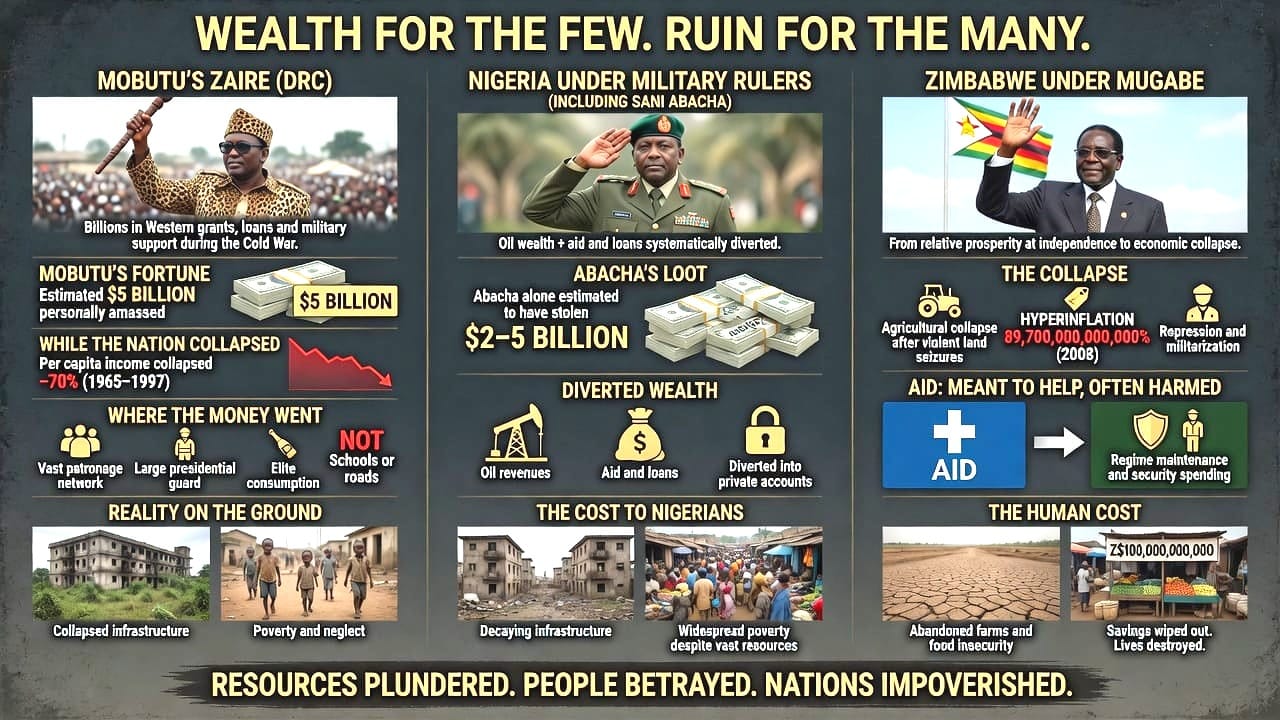
The Global Economic Shambles: Consequences of Inaction, the Imperative for Urgent Measures, and a Path to a Stable World Order Grounded in Neglected Postwar Precedent
The world economy is breaking under overlapping stresses—stagflation, fragmentation, debt failure, climate damage, and weak institutions. Without major reconstruction, today’s shambles will devolve into deeper crises; only renewed global architecture can halt the slide.
Introduction: A World in Disarticulation
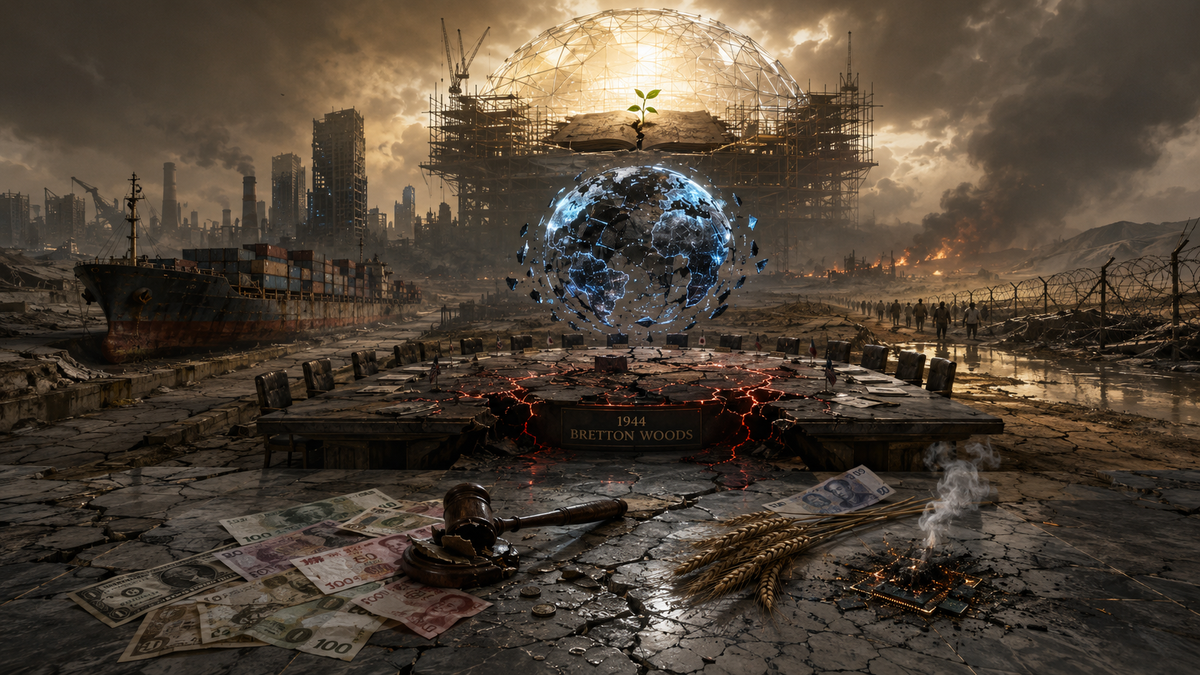
The world economy is in a shambles. This stark assessment is no longer confined to polemical journalism or political rhetoric; it has become a central motif of serious scholarly and institutional diagnosis. The post-pandemic global order has been convulsed by overlapping shocks that have coalesced into a durable state of polycrisis, where economic, geopolitical, ecological, and social dysfunctions reinforce one another. What distinguishes the current malaise from ordinary cyclical downturns is the simultaneity of demand-side stress, supply-side fragmentation, balance-sheet fragility, and institutional corrosion, all unfolding against a backdrop of diminished international cooperation. This report provides a comprehensive analysis of the disarticulation of the world economy. It traces the origins of the present disorder, examines its key structural dimensions, evaluates the immediate consequences of maintaining the status quo, identifies the urgent measures required to avert global conflict and catastrophe, and draws upon the neglected institutional and moral lessons of the immediate post-World War II era to chart a viable path toward a more stable world order.
Part One: The Anatomy of the Shambles
The first dimension of the unraveling is the persistent and uneven macroeconomic instability that has shattered the post-2008 consensus of secular stagnation and low inflation. The synchronized monetary expansion during the COVID-19 pandemic, while preventing an outright depression, sowed the seeds of a global inflationary surge whose aftershocks continue to reverberate. Fiscal transfers of unprecedented scale, supply-chain bottlenecks, and a sharp rotation of demand from services to goods ignited price pressures that were initially dismissed as transitory. By the time major central banks acknowledged the structural character of the inflation, it had already embedded itself in core services, wages, and expectations. The subsequent aggressive monetary tightening—the most synchronized in four decades—has managed to cool headline inflation from double-digit peaks, but at the cost of a deeply fragmented growth landscape.
Advanced economies, particularly the United States, have exhibited surprising resilience in aggregate demand, buoyed by tight labor markets and pandemic-era savings buffers. Yet this aggregate picture conceals a profound divergence. Europe, hit by the energy crisis triggered by the war in Ukraine, has teetered on the edge of recession, its industrial base permanently impaired by the loss of cheap Russian gas and by competitive pressure from subsidized green industries elsewhere. Japan has struggled with a collapsing currency and the belated return of inflation in a society structured around price stability. Among emerging and developing economies, the picture is bleaker still. The tightening of global financial conditions has triggered capital outflows, currency depreciations, and debt crises across a swath of nations from Sri Lanka and Pakistan to Ghana and Zambia. The International Monetary Fund has repeatedly warned that over sixty percent of low-income countries are at or near debt distress, caught in a suffocating trap between dollar-denominated liabilities and collapsing fiscal space. This divergence not only stretches the definition of a synchronized global business cycle; it creates a world of macroeconomic islands where monetary and fiscal policies increasingly operate at cross-purposes.
The second dimension of the shambles is the collapse of the rules-based trading order and the rise of geoeconomic fragmentation. The vision of a seamlessly integrated global marketplace, nourished by comparative advantage and institutionalized by the World Trade Organization, has given way to a weaponized interdependence in which supply chains are carved up along geopolitical fault lines. The war in Ukraine crystallized this transformation. Sanctions regimes, export controls on advanced semiconductors, and the securitization of energy and food supplies have become permanent instruments of statecraft. What began as targeted measures against Russia has metastasized into a broader bifurcation of the global economy into blocs centered on the United States, China, and a precarious non-aligned middle. Trade growth, once consistently outpacing GDP growth, has stalled. Foreign direct investment is increasingly concentrated among geopolitically aligned nations, a phenomenon the World Bank terms geoeconomic fragmentation, eroding the efficiency gains that underpinned three decades of poverty reduction.
The fragmentation is most visible in the technological domain. The race for supremacy in artificial intelligence, quantum computing, and clean energy has prompted a deluge of industrial policies—the Inflation Reduction Act in the United States, the European Green Deal Industrial Plan, China’s dual-circulation strategy—that prioritize self-sufficiency and national champions over multilateral coordination. While framed as defensive measures against supply-chain vulnerabilities, these policies amount to a subsidy arms race that distorts capital allocation, raises consumer costs, and locks in redundant capacity. The semiconductor industry exemplifies the dynamic: chip fabrication capacity is being built simultaneously in Arizona, Ohio, Saxony, and Kumamoto at costs significantly higher than in Taiwan or South Korea, with the implicit assumption that geopolitical security trumps economic logic. This is less a shambles of output than a shambles of efficiency, a systematic misallocation of global savings toward politically motivated redundancy that will depress productivity for years to come.
The third and perhaps most structurally alarming dimension is the sovereign debt overhang and the fragility of the global financial architecture. Decades of financialization, deregulation, and the expansion of non-bank financial intermediation have created a global balance sheet that is larger, more interconnected, and more opaque than at any point in history. Total global debt—public, corporate, and household—stands at a record share of world output. As real interest rates have risen sharply from historic lows, the cost of servicing this debt has soared, triggering a silent cascade of stress in private credit markets, commercial real estate, and the sovereign bond markets of the developing world. The banking turmoil of early 2023, which claimed several regional U.S. banks and the venerable Credit Suisse, was a symptom of this deeper malady: the mismatch between long-duration assets, inflated by years of quantitative easing, and the sudden reality of tighter money.
The international financial safety net, designed in the mid-twentieth century and patched haphazardly ever since, is woefully inadequate for this new environment. The IMF’s lending capacity, though expanded, remains a fraction of the potential liquidity needs of systemically important emerging markets. Bilateral swap lines between central banks are selective and geopolitically conditioned, leaving many nations exposed to the coercive dynamics of the strong dollar. The Common Framework for debt restructurings has proven slow and toothless, failing to compel private creditors to share the burden with official lenders, thereby prolonging debt overhangs that cripple investment in health, education, and climate adaptation. This institutional vacuum means that the next wave of sovereign defaults, when it arrives, will unfold in a disorderly fashion, radiating through the commodity markets and banking systems that link the periphery to the core.
Closely intertwined with the debt crisis is the climate emergency, which has transitioned from a long-term externality into an immediate macroeconomic shock. The physical risks of a warming planet—droughts, floods, heatwaves, and the degradation of arable land—are now manifesting as simultaneous hits to agricultural output, energy infrastructure, and labor productivity across continents. The economic costs of climate-linked disasters have escalated far beyond the actuarial models of insurers and reinsurers, leading to the retreat of coverage from entire regions and the emergence of a protection gap that ultimately falls on governments. The transition to a low-carbon economy, while essential, introduces its own series of dislocations. The so-called greenflation caused by soaring demand for critical minerals such as lithium, copper, and cobalt, combined with underinvestment in mining and refining, creates new input-cost volatilities reminiscent of the 1970s oil shocks. Meanwhile, the huge capital reallocation required for the net-zero transition risks being thwarted by the very fragmentation and fiscal exhaustion described above. Developing nations, which bore little responsibility for the stock of atmospheric carbon, are being asked to leapfrog fossil fuels at precisely the moment they are drowning in debt and denied affordable capital. The result is a planetary coordination failure where neither mitigation nor adaptation proceeds at the necessary scale, embedding a future of recurrent climate-driven supply shocks that will keep the world economy in a state of perpetual instability.
Underpinning these interlocking crises is a deeper social and demographic rot that erodes the political foundations of economic policy. Across the developed world, populations are aging rapidly, shrinking workforces, and straining pay-as-you-go pension and healthcare systems. These pressures will intensify the fiscal burdens on already heavily indebted states and create intergenerational conflicts over resource allocation. In many developing nations, a youth bulge confronts labor markets incapable of providing dignified employment, fueling migration, social unrest, and the allure of populist strongmen. Inequality of wealth and opportunity, exacerbated by the long cycle of asset-price inflation and the disproportionate impact of the pandemic on the poor, has poisoned the well of public discourse. The social contract that sustained the postwar mixed economy—that hard work and education would yield rising living standards for the next generation—has been broken in large swaths of the Western world. The political consequence is a degenerative cycle: electorates, disillusioned with the incrementalism of liberal technocracy, turn to nativist, protectionist, and fiscally reckless movements that further undermine the international cooperation needed to solve the polycrisis.
The labor market, a traditional anchor of aggregate demand, is itself transmuting into a source of disorder. The post-pandemic phenomenon of the Great Reshuffling, characterized by elevated quit rates, labor shortages in contact-intensive sectors, and a renegotiation of work-life boundaries, has given way to a more brittle reality. The rapid deployment of generative artificial intelligence threatens to compress the wage structures of white-collar, cognitive occupations just as automation and offshoring once hollowed out routine manufacturing. The simultaneous demand for high-end tech workers and the incipient displacement of paralegals, call-center operators, and junior programmers creates a polarized labor market that traditional fiscal and monetary tools cannot easily address. Coupled with the reconfiguration of supply chains, this technological disruption is generating a protectionist impulse around labor that takes the form of resistance to immigration and trade, even as demographic reality demands greater mobility. The result is a mismatch as profound as any in the real economy: capital searches for skilled labor that is artificially constrained by borders, while surplus labor in the Global South lacks the legal pathways to meet that demand.
The cumulative effect of these dynamics is an intellectual and institutional crisis of macroeconomic governance. The regime of inflation targeting by independent central banks, buttressed by flexible exchange rates and fiscal rules, served as the intellectual anchor of the Great Moderation. That regime is now besieged from all sides. Central banks are being pressed to address climate change, inequality, and industrial competitiveness with instruments designed solely for price stability. Their credibility has been dented by the inflationary overshoot and by the perception that quantitative easing disproportionately benefited asset holders. Fiscal authorities, having rediscovered the power of the public purse during the pandemic, are now caught between the imperative to subsidize energy, defend industrial bases, and finance the green transition on the one hand, and the discipline imposed by bond vigilantes on the other. The brief moment of Keynesian resurgence has given way to a messy fiscal-financial dominance in which monetary policy is constrained by the sovereign’s debt-servicing burden. No new consensus has emerged to replace the shattered orthodoxies, leaving policymakers to navigate by feel, reacting to each new shock with ad hoc measures that introduce fresh distortions.

Part Two: The Consequences of Maintaining the Status Quo
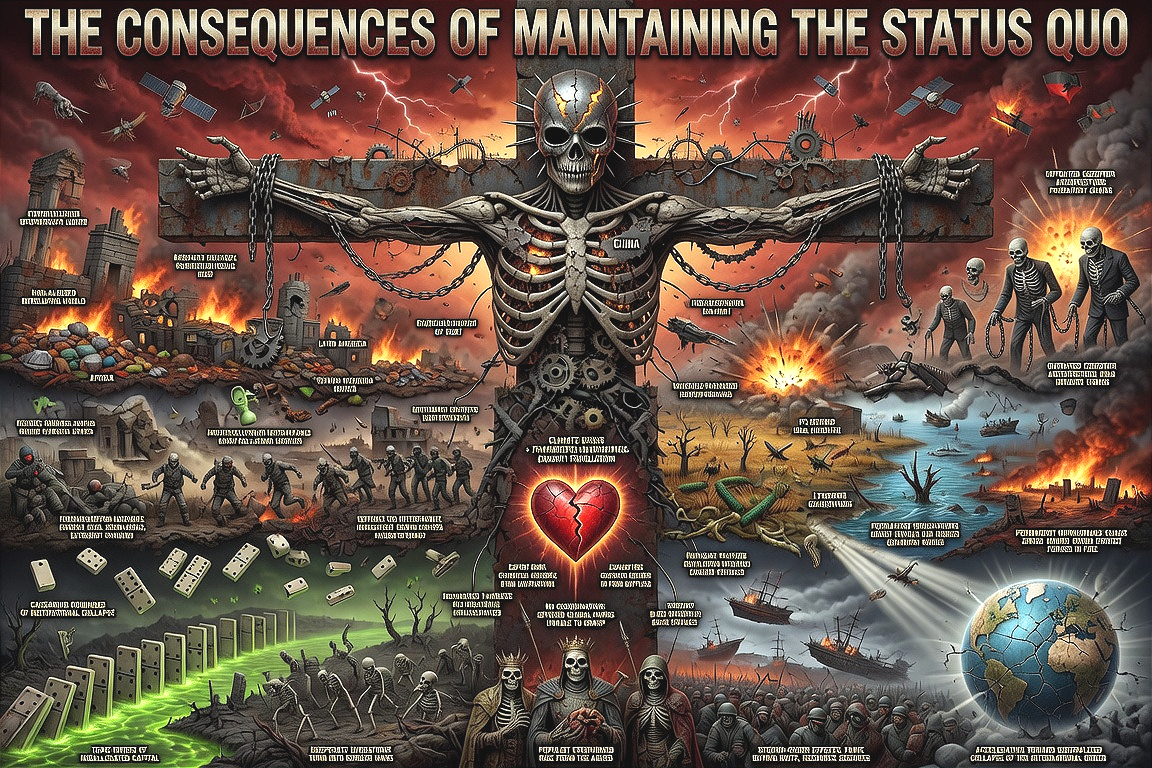
To fully grasp the severity of the current global economic shambles, one must look beyond the diagnostic catalog of overlapping crises and interrogate the trajectory that inaction prescribes. While the deep structures of history make clear that systemic change is inevitable—whether through managed reform or violent rupture—the immediate consequences of maintaining the status quo are not a passive continuation of present discomforts. They constitute a dynamic of active deterioration, a cascade of second-order effects that will transform a polycrisis into a generalized collapse of the international order.
The maintenance of the status quo entails a world in which major powers continue to prioritize narrowly defined national security and industrial self-sufficiency over the collective management of global public goods. The immediate effect of such a course is the entrenchment and acceleration of geoeconomic fragmentation. As the United States, China, and the European Union deepen their respective spheres of industrial and technological influence, the global trading system will cease to function as a single efficiency-maximizing mechanism and will instead solidify into blocs characterized by incompatible standards, duplicate supply chains, and escalating tariff and non-tariff barriers. The immediate consequence is not a tidy decoupling into two self-contained systems, but a chaotic and lossy partial decoupling that immiserates the non-aligned developing world most severely. Nations in Africa, Southeast Asia, and Latin America, forced to choose between incompatible digital ecosystems, payment rails, and security guarantees, will see their terms of trade deteriorate and their access to critical technologies curtailed. The cost of the green transition, already prohibitive, will soar as rival blocs hoard critical minerals and bid up the price of inputs in a zero-sum scramble. Inflationary pressures, far from being fully tamed, will mutate into a chronic condition of supply-side volatility, rendering the task of central banks impossible and eroding the purchasing power of populations least able to hedge against it.
Simultaneously, the status quo path leaves the sovereign debt crisis to fester. The failure to reform the international financial architecture and to enact a comprehensive, mandatory framework for sovereign debt restructuring means that heavily indebted nations will continue to endure a decade or more of lost development. The immediate effect is a silent humanitarian catastrophe, as governments divert scarce fiscal resources from health, education, and climate adaptation to interest payments on debts held by private creditors and, increasingly, by powerful official bilateral lenders. This fiscal strangulation, maintained in the name of creditor rights and market discipline, breeds political instability, mass migration, and state collapse. It creates ungoverned spaces that become vectors for transnational organized crime, pandemics, and extremist ideologies. The insistence on an outdated, creditor-friendly architecture thus becomes a direct engine of the very security threats that the developed world claims to fear, a self-defeating cycle of extraction and blowback.
The most perilous immediate consequence of inaction, however, lies in the interaction between a fragmented economic order and an accelerating climate crisis. A status quo defined by geopolitical rivalry excludes the possibility of the necessary planetary coordination on emissions reduction, technology transfer, and adaptation finance. The physical shocks of climate change—synchronized harvest failures, mass-disabling heatwaves, the inundation of coastal megacities, and the collapse of critical ecosystems—will strike with increasing frequency and intensity upon a world system that has been stripped of its redundancy and cooperative capacity. The immediate result will be a series of cascading emergencies in which nations treat climate disasters as national security crises to be managed through border closures, resource seizures, and military postures. Climate-driven food shortages, for example, will not be met with a multilateral mechanism for equitable distribution, but with export bans and panic buying that magnify the initial shock, as was seen in a milder form at the onset of the Ukraine war. In a fragmented world, the insurance and reinsurance markets that price and distribute risk will retreat further from exposed regions, leaving vast populations without the financial means to rebuild, thereby creating permanent zones of uninsurable chaos. This is the furnace in which armed conflict is forged—not as a result of deliberate aggression, but as the structural consequence of a system unable to allocate survival resources cooperatively.
Part Three: Urgent Measures to Avert Global Conflict and Catastrophe
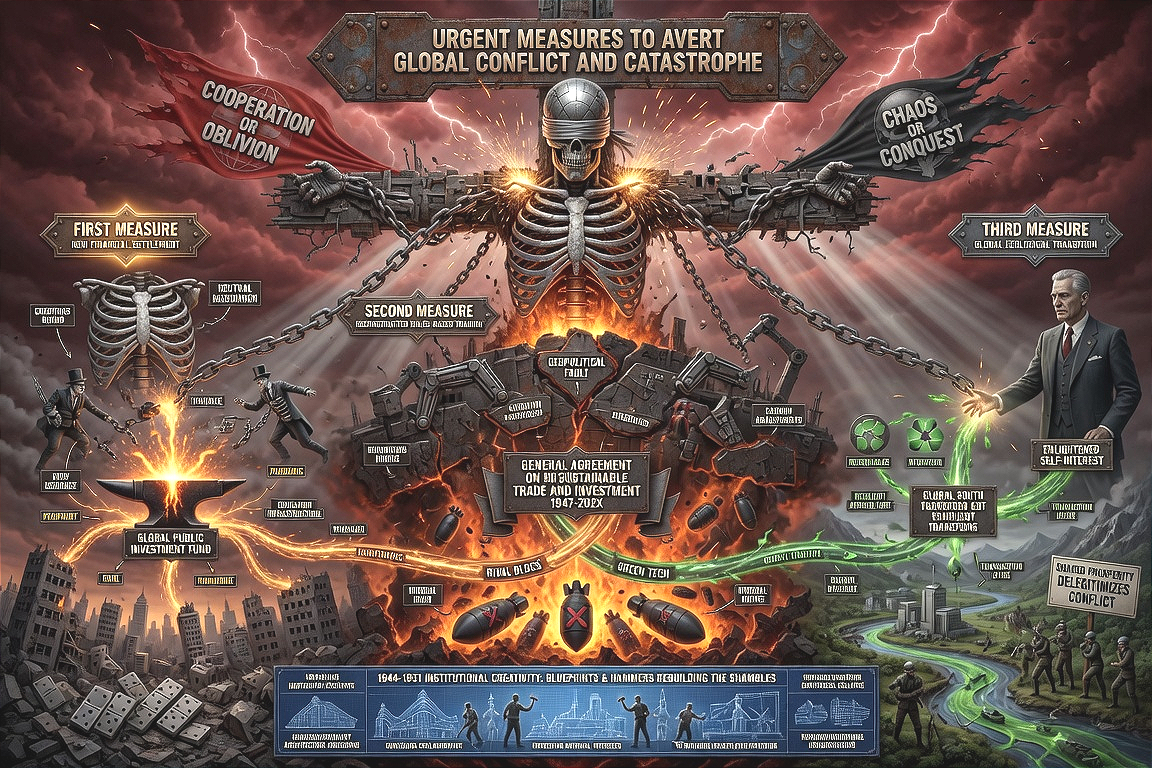
Urgent measures are required, not as a matter of aspirational reform but as a stark imperative of survival. History, particularly the period of institutional creativity between 1944 and 1951, provides a clear template for what must be done, even as the specific prescriptions must be adapted to a multipolar, digitally native, ecologically imperiled age. The architects of the postwar order, working in the shambles of a world shattered by depression, protectionism, and total war, understood that a stable and peaceful international system could not be built on the spontaneous interaction of sovereign powers. It required a conscious, designed framework of rules and institutions that embedded the pursuit of national interest within a collaborative architecture that provided public goods and managed systemic risks.
The first and most urgent measure is a new financial settlement. The Bretton Woods system, however imperfect in its original incarnation, was founded on the principle that cross-border capital flows must serve productive investment and trade, not ungovernable speculation, and that adjustment burdens must be symmetrically shared between surplus and deficit nations. Today’s equivalent must begin with a comprehensive, orderly, and generous write-down of unpayable sovereign debts, supervised by a truly neutral arbiter and binding on all classes of creditors. This must be paired with a massive issuance of new Special Drawing Rights by the International Monetary Fund, directed not by quota but by need, and channeled into a Global Public Investment Fund for climate mitigation, pandemic preparedness, and education. The urgency here cannot be overstated: the alternative is a cascade of sovereign defaults that destroys the banking systems of both the periphery and the core, generating a crisis of the magnitude that the postwar planners successfully avoided after 1945.
The second measure is the reconstruction of a rules-based trading regime, stripped of the utopianism of the 1990s and retooled for a world that legitimately values resilience alongside efficiency. This does not mean a return to naive hyper-globalization. It means a negotiated settlement that sets common rules for industrial subsidies, carbon border adjustments, and technology transfer, preventing the subsidy arms race that currently diverts trillions of dollars from productive investment. The General Agreement on Tariffs and Trade of 1947 was a provisional arrangement, born of a recognition that prosperity was indivisible and that the beggar-thy-neighbor policies of the 1930s had led directly to war. A contemporary equivalent, perhaps a General Agreement on Sustainable Trade and Investment, would establish a floor beneath which geopolitical competition in trade cannot sink, keeping open the channels for food, energy, and critical green technologies even between rival blocs. Without such a floor, the logic of total economic warfare will escalate until a flashpoint—over Taiwan, the South China Sea, or a critical mineral supply route—ignites military confrontation.
The third urgent measure, and in many ways the most fundamental, is the institutionalization of the global ecological transition. The postwar era saw the creation of the Marshall Plan, an act of unprecedented enlightened self-interest in which a hegemonic power recognized that its own prosperity was inextricably linked to the reconstruction of its former enemies and the developing world. Today’s equivalent is a Global Green Marshall Plan, financed by the debt and SDR mechanisms previously described, along with globally coordinated carbon taxes and financial transaction levies. Its purpose is to finance the decarbonization of the Global South on a grant and highly concessional basis, transferring the renewable energy, green hydrogen, and climate-resilient agricultural technologies that already exist but remain locked behind patent walls and unaffordable price points. The lesson of the postwar period is that stability cannot be built on a foundation of economic apartheid. The Marshall Plan worked not only because it provided capital, but because it offered a vision of shared prosperity and security that delegitimized the appeal of Soviet communism. Today, a Global Green Marshall Plan is the only strategy that can counteract the centrifugal pull of competing authoritarian models and create a material stake for all nations in a cooperative order.
Part Four: Recovering Neglected Postwar Precedent for a Stable World Order
Underpinning all these measures is the forgotten moral and intellectual core of the postwar settlement: the rejection of fatalism and the embrace of a philosophy of radical institutional pragmatism. The founders of the United Nations, the Bretton Woods institutions, and the European Coal and Steel Community were not naively optimistic. They were clear-eyed survivors of catastrophe who understood that sovereign states, left to their own mechanical devices, tend toward conflict and collapse. They created structures that deliberately constrained the destructive tendencies of nationalism while channeling the legitimate pursuit of welfare into cooperative channels. This generation neglected that wisdom, seduced by the end of the Cold War into believing that the natural state of human affairs was a self-regulating global market managed by a benign hegemon.
The path toward a more stable world order, therefore, requires a conscious act of political imagination and will that matches the scale of the mid-twentieth century. It requires a new congress of powers, convened not after a cataclysmic war but in the face of its terrifying proximity, to design the institutions of the twenty-first century. Such a congress must be universal in aspiration but realistic in acknowledging that the current great powers hold a special responsibility and capacity to act. Its outcome cannot be the preservation of a Western-dominated order that the rest of the world legitimately resents; it must be the co-creation of a genuinely pluralistic order in which the security of all is the condition for the security of each.
Conclusion: The Interval Before Catastrophe
In sum, the world economy is in a shambles not because of a single catastrophic failure, but because the multiplicity of overlapping stresses—stagflationary macroeconomics, geoeconomic fragmentation, a broken sovereign debt architecture, accelerating climate damage, corroded social compacts, and doctrinal policy vacuum—has exceeded the capacity of the existing institutional order to process them sequentially. The metaphor of a shambles is apt: it implies a state of disarticulation in which parts that were once functionally related are now disconnected, misaligned, and hazardous. The post-Cold War architecture of globalization assumed a stable hegemonic power, a steadily deepening integration of markets, and a gradual convergence of political values. Those assumptions have vanished. In their place is a disordered transition, characterized by rivalry, mutual suspicion, and the re-nationalization of economic security.
The immediate consequence of failing to embark on the path of ambitious institutional reconstruction is not the indefinite persistence of the shambles. It is the progression of the shambles into a series of violent, uncontrolled decompositions—economic depressions, mass state failures, resource wars, and the final foreclosure of a stable climate. The status quo is not a holding pattern; it is a slope descending into an abyss. The means to arrest that descent, constructed from the unsentimental and highly practical lessons of our own shared history, remain within reach if the interval before another great catastrophe is used not for further recrimination and arms racing, but for the furious, determined building of a new architecture of human solidarity. The future is not preordained to be catastrophic; historical ruptures of this magnitude have in the past catalyzed institutional innovation, such as the Bretton Woods conference after the combined shambles of depression and war. But the conditions for such a renewal—a clear distribution of power, a sense of shared existential threat, and political leadership with long time horizons—are conspicuously absent. Until they emerge, the world economy will continue to lurch from crisis to crisis, its shambles deepening with each uncoordinated response, extracting a human toll most heavily from those least equipped to bear it.