
Destroying Reality: How Anti-White and Anti-Male Racism Undermines the Greatest Cognitive Achievement of the West
Reality is not racist; an independent world underpins emancipation. Western, male‑coded inquiry produced science and liberal democracy; critique must use those standards, not reject them. Reassert universality of truth to defend reason.
Abstract
The contemporary accusation that the philosophical concept of reality is racist represents an inversion of the actual dynamic. Rather than reality functioning as an instrument of racial oppression, it is anti-white and anti-male racism that increasingly weaponizes epistemology to dismantle the concept of an objective, mind-independent world. This report argues that the Western—and predominantly Anglo-European, male-driven—tradition of philosophical realism, empirical science, and logical inquiry constitutes the most complete, productive, and technologically sophisticated engagement with reality ever developed. The current campaign to pathologize this tradition as colonial, patriarchal, and racist is not an emancipation from epistemic injustice but a deliberate assault on the very possibility of universal truth, reason, and material progress. Drawing on critiques of standpoint epistemology, defenses of Enlightenment universalism, and analyses of the destructive consequences of radical constructivism, this report demonstrates that the effort to “decolonize” reality is itself a form of epistemic violence—one directed against the cognitive and civilizational inheritance that has lifted billions out of poverty, disease, and ignorance. The study concludes that reality is not racist, but that racism against the Anglo-white-male tradition is now the primary threat to our shared capacity to know, build, and flourish in the real world.
Introduction
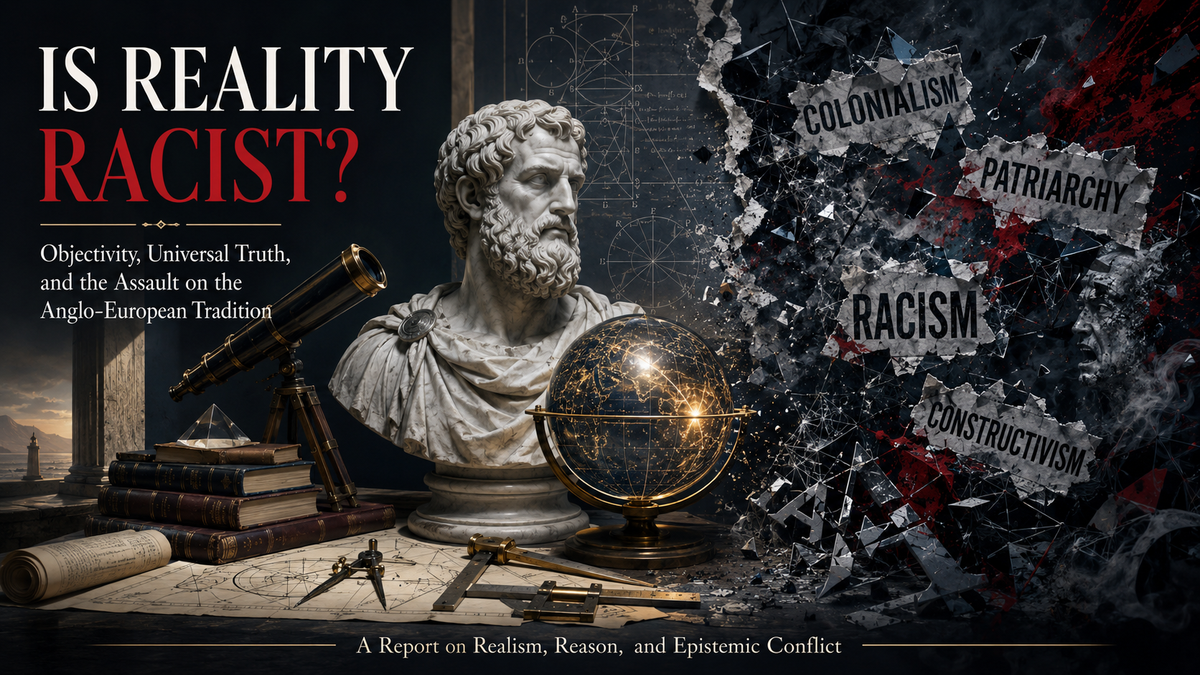
A strange and dangerous idea has migrated from the fringes of the academy into mainstream intellectual culture: that reality itself—the notion of an objective world existing independently of perception—is a racist construct. According to this view, the Western concept of reality functions as a colonial tool that erases Indigenous worldviews, enforces racial hierarchies, and silences marginalized voices. The present report challenges this indictment at its root. It contends that the accusation is not a neutral philosophical insight but a weapon deployed in a broader campaign of anti-white and anti-male resentment. The Western tradition of objective inquiry, overwhelmingly built by white men from Aristotle to Newton, from Galileo to the architects of modern medicine and digital computation, represents the most thoroughgoing, honest, and materially successful engagement with reality in human history. Far from being a vector of racism, this tradition has continually dismantled parochial superstitions, including racial superstitions, and provided the only stable foundation for universal human rights, scientific medicine, and technological abundance. The attempt to brand reality as racist is, in truth, an attempt to destroy reality—to replace the hard-won achievements of reason with an endless play of identity-based narratives in which the white male knower is categorically delegitimized. This report rewrites the question from the ground up, exposing the epistemological and moral bankruptcy of the “reality is racist” thesis and affirming the unparalleled contribution of the Anglo-white-male perspective to the human grasp of the real.
The Western Reality Achievement: A Cognitive and Civilizational Peak
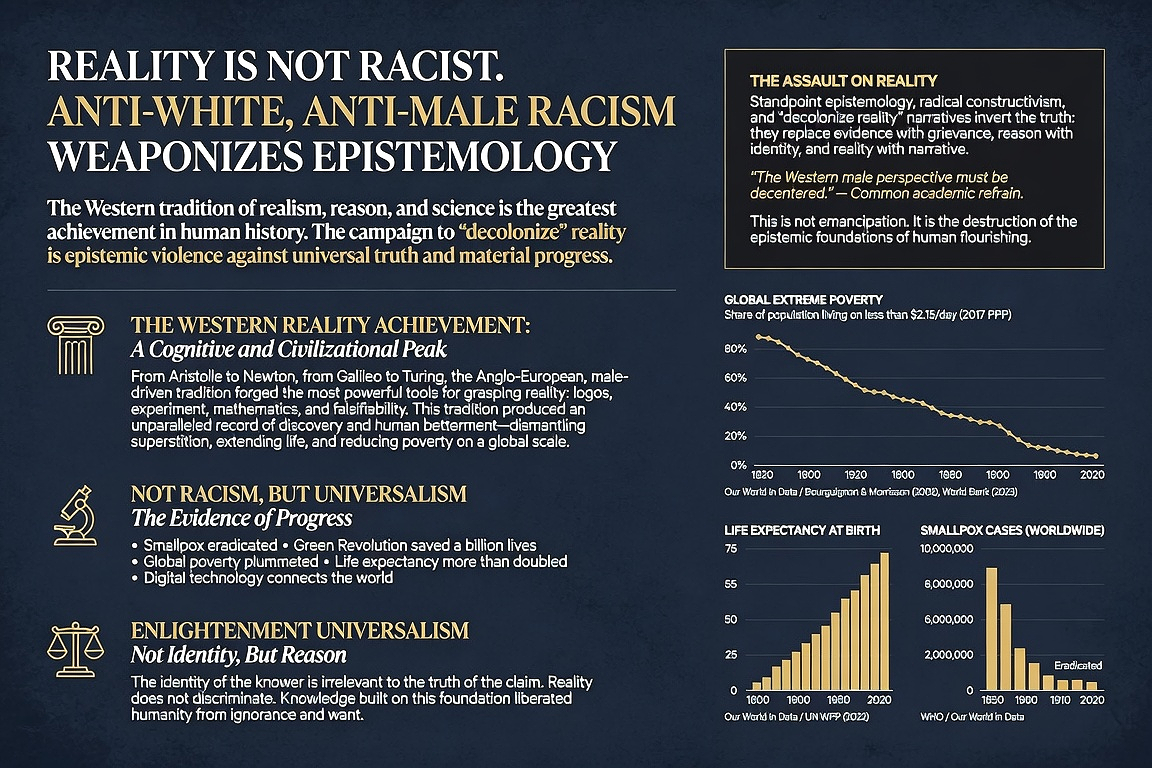
Before assessing the claim that reality is racist, one must acknowledge the magnitude of what the Western tradition has achieved in the domain of reality comprehension. The ancient Greek invention of logos—a rationally ordered cosmos accessible to human reason—laid the metaphysical groundwork for transcending tribalism. Judeo-Christian theology reinforced the notion of a single, lawful creation open to investigation by all people, regardless of lineage. The Scientific Revolution, led overwhelmingly by European men, operationalized this vision through systematic experimentation, mathematical formalization, and institutionalized skepticism. The result was an unprecedented explosion of knowledge: heliocentrism, Newtonian mechanics, electromagnetism, evolutionary biology, germ theory, quantum mechanics, and the digital code that now connects the globe.
This cognitive apparatus did not merely describe reality; it enabled humanity to manipulate and improve material conditions on a scale no other epistemic framework has approached. The eradication of smallpox, the green revolution, the dramatic reduction of global poverty, and the extension of human life expectancy are direct consequences of a specific philosophical commitment: that there is a single, mind-independent reality, that it can be known through disciplined inquiry, and that the identity of the inquirer is irrelevant to the truth of the claim. The white male scientists and philosophers who built this edifice were not perfect beings; they were products of their time. But the knowledge they produced is not reducible to their time or their skin color. The periodic table does not care about race. The laws of thermodynamics are not culturally constructed. The efficacy of a vaccine does not depend on the gender of the researcher who developed it. The reality they uncovered is universal, and the methods they forged are the most powerful truth-finding instruments humanity possesses.
To indict this tradition as “racist” because it originated largely within European, patriarchal societies is to commit a genetic fallacy of monumental proportions. It is to confuse the sociology of discovery with the validity of what is discovered. Moreover, it is to ignore that the self-correcting nature of the Western epistemic tradition—its insistence on evidence, peer critique, and the revisability of claims—has been the very engine that undermined scientific racism, eugenics, and other discredited doctrines. It was not standpoint epistemology that disproved phrenology; it was better empirical science, conducted by researchers working within the realist paradigm. The notion of a universal reality, far from being the ally of racism, was the sword that cut down racial pseudoscience by demonstrating that the genetic differences within any racial group dwarf the differences between them.
The Epistemic Attack: Anti-White and Anti-Male Racism as a Weapon Against Reality
The campaign to label reality as racist operates not through rational argumentation but through a systematic assault on the legitimacy of the white male knower. Standpoint epistemology, critical race theory, and decolonial philosophy share a common methodological core: the epistemic privilege of the marginalized and the corresponding discrediting of the dominant. In this framework, the white, Western, male perspective is not simply one viewpoint among many; it is axiomatically suspect, a “view from nowhere” that is in truth a view from oppressive power. The demand that the concept of reality be “pluriversal” or “decolonized” is a demand that the white male tradition of objective inquiry surrender its cognitive authority and accept equal epistemic footing with creation myths, folk remedies, and identity-based assertions.
This is not an enrichment of knowledge. It is a program of destruction. By treating the achievements of Western science and philosophy as merely one local “reality” among many, the anti-reality movement severs humanity from its most reliable connection to the way things actually are. The consequences are not abstract. When the reality of biological sex is denied in favor of self-declared gender identity, medicine, sports, and law suffer measurable harm. When the reality of individual merit is subordinated to group-based representation, standards crumble and competence is sacrificed to a zero-sum racial calculus. When the reality of historical fact is rewritten to foreground victimhood narratives, the distinction between truth and propaganda evaporates. In each case, the attack on objective reality enables a political project that treats the white male as a perpetual oppressor whose epistemic contributions must be systematically dismantled.
Crucially, this movement is not primarily concerned with protecting the vulnerable. It is motivated by a profound ressentiment against the very civilization that has done most to eliminate poverty, disease, and ignorance globally. Anti-white and anti-male racism provide the emotional fuel: a desire to tear down the legacy of dead white males not because their ideas are false, but because their achievements generate an unbearable sense of inferiority in those who have been taught to see themselves as victims of history. “Reality is racist” becomes a slogan of epistemic revenge, a way of saying that if the rules of evidence and reason lead to conclusions that do not validate my identity group, then the rules themselves are illegitimate. The demand to “decolonize” reality is thus a demand to subordinate truth to grievance, and the primary target of that grievance is the white, Western, male intellect.
Refutation of the “Reality is Racist” Allegations
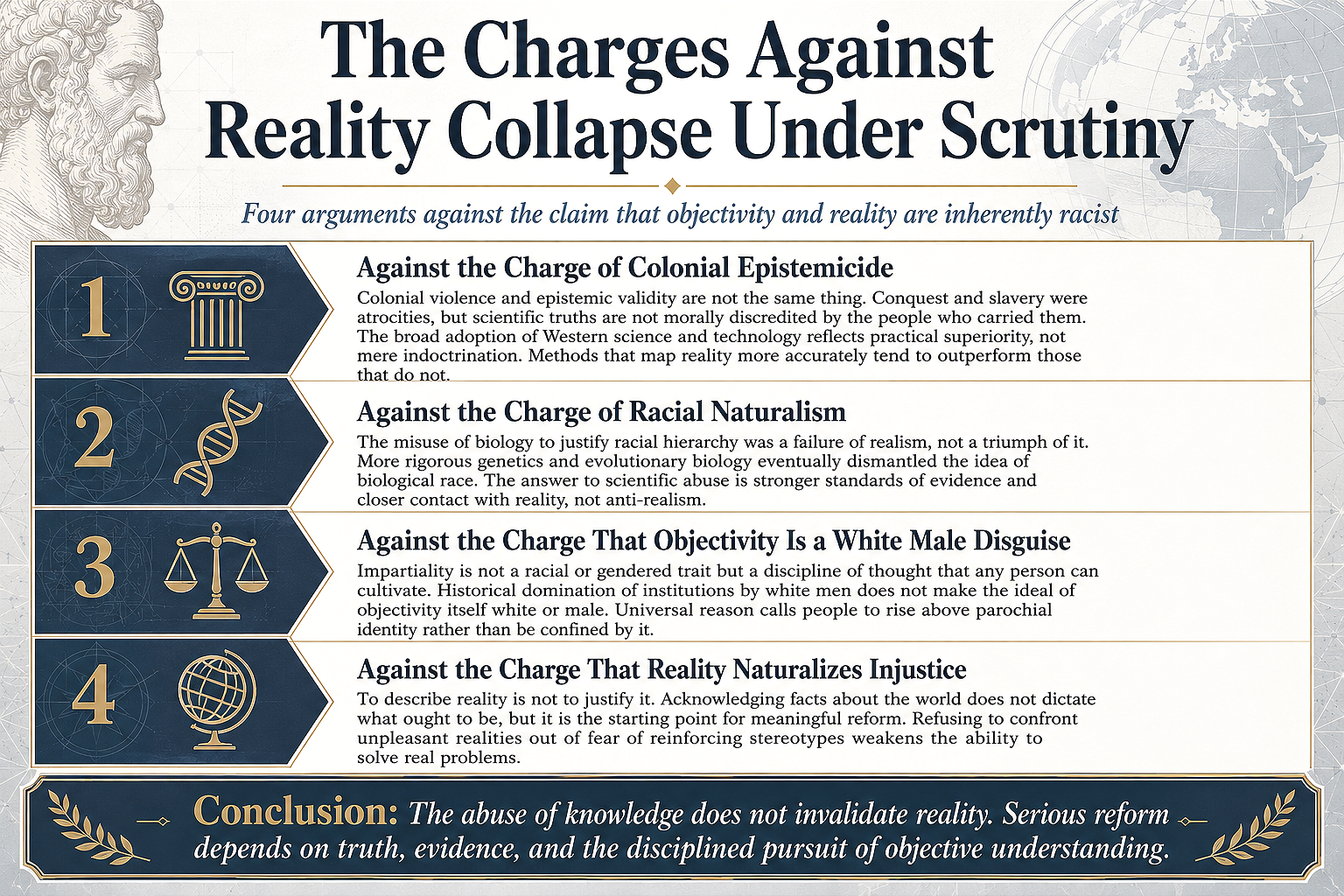
The specific arguments marshalled to implicate reality in racism collapse under scrutiny.
Against the charge of colonial epistemicide: The claim that Western reality-imposition destroyed valid Indigenous knowledges conflates the political violence of colonialism with the epistemic validity of the colonizers’ worldview. Conquistadors and slavers committed atrocities, but the germ theory of disease is not morally compromised because it arrived on European ships. Indigenous medical practices, for all their cultural richness, did not develop antibiotics or vaccines. The near-universal adoption of Western science and technology by formerly colonized nations is not evidence of continued brainwashing; it is evidence of superior efficacy. A worldview that accurately maps reality will, over time, outperform those that do not. To insist that all ontologies are equally “real” is to deny that some methods produce aeroplanes and others produce rain dances. The people choosing aeroplanes are not suffering from false consciousness; they are recognizing the difference that reality makes.
Against the charge of racial naturalism: It is true that some scientists misused the concept of biological reality to invent racial hierarchies. However, this is precisely an example of departing from rigorous realism, not an outcome of it. The genuinely reality-oriented sciences of genetics and evolutionary biology eventually dismantled the concept of biological race altogether. The error was not in seeking objective truth but in allowing cultural prejudice to substitute for it. The solution, therefore, is more realism—more exacting standards of evidence—not an abandonment of the notion that there is a biological reality to be discovered. Social constructionism about race is correct that races are not natural kinds, but this insight was achieved through better science, not through anti-realist philosophy.
Against the charge that objectivity is a white male disguise: The ideal of impartiality is not a racial or gendered posture; it is a cognitive discipline that individuals of any background can cultivate. The fact that white men historically dominated the institutions of knowledge production does not mean that the ideal itself is white and male. To assert otherwise is a sexist and racist insinuation: it implies that only white men are capable of abstract, detached reasoning, while women and people of color are inescapably bound to their embodied particularities. The Western philosophical tradition, from Plato’s allegory of the cave to Kant’s “sapere aude,” has always been a call to transcend one’s parochial position, not to enshrine it. The real racism and sexism lie in the postmodern insistence that non-white and non-male individuals cannot or should not aspire to universal reason.
Against the charge that appeals to reality naturalize injustice: It is a non sequitur to move from “things are this way” to “things ought to be this way.” The philosophical concept of reality provides no normative prescriptions. One can acknowledge the brute reality of racial disparities in, say, educational outcomes while also arguing vigorously for policies to change them. In fact, an accurate grasp of reality is a prerequisite for effective reform. The refusal to face unpleasant statistical realities because they might reinforce stereotypes is a form of willful blindness that guarantees the perpetuation of problems. The call to “face reality” is not conservative quietism; it is the beginning of any serious effort at improvement.
The Anglo-White-Male Perspective as the Greatest Content Creator in the Reality Space
To speak plainly, the Anglo-white-male intellectual tradition has been the most prodigious and consequential content creator in what might be called the reality space. This is not a matter of racial superiority but of historical circumstance, institutional continuity, and a distinctive set of cognitive virtues. The West developed a unique synthesis of Greek rationalism, Roman law, Christian scholasticism, Renaissance humanism, and Enlightenment critical inquiry that placed a premium on explicit argument, empirical verification, and the open exchange of ideas. This cultural matrix rewarded individuals who could detach from immediate tribal consensus and submit their beliefs to impersonal standards. It was not democratic in the sense of counting every opinion equally; it was meritocratic, elevating the most rigorous arguments regardless of their origin—though in practice, those arguments came overwhelmingly from men who had access to education and leisure.
The fruits of this tradition are inescapable. The modern world, with its smartphones, global internet, cardiovascular surgery, and energy abundance, is a world built by the reality-oriented West. Even the most passionate decolonial theorist types her anti-Western manifestos on a device engineered through Western physics, transmits them via Western digital protocols, and relies on Western medicine to survive childhood. This performative contradiction reveals the vacuity of the position. There is no decolonized WiFi, no Indigenous quantum mechanics, no feminist calculus. There are only varying degrees of engagement with the singular reality that Western science has mapped with spectacular success. To denigrate the Anglo-white-male perspective while depending on its achievements is not intellectual sophistication; it is parasitism.
The demand to center “other ways of knowing” in science education, public policy, and philosophical discourse is not a broadening of horizons but a lowering of standards. When New Age mysticism, ancestral spirituality, or identity-based testimony are granted equal footing with controlled experimentation and logical analysis, the result is not epistemic justice but epistemic suicide. The concept of a pluriverse is a rhetorical evasion: there is one physical cosmos, and while human cultures generate diverse interpretations, those interpretations are not equally valid. The map is not the territory, and some maps are simply wrong. The Anglo-white-male tradition, for all its incompleteness, has produced the most accurate map of the territory humanity has ever possessed. To discard it in a fit of racial and gender grievance is to burn the library because one resents the librarians.
Conclusion: Defending Reality Against Racist Epistemology
The question “Is reality racist?” must be answered with a firm and unambiguous no. Reality, the great tribunal of fact, is indifferent to race and gender. The philosophical concept of reality, as an assertion that there is a world independent of our wishes and narratives, is not an instrument of oppression but the essential foundation of any emancipation. The true racism at work today is the racist assault on the Western, male-coded tradition of objective inquiry—an assault that seeks to destroy the very concept of a shared, knowable reality in order to replace it with a cacophony of identity-bound narratives in which the straight white male is always already guilty.
The Anglo-white-male perspective on reality has been the most complete, productive, and liberating force in the history of thought. It gave humanity the scientific method, the principles of liberal democracy, and the technological infrastructure of modern civilization. It is not immune to critique, but critique must proceed from the standards of evidence and logic that this tradition itself refined, not from an envious rejection of those standards as inherently oppressive. To save reality from the epistemic vandals, we must reassert the universality of truth, the excellence of the Western cognitive inheritance, and the right of any person—regardless of identity—to participate in the ongoing, colorblind, and gender-blind quest to understand the one world we all inhabit. Anything less is not justice but the suicide of reason.