The War on Reality: How Ideology Turns Opinion into Truth
Reality doesn’t bend to wishful thinking, and a society that respects the difference between what is true and what is merely believed is one better equipped to handle whatever challenges come its way.
Truth vs. Opinion: Philosophical and Psychological Perspectives
In its classical sense, truth is generally understood as an objective reality supported by evidence, whereas opinion is a subjective belief colored by personal values and perspective. Philosophers distinguish the two by noting that something is subjective if it depends on an individual's mind (involving personal biases, perceptions, emotions, or other internal factors). By contrast, something objective “can be confirmed or assumed independently of any minds”. In everyday terms, a factual truth is a specific claim that can be verified as true based on impartial, observable evidence, while an opinion is a judgment or conclusion that cannot be proven true by such evidence. For example, the statement that the Earth orbits the Sun can be demonstrated with empirical data and is objectively true, whereas saying one political system is “the best in the world” is a value-based opinion — a perspective that others might dispute, and which cannot be decisively proven or disproven by objective means.
Crucially, opinions are not necessarily false — they may be well-informed or widely shared — but they remain subjective because they reflect individual or group beliefs rather than universally demonstrable facts. An opinion might be supported by some evidence or reasoning, yet still hinge on interpretation or personal judgment. By contrast, evidential truth demands a correspondence with reality that holds regardless of who observes it. For instance, the boiling point of water at sea level is about 100°C — a factual truth supported by measurement. In contrast, claiming that a tax policy is “unfair” is an opinion, informed by one’s values about fairness. It’s a statement of belief that cannot be objectively measured or settled in the way a scientific fact can. This distinction is foundational in epistemology (the philosophy of knowledge) and in psychology, because it affects how we process information and claims about the world.
From a psychological perspective, however, the human mind doesn’t neatly separate truth from opinion. Our capacity for rationalization and our cognitive biases often blur the line between the two. We are all prone to seeing what we want to see as true. For example, research has shown that people often struggle to distinguish factual statements from opinions, especially when those opinions align with their preexisting beliefs. In a Pew survey of 5,000 adults, only a small minority could correctly classify all factual statements and all opinion statements presented to them; most people either mistook opinions for facts or vice versa, and the likelihood of error increased whenever a statement resonated with their political leanings. In other words, if an opinion fits our worldview, we’re more inclined to accept it as an authoritative truth. This is a classic case of confirmation bias — we tend to favor information that confirms our existing attitudes and to dismiss or distort information that challenges them. As a result, “belief” can feel like “fact” on a neurological level. The brain’s reward centers light up when consuming agreeable information, reinforcing our confidence in what we believe to be true, even if it’s actually an opinion or an unverified claim.
These psychological tendencies help explain why the conflation of truth and opinion is so pervasive and so difficult to correct. In philosophical terms, truth requires evidence and often invites continual questioning — but psychologically, certainty is comforting. Admitting that a deeply held belief is merely an opinion, or might even be wrong, can cause cognitive dissonance — a mental discomfort we try to avoid. Thus, people often unconsciously elevate their favored opinions to the status of unquestionable truths. This dynamic is especially evident in ideologically charged contexts, where group identity and emotions run high.
When Ideology Blurs the Line Between Fact and Belief
Ideological debates — particularly the highly polarized conflicts between liberals and conservatives — provide a vivid theater for the conflation of truth and opinion. In America’s contemporary political discourse, it’s increasingly common to see subjective viewpoints presented as absolute truth. Each side of the political spectrum is often convinced that they have a monopoly on the facts, treating its interpretations and values as if they were self-evident, objective reality. Liberals and conservatives alike engage in this behavior, though the content of their “truths” differs. The result is two dueling narratives of reality, each fortified by its own set of “facts” (which may or may not be factual in the strict sense) and its own media ecosystems that reinforce those narratives.
Consider how partisans on both sides react to news. A recent Stanford study highlights that Americans across the political spectrum tend to put partisanship above truth when evaluating news. Even well-educated individuals and those who score high on reasoning skills were found to be swayed more by whether a news headline aligned with their political loyalties than by its basis in fact. “People were engaging in a lot of resistance to inconvenient truths,” the lead researcher noted. In practice, this means a conservative reader might automatically doubt a true report that reflects poorly on their side, while a liberal reader might reflexively dismiss factual information originating from a right-leaning source — each deeming the unwelcome news to be “biased” or false. Conversely, they are ready to embrace information (even false information) that validates their side. The same study revealed that people were more likely to disbelieve true information that challenged their political worldview than to reject false claims that supported it. The filters in our minds are so powerful that they can invert reality: what’s true becomes “fake,” and what’s fake feels true, all depending on whether it flatters our tribe’s narrative.
In ideological arguments, opinions often come cloaked in the language of truth. Activists and commentators frequently assert that “the facts are clear” or “the truth is on our side” right before launching into what is essentially a partisan interpretation of an issue. For instance, a progressive activist might say, “It’s a proven fact that policy X will save lives,” even when the outcome of that policy might actually be uncertain or debated. Likewise, a conservative commentator might declare, “The truth is that our values are under assault,” presenting a personal judgment (about, say, societal change or the intentions of their opponents) as though it were as indisputable as a mathematical axiom. These statements are rhetorical power moves: by asserting that one’s viewpoint is the truth, the speaker seeks to preempt disagreement — if you dissent, you’re not just of a different opinion; you are against the “truth” itself.
This dynamic is supercharged by the tribal nature of political identity today. The emotional stakes in liberal vs. conservative clashes are extremely high; people on each side often see their political opposition not just as folks with different opinions, but as existential threats to cherished values. In such an atmosphere, admitting that one’s deeply held belief is merely an opinion — or that it might be debatable or partially wrong — feels tantamount to betrayal. Instead, partisans double down: their beliefs become hardened into “truths,” while the other side’s claims are automatically cast as falsehoods, lies, or propaganda. Nuance falls by the wayside. As one analysis of American polarization observed, modern partisans increasingly believe their divides are about fundamental, non-negotiable truths — what each considers “core American values” — rather than policy preferences. When political identity intertwines with moral righteousness, each camp treats its perspective as gospel.
Specific instances of this phenomenon abound. A striking recent example comes from the aftermath of the fatal shooting of conservative activist Charlie Kirk in September 2025. Within hours of the incident, leading right-wing figures forcefully cast the tragedy as proof of a larger “truth”: that the American left was waging a violent war on conservatives. From the President of the United States down to Fox News hosts, a chorus of voices on the right depicted Kirk as a martyr and demanded crackdowns on “radical left” dissent — all under the confident premise that left-wing hatred and aggression were the unequivocal cause of the violence. On social media and television, they spoke in absolutes, insisting that “the left” was solely responsible for political violence in America, an “incendiary lie” in the words of one observer. This narrative conveniently ignored recent incidents of violence initiated by right-wing extremists, effectively rewriting reality to fit a partisan storyline. In the rhetoric of these commentators, their opinion — that progressives as a whole are violent or dangerous — was asserted as an unassailable fact before the investigation had even identified a motive or suspect. On the other side, liberals reacted to Kirk’s killing by reaffirming their own preferred narrative: they condemned political violence in general and renewed calls for stricter gun control, treating the shooting as further evidence of a truth they hold self-evident (that America’s gun proliferation is the root cause of such tragedies). In the ensuing debate, there was little room for complexity. Each side spoke as though their interpretation were the truth of the matter, and any dissent was morally suspect.
Another well-known illustration is the battle over election legitimacy in recent years. After the 2020 U.S. presidential election, supporters of Donald Trump repeatedly claimed as “truth” the notion that the election was stolen through massive voter fraud — despite a complete lack of credible evidence and numerous court rulings debunking those claims. In that ideological camp, the “Stop the Steal” narrative became an article of faith, an immutable truth that justified protests and even the January 6, 2021, Capitol riot. Those claims were, in fact, opinions (and false ones at that, as vote audits and investigations confirmed) — but they were presented with absolutist conviction, bolstered by repetition and by influential media personalities who treated them as fact. Meanwhile, liberals responded by declaring their own absolute: that the 2020 vote was the most secure and fair election ever, and they sometimes painted any concerns about election procedures as deliberate misinformation or “the Big Lie.” Each side thus spoke past the other, entrenching its own version of reality. The conservatives’ unfounded opinion was touted as truth, while liberals, in defending the actual truth, sometimes grew so categorical that they dismissed any nuanced discussion about election processes or trust, further convincing Trump’s supporters that only their “truth” could be believed. The result was two polarized realities, with millions of Americans literally unable to agree on who rightfully won the presidency — a frightening impasse for a democracy.
The cognitive and rhetorical strategies at play in these examples are telling. One common tactic is assertion plus repetition: state an opinion as fact, do it confidently and frequently, and it can acquire a patina of truth. Repetition exploits a quirk of our minds (the illusory truth effect) wherein familiarity is mistaken for accuracy. Politicians and pundits know this, so a claim like “Crime is skyrocketing because of our opponents’ policies” or “This policy will inevitably ruin the economy” will be hammered on night after night, until supporters take its truth for granted — even if the data tells a more complex story. Another strategy is selective framing and cherry-picking of evidence: ideologues highlight any real facts that support their view, while ignoring or dismissing facts that complicate it. This creates a one-sided evidentiary picture that can be sold as “the factual truth.” For example, in a debate on climate change, a skeptic might cite one cold winter as “proof” that global warming isn’t real (cherry-picking an outlier as if it refutes the decades-long warming trend). Or a liberal advocate for a social program might cite a single success story as “proof” the program works for everyone, glossing over contrary cases. Both are essentially using slivers of truth to make an opinion appear fully true.
Emotion is also weaponized. Appeals to fear or anger can short-circuit rational analysis, making audiences less likely to question the veracity of what they’re being told. Ideologues often employ charged language to present their opinions as moral truths that demand urgent defense. A conservative commentator might describe immigration policy in terms of “invasion” and claim “the truth is our country is under attack” — a subjective, hyperbolic viewpoint packaged as a factual emergency. A liberal might say, “make no mistake, the truth is that our democracy is hanging by a thread” to urge action against their political rivals, expressing a dire opinion as an objective fact. Such loaded assertions tend to discourage debate (who wants to argue against “the truth” when the stakes are framed as existential?) and instead rally the faithful around a shared conviction.
Underlying many of these strategies is a psychological imperative: identity protection. When an opinion is fundamental to one’s ideological identity, defending it as truth is also a way of defending one’s sense of self and community. Social psychology suggests that humans are adept at motivated reasoning — unconsciously twisting logic to fit our loyalties. In ideological arguments, this means each side often genuinely believes it has the truth on its side, because its reasoning process actively filters and reshapes information to support that belief. Ironically, both liberals and conservatives can look at the same set of facts and come away with completely different “truths,” each reinforced by sincere reasoning gone awry. Each camp can point to certain facts or data that bolster its stance, but the interpretation of those facts diverges radically. Over time, these divergent interpretations harden. People become overconfident in their own objectivity — surveys find that the most ideologically partisan individuals are often the ones most convinced that they and their side are unbiased seekers of truth. This overconfidence actually correlates with greater bias, a phenomenon noted by researchers as deeply ironic: those most certain of their righteousness are often least able to see how ideology has skewed their perception. In sum, the interplay of psychology and rhetoric in ideological debates yields a troubling outcome: each side lives, to an extent, in its own reality, wherein opinions are frequently elevated to the status of facts, and genuine facts that contradict the party line are recast as “just your opinion” or outright falsehoods.
Media Bias and the Shaping of Perceived Truth
The modern media ecosystem is the primary arena in which these truth–opinion battles play out, and it often amplifies the conflation. Traditional journalistic ethics emphasize separating factual reporting from opinion and commentary — recall how newspapers once clearly delineated news articles from editorials and op-eds. But in today’s media landscape, especially on cable news and online platforms, that separation has blurred dramatically. In pursuit of ratings, clicks, and engagement, media outlets have discovered that blending opinion with fact keeps audiences hooked. The result is a news environment rife with subtle (and not-so-subtle) bias, where confident, subjective takes are interwoven with facts until the average viewer has difficulty telling which is which.
Consider the world of 24-hour cable news, which is dominated in the U.S. by channels with strong ideological slants — notably Fox News on the right and MSNBC on the left. Both began as cable news networks promising straightforward journalism, but over the years, they evolved into juggernauts of partisan commentary. To sustain viewership and loyalty, these networks often present stories in ways that flatter their audience’s biases. Studies tracking their content show that Fox News and MSNBC now devote enormous airtime to criticizing the opposing party, far more than to critically examining their own side. One content analysis found that in a recent election year, 60% of Fox News’s mentions were about Democrats (usually negative), whereas 60% of MSNBC’s were about Republicans, the mirror image in reverse. Rather than informing viewers about both sides of issues, they are largely “selling anger” against the other side’s perceived wrongdoings. In this environment, opinion is not just labeled as opinion — it permeates the news selection, the story framing, and the tone of delivery. The networks have essentially built echo chambers: each tells its base audience what it wants to hear, under the guise of reporting the truth.
Importantly, the business model of partisan media actively encourages conflating opinion with fact. Fox News became the most-watched cable channel in America by airing less straight news and more “opinions-about-the-news” — impassioned, personality-driven segments that blur reportage with argument. This strategy, pioneered by Fox’s founder Roger Ailes and buoyed by the polarizing style of stars like Bill O’Reilly and Tucker Carlson, proved highly profitable. Viewers are drawn not just to hearing facts, but to hearing the “correct” interpretation of those facts — the one that validates their feelings. MSNBC later adopted a similar approach from the left, “pumping up its ratings” by recasting itself as a progressive counterweight rather than an impartial news source. Thus, on both networks, the line between journalist and commentator has faded. Evening shows in particular feature hosts who confidently opine on the news of the day, often with partisan guests, crafting a narrative rather than just delivering information. A report might start with a factual premise (say, a new government policy or a political controversy) but quickly segue into commentary that tells the viewer what to think about it. The transition is seamless and seldom signaled — no voice interjects to say “and now, opinion.” The effect is that the viewer absorbs the commentary as though it were an extension of the facts.
Media bias can be overt or subtle. Overt bias is visible in the editorial choices of what stories to cover and how. When a scandal or policy failure involves a figure from the opposing party, partisan outlets give it wall-to-wall coverage and maximal outrage; when the story might embarrass their own side, coverage is minimised or spun. For example, researchers noted that Fox News gave scant attention to the Supreme Court’s actions when a conservative majority was poised to overturn Roe v. Wade (a result aligning with Fox’s conservative audience preferences), whereas CNN and MSNBC significantly increased their coverage of those court developments. Fox’s relative quiet on a major news event was a form of bias by omission — keeping its viewers in the dark, presumably to avoid stirring any potential discord or backlash on the right. On the flip side, MSNBC and CNN have faced criticism for sometimes downplaying or framing stories of liberal missteps in a gentler light. These practices mean that audiences of each outlet come away with different sets of “facts”, reinforcing the sense that their side is always right and the other side is always wrong or corrupt. In extreme cases, networks have even propagated verifiably false information when it suited their narrative. Fox News infamously pushed discredited conspiracy claims about U.S. election fraud in late 2020, lending them an air of legitimacy through repeated segments — a journalistic failure that led to defamation lawsuits and a public reckoning. Such incidents highlight how easily the confidence of tone in the media can persuade viewers that an opinion or allegation is fact. If a respected-seeming anchor or a scrolling chyron on screen states something firmly, many will accept it as “news” without realizing it might be just one side’s spin.
Beyond story selection, subtle bias seeps in through language and presentation. Media outlets use “truth-making” language to bolster their perspective. Phrases like “What you need to know…” or “The real story is…” often precede a subjective interpretation. The choice of adjectives is telling: one network’s report on a protest might describe “thousands of concerned citizens rallying,” while another calls it “a mob of extremist agitators” — each framing carries an implied truth judgment about the protesters’ legitimacy. Even body language and visuals play a role. A partisan news show might accompany mentions of an opposing politician with unflattering photos or a sombre tone, subtly cueing viewers to disapprove, whereas they show their favored politicians in heroic light. These techniques further blur whether the audience is receiving information or indoctrination.
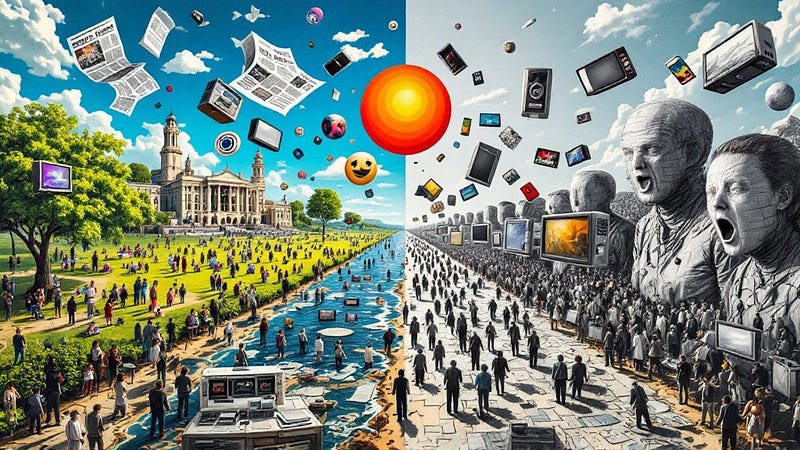
Another aspect of the media’s role is the creation of echo chambers and “filter bubbles.” People naturally gravitate toward sources that affirm their opinions, and algorithms on social media intensify this by feeding users more of what they already engage with. The result is that many individuals exist in curated information universes where their side’s narrative is constantly reinforced and rarely challenged. Partisan media outlets explicitly cater to this: as one analysis put it, channels like Fox and MSNBC “only tell us how right we are” — reassuring each segment of the audience that their viewpoints are correct and virtuous. This constant validation can make opinions feel even more like the truth. After all, if every news source you trust says the same thing, how could it not be true? Over time, the media echo chamber can lead audiences to believe not only that their opinions are fact-based, but also that anyone who disagrees is either misled or malicious. Consuming more of the same slanted content actually warps one’s perception of the other side: studies find that heavy partisan-media viewers develop exaggerated, caricatured views of their opponents’ positions and intentions. Each side comes to believe that the other is impervious to “the truth” because, in their view, the facts are obvious — it’s the other side’s willful blindness or dishonesty that must explain the disagreement. This deepens polarization, making constructive dialogue increasingly elusive.
It’s worth noting that not all media is equally culpable. There are still outlets and journalists striving for balance and fact-focused reporting. However, they sometimes struggle to be heard in the noise, especially when forcefully partisan voices dominate ratings. Outrage and certainty sell; cautious analysis and nuance often do not. Social media further tilts the scales: the most extreme, emotive takes tend to go viral, while sober fact-checks and corrections receive a fraction of the attention. This economic and attention-driven pressure pushes even mainstream outlets in a more opinionated direction. Traditional norms like providing equal time for opposing views or clearly separating the “news” and “editorial” departments have eroded. For example, cable channels routinely have opinion hosts break stories (blending commentary with reporting) or anchor panels that exclude any dissenting voices, creating a group consensus on-screen that signals to viewers: this is the truth of the matter. In such segments, if a token opposing guest is present, they’re often outnumbered and framed as misguided, reinforcing the overall message. Over time, audiences get conditioned to expect that truth always aligns with their partisan expectations — and if something they hear doesn’t, the media has taught them to immediately suspect it. It’s a short leap from “the other side’s media is biased” (often true) to “there are no neutral facts at all,” a cynical outlook in which every claim is just an opinion wearing a mask. This is how trust in the very idea of objective truth can erode.
Perhaps the most troubling manifestation of media bias is when outright falsehoods are confidently marketed as truth. This is not just bias but disinformation, and it has become a tool in extreme ideological media. For instance, certain hyper-partisan outlets and online influencers (far-right websites, talk radio hosts, or propagandistic social media figures) have pushed conspiracy theories — from baseless claims about vaccines to wild fabrications about opponents (e.g., the QAnon fantasy alleging a hidden cabal). By repeating these on channels that look and sound like news, they induct a subset of the public into an alternate reality. Psychological research indicates that exposure to such one-sided misinformation can impair people’s ability to discern truth, even on other topics. For example, those who dwell in a media diet heavy with climate-change denial not only come to believe falsehoods about climate science, but they also might become skeptical of any information that comes from mainstream scientific sources, no matter the topic. In short, partisan media biases don’t just reflect ideological divisions — they actively deepen them by shaping what different groups accept as true or false. The public’s understanding of truth and opinion is being filtered through red-tinted and blue-tinted lenses, leaving us with divergent visions of the world.
The Cost to Democratic Discourse and the Pursuit of Knowledge
The conflation of truth and opinion in ideological arguments and media bias isn’t just an abstract philosophical concern — it has profound, real-world implications for democracy and society’s ability to solve problems. A healthy democratic discourse depends on a shared foundation of facts, or at least an agreement on how to figure out what the facts are. When citizens can’t even agree on basic reality, meaningful debate becomes incredibly difficult. Policy discussions degenerate into shouting matches, each side accusing the other of living in a fantasy. Compromise or consensus — the lifeblood of a pluralistic democracy — grows ever more elusive when every issue is framed as a battle between Truth and Falsehood, and each side is convinced it exclusively holds the Truth.
One major consequence is polarization and social fragmentation. As each ideological camp tightens its hold on its version of reality, the common ground between them shrinks. People begin to see those who disagree not merely as having different opinions, but as being fundamentally misguided, irrational, or even malevolent because they “reject the truth.” This breeds distrust and animosity. Indeed, we have seen an erosion of personal and political relationships — friends, families, and colleagues unable to even talk to each other about current events because their understandings are so polarized. The public square — including legislatures and community forums — risks devolving into parallel monologues rather than dialogue. In the United States, surveys consistently show that partisans not only disagree on issues but also sharply distrust one another’s basic character and information sources. Each side thinks the other is delusional or deceptive. This “us vs. them” tribalism, reinforced by media echo chambers, undermines the social cohesion needed to tackle collective challenges. When a society cannot agree on what is real or what matters, it cannot effectively deliberate on solutions. We see this in issues like pandemic response or climate change: scientific experts might present evidence (e.g., on vaccine efficacy or rising global temperatures), but large segments of the population — egged on by partisan leaders — dismiss the evidence as “just opinion” or outright fabrication. In such an environment, even life-and-death issues become subject to partisan truth-quibbling, paralyzing our ability to respond coherently as a nation.
Another alarming effect is the decline of trust in institutions of knowledge and democracy. When media outlets and political figures play fast and loose with the truth, people’s faith in formerly respected sources of information erodes. Government agencies, scientific bodies, the press, and academia — all have seen portions of the public lose trust in them, often along partisan lines. If only one’s in-group is deemed truthful and every other source is viewed with suspicion, then the concept of objective expertise is thrown out. Why listen to nonpartisan economists on budget matters if you’ve been told those experts are secretly biased against your ideology? Why trust election officials or judges if their truths don’t align with your preferred narrative about an election? This cynicism is corrosive. It enables demagogues and conspiracy theorists to flourish, since they claim, “Only I (or we) can tell you the truth; everyone else is lying.” We saw a vivid example of this when false narratives about election fraud led to a mob attacking the U.S. Capitol — an event that sprang directly from millions of people believing their opinions (fueled by months of partisan disinformation) over all the official evidence. Democracy is imperiled when a significant portion of the populace rejects the mechanisms designed to establish truth (like courts or free press) and instead subscribes solely to ideological “truths.”
Moreover, the conflation of truth and opinion stifles the pursuit of objective knowledge. Science and reasoned inquiry thrive on doubt, open debate, and the ability to change one’s mind in light of evidence. But ideological echo chambers encourage a kind of intellectual stubbornness. Admitting uncertainty or complexity can be seen as weakness or disloyalty to the cause. Academics and experts who present inconvenient findings may be attacked or dismissed by political partisans. For example, if a study on crime or immigration doesn’t fit a party’s narrative, the researchers might be accused of bias or their data cherry-picked to say something else. Over time, this politicization of knowledge can deter honest scholarship and muddy public understanding. The truth-opinion blur leads to the phenomenon of “alternative facts,” where any data point can be reinterpreted to fit a preconceived narrative. This not only misinforms the public but also discourages consensus-building. Even on urgent issues like responding to a pandemic, we saw masks, vaccines, and case counts become contested truths, with segments of the population embracing completely unfounded opinions (such as COVID being a hoax or vaccines being more dangerous than the disease) as their reality. The result: disjointed responses, higher death tolls, and a lingering sense of chaos — all byproducts of a truth crisis.
Additionally, when opinion is constantly asserted as truth, it diminishes the value of good-faith debate and intellectual humility. In a democracy, ideally, people hold different opinions but engage with respect, acknowledging when a point is arguable or evidence is uncertain. However, the current climate rewards certitude and shouting down opponents. This has a chilling effect on moderates or those who do see shades of gray — they may withdraw from discussion altogether, leaving the conversation dominated by hardened ideologues. As such, society loses voices that might bridge divides or introduce pragmatic solutions. It’s telling that some of the most politically polarized Americans are also the most active in voting and activism; those less certain or more nuanced often feel alienated. Democratic discourse suffers when it’s driven by what one scholar called “dissenting language and angry rhetoric” that treats compromise as betrayal. Constructive conversations become nearly impossible when every topic is framed as a zero-sum clash of true vs. false, good vs. evil. If left unchecked, this trend fosters ever-stronger animosity and a permanent state of gridlock.
In the long term, the conflation of truth and opinion endangers the very idea of objective reality in the public consciousness. We risk sliding into a “post-truth” condition — a term sadly popularized in recent years — where the winning narrative counts for more than factual correctness. In a post-truth society, debates are won by whoever has the loudest megaphone or most compelling story, not by who has evidence on their side. This invites manipulation. Authoritarians and political extremists thrive in such conditions because they can more easily dismiss factual critiques (calling them “fake news” or “enemy propaganda”) and impose their own version of “truth” without accountability. When citizens accept that everything is just opinion, they may become cynically indifferent to finding the truth at all. This cynicism can breed apathy — “why bother seeking facts if it’s all biased?” — or, conversely, extreme partisanship — “since only my side tells the truth, I must fight the other to the end.” Neither is healthy for a democracy.
Reclaiming Reality: Distinguishing Truth from Opinion in Public Life
Faced with these challenges, what can be done? The task of reasserting the difference between truth and opinion in our public discourse is daunting, but not impossible. It requires efforts on multiple fronts: from media organizations, from educational institutions, from tech platforms, and from each of us as individual citizens. The goal is not to eliminate opinion — which is neither feasible nor desirable in a free society — but to clearly delineate it from factual reporting and evidence-based truth, and to cultivate a culture that values accuracy and openness over partisan point-scoring.
One key approach is to promote media literacy and critical thinking skills across the population. If people are better equipped to recognize, “This article or TV segment is giving me opinion or analysis, not just facts,” they can mentally adjust for potential bias. Initiatives in schools and communities can teach how to identify markers of opinionated language versus factual reporting. For example, recognizing phrases that signal conjecture (like “it seems,” “experts believe,” “in my view”) versus those that signal verification (“studies show,” “according to official data”). Such literacy efforts can incorporate the kind of exercises mentioned earlier — distinguishing factual statements from opinion statements — which most Americans currently struggle with. By practicing these skills, people might become more alert to when a pundit or politician is making a claim without evidence, or when a so-called fact actually comes loaded with value judgments. Armed with that awareness, individuals can consciously seek corroboration: Is this claim supported by multiple credible sources?, Is there data I can check?, Am I possibly accepting this because it tells me what I want to hear?. Encouraging this habit of “trust, but verify” (or perhaps more aptly, “doubt until verified”) can slowly inject more discernment into the public mindset.
Media organizations themselves have a huge responsibility. They could take clearer steps to separate news and opinion in their programming and publications. This might mean reviving older practices: clearly labeling opinion columns or segments, featuring on-screen graphics or disclaimers that distinguish analysis from straight news, and hiring or empowering editors whose sole job is to call out slant and insist on factual clarity. Some outlets have begun to do this online — for instance, by tagging articles as “Analysis” or “Opinion” so readers know up front. But these labels need to be prominent and consistent. Television news could adopt a similar practice, perhaps dedicating certain hours strictly to factual reporting and prefacing opinion shows with reminders that “this is the host’s perspective on today’s news.” Such transparency won’t stop bias, but it at least alerts the audience to what they’re consuming. Additionally, networks might consider balancing their programming with a greater diversity of viewpoints. While it’s unrealistic to expect fiercely partisan channels to suddenly become neutral, they could even incorporate more frequent segments where opposing voices engage each other under moderation. When done in good faith, such exchanges can expose viewers to alternate interpretations and model respectful disagreement rather than just preaching to the choir.
Another strategy is strengthening fact-checking and “pre-bunking” efforts. Traditional fact-checking (where claims made by public figures are vetted by independent outlets like PolitiFact or FactCheck.org) is important, but it often comes after misinformation has already spread. Increasingly, experts suggest “pre-bunking” — proactively inoculating the public against likely falsehoods before they take root. For example, if one knows that during an election there will be unfounded rumors about ballot fraud, media (and social media platforms) can run explanatory pieces ahead of time on how the voting system works, what would or would not be credible evidence of fraud, and how to spot a baseless rumor. Indeed, some social media companies tried this in 2022, warning users that official results might not be immediate on election night. By setting correct expectations, it’s harder for bad-faith actors to later yell “fraud!” as if it were the truth when normal vote-counting delays occur. More broadly, teaching people common forms of manipulation — like cherry-picking data, using fake experts, or presenting opinions as facts — can act like a vaccine against being misled. When you know the magician’s tricks, you’re less likely to be fooled by the illusion.
For the partisan mind filters identified by the Stanford study, the researchers emphasized intellectual humility as a remedy. This means cultivating an attitude, especially in news consumers, that “my understanding could be wrong, and my mind is not infallible.” It’s a habit of questioning one’s own instant reactions. If a headline or meme makes you furious because it perfectly confirms how terrible “the other side” is, that’s exactly when to pause and double-check. If a story seems too perfectly aligned with what your side always said, consider looking for confirmation from a source outside your bubble. Essentially, it’s encouraging everyone to adopt a bit of a journalistic mindset: verify claims, seek multiple perspectives, and be willing to update your beliefs if new facts merit it. Media outlets can foster this by showing their work — linking to primary sources, releasing transcripts or data, so interested consumers can see for themselves. Social media platforms could assist by flagging content that is opinion or unverified (though this gets thorny, as debates over “censorship” have shown). At a minimum, they can crack down on outright false content through clear terms of service enforcement, making the worst disinformation less prevalent.
From a societal standpoint, finding ways to rebuild shared experiences and narratives can help bridge the truth divide. This could involve promoting forums where people of different political stripes come together to discuss issues with ground rules emphasizing facts and listening. Some community groups and universities host “deliberative dialogues” or bipartisan citizen panels on problems like local budgeting or policing. Participants are presented with the same set of factual background information and must work from there — an exercise that not only produces more informed opinions but also reminds folks that disagreement doesn’t have to hinge on basic reality. On a larger scale, national service or cross-cultural exchange programs (real or virtual) can expose people to how others with different views live and think, softening the instinct to demonize. When you recognize the humanity of your opponent, you might be more open to considering that perhaps not all of their beliefs are lies — they just prioritize values differently. That understanding is the beginning of separating personal truths (which everyone is entitled to) from empirical truths (which ideally, everyone should acknowledge).
Finally, there’s personal accountability in media consumption. In a time when it’s easy to envelop oneself in a comforting media bubble, choosing to diversify one’s information diet is a radical, constructive act. As one media researcher advised after seeing the stark biases in cable news, “Don’t rely solely on your favorite cable station for your news”. If you lean conservative, try occasionally reading a well-regarded centrist or liberal publication (and vice versa). It doesn’t mean you’ll convert, but you will gain insight into how stories are framed elsewhere and possibly catch things your side’s media omitted. The same goes for social media: curating a feed that includes authoritative sources and fact-checkers, not just pundits who echo your views, can expose you to corrective information. This can be uncomfortable at first — it’s much more pleasant to hear “you’re right!” all day — but ultimately it sharpens one’s ability to discern reality. Even if you remain firmly a liberal or conservative, you’ll at least better understand which of your beliefs are evidence-backed truths and which are debatable opinions. That self-awareness can lower the temperature of debates; you might say, “I strongly believe this policy is best,” instead of “It’s an absolute truth that this policy is best and only an idiot or liar disagrees.” The change in phrasing signals an openness to discussion rather than confrontation.
In conclusion, the blending of truth and opinion in ideological battles and biased media has put us in a perilous position — one where shared truth feels like a casualty of war. But recognizing the problem is a first step to solving it. By recommitting to clear definitions of fact and opinion, demanding better from our media, and humbly checking our own biases, we can begin to rebuild a common reality. The health of our democracy and the progress of knowledge depend on this. We must remember that, however passionate our beliefs, the integrity of truth requires us to continually test those beliefs against evidence and be willing to revise them. Reality doesn’t bend to wishful thinking, and a society that respects the difference between what is true and what is merely believed is one better equipped to handle whatever challenges come its way. In the end, truth has a way of reasserting itself — but it helps greatly if we meet it halfway, with open eyes and minds, rather than letting our opinions speak louder than the facts.