"The Wizard of Oz" and the Dialectics of Moral Authority and Existential Comfort: A Philosophical Inquiry
The film uses its Technicolor spectacle to show that real moral authority is the kind we claim after seeing through false power, and that our deepest comfort comes from recognizing and gratefully embracing the fragile, temporary home we already inhabit.
Abstract
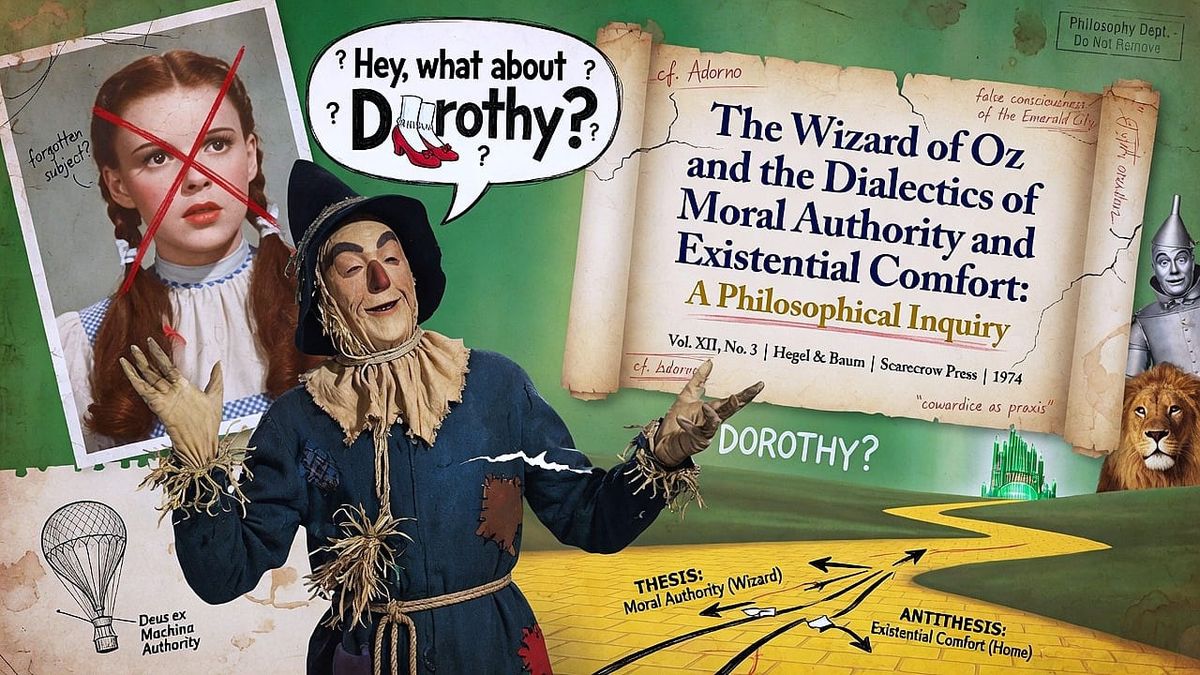
Victor Fleming’s 1939 cinematic adaptation of L. Frank Baum’s The Wonderful Wizard of Oz transcends its identity as a beloved children’s fantasy, operating as a sophisticated philosophical text that interrogates the nature of moral authority and the human pursuit of existential comfort. Through its narrative of Dorothy Gale’s journey from a monochromatic Kansas to the technicolor Land of Oz and back again, the film dramatizes a profound existential pilgrimage wherein traditional hierarchical models of moral guidance are systematically dismantled and replaced by a subjective, intersubjective, and radically humanistic framework. This report argues that The Wizard of Oz presents a nuanced critique of institutional moral authority, embodied in the titular Wizard, while simultaneously offering a vision of existential comfort that emerges not from the granting of external boons but from the recognition of intrinsic worth and the formative power of communal solidarity. By tracing Dorothy’s arc from anxious displacement to self-possessed contentment, the film prefigures key tenets of existentialist philosophy, reimagines the classical hero’s journey as an interior confrontation with autonomy, and ultimately posits that the ground of moral and existential security lies in the embrace of finitude, relationship, and the deliberate, often arduous, reframing of desire.
Introduction
The perennial human dilemma of where to locate authoritative moral guidance and how to secure a durable sense of meaning, safety, and belonging—what may be termed existential comfort—finds remarkably distilled expression in The Wizard of Oz. At first glance, a story of a girl swept away by a tornado to a magical land populated by witches, talking animals, and a fraudulent wizard seems an unlikely vehicle for sustained philosophical analysis. Yet the film’s enduring cultural resonance suggests that beneath its whimsical surface lies a resonant interrogation of foundational philosophical problems: Who has the legitimate right to dictate moral precepts? What does it mean to live a life that matters? Is comfort something bestowed or something discovered? Set against the backdrop of the American Dust Bowl and the creeping anxieties of a world on the brink of war, the Kansas sections, filmed in sepia, present a world of constraint, misunderstood longings, and failed institutional protection. Oz, by vivid contrast, exteriorizes these internal struggles as phantasmagoric encounters, crystalizing the philosophical drama into a legible landscape.
The narrative structure operates as a dialectical movement. Dorothy’s initial flight, prompted by a threat to her beloved dog from the malevolent Miss Gulch, represents a rejection of a world where moral authority is unjust, petulant, and administratively negligent. Her magical escape to Oz is therefore not merely an adventure but a quest for a counter-world governed by a higher, more dependable form of authority—the Wizard. The journey along the Yellow Brick Road, the repeated deferrals of hope onto the Wizard’s omniscience, and the ultimate revelation of his humbug nature constitute a thoroughgoing critique of externalized moral and existential dependence. Concurrently, the parallel desires of the Scarecrow, Tin Man, and Lion serve as case studies in the pathology of misplaced self-doubt, each character convinced of a fundamental lack that only a designated authority can fill. The synthesis achieved in the film’s climax, and further ratified upon Dorothy’s return home, asserts that moral authority is not the exclusive possession of any institution or charismatic figure but is dispersed across conscientious selves and authentic communities, and that existential comfort is the affective corollary of embracing one’s own agency, intelligence, and capacity for love and courage.
The Disenchantment of Institutional Moral Authority
Central to the film’s philosophy is its relentless demystification of centralized moral authority. The Wizard of Oz is initially invoked as the ultimate solution to a plurality of profound human needs: homecoming, intellect, emotional fulfillment, and bravery. The denizens of the Emerald City reinforce his mystique, and his terrifying apparitions—flames, smoke, and a disembodied, booming visage—aesthetically borrow from age-old representations of divine or sovereign power. The Wizard’s authority is grounded in a classic Weberian charismatic-locum of legitimacy, sustained by spectacle, secrecy, and the precarious balance of hope and fear. Dorothy and her companions approach him as supplicants, implicitly endorsing a model of moral and existential economy where good things—courage, compassion, wisdom, belonging—are commodities that a hierarchical superior can and will dispense to the worthy. This reflects a common human habit of deferring to external authorities to validate one’s existence and to arbitrate one’s worth, a habit that spans religious, political, and social domains.
The revelation of the man behind the curtain constitutes one of cinema’s most powerful moments of philosophical disenchantment. The frightening, hypermasculine, omnipotent authority figure is unmasked as a kind, befuddled old man from Kansas, a “humbug” who manipulates levers and microphones. This moment does not merely expose a fraud; it radically reorients the moral axis of the narrative. If the Wizard is no moral authority at all, then the very category of a singular, supreme dispenser of moral goods is voided. Crucially, the Wizard is not presented as evil. He is a failed illusionist who got carried away by his own machinery, a banal rather than a malevolent force who, in his own words, is “a very good man, but a very bad wizard.” This nuance is philosophically significant. It suggests that the problem of false moral authority is not exclusively one of malicious deception but is often a structural product of collective human desperation to be led. The Emerald City itself, where residents wear green-tinted glasses to sustain an illusion, mirrors the mechanisms by which societies manufacture and sustain consent, reinforcing the idea that authority’s power is largely a consensual hallucination.
The film’s witches provide a contrasting model of moral direction. Glinda, the Good Witch of the North, consistently refuses to act as a substitute for Dorothy’s own agency. She withholds critical information—the power of the ruby slippers—until Dorothy has undergone a transformative journey of self-discovery. When asked by Dorothy how to return to Kansas, Glinda replies, “It’s always best to start at the beginning,” an instruction that privileges process over instant deliverance. She presents herself not as a commander but as a facilitator of Dorothy’s gradual, experiential understanding. The Wicked Witch of the West, on the other hand, is an authority of pure terror and tyrannical claim, demanding the slippers by right of sibling possession and pursuing Dorothy with relentless vengeance. Her moral claim is extrinsic and possessive, grounded in a naturalistic fallacy that converts physical proximity into ethical ownership. Her eventual dissolution by water—something so mundanely pure—underscores the fragility of a moral system built solely on fear and coercion. In juxtaposing these two figures, the film articulates a nuanced position: legitimate moral influence does not demand compliance, nor does it withhold critical resources as a test of servility, but instead fosters autonomy through guided revelation, while illegitimate authority seeks to dominate through force or mystery.
Existential Comfort and the Refutation of Essential Lack
Concurrent with its dismantling of external moral authority, the film constructs a vision of existential comfort that rests on the recognition of intrinsic human sufficiency. The Scarecrow, Tin Man, and Lion each express their core existential distress as a deficit of a specific, essential quality. The Scarecrow laments his lack of a brain, conflating the physical organ with the capacity for thought; the Tin Man desires a heart, equating the muscular pump with the capacity for love and emotional life; the Lion craves courage, perceiving his fear as an ontological flaw that negates his potential for regal, meaningful action. On a literal level, each character is deluded. The Scarecrow devises escape plans, solves logistical puzzles, and spouts extemporaneous geometry. The Tin Man weeps copiously, grieves small accidental deaths, and exhibits profound empathetic distress. The Lion, in his rescue of Dorothy from the Witch’s castle if not before, performs acts of breathtaking bravery while trembling. Their pain is genuine, but its source is a cognitive error: a belief that feeling, thinking, and acting bravely are impossible without a symbolically proper credential from an authority.
Philosophically, this dynamic parallels a persistent human inclination to essentialize internal states, mistaking the abstract noun for a substantive entity that one either possesses or lacks definitively. By projecting the source of their anguish onto an absent internal object, the characters displace responsibility for their own becoming onto the realm of luck or the benevolence of an external granter. The Wizard’s subsequent “gifts”—a diploma, a ticking heart-shaped watch, a medal of valor—are purely symbolic placebos. They confer no new substantive faculty. Yet they effect a profound transformation in the recipients. The Scarecrow immediately recites the Pythagorean theorem; the Lion feels fortified. This placebo effect is not mocked by the narrative but honored. It reveals that what the characters truly lacked was not intelligence, love, or courage per se, but the existential comfort of self-authorization—the warranted confidence to exercise capacities they already possessed. The diploma is a social acknowledgment that validates a latent identity, and identity requires recognition to be phenomenologically real to the self. Existential comfort, the film suggests, thus has an inescapably social dimension; it is co-constructed in the space between self-belief and communal affirmation.
Dorothy’s yearning is of a different but related order. Her desire for a place “where there isn’t any trouble” is the desire for a state of unperturbed being, a sanctuary that transcends the contingencies and disappointments of daily life. Her journey over the rainbow literalizes this metaphysical homesickness. The film’s famous resolution, however, resists a simplistic reading of “home” as a geographical location to which one simply returns. As philosopher Svetlana Boym theorized about nostalgia, the illness of homecoming, Dorothy’s initial Kansas is a site of frustration and longing itself. What changes across the narrative arc is not Kansas but Dorothy’s mode of perceiving and valuing it. Her famous declaration, “If I ever go looking for my heart’s desire again, I won’t look any further than my own backyard,” is a philosophically dense assertion. It does not mean that one’s literal, problematic backyard is intrinsically sufficient nor that transcendent adventure is folly. It articulates a perspective of existential reframing wherein comfort is found, after a long and perilous detour, in the voluntary embrace of the finite, the imperfect, and the proximate. This is not resignation but a conscious, reflexive affirmation of the thoroughly ordinary as the site of genuine value—a Kierkegaardian movement of infinite resignation, followed by the faith that recovers the finite in a new light.
The Intersubjective Bond as a Foundation for Meaning
No character in The Wizard of Oz achieves existential comfort in isolation. The community forged along the Yellow Brick Road is central to the film’s moral and existential palette. The group coheres not through shared origin, identity, or creed but through a convergence of parallel yet distinct vulnerabilities. Their solidarity is one of shared risk and reciprocal aid. The Scarecrow, Tin Man, and Lion do not merely accompany Dorothy; they repeatedly recontextualize her journey and their own through acts of deliberate care. When the Scarecrow declares he will “while away the hours, conferrin’ with the flowers,” and then risks immolation to save Dorothy from the Witch’s fire, the act is a self-authored ethical decision independent of any diploma. The Tin Man’s tears over the mere thought of Dorothy leaving Oz reveal a heart so emotionally saturated that his quest for one becomes deeply ironic. The Lion’s pledge, “I’ll fight you with one paw tied behind my back,” exemplifies the courage he falsely claims to lack. These actions demonstrate that the attributes they seek are performatively realized through friendship, not bestowed by an institution.
This constellation of companions models what philosopher Emmanuel Levinas might call an ethical relation, where the face of the other commands one’s care prior to any theoretical framework. For Dorothy, the well-being of her friends repeatedly takes precedence over her own immediate agenda to reach the Wizard; she goes to confront the Witch not for her own gain but to save the Scarecrow’s life. This shift from a self-focused quest to a relational ethics underscores the idea that existential comfort is not a private, inward attainment but a byproduct of decentering the self in love and responsibility toward others. In the climax, when the Wizard prepares to take Dorothy away in his balloon, she delays to chase Toto, missing her ride. This moment, often misread as a mere plot contrivance, is philosophically pivotal. It illustrates that her deepest attachments—to the immediate, visceral bond with a small, loyal creature—outweigh the promised deliverance of a spectacular, yet impersonal, means of escape. The authentic takes precedence over the grandiose. Existential comfort is here shown to be rooted in the concrete bonds of care that tether us to the messy, unpredictable, and ultimately human-scale world.
Moral Authority Reconstructed: Self-Authorization and the Wizard’s Redemption
The film’s deconstruction of the Wizard’s authority does not lead to moral nihilism. Instead, it allows for a reconstruction of moral authority on radically humanized grounds. After the revelation, the Wizard ceases to function as a supernatural arbiter and transforms into an avuncular wise figure who draws on his residual wisdom—his very ordinary, Kansas-bred common sense—to help the Scarecrow, Tin Man, and Lion by providing the symbolic validations they need. By openly admitting his fraudulence and then using his experience to serve, he models a post-revelatory ethical posture. Authority becomes a function of honesty, practical wisdom, and servanthood. This mirrors a philosophical shift from a command-obedience model to a dialogical, immanent model of moral guidance. Moral authority, per the film, is ultimately grounded in the capacity to facilitate another’s self-realization without claiming transcendental warrant.
Simultaneously, the film places moral authority in the hands of the subject who is willing to recognize the power they already hold. Glinda tells Dorothy, “You’ve always had the power to go back to Kansas.” When the Scarecrow asks why she didn’t tell Dorothy earlier, Glinda replies, “Because she wouldn’t have believed me. She had to learn it for herself.” This exchange is the hermeneutic key to the entire philosophy of the work. Knowledge that is merely bestowed, like a proclamation, does not yield the existential weight of knowledge that is experientially earned. The power of the ruby slippers—a symbol of desire, blood-red life force, and the ability to traverse ontological realms—was always with Dorothy. Her capacity to return home, an act that requires no geographic wizardry but rather an internal reorientation of will and perception, was inalienable. The spell (“There’s no place like home”) is not a magic incantation in the traditional sense but a concentrated, ritualized act of directing one’s full consciousness toward a reconceived end. Dorothy’s final, teary-eyed repetition of the phrase, surrounded by her friends, is a moment of deep existential decision. She actively appropriates her desire for home, converting it from a whining complaint into a solemn affirmation. The moral authority to determine where value resides and how to reach it has passed entirely to her.
The ambiguous figure of Professor Marvel in the Kansas frame narrative further textures this argument. He is a charlatan carnival fortune-teller who, through gentle deception and folk wisdom, redirects Dorothy’s attention back to her Aunt Em’s potential grief. He is also, the film suggests through the dream logic, the Kansas analogue of the Wizard. Yet his advice, though issuing from a humbug, is wise and compassionate. This suggests that moral insight can emerge from flawed vessels; what matters is not the sovereign purity of the source but whether the counsel fosters a more loving, attentive, and responsible orientation in the hearer. The Professor does not command; he suggests and invites. His moral authority, like the re-humanized Wizard’s, is contingent, ecological, and situational rather than absolute. The film thus charts a matrix of moral influence that moves from a tyrannical model (the Wicked Witch), through an institutional pseudo-divine model (the pre-exposed Wizard), through a non-interventionist guiding intelligence (Glinda), to a fully realized self-governance and mutual edification among peers.
Existential Comfort as the Embrace of Finitude
The conclusion of Dorothy’s journey is often criticized as a retrograde endorsement of provincialism, an admonition to cower within the bounds of the familiar. Yet a closer philosophical reading reveals a far more profound statement about the nature of existential comfort. What Dorothy discovers is not that Kansas is objectively superior to Oz but that the flight from the difficult and the mundane into a realm of pure fantasy is a category error in the search for meaning. The film is not anti-imagination; rather, it asserts that existential comfort requires a synthesis between the aspirational and the actual. Dorothy’s heartfelt insistence that she will stop searching “any further than my own backyard” comes after she has traversed a landscape of intense beauty, terror, friendship, and loss. The backyard is no longer a symbol of confinement but a field of potential that she now freely and knowingly chooses to inhabit. This is an act of what existentialist philosophers term authentic existence: choosing oneself in one’s situation, owning one’s past and one’s limits, and deciding to love them not despite but through clear-eyed awareness of their insufficiency. Existential comfort is not the absence of trouble but the capacity to dwell meaningfully within the trouble.
Kansas is defined by its immediate relationships—Aunt Em, Uncle Henry, and the farmhands Hunk, Hickory, and Zeke. When Dorothy awakens and sees them gathered around her bed, she immediately maps her dream companions onto them. “And you were there, and you, and you!” This recognition suggests that the raw material for the rich inner life of adventure and significance was always latent in the people and circumstances she had dismissed as prosaic. Their concern for her illness demonstrates a care that she had been too agitated to perceive. Existential comfort, then, is in part an awakening to the love that already constitutes one’s world. The closing line, “There’s no place like home,” resonates not as a tautology but as a hard-won existential theorem: the home one seeks is a relation, a mode of attention, a deliberately inhabited space of belonging that one carries back into the world from the furthest reaches of one’s internal explorations.
Conclusion
The Wizard of Oz evolves from a fairy-tale quest into a sophisticated dialectical treatise on moral authority and existential comfort. The film systematically critiques the psychological and ethical reliance on institutional and charismatic figures who claim to monopolize the means of human fulfillment, revealing such figures to be projections of collective anxiety and yearning. The unmasking of the Wizard does not plunge the world into chaos but liberates the characters into a new moral adulthood where their intrinsic capacities—intellect, emotional depth, courage—are recognized and celebrated through both self-acknowledgment and communal affirmation. The Good Witch Glinda’s pedagogy of indirect guidance and the film’s endorsement of the placebo effect of symbolic gifts together articulate a model where moral authority becomes immanent, distributed among peers and exercised through the gentle, non-coercive facilitation of self-discovery.
Existential comfort, in the film’s vision, is not delivered by an external agent but constituted through a perilous yet ultimately rewarding process of internal and relational integration. It requires a confrontation with one’s deepest insecurities, a journey through a disenchanted landscape where easy answers are exposed as humbug, and a final, volitional turn toward the finite and the familiar as the only genuine theater for meaning-making. Dorothy’s return to Kansas is not a defeat but a consummation, a deliberate re-investment of wonder in the ordinary, made possible by the recognition that the mind, the heart, and the nerve needed to face life’s trials were hers—and ours—all along. In this reading, the film deploys its Technicolor phantasmagoria to teach an enduring philosophical lesson: the truest moral authority is the one we grant ourselves after we have learned to see the lie in the great and powerful, and the profoundest comfort lies in the clear-eyed, grateful embrace of the fragile, temporal home we already inhabit.