Trump Wants Everyone to Be Rich
The assertion that Donald Trump wants everybody to be rich is fundamentally rooted in a classic, aspirational vision of America: a fluid…
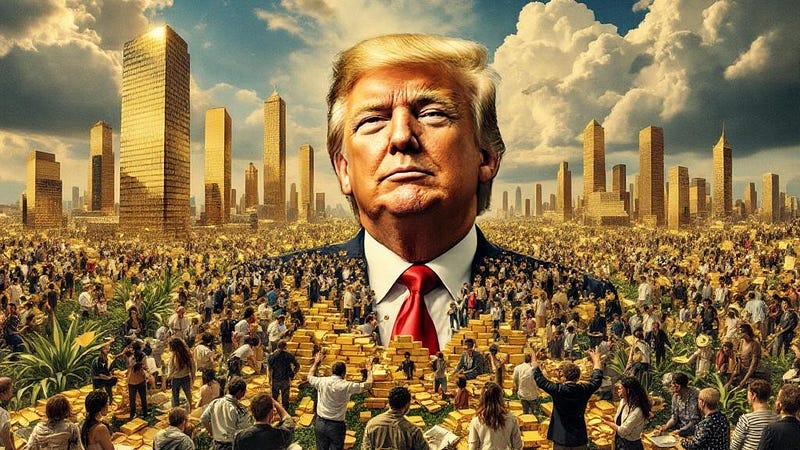
The assertion that Donald Trump wants everybody to be rich is fundamentally rooted in a classic, aspirational vision of America: a fluid, classless society where individual ambition and effort are the sole determinants of success. From this perspective, the issue of race becomes inconsequential, because the system itself is designed to reward anyone who has the determination to work hard and seize opportunity. This philosophy rejects the notion of systemic barriers as insurmountable, instead promoting an economic environment where every citizen, regardless of background, can theoretically achieve prosperity. Trump’s governance and rhetoric consistently reflect this core belief in a meritocracy where wealth is accessible to all who actively pursue it.
Trump’s economic narrative is powerfully colorblind. It focuses not on group identity or historical grievance, but on the potential of the individual actor within a booming national economy. His speeches are filled with promises of job creation, tax cuts, and deregulation — policies framed as universal benefits that lift all individuals who are willing to participate. The record-low unemployment rates for Black and Hispanic Americans achieved before the pandemic were frequently highlighted not as a racial achievement, but as proof that his policies were working for everyone. The message was clear: a thriving capitalist economy, unleashed from government overreach, creates a tide of opportunity that raises all boats, making individual grit and initiative the primary variables for success.
This vision aligns with the ideal of a truly fluid society where class is not a permanent station but a temporary condition. The 2017 Tax Cuts and Jobs Act was championed under this very premise. By allowing businesses and individuals to keep more of their money, the policy was intended to fuel investment, entrepreneurship, and upward mobility. The concept is that anyone, from any starting point, can start a business, invest in the stock market, and climb the economic ladder. In this framework, wealth is not a finite resource being redistributed, but an infinite potential to be created by driven individuals. The pathway to being rich is open to all who play the game with skill and determination.
Furthermore, this worldview consciously moves beyond what it characterizes as the divisive politics of race. It posits that focusing on racial categories only serves to create a mindset of victimhood and limitation. Instead, the empowering message is that in today’s America, the only thing holding anyone back is a failure to adopt a winning mentality. This is the ultimate expression of a classless ideal — your current circumstances do not define your destiny; your actions do. By championing school choice, for example, the argument is that it empowers every family, of every race, to seek a better education and thus a better future, breaking the cycle of dependency on failing systems.
Ultimately, the statement that Trump wants everybody to be rich is a proclamation of faith in the American Dream itself. It is a rejection of a static, zero-sum economic model in favor of one of boundless growth and individual agency. It argues that the nation’s economic machinery is now primed for success, and the responsibility falls on the individual to step forward, work hard, and claim their share of the prosperity. In this vision, race is not a consequential factor in the ledger of financial success; it is the timeless principles of ambition, risk, and relentless effort that determine who becomes rich.