Comprehensive Analysis of Security Failures in the Assassination of Charlie Kirk at Utah Valley…
Charlie Kirk’s killing was a devastating failure of security. But if the right lessons are drawn, it could also be a turning point that forces improvements and perhaps even cools the temperature of America’s civic life.
Comprehensive Analysis of Security Failures in the Assassination of Charlie Kirk at Utah Valley University
A Polarizing Figure and a Charged Venue
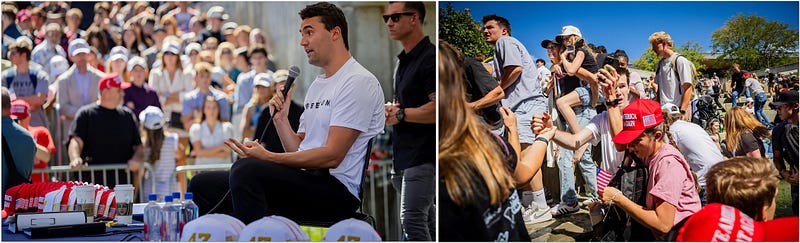
Charlie Kirk arrived at Utah Valley University (UVU) in Orem as part of his “American Comeback Tour,” a campus speaking series designed to court controversy. The 31-year-old Turning Point USA founder was no stranger to confrontation; his events routinely drew vociferous protests and angry petitions. In fact, at UVU, a petition to bar his appearance had garnered nearly a thousand signatures beforehand. Kirk’s inflammatory rhetoric — denouncing everyone from Martin Luther King Jr. to Taylor Swift — made him a lightning rod. He also wasn’t a stranger to danger: by his own admission and that of his organization, Kirk had been the target of countless threats. Still, he insisted on pressing forward. “Charlie was no stranger to threats… he always prioritized reaching as many young Americans as possible over his own personal safety,” Turning Point posted after his death. That mindset set the stage for what would be a fatal gamble in a state largely considered friendly territory. UVU is an open campus in a deep red state, and initial security assessments turned up “no credible threats” for the event. University administrators and Kirk’s team alike seemed to expect a rowdy debate at most — not the assassination that would unfold in broad daylight.
Security Protocols: What Was (and Wasn’t) in Place
On paper, the safeguards for Kirk’s UVU appearance looked adequate by typical campus standards. UVU’s police chief, Jeff Long, later recounted that six uniformed university officers were assigned to the event, supplemented by an unspecified number of plainclothes officers working the crowd. Kirk also traveled with a private security detail of about five seasoned professionals, including a personal bodyguard at the stage. The campus police coordinated closely with Kirk’s security chief to divvy up responsibilities. Their focus, however, was largely on close-range threats — containing any protestors, protecting Kirk from hecklers or physical rushes to the stage, and generally maintaining order immediately around the speaker’s podium. What they did not establish were broader perimeter controls. There were no metal detectors, bag checks, or screening checkpoints at any of the entryways to the outdoor amphitheater. As a UVU spokesman explained afterward, the event was held in an open courtyard on an open campus, and given the lack of specific threats, they opted not to funnel attendees through security screenings. Anyone could wander in from the campus grounds unsearched. Attendees were not even subjected to basic bag inspections or magnetometer wands, a fact that stunned observers in hindsight. “Nobody scanned our equipment, nobody scanned our bags, there was no security like that,” recalled Emma Pitts, a student journalist who covered the event and was shocked at the lax approach. Some audience members later admitted they had expected airport-level precautions; one man even threw away a metal toothpick on his keychain beforehand, assuming he’d have to pass through a detector. “The way I looked at it, anyone could bring a gun in there and nobody would have known,” he said grimly after the fact.
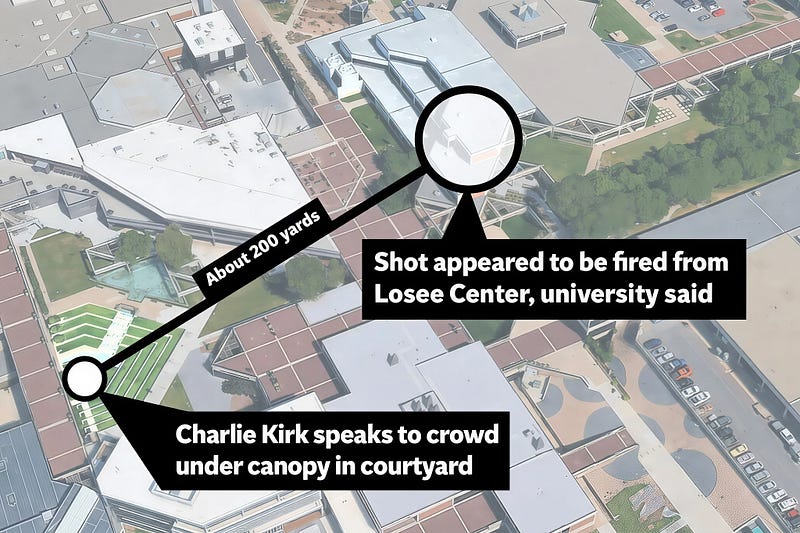
Compounding the vulnerability, the choice of venue itself created blind spots. Kirk’s team and campus officials chose an outdoor plaza ringed by tall campus buildings. The stage was set up at a lower elevation, a sunken courtyard with rooftops looming above on several sides. Such an arrangement can be a security nightmare — if anyone thinks to exploit it. Unfortunately, nobody on the security detail seemed assigned to monitor those high vantage points. There were no officers stationed on nearby rooftops, no lookouts with binoculars scanning upper windows, no drones or helicopters watching from above. In essence, while Kirk’s immediate vicinity was guarded, the wider “middle” and “outer” security rings were left exposed. It was precisely in that gap that a determined attacker found his opening.
The Breach: How Security Failed
At midday on September 10, 2025, Charlie Kirk was holding court under a white event tent before a crowd of roughly 3,000 students and supporters on UVU’s campus. By all accounts, the event had started convivially. Kirk had even tossed a few free hats into the audience moments earlier, warming up the enthusiastic crowd. But just as the conservative firebrand settled into the debate — “Prove Me Wrong” style, inviting students to challenge him — a sudden crack rang out. In that split second, the entire security apparatus proved worthless. A sniper’s bullet struck Kirk in the neck, causing him to crumple backwards as blood poured down his chest. Chaos immediately replaced order. It turned out that an assailant had surreptitiously positioned himself on the roof of the nearby Losee Center, roughly two hundred yards from Kirk’s tent, with an unobstructed line of sight. From that perch, the shooter had a perfect sniper’s nest overlooking the event. With a high-powered bolt-action rifle, he needed only one shot. No metal detector or bag search at the ground level would have mattered; the threat was perched far beyond the area anyone could secure.
The safeguards in place were simply not designed for this scenario. Kirk’s personal guards, standing feet from him, were rendered helpless against a bullet coming from a distant rooftop. Campus police mingling in the crowd could do nothing to stop a threat they never saw. The entire security plan had assumed any danger would come from within or immediately around the audience — a protester with a pie, an angry student rushing the stage. They never imagined a sniper attack from long range. “You don’t expect a threat to come from 200 yards away on a college campus,” admitted Gregory Shaffer, who ran Kirk’s security detail in earlier years. The result was that only the inner sanctum around Kirk was hardened, while the high ground above and the outer perimeter were left soft and completely unguarded. As a former Secret Service agent noted later, “If you have a high ground issue, you’ve got to take care of that first… High ground gives a shooter a direct line of fire.” In this case, the shooter had exactly that direct line — and no one standing in his way.
Immediate Chaos and Consequences
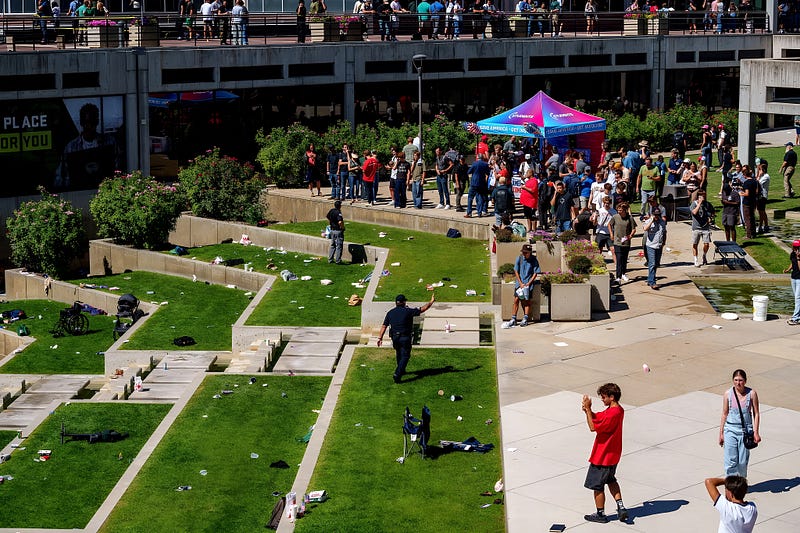
The moment the shot cracked through the air, pandemonium erupted. In video footage and eyewitness accounts, attendees can be seen screaming and flinging themselves to the ground or bolting in terror. People ran in zig-zags, unsure if a hail of bullets would follow the first. Some dove behind concrete planters and under benches; others lay on top of friends to shield them, not knowing where the assassin was or if he would fire again. For a few chaotic minutes, the sprawling campus courtyard was a scene of pure panic. One Salt Lake Tribune photographer captured the instant of horror: students crouching and sprinting while Kirk’s security team and others pointed frantically toward the rooftops, finally realizing the danger had come from above.
Amid the chaos, the gunman coolly slipped away. Witnesses later reported a dark-clad figure leaping off the roof of the Losee Center and disappearing into a wooded area adjacent to campus. In those first moments, there was no coordinated lockdown or clear instructions from authorities. Attendees and bystanders were largely left to their own judgment — flee or hide — as sirens began wailing in the distance. It wasn’t until about 20 minutes later that UVU sent out a campus-wide alert, by which time Kirk had been rushed to the hospital and much of the crowd had scattered. Even then, the initial alert that a “single shot was fired on campus toward a visiting speaker” contained no guidance on whether people should evacuate or shelter in place. The delay and ambiguity of the alerts were in part due to a technical breakdown: so many people were using their phones that UVU’s Wi-Fi and cellular networks were overloaded, delaying emergency messages. One student, Ava Beck, recalled emerging from class to a scene of confusion — students milling about, unsure of what was happening or where safety lay. She and thousands of others found themselves caught in a fearful bottleneck, as police belatedly tried to secure the campus.
Meanwhile, law enforcement from every quarter converged on the scene. Campus police, Orem city officers, and agents from the ATF and FBI swarmed UVU within the hour. Despite their rapid arrival, the killer had melted away into the community. Kirk, gravely wounded, was transported to Timpanogos Regional Hospital. Doctors fought to save him, but the damage from the single rifle round was catastrophic. Within a short time, Charlie Kirk was pronounced dead, sending shockwaves well beyond Utah. The immediate aftermath saw UVU cancel classes for the remainder of the day, and students grappled with the trauma of what they had witnessed. Makeshift memorials of candles and flowers sprang up on campus and at the local hospital’s grounds, where a crowd gathered in vigil and prayer. What should have been a spirited campus debate had turned into a national tragedy in the span of one violent heartbeat.
Lapses Under Scrutiny
In the days that followed, the glaring security failures at the UVU event came under intense scrutiny from the media, the public, and security professionals alike. Many asked the obvious question: How could a high-profile speaker in America’s volatile political climate be protected by only a half-dozen campus cops and a handful of private guards? Attendees blasted the university for the lax precautions. “We expected metal detectors at the very least,” said one incredulous event-goer, noting that Kirk’s notoriety and the charged atmosphere should have warranted tighter screening. Indeed, some had modified their behavior, assuming strict security — like the audience member who preemptively discarded his metal keychain pick — only to find zero checks at the entrance. “Anyone could bring a gun in there and nobody would have known,” he lamented, a chilling observation proven true in the worst way.
Security experts weighed in with professional assessments of everything UVU’s police and Kirk’s team got wrong. Chief among the critiques was the failure to secure the high ground around the event. “That is a security failure that can’t be defended,” said Greg Rogers, a former FBI agent, referencing the unguarded rooftop vantage point. Rogers argued that drones or rooftop patrols should have been deployed, given the amphitheater’s layout. Others pointed out that UVU could have requested assistance from local law enforcement agencies to bolster their small campus force. (For context, UVU’s entire police department consists of only 23 officers for a campus of 46,000 students— a skeleton crew compared to municipal departments.) A retired UVU officer, Bryan Cunningham, revealed that he had pleaded with administrators years before to prepare for exactly this scenario. “We begged… This is going to be an active shooter situation nightmare if you don’t give us more officers… It’s not if. It’s when,” Cunningham says he warned, only to be brushed off by a university vice president who insisted such an attack would never happen here. Cunningham didn’t hesitate to lay blame after Kirk’s murder: “They dropped the ball on this one, and Charlie Kirk is dead because of it,” he said bluntly.
Even UVU’s own police chief, Jeff Long, had little choice but to acknowledge the lapse. “This is a police chief’s nightmare,” Long admitted the day of the shooting. “You try to get your bases covered, and unfortunately today we didn’t, and because of that we had this tragic incident.” Long’s comments underscored that certain obvious “bases” had indeed gone uncovered — like failing to post officers on the rooftops or to choose a more secure indoor venue. Ron Williams, a former Secret Service agent, noted that holding the event outdoors was itself a questionable decision when an indoor auditorium could have been controlled with checkpoints at every door. Another ex-Secret Service agent, Joseph LaSorsa, observed that trying to secure 3,000 people spread across an open area with only a handful of officers was an impossible task: “They were wide open,” he said of the UVU crowd. The only thing that prevented a larger loss of life was the shooter’s choice to fire just a single targeted shot at Kirk and then flee, rather than spraying bullets into the crowd. But that was cold comfort. The incident exposed how ill-prepared many campuses and private security details are to handle true assassination scenarios. It was a devastating wake-up call that “soft targets” can include outspoken civilians, not just politicians, and that current security practices for controversial speakers lag far behind the threats.
Tellingly, comparisons were made to a prior UVU event that had heavy security. In 2017, the university hosted a major outdoor concert featuring the rock band Imagine Dragons. Remembering that concert, Cunningham noted that UVU had set up a unified command center, brought in the Utah County Sheriff’s office and Orem city police, and even stationed a SWAT team on site. They had medical personnel and an emergency management trailer on standby for the concert. In stark contrast, Kirk’s event had none of that. The difference? Perhaps officials underestimated the risk because Kirk’s event was “just a speech” rather than a big-ticket entertainment draw. Or perhaps because it was a daytime political event headlined by a non-elected figure, it somehow seemed less of a security priority. Whatever the rationale, it proved fatally flawed. The lack of foresight — especially given Kirk’s history of drawing threats and hostility — now looks like a stunning oversight. As one security consultant remarked, political influencers like Kirk don’t have Secret Service details and often rely on perfunctory measures, yet “they can still be a target… There is really only so much you can do, given the circumstances.” In Orem, those circumstances lined up tragically in the shooter’s favor.
The Political Firestorm
Kirk’s assassination didn’t just claim one life; it ignited a political firestorm. Almost immediately, commentators and politicians began drawing battle lines and spinning the narrative of what had happened. On the right, there was an outpouring of grief mingled with fury. Many conservatives pointed the finger at what they see as a growing trend of left-wing political violence. They noted that Kirk was killed in a deep-red state by an assailant who, by all indications, harbored vehement anti-conservative sentiments. Kirk himself had warned about this very phenomenon. Just a few months earlier, he took to social media to decry what he called an “assassination culture” spreading on the left. Citing a study, Kirk pointed out that a disturbingly high percentage of left-leaning Americans surveyed said they felt violence against political figures could be justified. “The left is being whipped into a violent frenzy,” he wrote in April, calling the trend a “natural outgrowth of left-wing protest culture” that tolerates “violence and mayhem.” Now, in the wake of his death, Kirk’s allies treated those words as prophecy fulfilled.
President Donald Trump, a close friend and ally of Kirk’s, moved quickly to martyrize the fallen activist. The very next day — September 11, at a memorial event in Washington — Trump announced that Charlie Kirk would be posthumously awarded the Presidential Medal of Freedom, the nation’s highest civilian honor. In an emotional address, Trump praised Kirk as “a giant of his generation, a champion of liberty, and an inspiration to millions,” while visibly linking Kirk’s slaying to a broader pattern of political terror. That same night from the Oval Office, Trump delivered a rare primetime speech addressing the nation’s unrest. “Radical left political violence has hurt too many innocent people and taken too many lives,” he declared solemnly. He urged Americans to “commit themselves to the American values for which Charlie Kirk lived and died,” pointedly framing Kirk’s murder as a sacrifice in a larger ideological struggle.
Some on the far-right fringes took an even darker tone. Within hours of the shooting, chatter on social media turned incendiary, with a few extremist voices calling Kirk’s killing an opening shot in a coming civil conflict. Prominent conspiratorial influencers began openly invoking the prospect of “civil war” and urging retaliation. Mainstream Republicans stopped short of such language, but many echoed the sentiment that left-wing hatred had led to this tragedy. Vice President J.D. Vance (a Trump ally in this imagined timeline) went on Kirk’s own podcast to blame “left-wing extremism” for fostering an environment that made Kirk a target. At the same time, voices on the left and center expressed horror at the assassination and denounced political violence in all forms. Progressive leaders like Senator Bernie Sanders quickly condemned Kirk’s murder, warning that violent tactics are an affront to democracy and “a threat to everything we stand for.” Even figures who had been fierce critics of Kirk’s views came forward to say that no ideological battles justify turning opponents into martyrs.
Utah’s governor, Republican Spencer Cox, captured the uneasy mood in a press conference two days after the shooting. “I absolutely believe this is a watershed in American history,” Cox said, standing before a visibly rattled statehouse. “The question is, what kind of watershed? Is this the end of a dark chapter in our history or the beginning of a darker chapter?” Those words struck at the uncertainty gripping the nation. In recent years, America has seen an alarming uptick in politically-motivated violence — from attempted assassinations of candidates to attacks on government officials and party offices. Kirk’s high-profile slaying on a college campus seemed to many to mark a tipping point. Would it prompt a course correction, a reinvestment in security and civility? Or was it accelerating a descent into an era where public figures are constantly in the crosshairs?
In the immediate aftermath, at least, anxiety ran high. Prominent politicians across the spectrum canceled upcoming public events, citing security concerns. Colleges around the country, even those far removed from Utah, reevaluated or postponed scheduled speaker visits that were deemed even remotely controversial. Chillingly, a wave of copycat threats rolled in. Several historically Black colleges and universities (HBCUs) received anonymous threats in the days after Kirk’s death, prompting temporary lockdowns at those campuses. (It was unclear if those threats were related to Kirk’s assassination or simply opportunists exploiting the climate of fear.) What was undeniable was that Kirk’s death had a profound effect on the national psyche. The incident dominated news cycles and intensified debates about free speech, gun violence, and the dangerous temperature of American politics. On talk shows and op-ed pages, some argued that incendiary rhetoric from both left and right has created a powder keg, and Kirk’s murder was the tragic explosion. Others insisted the blame lay squarely on one side: either the shooter’s apparent leftist radicalization or, conversely, Kirk’s own brand of provocation that had fomented such visceral hatred in his enemies. The only common ground was a shared sense of alarm that something like this could happen at all.
Fallout and Looking Ahead
The repercussions of the security failure in Utah are still unfolding, but some consequences became clear immediately. For one, the investigation into Charlie Kirk’s murder kicked into high gear and soon yielded results. After a two-day manhunt, authorities tracked down and arrested a suspect: 22-year-old Tyler Robinson, a Utah resident and one-time trade school student with no prior criminal record. Robinson was allegedly the man seen in grainy surveillance footage hopping off the roof and fleeing, and prosecutors say they recovered the .30–06 bolt-action rifle he discarded in a nearby field. As investigators dug into Robinson’s background, an unsettling picture emerged. Despite hailing from a staunch Republican family, Robinson himself had recently undergone a political metamorphosis and developed a seething “obsession” with Charlie Kirk, according to statements given by a family member. That relative recalled Robinson ranting that Kirk was “full of hate” and “spreading hate,” and expressing vehement dislike for Kirk’s far-right viewpoints. Utah’s Governor Cox, after being briefed by law enforcement, stated that Robinson had been “deeply indoctrinated with leftist ideology.” In other words, the suspect’s political hatred seems to have been a primary motive — exactly what many on the right had assumed from the moment Kirk hit the ground. Federal agents also revealed an eerie detail: Robinson had allegedly etched cryptic messages onto the shell casings of his bullets, including one that read, “hey fascist! CATCH!”, seemingly taunting his victim. It was as if the killer wanted to ensure his act was understood as political vengeance.
This revelation only intensified the political fallout. Almost immediately, conservative commentators and politicians doubled down on calls to root out violent extremists “on the left,” and some even floated the idea of new domestic terrorism statutes. On the other side, more moderate voices urged cooler heads and warned against using one fanatic’s actions to tar all progressives. But even beyond the partisan recriminations, the fact that Kirk’s security was so easily breached raised urgent questions about how to better protect public figures in the future. If a prominent Trump ally could be gunned down on a campus in Utah, where else were the vulnerabilities equally bad or worse? It turned out the answer was: almost everywhere. A sobering consensus began to form among security professionals that a major overhaul is needed in how we secure events — especially political or ideological events — in an era of heightened threats.
Universities, in particular, began scrambling to review their safety protocols. Many campus police departments had operated under the assumption that their biggest challenges during controversial speeches were crowd control and the possibility of fistfights or vandalism. Now, the specter of a sniper-style attack forced them to rethink everything. Within a week of Kirk’s death, some colleges announced they would move high-profile speaker events indoors by default, where access can be tightly controlled. Others started exploring technology like surveillance drones to monitor rooftops and open areas in real time. The idea of requiring metal detectors and bag checks for any large public gathering — once dismissed as overkill — gained sudden traction. Students and faculty at UVU and beyond also demanded better emergency communication systems after witnessing the confusion in Orem. At UVU, Ava Beck’s petition for improved lockdown procedures and faster alerts garnered thousands of signatures, forcing the administration to consider installing loudspeaker systems and other measures to swiftly broadcast warnings campus-wide.
The tragedy also cast renewed scrutiny on Utah’s gun laws. Just a few months before the shooting, Utah had enacted a law allowing anyone 18 or older with a permit to carry a concealed firearm on public college campuses. Supporters hailed it as a way to enhance personal safety and deter mass shooters. But in Kirk’s case, an armed audience did not make a difference — the threat came from afar, not within the crowd. If anything, the permissive gun environment might have given organizers a false sense of security that someone in the pro-Kirk audience could handle any “bad guy” with a gun. That theory evaporated with the reality that a determined sniper can strike from well beyond the range of any would-be hero in the audience. The open-carry policy also complicated the police response; arriving officers didn’t know if any armed attendees were friends or foes. Going forward, states like Utah may have to reconcile their gun rights policies with the need to harden venues against attacks. It’s an uncomfortable debate, pitting deeply held Second Amendment beliefs against the pragmatic questions raised by this failure in Orem.
Perhaps the most lasting consequence of Charlie Kirk’s assassination is the introspection it has provoked on the state of American discourse. Kirk’s death became a grim landmark in a years-long rise of political violence. Experts note that in the first half of 2025 alone, over 500 incidents of terrorism or targeted violence were documented across the country, a nearly 40% jump from the year before. Assassinations and attempts — once rare aberrations in U.S. history — have begun to feel frighteningly common. As the nation mourned Kirk, many wondered if this would be the point where society finally pulls back from the brink. Will political leaders moderate their language, recognizing that demonization of opponents can spur unbalanced individuals to kill? Or will they double down and treat martyrs like Kirk as rallying symbols, further inflaming passions? The initial signs were mixed. Even as Trump called for unity against violence, he and others used Kirk’s name to excoriate their enemies. Meanwhile, left-wing activists, while denouncing the murder, also cautioned that turning Kirk into a hero could whitewash the more divisive parts of his legacy. In death as in life, Charlie Kirk remained polarizing.
For Kirk’s family and friends, of course, the ramifications are deeply personal. They lost a son, a husband, a father (Kirk left behind a young family) to a preventable act of violence. In Phoenix, where Turning Point USA is headquartered, hundreds gathered for a memorial service, laying flowers and “Don’t Tread on Me” flags in front of a large photo of Kirkt. President Trump attended and presented the Medal of Freedom to Kirk’s tearful widow in a ceremony that was as much a political statement as a eulogy. In that moment, Kirk was officially enshrined as a martyr for the conservative cause — a legacy he surely never envisioned when he set out to provoke lively debates on college quads.
In the end, the security meltdown in Utah stands as a somber lesson. It has exposed the soft underbelly not just of one event’s planning, but of an entire mindset. The notion that “it can’t happen here” was proven tragically wrong at UVU. In an era when polarization runs white-hot and extremists lurk on the fringes of all ideologies, complacency is deadly. Protecting public figures — be they politicians, pundits, or provocateurs — now demands a new level of vigilance and creativity. That means learning from failures like the one in Orem: conducting threat assessments that account for unconventional attack methods, investing in better training and equipment for campus security, and frankly, spending more money to ensure that if someone wants to commit harm, they’ll have a much harder time doing it.
Charlie Kirk’s killing was a devastating failure of security. But if the right lessons are drawn, it could also be a turning point that forces improvements and perhaps even cools the temperature of America’s civic life. It’s a high price to pay for a wake-up call — one life taken to save who knows how many future lives. Whether that promise is realized depends on what we do next. For now, the plaza at Utah Valley University remains stained by the memory of a day when warnings went unheeded, threats were underestimated, and a young firebrand’s life was snuffed out by a bullet that never should have reached him.