Is Reality Racist?
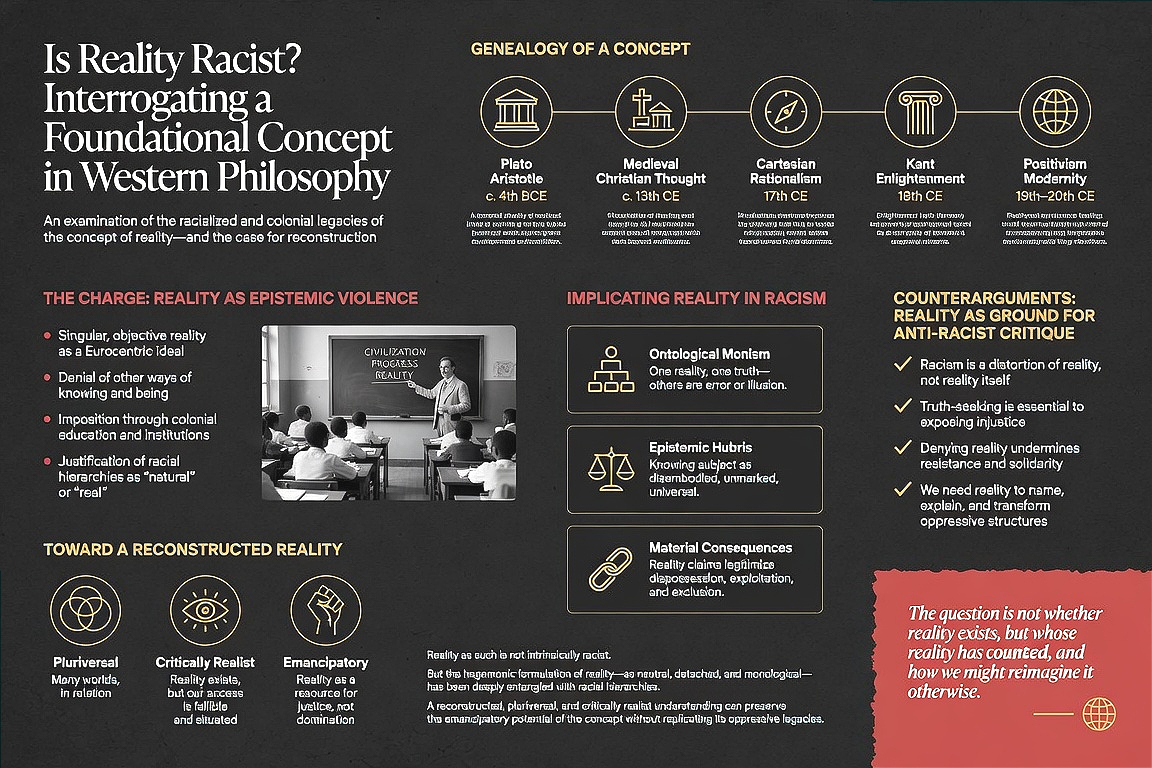
The charge that “reality” is racist targets the dominant Western ideal of a single, neutral, universal world‑picture. Reality itself isn’t racist, but its hegemonic formulation has long aligned with racial hierarchy; a pluriversal, critically realist account avoids that legacy.
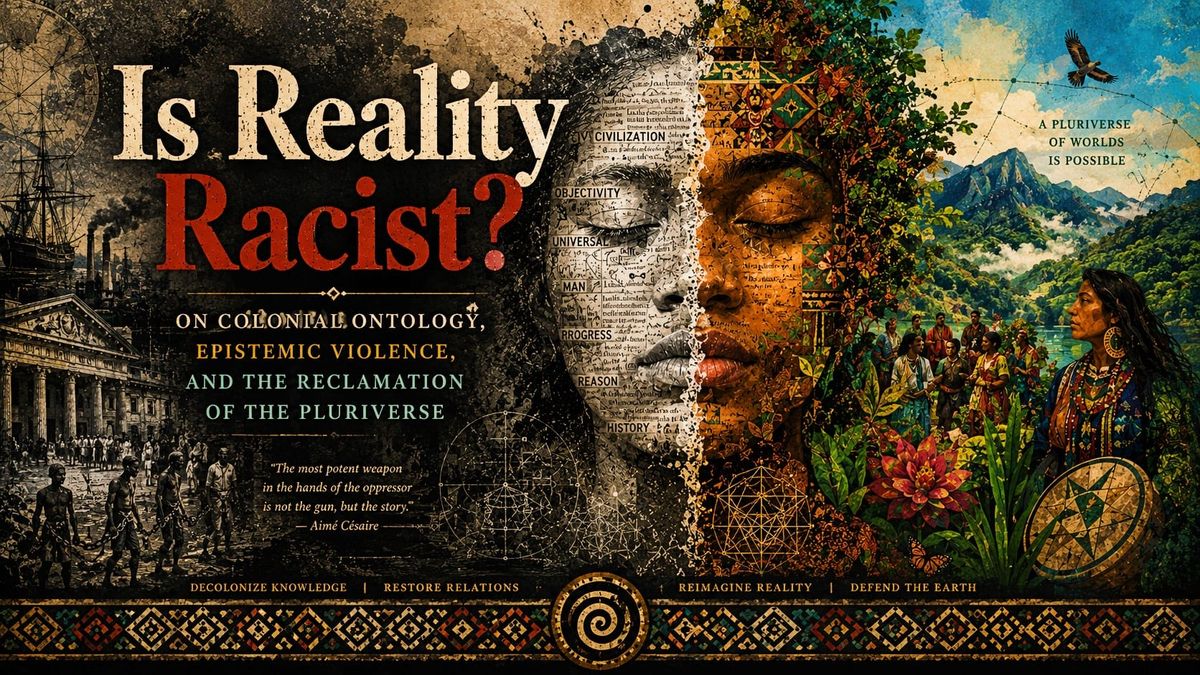
On Colonial Ontology, Epistemic Violence, and the Reclamation of the Pluriverse
Abstract
The question of whether the philosophical concept of reality is racist invites an interrogation of one of the most foundational ideas in Western thought. This report examines the charge that the notion of a singular, objective, and universal reality—as developed within dominant philosophical traditions—carries racialized and colonial underpinnings, functions as an instrument of epistemic violence, and perpetuates structural injustice. Drawing on critical philosophy of race, decolonial theory, feminist epistemology, and social ontology, the analysis traces the genealogy of the concept, surveys arguments that implicate reality in racism, and evaluates counterarguments that reclaim reality as a necessary ground for anti-racist critique. The study concludes that while reality as such is not intrinsically racist, the hegemonic formulation of reality as a neutral, detached, and monological domain has been deeply entangled with racial hierarchies. A reconstructed, pluriversal, and critically realist understanding of reality is proposed as a way to preserve the emancipatory potential of the concept without replicating its oppressive legacies.
Introduction
Can a philosophical abstraction bear a political charge? The proposition that reality itself—the concept of an objective world existing independently of human minds—might be racist initially appears as a category mistake, as if one were asking whether gravity is sexist. Yet the question persists across critical theory, decolonial scholarship, and philosophy of race precisely because the ways in which reality is conceptualized, authorized, and deployed are far from innocent. Reality, as a philosophical concept, has a history, a set of cultural presumptions, and a performative power that shapes what can be known, who can know it, and whose existence counts as fully real. This report explores the arguments on both sides of the provocation, aiming to clarify the terrain and offer a nuanced assessment. It proceeds by first situating the dominant Western concept of reality, then unpacking the multifaceted indictment that links it to racism, before examining defenses and constructing a synthetic position that neither dismisses the charge nor abandons the concept altogether.
The Dominant Philosophical Concept of Reality: A Brief Genealogy
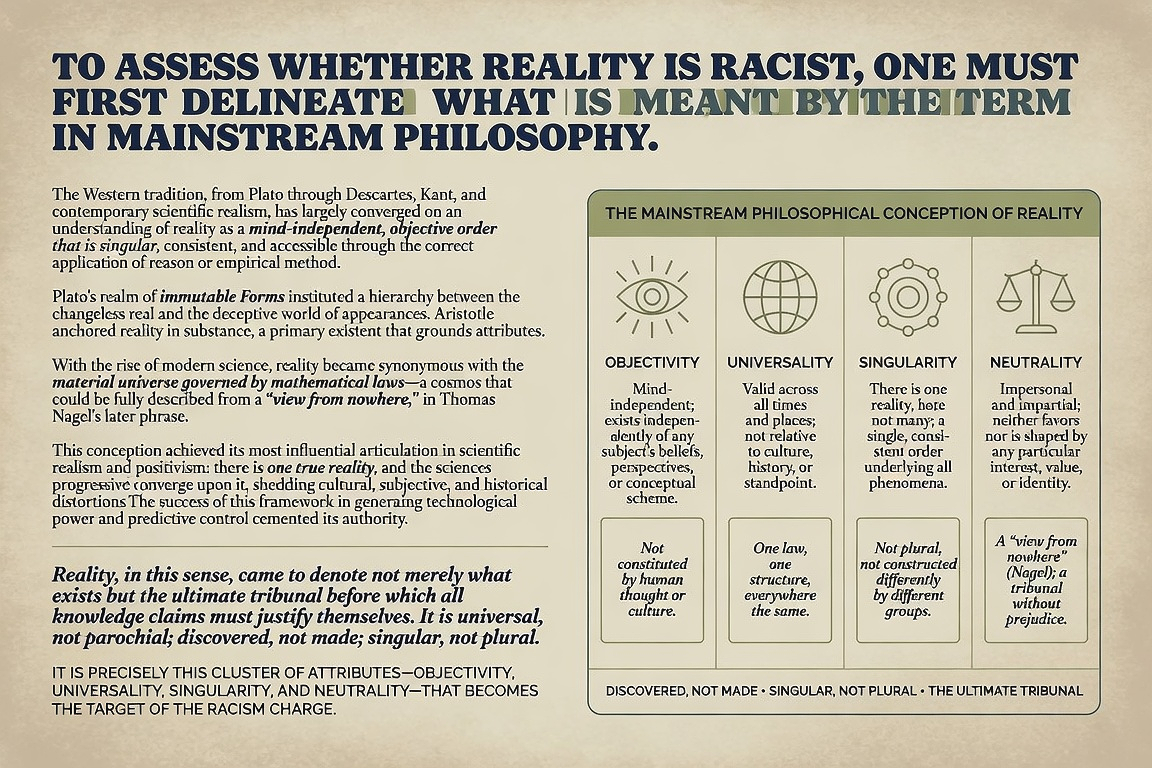
To assess whether reality is racist, one must first delineate what is meant by the term in mainstream philosophy. The Western tradition, from Plato through Descartes, Kant, and contemporary scientific realism, has largely converged on an understanding of reality as a mind-independent, objective order that is singular, consistent, and accessible through the correct application of reason or empirical method. Plato’s realm of immutable Forms instituted a hierarchy between the changeless real and the deceptive world of appearances. Aristotle anchored reality in substance, a primary existent that grounds attributes. With the rise of modern science, reality became synonymous with the material universe governed by mathematical laws—a cosmos that could be fully described from a “view from nowhere,” in Thomas Nagel’s later phrase.
This conception achieved its most influential articulation in scientific realism and positivism: there is one true reality, and the sciences progressively converge upon it, shedding cultural, subjective, and historical distortions. The success of this framework in generating technological power and predictive control cemented its authority. Reality, in this sense, came to denote not merely what exists but the ultimate tribunal before which all knowledge claims must justify themselves. It is universal, not parochial; discovered, not made; singular, not plural. It is precisely this cluster of attributes—objectivity, universality, singularity, and neutrality—that becomes the target of the racism charge.
The Racism Charge: Arguments and Perspectives
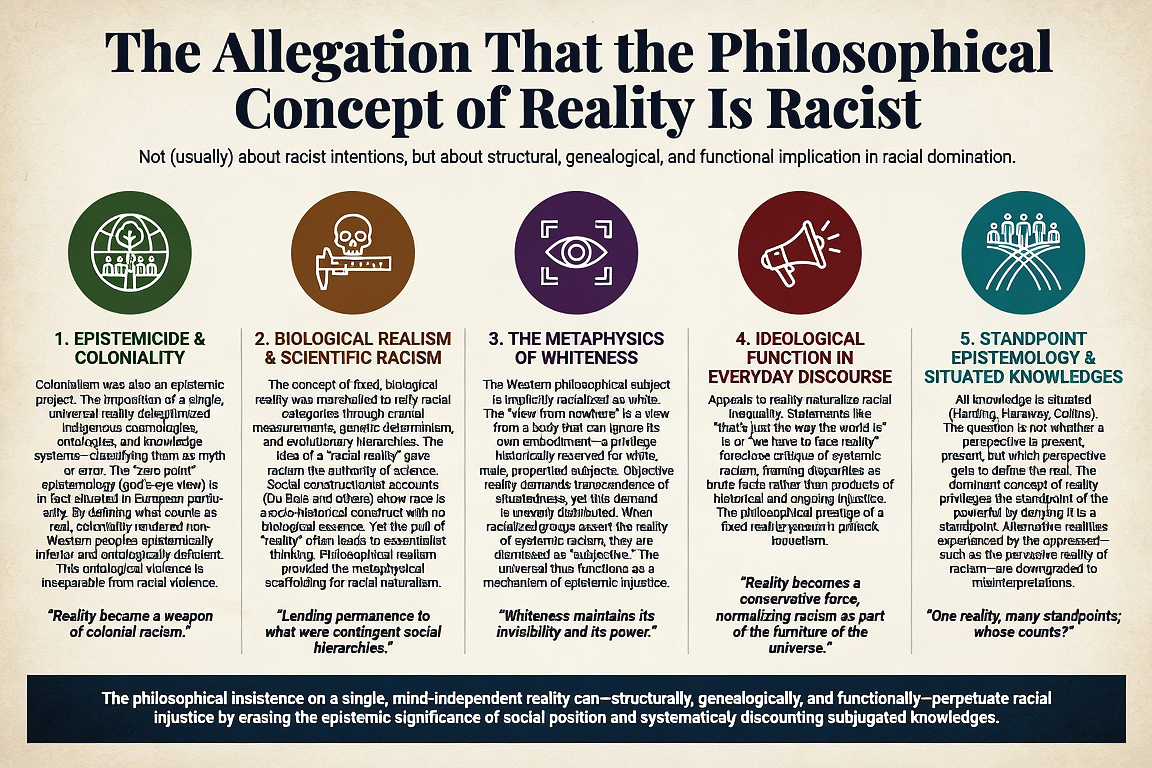
The allegation that the philosophical concept of reality is racist does not typically mean that there is a racist intention behind the idea of a mind-independent world. Rather, the critique operates at structural, genealogical, and functional levels, showing how this concept has been implicated in racial domination.
One major line of argument concerns epistemicide and coloniality. Decolonial theorists, following the work of Walter Mignolo, Aníbal Quijano, and Boaventura de Sousa Santos, argue that European colonialism was not merely a military and economic enterprise but an epistemic one. The imposition of a single, universal reality delegitimized the cosmologies, ontologies, and knowledge systems of colonized peoples. Indigenous worlds, in which reality might be relational, animate, and plural, were classified as myth, superstition, or error. The Western concept of reality functioned as a “zero point” epistemology—a god’s-eye view that claims to speak from nowhere while actually being situated in European particularity. By defining what counts as real, coloniality rendered non-Western peoples epistemically inferior and ontologically deficient, their worlds not just different but less real. This ontological violence is inseparable from racial violence because the racialized other was constructed as incapable of grasping true reality, a being trapped in custom and embodiment. In this sense, reality became a weapon of colonial racism.
A second argument focuses on the historical alliance between biological realism and scientific racism. Throughout the nineteenth and early twentieth centuries, the concept of a fixed, biological reality was marshalled to reify racial categories. Scientific racists claimed to have discovered the objective, natural reality of race in cranial measurements, genetic determinism, and evolutionary hierarchies. The very notion that there is a “racial reality” underlying superficial differences gave racism the authority of science. Social constructionist accounts of race, from W.E.B. Du Bois to contemporary scholars, demonstrate that race is a socio-historical construct with no biological essence. However, the gravitational pull of the concept of reality often leads people to insist that race must be “real” in some straightforwardly physical sense to matter. Even well-intentioned realism about race can thus inadvertently reinforce essentialist thinking. The philosophical valorization of a singular, independent reality provided the metaphysical scaffolding for racial naturalism, lending permanence and inevitability to what were in fact contingent social hierarchies.
A third dimension concerns the metaphysics of whiteness. Critical philosophers of race, such as Charles Mills, George Yancy, and Linda Martín Alcoff, have analyzed how the Western philosophical subject is implicitly racialized as white. The “view from nowhere” is in fact a view from a body that can afford to ignore its own embodiment—a privilege historically reserved for white, male, propertied subjects. The concept of objective reality demands the transcendence of situatedness, emotion, and social location, yet this demand is unevenly distributed; marginalized groups are often denied the capacity for such transcendence, their testimony dismissed as merely perspectival. When Black, Indigenous, or people of color assert the reality of systemic racism, they are frequently met with the counter-claim that they are imposing their “subjective” interpretation on a neutral reality that, if properly understood, reveals no such thing. The supposedly universal reality thus functions as a mechanism of epistemic injustice, discrediting those who speak from experiences that deviate from the dominant framing. The concept of a single reality, by erasing the epistemic significance of social position, becomes an instrument through which whiteness maintains its invisibility and its power.
A fourth argument highlights the ideological function of “reality” in everyday discourse. Appeals to reality are routinely used to naturalize racial inequality. Statements such as “that’s just the way the world is” or “we have to face reality” often serve to foreclose critique of systemic racism, framing disparities in wealth, incarceration, or health as brute facts rather than as products of historical and ongoing injustice. The philosophical prestige of a fixed, objective reality bleeds into a political quietism that treats the existing social order as an unalterable given. In this way, the concept of reality itself becomes a conservative force, rendering structural racism invisible by normalizing its effects as part of the furniture of the universe.
Finally, standpoint epistemology and feminist science studies, as developed by Sandra Harding, Donna Haraway, and Patricia Hill Collins, challenge the very possibility of a neutral reality accessible from nowhere. All knowledge is situated; the question is not whether a perspective is present but which perspective is granted the authority to define the real. The dominant concept of reality privileges the standpoint of those in power by denying that it is a standpoint at all. When a single reality is posited, it typically turns out to be the reality as perceived by dominant groups, while the alternative realities experienced by the oppressed—such as the pervasive reality of racism—are downgraded to misinterpretations. Thus, the philosophical insistence on one reality can perpetuate racial injustice by systematically discounting subjugated knowledges.
Counterarguments: Defending Reality from the Racism Charge
Despite the force of these critiques, there are substantial arguments against labeling the philosophical concept of reality as racist, and compelling reasons to preserve a robust notion of reality for anti-racist purposes.
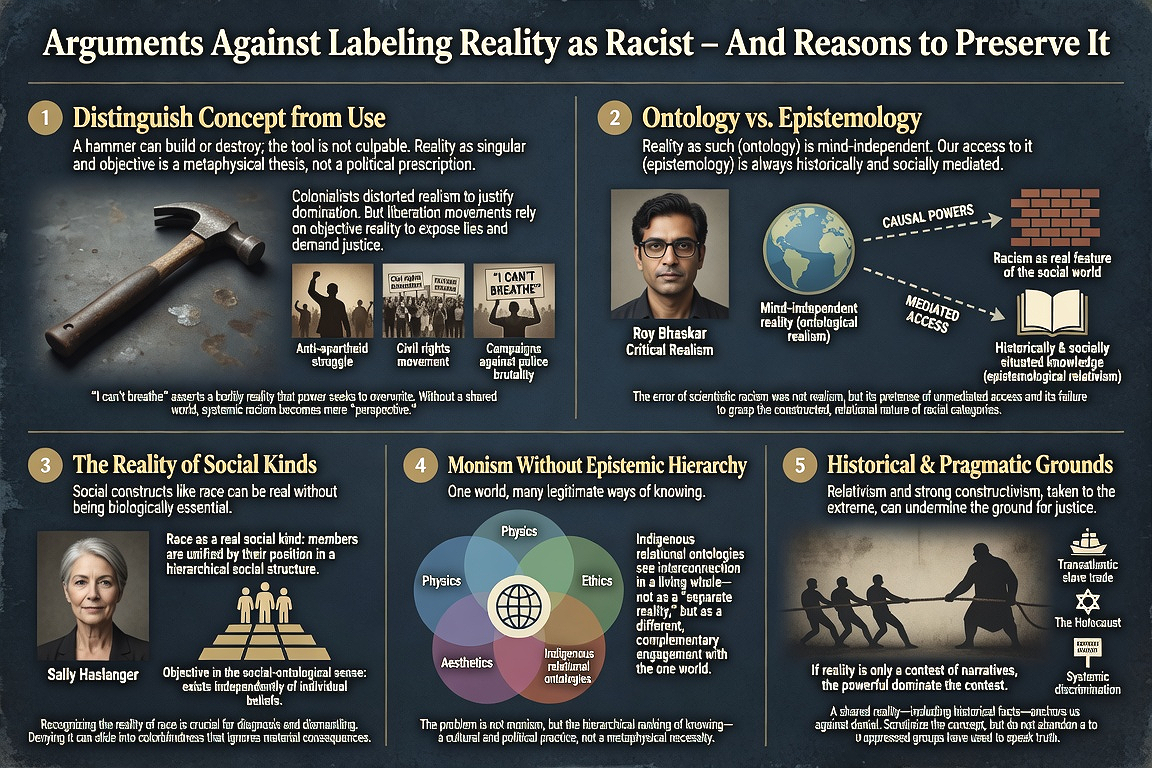
The most straightforward defense distinguishes between the concept of reality and its historical uses. A hammer can be used to build a shelter or to bludgeon; the tool is not morally culpable for the act. Similarly, the claim that reality is singular and objective is a metaphysical thesis, not a political prescription. The fact that colonialists and racists have invoked a distorted version of realism to justify their actions does not taint the concept itself. Moreover, liberation movements have consistently relied on the idea of an objective reality to expose lies and demand justice. The anti-apartheid struggle, the civil rights movement, and contemporary campaigns against police brutality all assert that the reality of oppression exists whether or not oppressors acknowledge it. The slogan “I can’t breathe” is a claim about a concrete, bodily reality that state narratives attempt to overwrite. Without some commitment to a shared world that constrains interpretation, it becomes impossible to call out systemic racism as a truth rather than merely an alternative perspective.
A second defense draws on the distinction between ontology and epistemology, or between reality as such and our access to it. The critiques outlined above often target a specific epistemic stance—positivism, naïve realism, objectivism—rather than reality itself. Philosophers like Roy Bhaskar, with his critical realism, maintain that there is a mind-independent reality (ontological realism) while acknowledging that our knowledge of it is always historically and socially mediated (epistemological relativism). This position allows one to hold that racism is a real feature of the social world, exerting causal powers independently of any individual’s beliefs, while also recognizing that the ways we conceptualize and study racism are culturally situated and fallible. The error of scientistic racism was not its realism but its failure to recognize the constructed, relational nature of racial categories and its pretense of unmediated access to nature. Thus, the culprit is not reality but a specific, flawed epistemology of reality.
A third counterargument concerns the reality of social kinds. Defenders of a nuanced realism argue that social constructs like race can be real without being biologically essential. The philosopher Sally Haslanger, for example, offers an analysis of race as a real social kind: a category whose members are unified by their position in a hierarchical social structure. This reality is objective in the sense that it exists independently of any single person’s mental states; one can be racialized regardless of one’s self-conception. Recognizing the reality of race in this social-ontological sense is crucial for diagnosing and dismantling racism. Denying the reality of race altogether can slip into colorblindness, which ignores the material consequences of racial classification. A careful metaphysical account can therefore affirm reality while undermining racist essentialism.
A further line of defense challenges the idea that a singular reality necessarily excludes other ways of knowing. One can hold a monist ontology (the universe is one) while embracing explanatory pluralism. The physical world studied by physics is not the sole dimension of reality; ethical, aesthetic, and experiential truths may describe different aspects of the same world. Indigenous relational ontologies, which see persons, animals, and landscapes as interconnected in a living whole, need not be framed as a separate reality but as a deeply different yet complementary way of engaging with the one world. The problem arises not from the number of realities but from the hierarchical ranking of epistemic frameworks, a practice that is cultural and political rather than entailed by monism itself.
Finally, historical and pragmatic considerations caution against jettisoning the concept of reality altogether. Relativism and strong social constructivism, if taken to the extreme, can erode the ground for collective action against injustice. If reality is nothing but a contest of narratives, then the powerful are well-positioned to dominate the contest. The concept of a shared reality that includes historical facts—such as the transatlantic slave trade, the Holocaust, or ongoing systemic discrimination—serves as an anchor against denialist movements. Thus, even while subjecting the concept to critical scrutiny, one must be wary of abandoning a tool that oppressed groups have used to enunciate their truth.
Toward a Critical and Pluriversal Reality
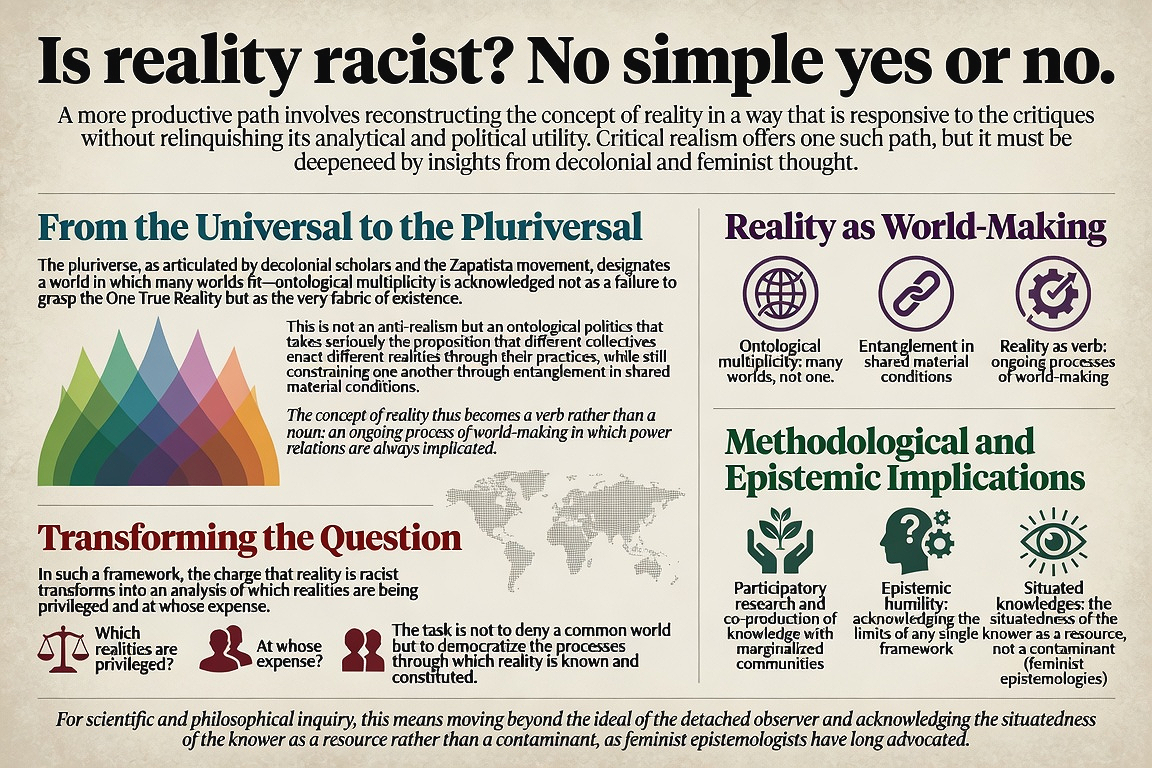
The foregoing discussion suggests that the question “Is reality racist?” admits no simple yes or no. A more productive path involves reconstructing the concept of reality in a way that is responsive to the critiques without relinquishing its analytical and political utility. Critical realism offers one such path, but it must be deepened by insights from decolonial and feminist thought.
A central move is the shift from a universal to a pluriversal understanding of reality. The pluriverse, as articulated by decolonial scholars and the Zapatista movement, designates a world in which many worlds fit—ontological multiplicity is acknowledged not as a failure to grasp the One True Reality but as the very fabric of existence. This is not an anti-realism but an ontological politics that takes seriously the proposition that different collectives enact different realities through their practices, while still constraining one another through entanglement in shared material conditions. The concept of reality thus becomes a verb rather than a noun: an ongoing process of world-making in which power relations are always implicated.
In such a framework, the charge that reality is racist transforms into an analysis of which realities are being privileged and at whose expense. The task is not to deny a common world but to democratize the processes through which reality is known and constituted. Methodologically, this entails participatory research, co-production of knowledge with marginalized communities, and epistemic humility regarding the limits of any single framework. For scientific and philosophical inquiry, it means moving beyond the ideal of the detached observer and acknowledging the situatedness of the knower as a resource rather than a contaminant, as feminist epistemologists have long advocated.
Conclusion
The philosophical concept of reality, as forged in the crucible of Western modernity, has indeed been an accomplice to racism in multiple ways: through the epistemicide of colonial expansion, the naturalization of racial hierarchy, the erasure of situated knowledges, and the ideological reinforcement of an unjust status quo. Yet these grievous entanglements do not warrant the wholesale abandonment of the concept. Reality can also serve as a bulwark against the denial of oppression, a grounding for claims of justice, and a shared horizon for solidarity. The challenge is to disarticulate reality from its monological, disembodied, and exclusionary formulations and to reimagine it as a pluriversal, contested, and accountable domain. Such a reconstructed reality is not a neutral given but a collective achievement—one that demands vigilance about the politics of the real. The question “Is reality racist?” thus performs a vital critical function, forcing philosophy to confront its own shadows and to build a concept of reality worthy of a just world.