
The Distinctive Custodial Experience of Condemned Prisoners in the United States
Death row creates a separate penal world: extreme isolation, sensory deprivation, no rehabilitation, and the psychological weight of impending execution. Built from long delays and default segregation, it forms a distinct system governed by the logic of terminality.
Introduction
The United States correctional system operates under a constitutional mandate to avoid cruel and unusual punishment while simultaneously administering the most severe criminal sanction: the death penalty. This dual obligation generates a unique and often contradictory custodial environment for individuals sentenced to death. Death row inmates, whether housed in state or federal facilities, are subjected to a regime of confinement that differs markedly from that of the general prison population, even from those serving life without parole. These differences permeate every aspect of daily existence, from physical housing and social interaction to psychological well-being and legal engagement. Understanding how condemned prisoners are treated differently requires an examination of security classifications, institutional policies, the psychological burden of indefinite waiting, and the legal architecture that both creates and justifies these conditions. This report synthesizes academic research, legal analysis, and institutional observations to delineate the multifaceted treatment disparities that define life under a sentence of death.
Historical Context and Legal Underpinnings
The modern death row emerged as a distinct institution following the Supreme Court’s temporary abolition of capital punishment in Furman v. Georgia, 408 U.S. 238 (1972) and its subsequent reinstatement in Gregg v. Georgia, 428 U.S. 153 (1976). The Gregg decision mandated bifurcated proceedings separating guilt from sentencing, which created a new class of prisoner: the condemned individual awaiting execution while exhausting appellate remedies. Prior to this, executions followed relatively swiftly after sentencing. The new legal framework, designed to enhance procedural fairness, inadvertently birthed a prolonged period of confinement that now averages over two decades in many jurisdictions. This extended wait, coupled with the finality of the sentence, prompted correctional authorities to develop specialized management strategies.
The Eighth Amendment’s prohibition on cruel and unusual punishment serves as a constant, albeit contested, backdrop. Courts have long recognized that the conditions of confinement for death-sentenced inmates must meet constitutional standards, yet they have also granted wide latitude to prison administrators who cite security necessities. In cases like Turner v. Safley, 482 U.S. 78 (1987), the Supreme Court established that prison regulations impinging on inmates’ constitutional rights are valid if reasonably related to legitimate penological interests, a standard that has insulated many restrictive death row policies from judicial reversal. The death row phenomenon, a concept recognized in international human rights law and referenced in numerous mental health studies, describes the immense psychological suffering caused by the protracted wait for execution under harsh conditions. While U.S. courts have largely declined to find that this delay alone constitutes cruel and unusual punishment, the phenomenon provides a crucial lens for analyzing the distinctive treatment of this population.
Housing and Physical Conditions of Confinement
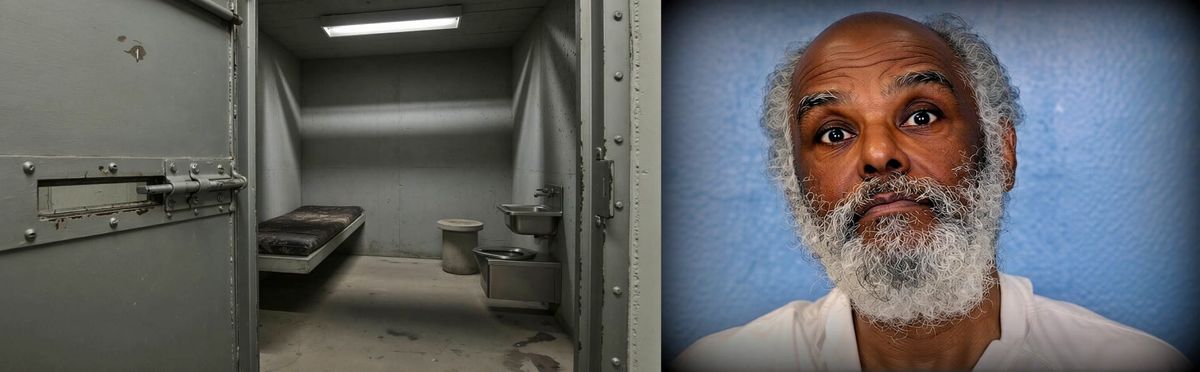
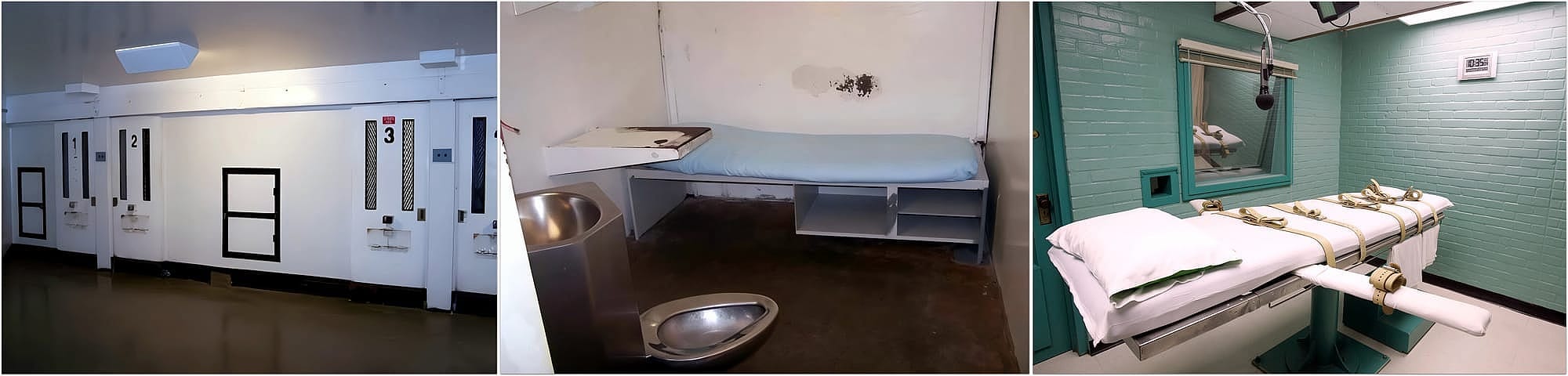
The most immediate distinction between death row and general population is the housing assignment. Condemned prisoners are almost universally placed in some form of solitary confinement or administrative segregation, even when they have not committed disciplinary infractions. The justification is multifaceted: the perceived heightened risk of escape, the potential for violence given that inmates have nothing to lose, the need to separate high-profile offenders from the general population, and administrative efficiency in managing a subset of prisoners with unique legal and visitation requirements. This segregation typically means a single cell, often smaller than general population cells, with solid steel doors rather than bars, and limited or no physical contact with other human beings.
The physical environment varies by jurisdiction but consistently involves extreme restriction of movement. In many state systems, such as Texas and Alabama, death row inmates may spend twenty-two to twenty-four hours per day inside their cells. Recreation, when permitted, is often solitary, conducted in a small, enclosed cage or a barren concrete yard, sometimes with no access to direct sunlight, exercise equipment, or meaningful activity. A report from the Texas Department of Criminal Justice indicates that condemned men in the Polunsky Unit may be offered a few hours per week of solitary rec time in a small, roofed enclosure that critics have likened to a dog run. Federal death row inmates, housed at the Special Confinement Unit in Terre Haute, Indiana, experience a similar regime: they are confined to their cells for the vast majority of the day, with meals delivered through a slot in the door. Contrast this with the general population, where inmates typically have access to communal dining halls, dayrooms, group recreation, and educational or vocational programming.
The sensory deprivation inherent in these living conditions is profound. Constant artificial lighting, a lack of windows or views of the natural world, and the omnipresent noise of a prison facility merge with extreme isolation to produce a disorienting and stressful environment. Unlike most other segregation inmates, who are often placed in restrictive housing for disciplinary reasons and can earn their way back to general population through good behavior, death row inmates are in a permanent state of punitive isolation irrespective of their conduct. This indefinite solitary confinement is unique to the condemned, as even prisoners serving life without parole in high-security facilities generally have opportunities for communal living, jobs, and programs.
Social Interaction and Privileges
The regime of isolation dictates a near-total restriction on social interaction. Condemned prisoners are denied the ordinary human contact that general population inmates take for granted: cellmates, group meals, shared recreation, and the casual camaraderie of prison life. Visitation policies are typically far more restrictive. Contact visits, where an inmate may embrace a family member, are widely prohibited on death row; visitors must communicate through thick glass partitions, often over a telephone. This strips away one of the few remaining sources of emotional support and physical comfort. In some states, death row inmates may be shackled in a special chair during visits, further dehumanizing the encounter. The frequency and duration of visits are often curtailed compared to general population, and the visitor approval process can be more onerous.
Correspondence and telephone access are similarly constrained. While general population inmates may have relatively free access to phones during dayroom hours and can send and receive mail with fewer restrictions, death row communications are heavily monitored and limited. Access to education and vocational training, core components of rehabilitation and a means of constructive engagement for other prisoners, is almost entirely absent for the condemned. The stated purpose of these programs is to facilitate reintegration into society, a rationale that does not apply to those sentenced to die. Consequently, death row inmates are systematically excluded from programs that could provide intellectual stimulation, skill development, and a sense of purpose. Religious services may be offered, but often in a remote format, such as over a closed-circuit television, or with the inmate locked in a separate cage within a chapel, negating the communal aspect of worship.
The deprivation extends to personal property. Condemned prisoners are typically limited to fewer personal belongings, fewer books, and fewer hobby materials. Radios and televisions, where allowed, may be limited to small, see-through, prison-issue units with restricted channels. The cumulative message is one of extreme deprivation and sensory monotony, a deliberate stripping away of stimuli and normalcy that marks death row as a space apart.
Psychological and Emotional Toll
The psychological consequences of this distinctive treatment are severe and well-documented. Research conducted by mental health professionals, including seminal work by Craig Haney and by the late Stuart Grassian, demonstrates that prolonged solitary confinement can cause a specific psychiatric syndrome characterized by anxiety, depression, paranoia, hallucinations, cognitive impairment, and suicidal ideation. For death row inmates, this baseline pathology is compounded by the knowledge that they are awaiting execution. The death row phenomenon encompasses a chronic state of existential dread, powerlessness, and the traumatic oscillation between hope and despair as legal appeals progress and fail. Inmates develop complex psychological responses, including a flattening of affect, dissociation, and a morbid obsession with death. The waiting, often described by inmates as being buried alive, constitutes a unique psychological burden not shared by those serving life sentences, who can psychologically adapt to a future, however circumscribed, within the prison.
Correctional mental health services on death row are frequently inadequate to address these profound needs. The primary institutional focus is on preventing suicide, which is accomplished through heightened surveillance, strip-searching, and the removal of personal property that could be used in an attempt, measures that can paradoxically increase despair. Therapeutic interventions are minimal. Confidential counseling is nearly impossible in an environment where every interaction is monitored. The sheer monotony, lack of stimulation, and absence of meaningful human connection erode personal identity and coping skills. Former warden and scholar Frank Thompson has noted that the level of mental suffering on death row surpasses anything seen in general population, even in solitary confinement units, because it is compounded by a deliberate, state-sanctioned plan to kill the inmate at a set time. This psychological dimension is a fundamental aspect of the distinct treatment of the condemned.
Legal Representation and the Appeals Process
The legal journey of a condemned prisoner is uniquely burdensome and shapes daily life. Death row inmates spend years, sometimes decades, in a labyrinth of state and federal habeas corpus proceedings, clemency petitions, and last-minute litigation. The quality of post-conviction representation is notoriously uneven, and many condemned individuals rely on overburdened public defenders or underfunded nonprofit legal organizations. This legal precarity generates chronic stress and forces inmates to maintain a dual mental existence: they must simultaneously prepare for execution, including drafting a will and making funeral arrangements, while vigorously pursuing claims of innocence or constitutional error. General population inmates with life sentences also engage in appeals and habeas litigation, but their efforts are not conducted under the shadow of a death warrant; a successful appeal for them may reduce a sentence or challenge conditions, but failure does not result in an execution date.
The execution clock introduces a distinctive, discontinuous temporality. When an execution date is set, the inmate is often moved to a special cell near the execution chamber for the final days or weeks. This transition, known as the death watch, subjects the condemned to an even more intensive regime of observation, isolation, and sensory deprivation. During this period, access to legal materials and counsel is crucial, as frantic last-minute appeals may be filed at any hour. The phone and visitation privileges may shift abruptly to allow for final family visits, which are still strictly non-contact. This perimortem phase has no analogue in the general prison experience; it is a procedural and psychological ordeal designed entirely around the logistics of terminating life. The inmate’s last days are meticulously regulated in a way that underscores their unique status, from the round-the-clock observation by a special team of officers to the prescribed last meal and the choreography of the execution itself.
Execution Protocols and Final Arrangements
The final act of distinction is, of course, the execution itself, a process governed by highly specific protocols that vary by jurisdiction and method. In federal and most state systems, the execution team operates under a veil of secrecy that has been widely criticized but is justified by the state as necessary to protect personnel and ensure the process proceeds without disruption. The condemned inmate is usually strapped to a gurney or seated in an electric chair or gas chamber, while a curtain may be drawn back for witnesses. The last words of the condemned are recorded, and in some jurisdictions, the inmate is allowed to make a final statement. The preparation involves shaving parts of the body for intravenous line placement or electrode attachment, a clinical and invasive procedure that stands in stark contrast to the natural death that, while rare in prison, is managed with palliative care for general population inmates.
The rituals surrounding death also differ fundamentally. An inmate dying from illness or old age in a general prison medical unit may receive hospice care, pain management, and visits from family, often with the goal of a dignified passing. In contrast, the death row inmate’s death is a scheduled event, planned months or years in advance by the state, with the medicalized language of protocol masking a coercive and punitive conclusion. After execution, the body’s disposition is governed by specific administrative rules; family members may claim the remains under conditions, but the state retains control. Some jurisdictions still use inmate labor to build coffins for the executed. This final divergence encapsulates the broader reality: from the moment of sentencing until the pronouncement of death, the condemned inhabit a parallel correctional system in which every interaction, every spatial and temporal structure, is defined by the state’s ultimate intention to extinguish their life.
Comparative Analysis: State and Federal Systems
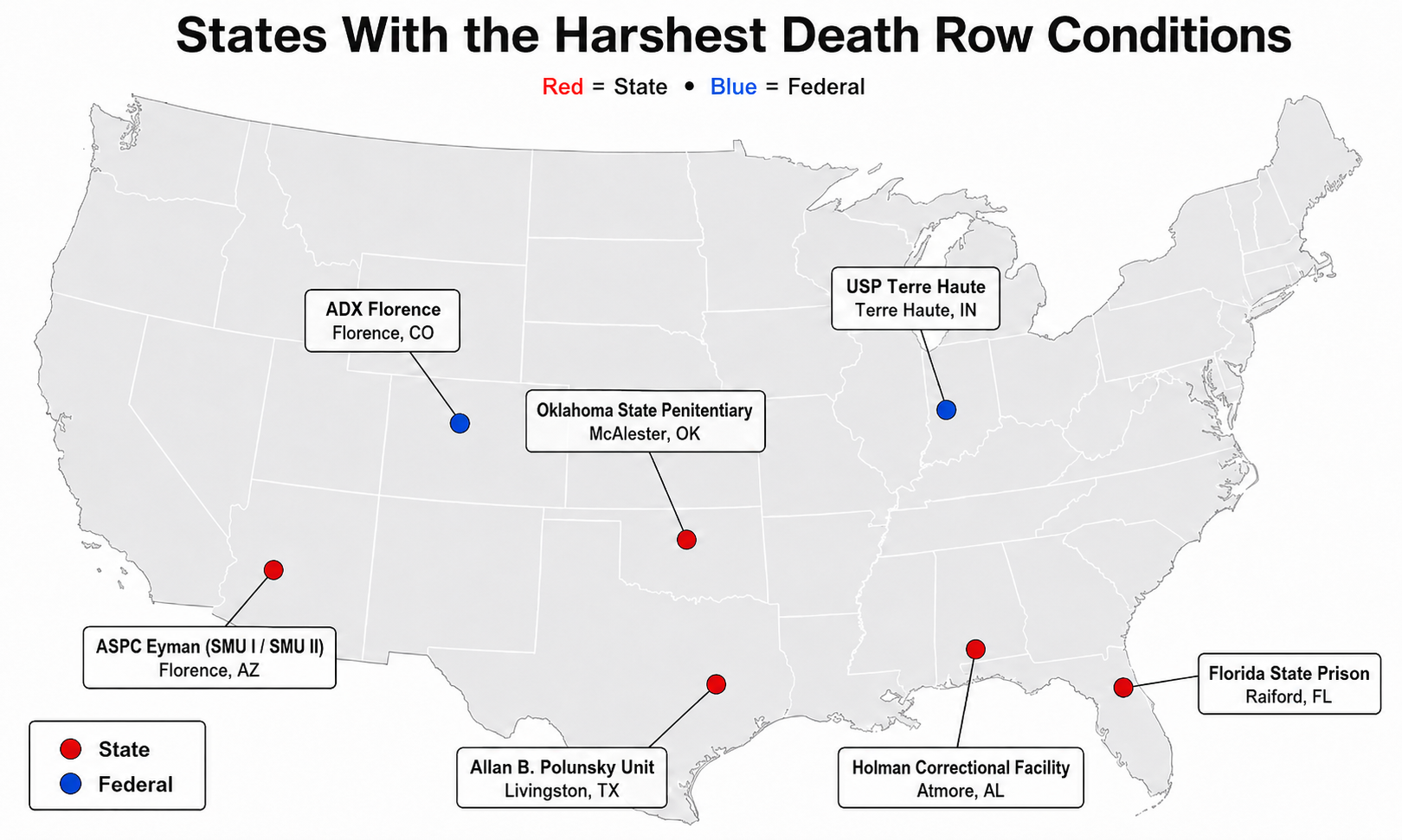
While the overall contours of death row confinement are consistent across the United States, there are notable variations between state systems and between the federal system and the states. Federal death row, housed at Terre Haute, is relatively small, with a few dozen inmates, and operates under the Bureau of Prisons’ stringent administrative maximum protocols. Federal death row inmates have access to some privileges, such as personal property and limited communal activities, but the isolation remains profound. The federal execution protocol, revived in 2020 under the Trump administration after a hiatus, has been the subject of intense litigation regarding its use of a single drug, pentobarbital, and the speed with which executions were scheduled.
State systems exhibit a patchwork of conditions. Some states, like California, have historically housed condemned men in a de facto general population setting at San Quentin, where they could have jobs, attend classes, and interact in large groups, though this is an outlier and is itself in transition. In 2016, California voters approved a measure to move death row inmates into the general population to participate in work programs, reflecting a reformist impulse, though implementation has been slow and contentious. Missouri, on the other hand, has been criticized for its extremely restrictive housing, with inmates held in small, windowless cells in near-complete isolation. Texas, the state with the most executions, operates a high-tech supermax-style facility where condemned men are under constant surveillance and are allowed out only for solitary recreation and, in their final days, for a death watch cell. The South’s death rows, including those in Alabama and Louisiana, often feature harsh conditions, limited air conditioning, and overcrowding that exacerbates the physical and psychological distress.
These jurisdictional differences highlight that the distinctive treatment is not a monolithic policy but a spectrum of practices rooted in local legal cultures, resource availability, and political pressures. Yet, the common denominator remains the permanent segregation and the psychological torment of the death watch, which unites all condemned prisoners in a status fundamentally unlike any other inmate classification.
Conclusion
Death row inmates in the United States endure a custodial regime that is fundamentally distinct from that of general population prisoners, and indeed from that of any other incarcerated group. This distinctiveness is not merely a matter of degree but of kind, encompassing the architectural space, the deprivation of sensory and social stimuli, the suspension of rehabilitative opportunities, and the all-encompassing psychological burden of waiting for a state-sanctioned death. Rooted in a legal history that simultaneously lengthened the period between sentencing and execution and imposed administrative segregation as a security default, the treatment of the condemned constitutes a parallel penal system governed by the logic of terminality. Academic and scientific research consistently identifies this constellation of conditions as producing a unique form of suffering that implicates both constitutional protections and international human rights standards. As the national debate over capital punishment continues, the lived experience of those on death row remains a critical area of inquiry, one that forces a reckoning with what it truly means for the state to isolate a human being for years, only to take their life at a scheduled hour.